Request for Poster Submissions for Bone Collections Conference

Bone Collections: Using, conserving and understanding osteology in museums.

Tuesday, 8th September 2015
University Museum of Zoology, Cambridge

NatSCA invites you to submit abstracts for short, informal poster presentations to be held at the NatSCA Bone Collections day on the 8th September at the University Museum of Zoology, Cambridge.

The day will include both a workshop on in-depth case studies of bone cleaning, re-articulation, conservation and restoration as well as presentations on bone identification and preparation, covering a wide variety of museum osteology topics.

Spaces are still available for both workshop and talks. The full programme and booking are available here.

Working with, understanding, using, maintaining and conserving bone collections is a large and complex topic. If you have experience and would like to submit a poster, please follow the guidelines below.

We hope that this poster session will facilitate skills-sharing and friendly discussion among participants, as well as providing an opportunity to exchange tips and tricks. Poster presentations are an ideal format for student projects, case studies, innovative ideas, and tried and tested techniques, as well as research related to this topic.

Abstracts must be submitted by 14th August, 2015. All submissions will be acknowledged within a few days. The posters will be on view throughout the day, with an organised time period for authors to discuss posters with conference attendees. Please ensure posters are no larger than A2 (420 x 594mm).

All abstracts will be printed and made available to attendees, and all posters will be made available on the NatSCA blog in pdf format.

Abstract submission:

  • List all authors: surname first, followed by first and middle names or initials. Separate authors’ names with semicolons
  • List authors’ institutions and addresses
  • Include the title in boldface
  • Abstract

Please send your abstracts and any queries to:

Natalie Jones

nj273@cam.ac.uk
T 07786 023709

or

Vicky Purewal

E vjpurewal@gmail.com
T 07917533411

How ‘The Beetles’ Changed my Life

Beetles are one of the most successful groups of organisms on the planet. In the UK there are over 4000 species, compared to fewer than 600 wild bird species and around 90 mammal species. Beetles are critical to the health of many habitats, through their roles as feeders on plants and fungi, recyclers of animal and plant debris, and as predators.

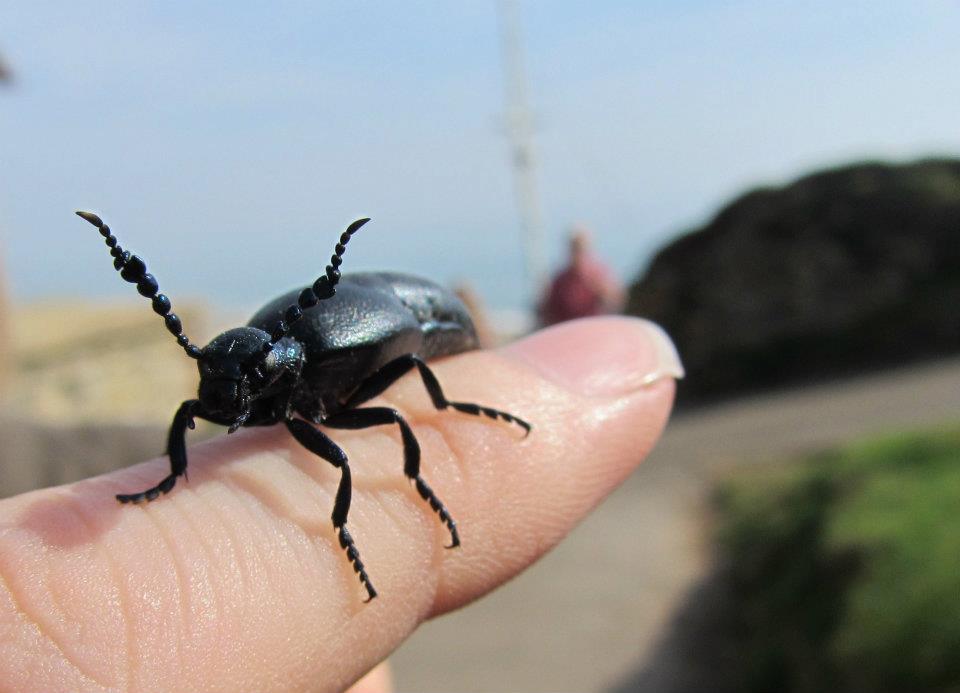
When I first began volunteering with natural science collections at Plymouth City Museum, I occasionally assisted local entomologist Peter Smithers of Plymouth University, who regularly ran ‘Bug Hunts’ with schools around the Devon and Cornwall area. It was here that I came across some of my first beetles. In 2010, whilst walking along the South West Coast Path near the chalk cliffs at Beer, I found a black beetle with a vinyl-like sheen. It was beautiful, but unlike anything I had seen before. I later discovered that it was from a distinctive group called Oil Beetles (Meloidae), which possess one of the most extraordinary life cycles of any UK insect: they are nest parasites of solitary mining bees such as Andrena, Anthopora, and Lasioglossum.

After a female Oil Beetle lays her eggs in a nest hole, the larvae (known as triangulins) wait on a plant until they can attach themselves to a passing bee, using hooks on their feet. The larvae then eat the stored pollen and nectar in the bee’s nest. The strategy means minimal effort from the adult female in raising her young, and the larvae have all the food they need.

Black Oil Beetle (Meloe proscarabaeus)

Black Oil Beetle (Meloe proscarabaeus)

At the time of my discovery, Buglife was leading the way in trying to understand the state of Oil Beetle populations in the UK, which had suffered severe declines over the past 100 years. With four species believed to be extinct already, there was an urgent need to understand the distribution of the remaining Black, Violet, Rugged and Short-necked Oil Beetles. Buglife launched an Oil Beetle Recording Scheme to map their distribution and engage people of all ages through citizen science.

The survey results have enabled Buglife to learn more about the habitat preferences and hosts of the remaining species, and gain a better understanding of the health of the UK landscape, as Oil Beetles are restricted to wildflower-rich habitats, unimproved coastal grasslands, and woodland edges. Two species of Oil Beetle that were believed to be extinct in the UK have been re-discovered. The Short-necked Oil Beetle was found in South Devon in 2006, before a much larger second population was found on the Isle of Coll in Scotland in 2010. The rare Mediterranean Oil Beetle was found on the same Devon site in 2012, having been last recorded in Kent in 1906.

The efforts of Buglife, local recorders and naturalists have produced valid records to create time series of biodiversity data. Museum collections can also provide useful time series data for conservation efforts, based on specimen label data in terms of location and distribution in a given year. Where a species has been recorded in a particular place and time, we can perhaps find relic populations or sites for reintroduction.

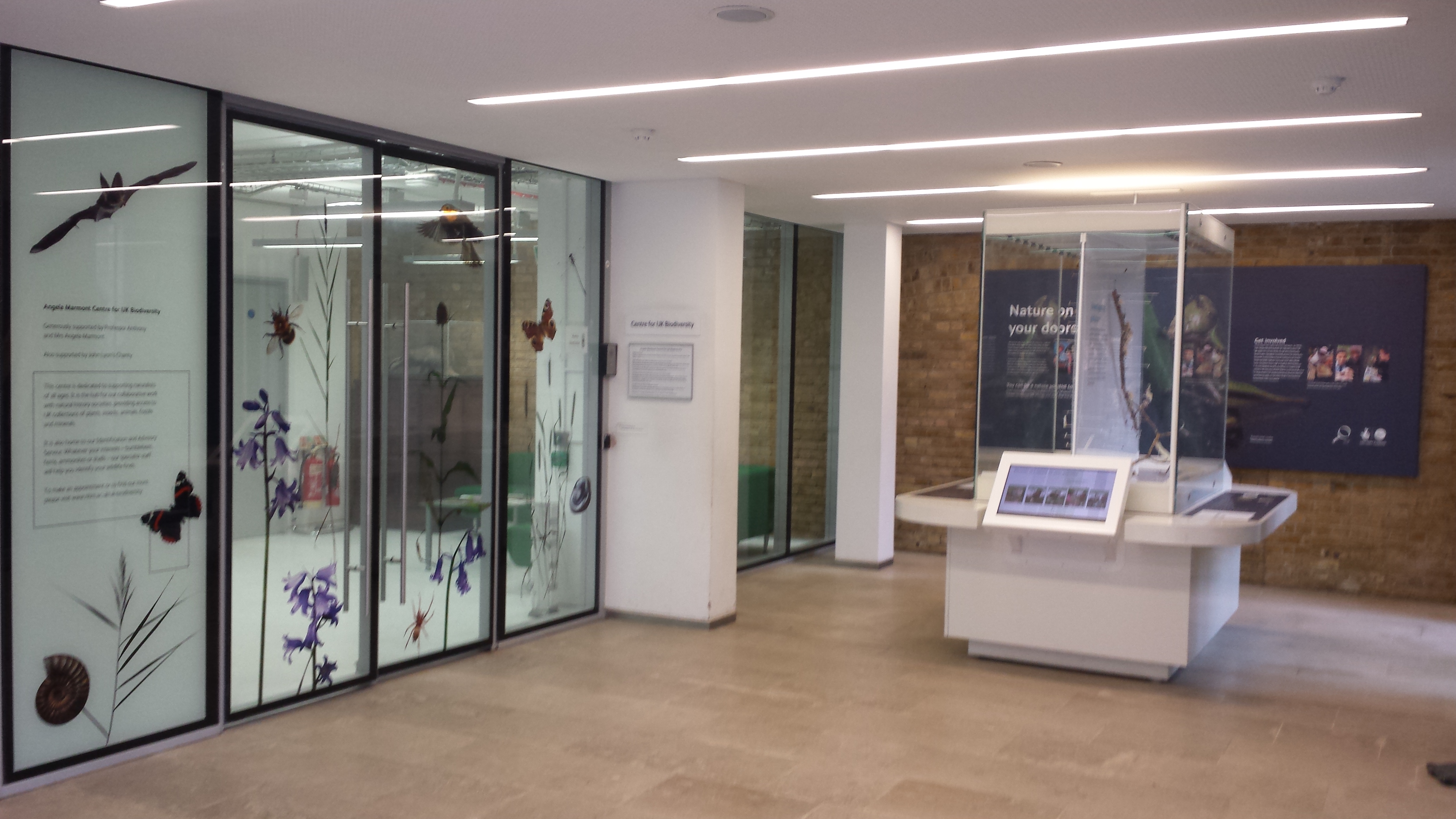
Interior of the Angela Marmont Centre, NHM

Angela Marmont Centre, NHM

It was my interest in Buglife’s Oil Beetle recording scheme that led me to recently join the Natural History Museum’s Angela Marmont Centre for UK Biodiversity (AMC) as an Identification Trainee. The AMC provides world-class facilities in the museum’s Darwin Centre for citizen scientists, as well as expert and amateur naturalists, to enable them to identify UK species using the AMC’s extensive reference collections. Working here is brilliant, and I hope to be trained to identify the key UK biodiversity groups, gain more practical experience of surveying UK wildlife, assist the AMC team in developing citizen science projects based around museum collections, and continue to develop collections management experience through curatorial projects.


Anthony Roach
Skills for the Future Trainee & Science Educator
NHM


Understanding Museum Taxidermy: Construction, Care and Commissioning

Taxidermy, the art and science of preserving an animal by placing the skin around an artificial body, has always been an important part of natural history collections. During the Victorian era, explorers would bring large and exotic animals back from their long voyages: the mounted skins would be displayed, enthralling the Victorian public, who had never seen creatures such as gorillas and giraffes before. While we thankfully no longer hunt and kill animals for display in museums, taxidermy is still as important as ever for teaching about the natural world – probably more so now as more and more species are threatened with extinction. While there has been a resurgence in the popularity of taxidermy, it is still the case that the number of experts capable of producing and preserving taxidermy is dwindling (in the UK, at least). With this in mind NatSCA, in association with Lancashire Conservation Studios, ran a day of talks and hands-on sessions, entitled ‘Understanding Museum Taxidermy: Construction, Care and Commissioning’, on the 1st April.

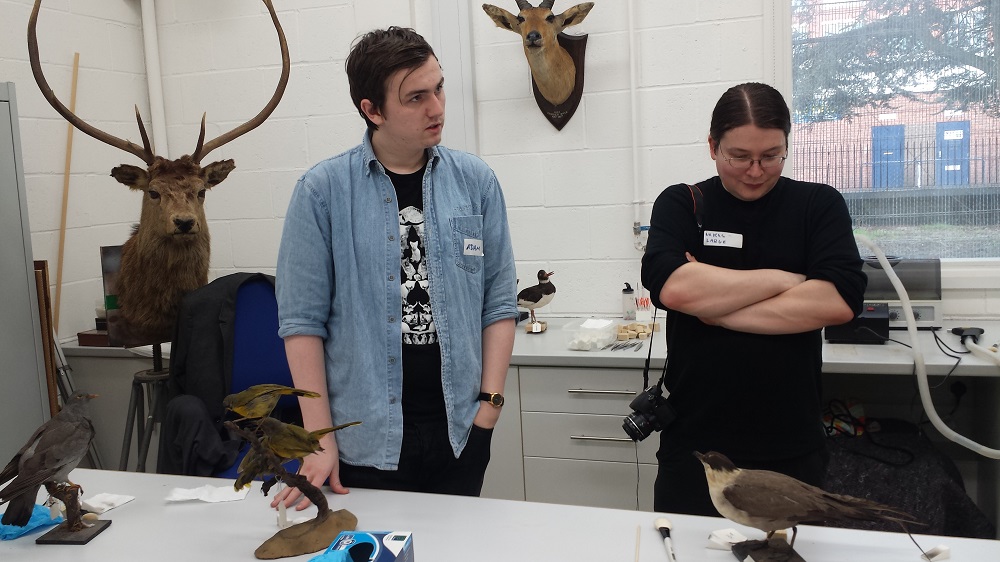
The day was led by Lucie Graham, Natural History Conservator at Lancashire Museums. Lucie began by demonstrating how taxidermy can be prepared using a wide variety of different methods, with internal moulds being formed from wood wool, balsam carvings, plaster and more. Taxidermy is an art, and each artist has their own methods. Lucie then went on to discuss how taxidermy can fall into disrepair if not properly cared for or prepared in the first place. We were able to get a close look an assortment of suffering taxidermy from Lancashire Museums, and discuss how we might treat each one to allow it to be better used and conserved. We had an adorable fox cub on our table, which had suffered from some fading, surface dirt and some loose digits on one paw. A bit of a clean and some adhesive to fix the paws, and this little cub could be looking much better!

taxidermy day3

Next we went through to the conservation lab for some cleaning demonstrations, where many of us were amazed to find out that simple cosmetic sponges get thick dirt off taxidermy effortlessly! We were also shown how to preen and straighten the feathers of a taxidermy bird, using steam to ease the process.

taxidermy day2

Finally were talks from a couple of the country’s leading taxidermists. James Dickinson discussed how museums can go about commissioning taxidermy. The Guild of Taxidermists can offer lists of accredited practitioners, ensuring that museums are able to make informed decisions and seek the services of the best person for the job. Jack Fishwick, judge at international taxidermy competitions, showed us a sample of his vast collection of bird photographs, which he uses for inspiration and feel for a bird’s shape and movement in life – vital for producing realistic taxidermy. The day finished with passionate discussion about the shrinking pool of skilled taxidermists – Jack and James warn that we may have no dedicated taxidermists left within the next two decades, which could be a disaster for museums wishing to expand and preserve their collections.

Glenn Roadley
Natural Science Curatorial Trainee

#MuseumWeek on Twitter – what’s the point?

The last few days have seen Twitter alive with activity centred on museums, with the 2015 #MuseumWeek hashtag providing an opportunity to celebrate culture using images, videos and a maximum of 140 characters.

MuseumWeek

This Twitterstorm in a teacup may seem a bit pointless to some, but it’s difficult to fully appreciate the value of social media until you really use it and experience the benefits first hand.

That’s why this year’s NatSCA conference ‘Museums Unleashed’ is partly about getting everyone up to speed with what’s out there, how it works, and what people are using it for – to make sure that our members aren’t left behind as the museum sector increasingly embraces the digital age.

natscabristol2015

Social media provides an incredibly powerful medium for communicating with other subject specialists, and it also provides a mechanism for developing genuine dialogue with audiences. Hashtags like #MuseumMonday and #FossilFriday allow objects from behind the scenes to be shared around the world quickly and easily, bringing otherwise hidden collections into the public consciousness.

The playful and informal nature of these online interactions may be a significant departure from the authoritative and reserved image projected by some museums, perhaps causing a little discomfort for some, but that informal interaction is the very thing that makes social media such a fantastic mechanism for developing dialogue and bouncing ideas between peers.

Finally, it never pays to underestimate the power of the public as advocates for your collections. A museum with a facilitative approach to social media in its gallery spaces can benefit from the buzz created by people wanting to create and curate their own digital content, inspiring others to visit and generating a deeper interest in the museum’s activities – with minimal input required from staff.

I strongly suggest that you take a look at the various interesting subthemes within #MuseumWeek to see if you can contribute. Today is #familyMW, Saturday is #favMW (for your favourites) and Sunday is #poseMW (maybe put that selfie stick to good use?), so you still have time to get your phone out and get involved!

NatSCA Digital Digest


Chill out with NatSCA's Digital Digest. Binturong (C) Emma-Louise Nicholls

Calm down and chill out with NatSCA’s Digital Digest. Binturong /Arctictis binturong/ (C) Emma-Louise Nicholls

Welcome to the weekly digest of interesting things from around the web with relevance to natural science collections. We hope you find this useful and if you have any articles that you feel would be of interest, please contact us at blog@natsca.org


1. Conference: A Question of Ecology: Answers from Biological Recording

23rd – 25th April 2015

Synopsis

‘Biodiversity information is crucial to understanding ecological relationships and supporting conservation effort in a changing climate. Use of volunteer-collected biological records by the professional scientific community is widely encouraged and celebrated, but much interpretation of biological records is carried out by amateur naturalists, who are uncovering new ecological knowledge from their own records and sharing that knowledge with others.’ ~ National Forum for Biological Recording

Click here for more information.

2. FREE Course: Behind the Scenes at the 21st Century Museum

Starts 1st June 2015, lasts 6 weeks, all online

Synopsis

‘How can we understand museums today? Who makes the decisions about what to put in them and whose stories they tell? Who are museums for and why are they working to engage new audiences? How do we respond emotionally to museum objects and spaces? And how can museums play a role in the pursuit of social justice, human rights, or health and wellbeing?’ ~ Future Learn

Click here to find out more.

3. Event: An unconquerable aversion to Piccadilly”: Charles Waterton, traveller, taxidermist and pioneer conservationist

31st July to 1st August 2015

Synopsis

‘The Annual General Meeting or the Society for the History of Natural History will be held in association with a one day conference of talks celebrating the life and work of Charles Waterton and a second day with related excursions around Wakefield in West Yorkshire.

The Wakefield Museum, at Wakefield One, is currently hosting an exhibition “The extraordinary world of Charles Waterton” and the Society’s meeting will take place at a venue within easy reach of the Museum and will include a visit to the exhibition’ ~ Society for the History of Natural History

Click here for more details and to apply


Compiled by Emma-Louise Nicholls, NatSCA Blog Editor