NatSCA Digital Digest

NatSCA polar bear

Jobs

Education Assistant – National Museum of Ireland – Natural History

Duration: Permanent

Closing date: 5th June 2015

To apply, click here

Conferences and Workshops

A few exciting talks are coming up at the Natural History Museum soon, which I thought would be worth highlighting for you. The first is the Annual A. R. Wallace Lecture which this year will take place on the 2nd June 16:30-17:30. The subject is ‘Wallace, Darwin, and Spiritualism: The Trial of the Spirit-Medium Henry Slade, 1876’. For more information, click here.

On the 24th July at 16:30, the SciFri Seminar series brings to you ‘The Greatest Living Naturalist- The Life and Conflicts of Professor Richard Owen’, in celebration of Richard Owen’s birthday. It will be in the Neil Chalmers Seminar Room. For more information, click here.


Exhibitions

The long awaited ‘Power of Poison’ exhibition has opened at the Old Truman Brewery in London. The website invites you to ‘discover the alluring, seductive and terrifying role of poison and how it affects our everyday lives through nature, myth, medicine and healing’ and of course, will contain spiders, snakes, and other lovelies. For more information, click here.

Content assembled by Emma-Louise Nicholls

NatSCA Digital Digest

Chameleon

Events

Now that the 2015 NatSCA Conference is over, the next conference for your diaries is Refloating the Ark: Connecting the public and scientists with natural history collections on 17th – 18th June at Manchester Museum. The full programme, abstracts, and booking information can be found here.

Developing Skills for Collection Managers – 28th May 2015, NHM. An afternoon seminar and workshop run by Nick Poole of the Collections Trust, providing tips on putting collection competency frameworks into practice and improving collections skills.

Jobs

Keeper, Science and Technology – National Museums Scotland. Applications close 31st May 2015.

Learning and Events Assistant – NHM, Tring. Applications close 31st May 2015.

As always, do keep an eye on the jobs page of the NatSCA website!

Around the Web

Watch the team at the Museum of Zoology, Cambridge decant their carnivore case in 2 minutes! Also check out this blog for a conservator’s-eye view of their current redevelopment project.

A good article about how the current financial crisis has left the natural history museum in Dublin in dire straits. A very sad story.

The International Institute for Species Exploration has released a list of the Top 10 New Species of 2015! The list is released on 23rd May each year, to coincide with the birthday of Carolus Linnaeus, the father of taxonomy. Happy birthday Linnaeus!

NatSCA Digital Digest

Gorilla skull on a black background

Your weekly round-up of news and events happening in the wonderful world of natural sciences!


Jobs

Unusually, there are a few natural science jobs out there in the UK at the moment:

Curatorial Assistant (Human Remains and Repatriation) – Natural History Museum. Applications close 29th March.

Curator/Lecturer in Vertebrate Palaeontology – Cambridge University. Applications close 3rd April.

Several interesting posts at Royal Botanic Gardens, Kew, including an Assistant Curator (applications close 7th April).

And, just in case you haven’t already seen it:

Collections Manager (Life Collections) – Oxford University Museum of Natural History. Applications close 10th April.

Events

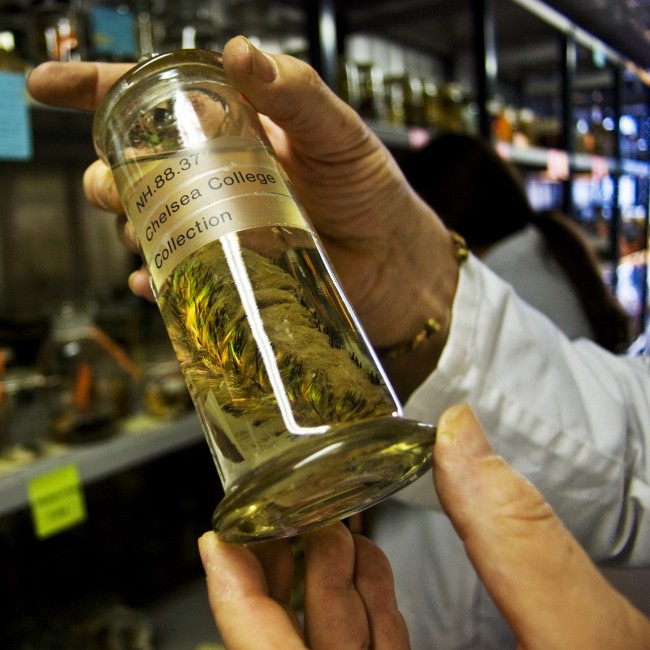
Simon Moore’s renowned fluid preservation course will next run on 1st – 4th June at the Horniman Museum & Gardens. The four-day course costs £300 (NatSCA members can apply for a bursary). See here for details and booking.

A fluid-preserved specimen in a jar is held up to the camera. Image: Russell Dornan

Learn the skills to care for fluid-preserved specimens (Image: Russell Dornan)

The Society for the History of Natural History (SHNH) has put out a call for speakers for their annual conference, to be held at Wakefield Museum on 31st July – 1st August.

The Museum Ethnographers Group (MEG) 2015 conference is entitled Nature and Culture in Museums, and will explore the relationship between natural science and ethnography. It takes place at the Powell-Cotton Museum on 20th – 21st April, and booking is open now!

In the Media

Today is Taxonomist Appreciation Day, a holiday devised by Dr Terry McGlynn, of California State University Dominguez Hills, to highlight the decline in taxonomic skills and the importance of museum collections.

These taxonomists definitely deserve some appreciation: A census of all known marine life by WoRMS (the World Register of Marine Species) has added many new species and removed 190,400 duplicates!

Darwin’s ‘strangest animals ever discovered’ finally find their place in the tree of life.


Got a submission for the blog or Digital Digest? Email us at blog@natsca.org!

NatSCA Digital Digest

Welcome to the weekly digest of posts from around the web with relevance to natural science collections. We hope you find this useful and if you have any articles that you feel would be of interest, please contact us at blog@natsca.org

1. Blog: Personal Space in Patagonian Cormorants

Chicago Professor Jerry Coyne’s blog Why Evolution is True this week contains a great example of modern technology, in this case drones, being used to observe the natural world. I wonder if drone footage will be mentioned as an example of ‘modern media’ at the NatSCA conference. I digress: The nesting sites are quite magnificent and reminiscent of frogspawn from a distance.

Synopsis

In Jerry Coyne’s own words:

From Grind TV we have lovely video and photographs of 5300 pairs of Imperial Cormorants (Phalacrocorax atriceps, also known as “Imperial Shags”) nesting en masse in Patagonia.  The nests cover an area of 2000 m², which is less than half the area of an American football field.

Follow the Link to see.

2. Event: Strange Creatures: the Art of Unknown Animals

Where: The Grant Museum of Zoology

Date: 16th March – 27th June

Open to: all

Admission: Free

Synopsis

From the Grant Museum website:

When new regions are explored and the animals in them discovered, how does the wider world get to experience these species? From the earliest days of exploration, art has been essential in representing creatures that are alien to people at home.

The Strange Creatures exhibition will explore the world of animal representations, featuring the painting of a kangaroo by George Stubbs which was recently saved for the nation. It was painted following Captain Cook’s first “Voyage of Discovery” and is Europe’s first image of an Australian animal.

Click here to find out more.

3. Job: Collections Manager (Life Collections)

Organisation: Oxford University Museum of Natural History

Salary: Grade 7: £30,434 – £37,394 with a discretionary range to £40,847

Duration: Full-time, permanent

Location: Oxford, UK

Closing date: 10th April 2015

Synopsis

Oxford University Museum of Natural History houses the University’s internationally important geological and zoological collections, which are used for research, teaching, and public engagement in science. It is seeking to appoint a new Collections Manager for the Life Collections.

The Life Collections comprise six million specimens, of which around 30,000 are zoological type specimens, and there are currently 10 staff with collection management responsibilities in this area. The collections have particular strengths in insects, crustaceans and vertebrates. The Collections Manager will work across all areas of Life Collections, but the role will have particular emphasis on the vertebrate and/or malacology collections. The successful applicant will be responsible for documentation, imaging, databases and conservation, and will facilitate research visits and loans. They will also be part of the teams developing new exhibitions and displays, and will participate fully in the museum’s outreach and public engagement programme. It is expected that the successful applicant will engage in field collecting and some collections-based research.

Click here for more details and to apply


On a different note, our very own Emma-Louise Nicholls is going to be doing the Richmond half-marathon next week. She is raising money for Save the Rhino – a cause dear to all our hearts. If you would like to donate, here’s how.


Compiled by Samuel Barnett, NatSCA Blog Editor

NatSCA Digital Digest

Welcome to the weekly digest of posts from around the web with relevance to natural science collections. We hope you find this useful and if you have any articles that you feel would be of interest, please contact us at blog@natsca.org

1. Blog: Natural History Blog

Russell Dornan

Synopsis

A great blog worth checking out:

‘My name is Russell Dornan and I was the biology curatorial trainee at Hereford and Ludlow Museums. I blogged throughout my 12 month journey through their natural history collections and went on to be the Natural History Project Co-ordinator at the Horniman Museum in London.

I am now the Web Editor at Wellcome Collection.

All views expressed in this blog are mine alone and do not represent the opinions of my employer.’

Russell Dornan's #MuseumSelfie

Russell Dornan’s #MuseumSelfie (Image by Russell Dornan)

Wunderkammer

2. Volunteer Position: Mudchute Volunteer Coordinator

Mudchute, East London Countryside

Synopsis

We have a fantastic opportunity for an experienced Volunteer Coordinator to join our team at Mudchute Park and Farm to manage the recruitment, supervision and support of our volunteering programme.

We are looking for an organised, dynamic and enthusiastic individual who has the experience of working in a multi-cultural environment Inner City Environment with groups and individuals from a diverse background. Experience of working with and the ability to enthuse and motivate disadvantaged individuals is essential.

If you think this could be you, we’d love to hear from you! For more details about this part time position, including how and when to apply, please download the application pack by following the website below.

Please note that applications must be received by noon on Friday, August 29th.

Mudchute Volunteer Position

3. Training: Accreditation Plus Training- Making your objects accessible

University of the Arts, London

Synopsis

Wednesday 10 September 2014, 1.30-4pm

Central St Martins

http://www.arts.ac.uk/csm/about-csm/find-us/

‘Research has proven that touching and handling objects is an important part of the learning experience. However for many museums, allowing visitors to handle objects is an area in which they lack confidence or ‘trained’ staff. This training will address the issue of how we balance the care and conservation of objects against issues of access. Experienced practitioners from Central St Martins will provide guidance on best practice in object handling and discuss how robust systems can make it possible to manage access to collections through handling whilst still protecting them for future generations.

In the session you will:

  • Look at a range of things to consider in order to handling by your visitors.
  • Explore why we use object handling in our museums
  • Learn best practise for handling objects

It is aimed at staff and volunteers who will be developing and delivering handling sessions within their museums.’

To book, fill in an online application form on the Regional Programmes website:

Training Programmes

Training course booking form

Compiled by Emma-Louise Nicholls, NatSCA Blog Editor