NatSCA Digital Digest

(Image by Ton Rulkens, in public domain)

(Image by Ton Rulkens, public domain)


Your weekly round-up of news and events happening in the world of natural sciences

News

The BBC just posted a down to earth (or sea) article called The man who swims with sharks, by Melissa Hogenboom, feature writer for BBC Earth. Combined with beautiful images, it talks about swimming with and photographing sharks and summarises some very interesting facts about these majestic animals.

Exhibitions

If you haven’t seen the Natural History Museums’ exhibition Coral Reefs: Secret Cities of the Sea, you should definitely go this weekend. If you have seen the Natural History Museums’ exhibition Coral Reefs: Secret Cities of the Sea, you should definitely go this weekend. It will be your last opportunity to see (or re-see) the exhibition as it closes on the 13th September. There are fantastic specimens, cool interactive games and a video of the only coral spawning ever to have occurred in captivity. I personally recommend it to you.

Opened just last week is the new exhibition In the Footsteps of Elephants. This two and a half week exhibition is only open from the 3rd to the 20th September, so if it’s up your street you need to get a wriggle on. The exhibition is being held at the Nature in Art Museum and Gallery in Gloucestershire, which looks really worth too.

Jobs

If you are looking to move, or move into a, role in natural sciences the Naturejobs Career Expo in London on Friday 18th September should be a great place to meet others in the field, attend workshops and conference talks, schmooze with potential employers, and even get your CV looked at.

If Brachiopods are your thing, then the Natural History Museum in London is currently looking for a curatorial assistant to join them in the Earth Sciences Department. The contract is for a year, and the deadline is the 14th September. Sounds like a shell of a good opportunity (!)

As ever, if you would like to write a blog for NatSCA on anything natural sciences related, give us an online shout blog@natsca.org.

The financial value of museum objects

In the museum sector there’s a bit of unwillingness to discuss the financial value of objects. After all, museums are not run as salerooms and their focus is on the other sorts of value that collections hold.

Of course, for some artworks it can be hard to ignore the massive price tags that they sometimes carry and there are some good arguments that in our materialistic society, which has become increasingly focussed on economics, there are sound reasons for including financial value in considerations about collections. An interesting discussion about this between two NatSCA stalwarts, Jan Freedman and Mark Carnall, was recently published by the Museums Association.

Worth £175 million today. Card Players (5th version ca.1894-1895) by Paul Cezanne is the most expensive painting in the world. For now... (image from Musée d'Orsay)

Worth £175 million today. Card Players (5th version ca.1894-1895) by Paul Cezanne is the most expensive painting in the world. For now… (image from Musée d’Orsay)

For those of us who work in museums, we normally only consider a specimen’s price-tag when acquiring new material, deaccessioning material or dealing with insurance valuations for exhibitions and loans.

When acquiring specimens, the consideration is about whether an asking price is fair and an appropriate amount to spend in the context of institutional priorities and budget. When deaccessioning, the consideration is rather more complex and is linked to appropriate methods of disposal and the motivations for disposal. Deaccessioning shouldn’t be done in order to make money, but disposal by sale may be an option as long as the processes involved in the decision meet professional standards.

The controversial disposal by sale of the statue of Sekhemka has caused problems for Northampton Museum & Art Gallery. (Image of the statue on display c.1950s - uploaded by Bibilovski, 2012)

The controversial disposal by sale of the statue of Sekhemka has caused problems for Northampton Museum & Art Gallery. (Image of the statue on display c.1950s – uploaded by Bibilovski, 2012)

When assessing these sorts of values it can be very useful to look to private auctions for a guide, which take place every so often at a variety of auction houses. For natural history it can be worth checking Sotheby’sBonhams and Summers Place. However, auctions tend to deal with the more showy objects, rather than the scientific specimens that museum staff often have to deal with, especially for research loans.

Insurance valuations are slightly different, since these may not simply relate to the market value of an object, but could take into consideration the cost of conservation if the object is damaged, or the cost of going into the field to collect a similar specimen to replace it if it’s the sort of specimen that doesn’t come up for sale. Either of these possibilities may be far more expensive than a likely sale value.

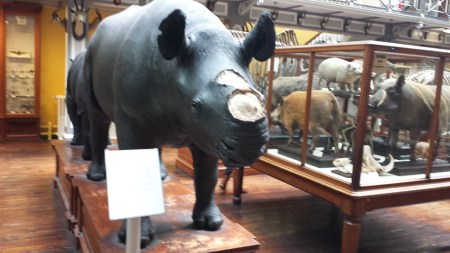
One of the issues with putting a price on objects is that it may make them more obviously attractive to criminals. For instance, a sudden spike in the street value of illegal rhino horn in parts of Asia around 2009 led to a massive increase in the prices of antique rhino trophies at auction, until special measures were introduced to stop this loophole in trade. In addition it has led to the targeted thefts of hundreds of specimens from collections around the world.

Taxidermy rhino with the horn removed and sign explaining the problem of thefts from museum specimens. (Image by Dr John Hutchinson, 2013)

Taxidermy rhino with the horn removed and sign explaining the problem of thefts from museum specimens. (Image by Dr John Hutchinson, 2013)

Of course, by being aware of the changing value of specimens and therefore the changing risk of theft, museums are able to take steps to ensure that appropriate security measures are put in place to properly care for their objects. So although the financial value of objects can be complex to address, it is clear that there is a need for museums to know how much their collections are worth, since other people may be only too aware.

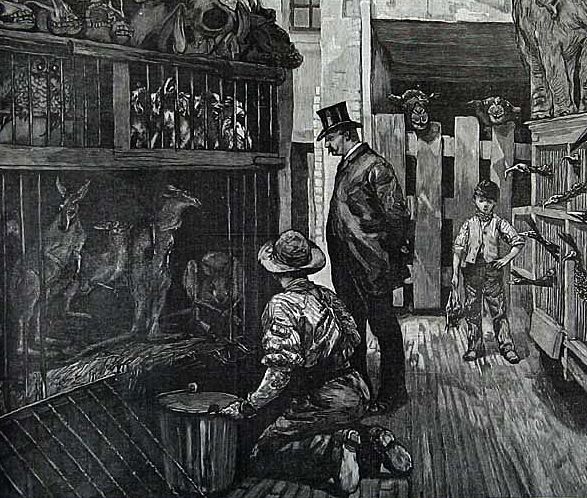
Charles Jamrach: Exotic Animal Collector

Charles-Jamrach-Shop

The week before last saw historian Elle Larsson speaking at PubSci. The talk centred around the exotic animal trade and, in particular, the life of Charles Jamrach: a trader of animal specimens – both living and dead.

Charles’ father was an entrepreneur from Hamburg who noticed that sailors were bringing back exotic animals in the hull of their ships and selling them. There was such huge interest in these peculiar beasts that sailors were able to retire from the profits. Jamrach Senior wanted a cut of the action. It soon became apparent that London was the hub of the exotic animal trade and Charles moved to London in 1840 to set up his business after the death of his father.

Charles began forming a network of contacts and runners between Liverpool, Marseilles, and Bordeaux. He was soon able to boast that he could get ‘any animal except a Koala’. The relationship between Koalas and gum trees had not been fully realised at this point and three unsuccessful attempts to secure one had resulted in failure. Jamrach was forced to concede this one shortcoming. Jamrach was buying between a shilling and five pounds, depending on the specimen. With the middle men involved it was no longer possible for a sailor to make his fortune selling exotic animals as the profit was split among too many people. Even Jamrach sometimes had to take a lower asking price for one of his animals than he had originally paid for it: He was certainly not guaranteed a better price later and the cost of keeping the animal in sellable condition was not cheap.

He sold living specimens to zoos and private collectors, dead specimens to museums. Whatever these groups turned down, the taxidermists picked up. In late Victorian London there was a fashion for furniture made from animal parts. People would choose an animal (often still alive) that they wanted turned into cutlery, a chair, or piano and the poor beast would be sent to the taxidermist for production. It is hard to imagine such a situation today, though the culinary world still has a “choose live product” remnant of these bygone days.

There’s one area in which Charles Jamrach reminds me of Archcancellor Ridcully, from Terry Pratchett’s Discworld – in the sense that they both did their bit for endangered species… by keeping them that way: in 1851 Jamrach acquired a quagga for the Zoological gardens. In 1883 the quagga was declared extinct in the wild.

The interest in unusual wildlife had a political motive in many cases: a zoo of the British Empire showcasing species from elsewhere was not just introducing the public to animals they had never heard of, it was showing the dominion that man had over the animal and the empire had over the animals’ home land. On one occasion a bengal tiger managed to back out of a poorly made transport crate and run off down the road – grabbing hold of a young boy. Jamrach managed to subdue the tiger with his truncheon but the boy’s parents still, understandably, sued. Jamrach was now famous: not only was he bringing back animals that represented empiric might, he now personally symbolised Britain beating down the tiger, symbol of rebellion against it.

Not everyone was a fan of Jamrach: awareness of animal welfare was in its infancy but this was the generation that saw it develop – the RSPCA was formed during the late Victorian era during Jamrach’s lifetime and he received a good deal of complaints abou the way his animals were treated. Complaints about Jamrach centred around the cramped transport conditions, stressed overcrowding of predators near their prey, and the malnourished states they reached London in. This was a time when the accepted wisdom for “reforming” a vicious and malnourished crocodile was to tie it down and force feed it. It is unclear whether Jamrach participated in this but he escaped criticism by dying in 1891 – the year that the practice was challenged. He left a vast sum of £7108 inheritance to his son: the equivalent of half a million pounds in today’s money.

To learn more about Elle Larsson’s research, visit the animal history museum – an online exhibition about the trade.

One of our dinosaurs, birds, crabs…. is missing

Reblogged from the UCL Museums and Collections Blog

One of our dinosaurs, birds, crabs…. is missing

By Mark Carnall, Grant Museum of Zoology

You may have figured from the title of this blog but I’m going to take a bit of time to talk about when specimens go missing from a museum collection. It can be a difficult thing for museums to talk about as most museums operate to care for the specimens and objects that are given in trust to them often for perpetuity, or more practically until the death of our part of the Universe. Currently a lot of my work here involves relocating our specimens following the move of the stores and museum a couple of years ago and trying to work out what happened to a missing specimen involves a bit of detective work, so I thought I’d offer an insight into the process.

Missing Specimens- The Prime Suspects

Collectively, museums look after billions of objects. The Grant Museum contains roughly 68,000 specimens which may sound like a lot but natural history collections regularly number in the millions. Even keeping track of a mere 68,000 of them can be problematic enough. Here’s the mental checklist I go through when a specimen can’t be located.

1. Somebody* put it back in the wrong place. A little known fact about museums is that under English law it is still possible to punish a museum professional with death if they commit this crime. Putting a specimen in drawer 43 instead of drawer 44 may sound trivial, but if it’s one of 200,000 superficially identical butterflies that’s been misplaced….. Of course, naturally you search the nearby area but if it isn’t immediately  findable the next step is to organise a search committee and comb the museum inch by inch until it is located. Sometimes this is how half dodos are rediscovered.
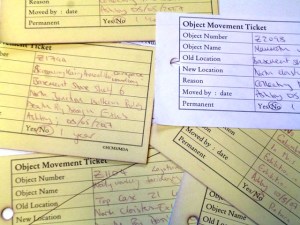
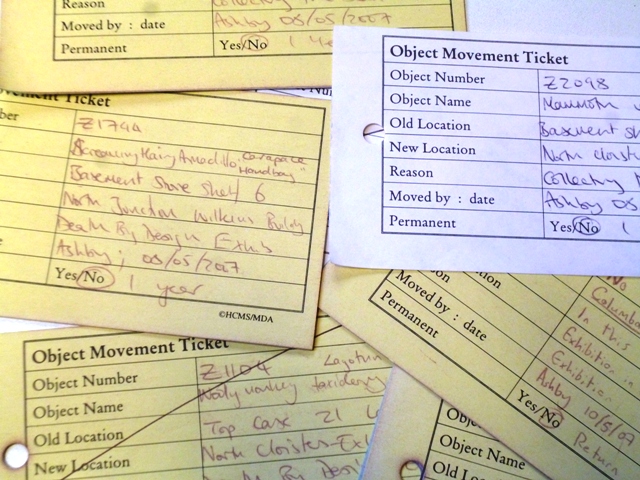
Good old object movement tickets. They still work when the servers don’t. (C) UCL Grant Museum

Good old object movement tickets. They still work when the servers don’t. (C) UCL Grant Museum

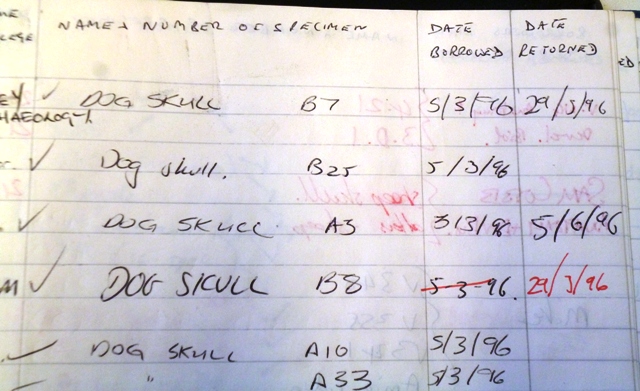
2. It’s temporarily somewhere else. At the Grant Museum, we use our specimens a lot. On any given day we’ve got specimens out for researchers, specimens on loan across the department and to other institutions, specimens being photographed and documented and our own rotating and temporary displays. For longer term movements, the ever useful object movement record should be where the specimen normally lives and the temporary location will be recorded on the database. For shorter term movements this won’t be the case and it’s true to say that with higher-than-you’d-expect regularity two people will need the same specimen at once. As for loans to other institutions it used to be common place to loan specimens on ‘permanent loan’ so some specimens have been temporarily somewhere else for 20, 30, 40 and even 60 years and before the current museum good practices and standards the loan agreement may or may not have been written down anywhere… There’s a good reason why ‘permanent loans’ have been all but outlawed in museums.

A page from one of the Grant Museum loan books. Note how some of the unnumbered ‘Dog skulls’ don’t appear to have a return date. SAD SMILEY FACE. (C) UCL Grant Museum

A page from one of the Grant Museum loan books. Note how some of the unnumbered ‘Dog skulls’ don’t appear to have a return date. SAD SMILEY FACE. (C) UCL Grant Museum

3. The specimen never existed in the first place. Many museums have gone through a number of phases in the attempt to catalogue every single object and specimen in the collection. Sometimes two or more people are documenting the same objects at the same time. This results in duplicate or ghost records appearing for the same object. Over time, and I can testify to this happening, you can be in the situation whereby you’ve got to try to work out whether the 20 physical dog skulls you have before you are the 20 records on the catalogue or not. Another complication is that we appear to have older catalogues of the collection which were part descriptions of the physical collection and part ‘wishlists’.

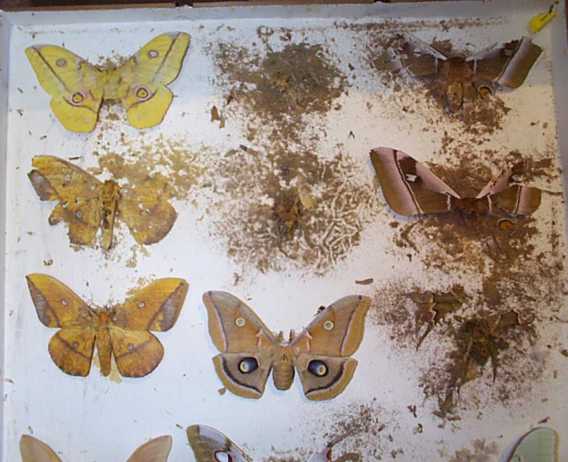
4. The specimen has been destroyed. Without constant monitoring and conservation work, sadly specimens may be degraded past the point of being recognisable, safe or otherwise usable. In addition specimens may be actively destroyed for the purposes of sampling or other investigation. Today we’d record a specimen as being disposed of and the method by which it was destroyed but in the past this may or may not have been recorded so you’ll be looking for objects that haven’t existed for a long long time.

Pest damage to entomology collections results in the disintegration of specimens. (C) UCL Grant Museum

Pest damage to entomology collections results in the disintegration of specimens. (C) UCL Grant Museum

5. The specimen was part of the ‘curator’s collection’. If you’ve been following my colleague Emma’s series on previous Grant Museum curators you will have read how some of our previous curators didn’t appear to leave much of a material trail in the museum. This is because in the past the boundaries between what belonged to the museum and what belonged to individuals was, how shall we say it, very fluid. When the curators moved on to other institutions they sometimes took their own collections with them or donated their important specimens to the Natural History Museum. Frustratingly, they didn’t always record that this had happened.

6. Stolen. Whether it’s innocent 5 year olds pocketing a handling specimen, a professional scientist accidentally retaining specimens sent to them or your organised criminals stealing to order it’s a sad fact of life that museum specimens do get stolen. There’s at least a bookshelf of literature on art thefts over the years, rhino horn thefts are at an all time high and then there’s the more run-of-the-mill smash and grab jewellery thefts. The real issue is at what stage the theft is noticed. Gallery display thefts tend to be obvious but if it’s one of 40,000 specimens in a storeroom that’s gone missing it can be months or years before it’s noticed. More often than not it’s when specimens come onto the open market that it’s realised it’s no longer in the museum.

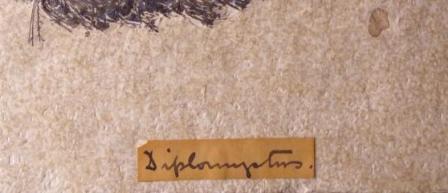
7. Misidentified. The classification of animals is constantly changing. In older collections you’ll have the full spread of names an animal has ever been known by that may be completely different to the current ‘consensus’ (which can be in a state of flux for 150 years and counting). Furthermore, depending on who has been documenting a specimen, your non specialist may get as far as bones, your generalist natural historian as far as lion and your carnivoran expert down to population you may be looking for a bag of bones labelled lion or looking for a lion labelled as a bag of bones.

A great example of the kind of handwriting you can expect to find on older specimens. Diplommyotns, Diplomyctus, Diplonijotus, Diplonnystus? Suggestions on a postcard please. (C) UCL Grant Museum

A great example of the kind of handwriting you can expect to find on older specimens. Diplommyotns, Diplomyctus, Diplonijotus, Diplonnystus? Suggestions on a postcard please. (C) UCL Grant Museum

8. Human Error. I don’t know if there’s a ‘background rate’ for errors that people make but when you scale museum staff adding up to 200 different fields of information (number, description, location, etc.) for thousands or hundreds of thousands of different specimens the inevitable fallibility of humans starts to add up. Couple this with the fact that, like GPs, scientists tend to have awful handwriting and you can be looking for a Z300 instead of an S800.

 So that’s the mental checklist I run through when a specimen can’t be located and it can be very heartening to relocate a missing specimen but ultimately some specimens end up recorded permanently as lost in the hope that at some point they’ll be rediscovered.

Mark Carnall is the Curator of the Grant Museum of Zoology

* For diplomacy I use the generic somebody here. In reality it’s always Mr. Nobody who takes responsibility for this.


Jake’s Bones: A Review

By Roberto Portela Miguez

When I was asked to review a book written by a twelve year old, I was slightly uncomfortable with the idea, as I thought that I would have to repress my usual critical and negative self and be gentle and considerate with the effort that this young nature enthusiast has put into such work. Needless to say, I did not want to come across as patronising either.

However, all my silly tribulations dissipated once I tucked into the book, and I actually found the publication not just faultless but truly enjoyable.

Jake McGowan-Lowe’s work is illustrated with beautiful photography and contains a wealth of knowledge and sound advice.

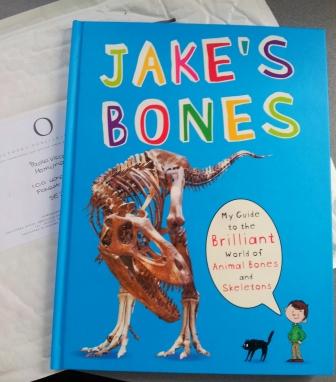
The new book by Jake McGowan-Lowe called Jake's Bones. (C) Paolo Viscardi

The new book by Jake McGowan-Lowe     called Jake’s Bones. (C) Paolo Viscardi


Each chapter has images of specimens from Jake’s very own skeletal collection, which ranges from the common British species to more exotic ones like armadillos and leopards. From the first pages one cannot fail to realise that this work was produced by someone with considerable first-hand experience on the topic. Maybe it was the picture of the more than two hundred skulls decorating his bedroom that gave away that the natural world is not just a pass-time for Jake, but something he is genuinely passionate about.

For each of the species included in the book, we are given details of some of the most significant skeletal adaptations and in specimens where a pathology is visible, Jake provides a well-founded interpretation.

The author does not shy away from using technical names for the different skeletal elements, but do not fear, because if you missed that lesson at school, there is a helpful glossary at the end. It is refreshing to see that Jake uses confidently and comfortably the relevant academic terminology. I was thrilled with this aspect of the editing and hold this as a triumph against those exhibition consultants that underestimate the level of knowledge of museum visitors and keep vanishing academic language from our galleries. You may now picture me taking my hat off to Jake for going boldly where museums used to go.

There is no osteological-related material that this studious naturalist cannot write about. From the basic “what is a bone?” to the more advanced ageing of animals from their bones, Jake displays an astonishing degree of knowledge on everything he presents.

The chapters that pleased me the most were the ones on tips for collectors, your bone collection and golden rules. It is easy to be awed by the natural beauty of the objects and their stories, but Jake wisely reminds all that there are a few important things to consider before we start accumulating our very own skeletal collection. Collection management, Health and safety and legislation are covered in these chapters and the author’s style makes it fun to read, so there is no excuse for accidents or incidents.

This is a great piece of work which I would recommend to anybody of any age and have no doubt that this will not be the last we will hear from such a talented science communicator.