Book Review: Integrated Pest Management for Cultural Heritage (2015)

A new book on Integrated Pest Management (IPM) by expert David Pinniger will be published next week, on Tuesday 5th May, entitled ‘Integrated Pest Management for Cultural Heritage‘. The book builds on years of research and advances in IPM techniques, and aims to be a working guide to be used by heritage professionals.

NatSCA member and conservator Lucie Graham has kindly reviewed the book for us in detail. This is available in NatSCA Notes & Comments. Please head over there and have a read.


Cover of Integrated Pest Management in Cultural Heritage, by David Pinniger


Understanding Museum Taxidermy: Construction, Care and Commissioning

Taxidermy, the art and science of preserving an animal by placing the skin around an artificial body, has always been an important part of natural history collections. During the Victorian era, explorers would bring large and exotic animals back from their long voyages: the mounted skins would be displayed, enthralling the Victorian public, who had never seen creatures such as gorillas and giraffes before. While we thankfully no longer hunt and kill animals for display in museums, taxidermy is still as important as ever for teaching about the natural world – probably more so now as more and more species are threatened with extinction. While there has been a resurgence in the popularity of taxidermy, it is still the case that the number of experts capable of producing and preserving taxidermy is dwindling (in the UK, at least). With this in mind NatSCA, in association with Lancashire Conservation Studios, ran a day of talks and hands-on sessions, entitled ‘Understanding Museum Taxidermy: Construction, Care and Commissioning’, on the 1st April.

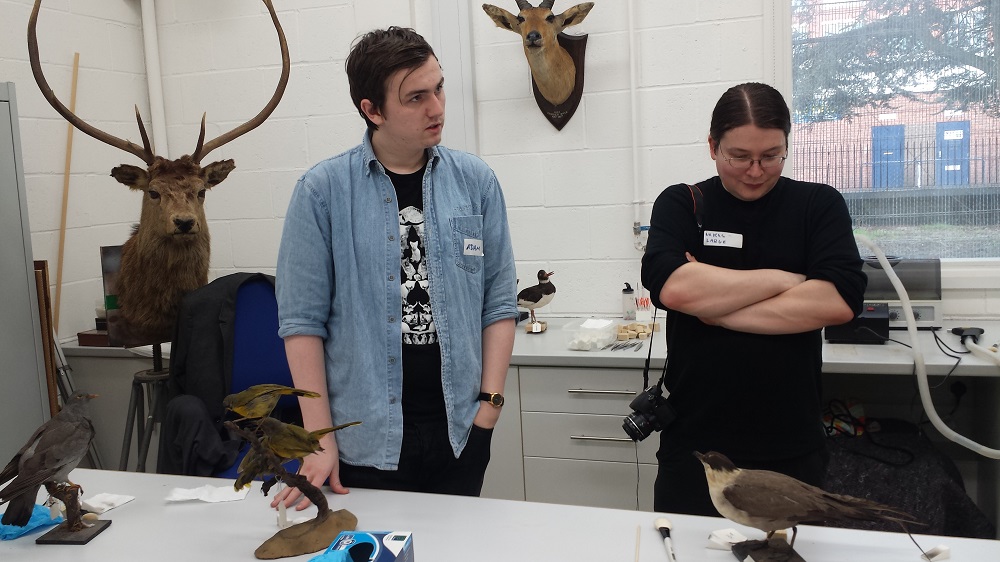
The day was led by Lucie Graham, Natural History Conservator at Lancashire Museums. Lucie began by demonstrating how taxidermy can be prepared using a wide variety of different methods, with internal moulds being formed from wood wool, balsam carvings, plaster and more. Taxidermy is an art, and each artist has their own methods. Lucie then went on to discuss how taxidermy can fall into disrepair if not properly cared for or prepared in the first place. We were able to get a close look an assortment of suffering taxidermy from Lancashire Museums, and discuss how we might treat each one to allow it to be better used and conserved. We had an adorable fox cub on our table, which had suffered from some fading, surface dirt and some loose digits on one paw. A bit of a clean and some adhesive to fix the paws, and this little cub could be looking much better!

taxidermy day3

Next we went through to the conservation lab for some cleaning demonstrations, where many of us were amazed to find out that simple cosmetic sponges get thick dirt off taxidermy effortlessly! We were also shown how to preen and straighten the feathers of a taxidermy bird, using steam to ease the process.

taxidermy day2

Finally were talks from a couple of the country’s leading taxidermists. James Dickinson discussed how museums can go about commissioning taxidermy. The Guild of Taxidermists can offer lists of accredited practitioners, ensuring that museums are able to make informed decisions and seek the services of the best person for the job. Jack Fishwick, judge at international taxidermy competitions, showed us a sample of his vast collection of bird photographs, which he uses for inspiration and feel for a bird’s shape and movement in life – vital for producing realistic taxidermy. The day finished with passionate discussion about the shrinking pool of skilled taxidermists – Jack and James warn that we may have no dedicated taxidermists left within the next two decades, which could be a disaster for museums wishing to expand and preserve their collections.

Glenn Roadley
Natural Science Curatorial Trainee

NatSCA Digital Digest

ChameleonYour weekly round-up of news and events happening in the world of natural sciences


Conferences

Conference season is well and truly upon us! Here are some dates for your diaries:

The National Forum for Biological Recording and the British Ecological Society are holding a joint conference at Sheffield University on 23rd – 25th April.

The conference of the Society for the Preservation of Natural History Collections will be held at the Florida Museum of Natural History this year, on the 17th – 23rd May. The theme is ‘Making Natural History Collections Accessible through New and Innovative Approaches and Partnerships’.

Refloating the Ark: Connecting the public and scientists with natural history collections. A two­‐day meeting at Manchester University on 17th – 18th June, exploring how natural history museums can contribute towards environmental sustainability by engaging effectively with the public and the scientific research community.


Workshops

The Linnaean Society is holding a workshop on Digitising Natural History and Medical Manuscripts on 27th – 28th April.

The 2nd International Conservation Symposium-Workshop of Natural History Collections will be held in Barcelona on 6th – 9th May. The Symposium-Workshop will emphasize concepts relating to the protection and conservation of natural history collections.

Risk Management in Collections Care is a one-day seminar at Kelvingrove Museum in Glasgow on 21st May, discussing how heritage organisations can use risk management to set priorities and efficiently allocate limited resources to reduce risks to collections.

As always, keep an eye on the events page of our website for more upcoming conferences and courses!


In the Media

Illustration of a Brontosaurus skeleton by Charles Othniel Marsh

This week’s big news: Brontosaurus is back! A new specimen-level cladistic analysis of diplodocids found strong support for Brontosaurus as a valid genus distinct from Apatosaurus. The internet rejoiced.

Entomologists from the Natural History Museum of Los Angeles County found 30 new species of fly in urban gardens.

Skeletal collections can tell us about the history of welfare standards in captive animals (warning: the paper is behind a paywall, but the abstract is free).

Brian Switek revisits his old fossil friend Teleoceras.

Three new species of wood lizard have been discovered in Ecuador and Peru by museum researchers.


Got a submission for the blog or Digital Digest? Email us at blog@natsca.org

Review of a Training Course on Pesticides and the Latest Legislation

The following is a review made by Roberto Portela Miguez, Mammal Group Curator at the NHM London:

About a week ago I attended a course and talk at the Natural History Museum of London, entitled “Control of Pesticide Regulations 1986 (as amended 1997) EU Biocides Regulations 528/2012”.

I know that, even if your two passions in life are pesticides and obscure legal documents, it is highly unlikely that you would rush to sign up for it.

After attending the event I can assure you that I still do not wish to look into both topics more than I need to. I do however strongly recommend all collections management staff to attend any future opportunity to listen to Bob Child’s talk or training event on this topic.

Robert Child was formerly Head of Conservation at the National Museum of Wales, and is now a Conservation Consultant, Advisor on Insect Pests to the National Trust and Director of Historyonics.

His company, Historyonics, sells insect pest products and carries out treatments on historic buildings and collections – so he has plenty of first-hand anecdotes to illustrate the various points he makes during his talks.

His experience on these matters is vast, but possibly more important: he is a brilliant communicator that can easily turn what is a dry and dull topic into two hours of effective and entertaining training.

The course Bob runs is required training for anybody using pesticides as part of their work ( this includes volunteers ) and is based on the requirements of the Control of Pesticides Regulations 1986 (as amended), the Control of Substances Hazardous to Health Regulations 1988 (as amended) and the new Biocides Regulation 528/2012. It is further based on the HSE’s publication ‘Recommendations for Training Users of Non-agricultural Pesticides’.

The course lasts for about two hours and covers both theoretical aspects on a Powerpoint and practical demonstrations of:

  • principles of pest control and nature of pesticides
  • legislation
  • storage and transport of pesticides
  • use of pesticides (on site assessments)
  • labels and data sheets
  • safety in preparation, clean up and disposal.
  • emergency procedures
  • record keeping

Once you have gone through the training, you will be qualified to apply pesticides in your collections and, without doubt, be extremely grateful that Bob has done all the reading of the relevant EU legislation on your behalf.

I know most of us do our best to prevent infestations but, just in case, better to be prepared and qualified than …you know.

Keep checking our NatSCA website and blog for news on future workshops and training events and if you want to contact Bob to run the course at your institution, you can email him to bobchild@historyonics.com .

Bill Pettit Memorial Project – Conservation of historic Taxidermy

Ann Ainsworth (Colchester and Ipswich Museums)

Hannah Clarke (Freelance Conservator)

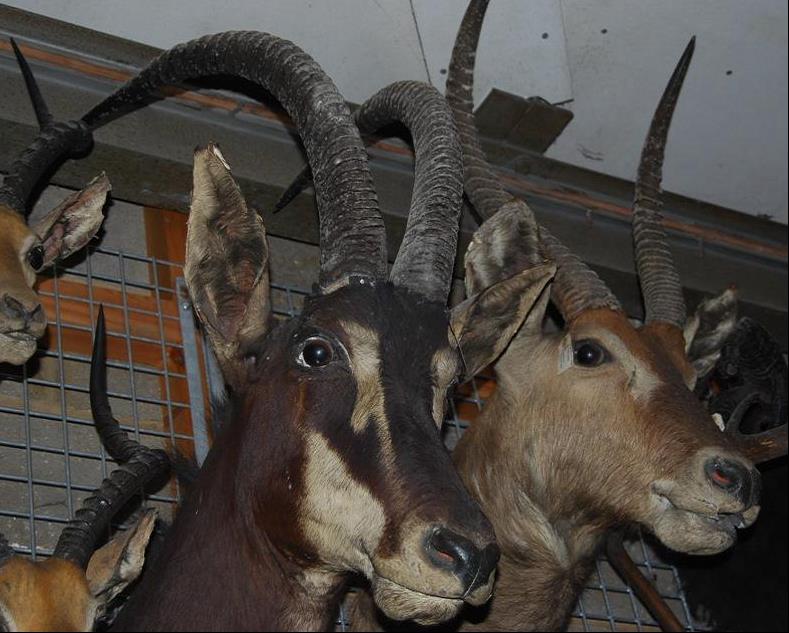
Ipswich Museum has an important historic collection which dates back to its opening in 1847. A recognised strength of the natural history collection is the historically important Victorian and Edwardian taxidermy of animals from across the globe.

The taxidermy collection is stored in an old building which used to be an old coach depot and later a garage. The space had become very dusty and dirty and a significant mould problem had developed.

one

We followed a very simple methodology of light dusting with soft brushes using a vacuum containing a HEPA filter. This was followed by swabbing with an alcohol/water solution to remove the mould and kill the spores. Where possible specimens were covered or wrapped in polythene to act as a protective cover to protect from dust, provide an external surface for mould to grow on, and to prevent pest damage which is also a potential problem within the stores.

two

The variety of conservation problems, meant that many different treatment processes needed to be used by Hannah. Some of the processes included dry cleaning, wet cleaning, re-adhering, colour matching, re-inserting feathers, removing old varnish with solvents, mitring, sealing with brown gum tape, and applying and buffing wax. New panels of glass and sections of beading had to be sourced and cut to size.

The top panel of the pike case had warped and bowed, as the glass side panels had been broken previously. There were no structural supports on the front inside edges of the case either, meaning that the top of the case was unsupported from the front. The existing beadings on the rear inside edges were not secure, and the metal tacks used to hold the mitred sections of wood in place were very loose. New beading was sourced to match as close to the original as possible and was then colour matched and held in place using new tacks.

Cygnet before conservation

Cygnet before conservation

Cygnet after conservation

Cygnet after conservation

The Bill Pettit Memorial funding went towards payment for the freelance Conservator in terms of time and travel expenses and the purchase of replacement glass and beading for the cases where broken or damaged.

It was agreed that conserved cases would not be returned to store until the planned repair work had been successfully completed. As many of the conserved cases as possible were put on public display in the museum galleries. This has enabled part of the collection not normally seen by visitors to be on display. It has also helped to present a strong message of the Museum Services’ wish to improve the condition of specimens and its storage facilities and helped to raise the profile of the project.

Spicer platypus case after conservation

Spicer platypus case after conservation