NatSCA Digital Digest


NatSCA 2

Your weekly round-up of news and events happening in the world of natural sciences

Conferences and Workshops

As PalaeoSam mentioned in the last Digital Digest, the Symposium of Vertebrate Palaeontolotgy and Comparative Anatomy is on next week. It is my personal palaeo highlight of the year and so am sad that I will miss it this year. (Though not too sad given I am missing it to be in Italy for the Grand Prix.) If you are attending and would like to do a super write up of the weeks’ events, please do let us know.  I look forward to experiencing SVPCA through the eyes of a blogger.
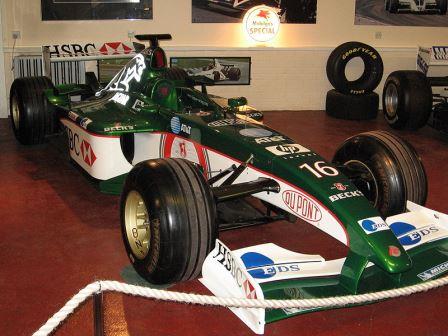
Jaguar

Those of you who are fans of F1 will know why this car is relevant to natural history (image in public domain)

News

Not really on the subject of natural history, but a topic that will touch the heart of any museum professional or visitor. ISIS have taken even more away from the us, the global nation, via the destruction of an Ancient temple in Palmyra. These open air museums are original sites of cultural heritage and are irreplaceable once gone. Not at the top of the list of the most tragic event of the last couple of weeks by any means, but a sad day for museums nevertheless.

News from the Blogosphere

The #MuseumInstaSwap phenomenon has launched as staff from some of the top museums in London (including the NHM and the Horniman) swap museums and take to social media to chat about it. An article in Time Out nicely summarises what is going on but a lot of the museums involved have their own exciting blogs on it worth looking up. Hence this is in the News from the Blogosphere section, see?

Highlights from the Papers

More and more, scientists are relying on Citizen science, as a means of collecting data. The mode of research is especially important in fields such as marine biology where the incorporation of sightings made by anglers, for example, can add significantly increase the size of datasets. An article in Nature called Rise of the Citizen Scientist explores the good the bad and the ugly of this practice as a research tool.


As ever, if you would like to write a blog for NatSCA on anything natural sciences related, give us an online shout blog@natsca.org.

Using Social Media as part of a Curatorial Traineeship

This post is another in our series of presentation write-ups from the 2015 NatSCA Conference, Museums Unleashed!


It felt like I was up there for hours when it was happening, but then it was over with a massive sense of relief. That’s how I’d summarise my first presentation in front of fellow NatSCA conference attendees.

We (myself and another two Natural Science Curatorial Trainees, Glenn and Lukas) had been asked to prepare a talk fitting with the conference theme of ‘Museums Unleashed’.  The conference was to focus on sharing collections using digital platforms, television and other forms of media, so we decided to present on our own use of Social Media throughout the 12 months of our Traineeships.

The presentation we came up with explored our use mainly of Twitter and WordPress throughout our year (other social media platforms are available), which we used to document our experiences and engage with the wider museum community. We were able to speak about things such as how fun Social Media can be when it’s used well, and how good of a platform it can be to engage with members of the public in order to (hopefully) dispel some of the myth about museums being so exclusive.

Presenting in full flow! (Image from Clare Brown @CuratorClare)

Presenting in full flow! (Image from Clare Brown @CuratorClare)

We also got to speak about how Social Media (from our perspective as trainees) could be used for our host museums. For example, showing the support of an institution or organisation for a trainee by letting them be there, working with collections and allowing them to further advocate said collections.

Our presentation allowed us to touch on some things that can make Social Media a challenge too, such as building a following. This can be difficult, especially when trying to expand outside the ‘Museum bubble’ – it can be hard to find those who may be interested in a particular discipline or hashtag.

Finally, I would like to take this opportunity to thank everyone at the conference who gave us great positive feedback about our talk, as especially for myself being so nervous, it was great to hear I wasn’t a complete mumbling wreck! And thanks again to NatSCA and its members for its support of myself, and my fellow trainees whom it has helped support over the years of the HLF Skills for the Future
programme.


Adam Peel, Curatorial Trainee Natural Science, 2014 – 2015

NatSCA Digital Digest

natscaYour weekly round-up of news and events happening in the world of natural sciences

Jobs

Curator of Natural Sciences, Tullie House Currently seeking to become a designated collection, the natural sciences collections are looking for a curator who will get involved in ‘engagement activities, acquisitions, collections care projects, research, exhibitions and collection displays’. Deadline 10th August.

Curator, Grant Museum of Zoology Time is running out to apply for a job that has not been vacant for over ten years. If you think you could be the new Curator of this fantastic natural history collection, you have until 3rd August.

See the job page of the NatSCA website for more exciting opportunities!

News

The University Museums Group (UMG) are joining forces with the University Museums in Scotland (UMiS) to bring you Science and Society, their 2015 conference. It will take place on the 23rd and 24th September at Durham University. Bookings are now open so help yourselves to places.

Around the Web

A great blog came out recently by Jake of Jake’s Bones in which he says, I quote, “I’ve had a lot of T-rex action this week” in Learning about Tyrannosaurus. Now that’s a good week. Full of great images, Jake’s blog asks some interesting questions. He writes with the enthusiasm we all have but often don’t show, which makes the blog a great escape from the day.

Worth a look this week is an image on the National Geographic website (not that there’s ever really a day that it isn’t worth looking at). I don’t want to say much about it as it would risk spoilers, so I’ll let the image doing the impressing for itself. N.B. Make sure you read the caption, it may change what you think you’re looking at…

Something else definitely worth a gander is the tumblr page of Paleocreations. Past the impressive life-size Ichthyostega model at the top are eight images you can scroll through to show how Paleocreations produced the beautiful official artwork of Sophie, the most complete Stegosaurus skeleton ever found, for the Natural History Museum London.

NatSCA Digital Digest

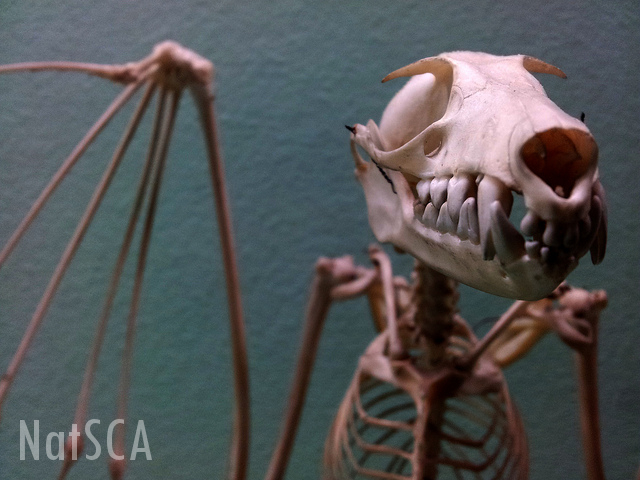
A mounted skeleton of a fruitbat leers at the cameraYour weekly round-up of news and events happening in the world of natural sciences

Jobs

Curator of Natural Sciences, Tullie House Museum. Fixed term for 12 months (with potential for extentsion). Tullie House is also looking for a Collections Access Manager at the moment.

Operations and Project Officer, Lyme Regis Museum. A great opportunity to work on the iconic Jurassic Coast.

UK Flora Collections Assistant, Royal Botanic Gardens, Kew. An interesting role combining field work, lab work, and collections!

As always, see out jobs page for more opportunities.

Events

SVPCA (The Symposium of Vertebrate Palaeontology and Comparative Anatomy) is coming up on 29th August – 4th September. This year it is to be held at the National Oceanography Centre in Southampton.

#AskACurator Day is back on Twitter on 16th September. It’s a great way for people to talk to museum staff who are normally ‘behind the scenes’, and for us to get exposure for the amazing work we all do with our collections.

Around the Web

Dinosaurs on tour: Dippy the Diplodocus will be leaving his home at the NHM for a holiday, and the museum is looking for host venues. Must have large gallery.

The genome of the kiwi (Apteryx mantelli) has been sequenced, revealing insights into its strange physiology.

Giant animals that are almost impossible to find! Did you know that the largest stick insect recorded is in the collection of the Natural History Museum (NHM), and is over half a metre long?

Brymbo Fossil Forest in Wrexham has been designated as a Site of Special Scientific Interest (SSSI), protecting the future of its precious 300 million year-old fossils. Sadly, many fossils were lost in arson attacks on the site last year.

NatSCA Digital Digest

natscaYour weekly round-up of news and events happening in the world of natural sciences

Jobs

Curator, Grant Museum of Zoology, UCL I can tell you from three years of first-hand experience (pseudo-first-hand; as curatorial assistant) that this is the job all curators should be applying for. The Grant Museum of Zoology is an amazing place to work and in this role I know you will have the opportunity to spread your curatorial wings and make a real difference in the natural history sector. The kind of job where you don’t mind getting up in the morning. Closing date for applications is 3rd August. Good luck!

If only for the superb job title, anyone with experience of learning programmes for families and children with ASC (Autistic Spectrum Condition) should definitely take a look at the current vacancy for the Dawnosaurs Programme Co-ordinator at the Natural History Museum. This looks like an amazing opportunity for the right person. The closing date for applications is the 22nd July.

See the job page of the NatSCA website for more exciting opportunities.

News

The next Museums Association exhibition and conference is due to take place on 5th and 6th November, in Birmingham. There is still time to register as an early bird who gets the cheaper worm rates. Early bird registration ends on the 7th August, click here for more.

Around the Web

Sun bear, fox, hippo or pangolin. What tickles your natural history bones the most? Choose your favourite to be the new museum mascot for Derby Museum and Art Gallery! If you are on Twitter, you can whip up some support for the sun bear, errr, I mean, your favourite using: @DMNature and @derbymuseums. The winning specimen will be announced on the 7th August. I’ve already chosen mine, can you guess what it is…?

The Friends of Crystal Palace Dinosaurs have been working up a storm of support lately, with ongoing events at the park complemented by a very dynamic talk at the Grant Museum by the master of science comedy- Prof Joe Cain, from UCL. These incredible statues are a vivid reminder of the evolution our concept of dinosaur appearances has gone through. They are also an important part of our British cultural heritage, that helped shape the palaeontological world in the mid 1800s. Find out more about these iconic statues that are in desperate need of conservation on the Friends of Crystal Palace Dinosaurs website.