NatSCA Digital Digest

NatSCA polar bear

Jobs

Education Assistant – National Museum of Ireland – Natural History

Duration: Permanent

Closing date: 5th June 2015

To apply, click here

Conferences and Workshops

A few exciting talks are coming up at the Natural History Museum soon, which I thought would be worth highlighting for you. The first is the Annual A. R. Wallace Lecture which this year will take place on the 2nd June 16:30-17:30. The subject is ‘Wallace, Darwin, and Spiritualism: The Trial of the Spirit-Medium Henry Slade, 1876’. For more information, click here.

On the 24th July at 16:30, the SciFri Seminar series brings to you ‘The Greatest Living Naturalist- The Life and Conflicts of Professor Richard Owen’, in celebration of Richard Owen’s birthday. It will be in the Neil Chalmers Seminar Room. For more information, click here.


Exhibitions

The long awaited ‘Power of Poison’ exhibition has opened at the Old Truman Brewery in London. The website invites you to ‘discover the alluring, seductive and terrifying role of poison and how it affects our everyday lives through nature, myth, medicine and healing’ and of course, will contain spiders, snakes, and other lovelies. For more information, click here.

Content assembled by Emma-Louise Nicholls

NatSCA Digital Digest

Hectors swallowtail butterfly extracting nectar from a flower. © Cláudio TimmWelcome to the weekly digest of interesting things from around the web with relevance to natural science. We hope you find this useful and if you have any articles of interest, please contact us at blog@natsca.org

1. Blog: Crime scene micropalaeontology

Natural History Museum, London

Synopsis

‘Micropalaeontological evidence is increasingly being used to solve major crimes. Read on to find out about [curator of micropalaeontology] Steve’s involvement in Crime Scene Live, how our collections could help forensic studies and how our co-worker Haydon Bailey gathered some of the evidence that was key to convicting Soham murderer Ian Huntley’- Giles Miller

Click here to read the whole blog.

2. Museum altruism: Trip Advisor

Anyone, anytime!

Synopsis

Now that the sunshine is here (I hope I don’t jinx it by writing that) potential museum visitors will be looking ahead at inspiration for how to spend their weekends, days off, school holidays, etc. In this day and age it seems the way to find such inspiration is on websites such as Trip Advisor, on which you can read other people’s reviews of places they have visited. Obviously popping on a review of your own collection, if you work in one, would be a bit naughty, but if you have been anywhere else lately, why not help their visitor numbers out by inspiring people to visit too?

Click here to find out more.

3. Now open: Sensational butterflies at the NHM

2nd April to 13th September

Synopsis

It’s back for another summer of beautiful live insects, screaming kids and irritated academics in the offices above. Sensational butterflies in the garden of the Natural History Museum London is now open, complete with exhibition trail, and is well worth a look.

Click here for more details


Compiled by Emma-Louise Nicholls, NatSCA Blog Editor

NatSCA Digital Digest


Chill out with NatSCA's Digital Digest. Binturong (C) Emma-Louise Nicholls

Calm down and chill out with NatSCA’s Digital Digest. Binturong /Arctictis binturong/ (C) Emma-Louise Nicholls

Welcome to the weekly digest of interesting things from around the web with relevance to natural science collections. We hope you find this useful and if you have any articles that you feel would be of interest, please contact us at blog@natsca.org


1. Conference: A Question of Ecology: Answers from Biological Recording

23rd – 25th April 2015

Synopsis

‘Biodiversity information is crucial to understanding ecological relationships and supporting conservation effort in a changing climate. Use of volunteer-collected biological records by the professional scientific community is widely encouraged and celebrated, but much interpretation of biological records is carried out by amateur naturalists, who are uncovering new ecological knowledge from their own records and sharing that knowledge with others.’ ~ National Forum for Biological Recording

Click here for more information.

2. FREE Course: Behind the Scenes at the 21st Century Museum

Starts 1st June 2015, lasts 6 weeks, all online

Synopsis

‘How can we understand museums today? Who makes the decisions about what to put in them and whose stories they tell? Who are museums for and why are they working to engage new audiences? How do we respond emotionally to museum objects and spaces? And how can museums play a role in the pursuit of social justice, human rights, or health and wellbeing?’ ~ Future Learn

Click here to find out more.

3. Event: An unconquerable aversion to Piccadilly”: Charles Waterton, traveller, taxidermist and pioneer conservationist

31st July to 1st August 2015

Synopsis

‘The Annual General Meeting or the Society for the History of Natural History will be held in association with a one day conference of talks celebrating the life and work of Charles Waterton and a second day with related excursions around Wakefield in West Yorkshire.

The Wakefield Museum, at Wakefield One, is currently hosting an exhibition “The extraordinary world of Charles Waterton” and the Society’s meeting will take place at a venue within easy reach of the Museum and will include a visit to the exhibition’ ~ Society for the History of Natural History

Click here for more details and to apply


Compiled by Emma-Louise Nicholls, NatSCA Blog Editor
NatSCA Digital Digest

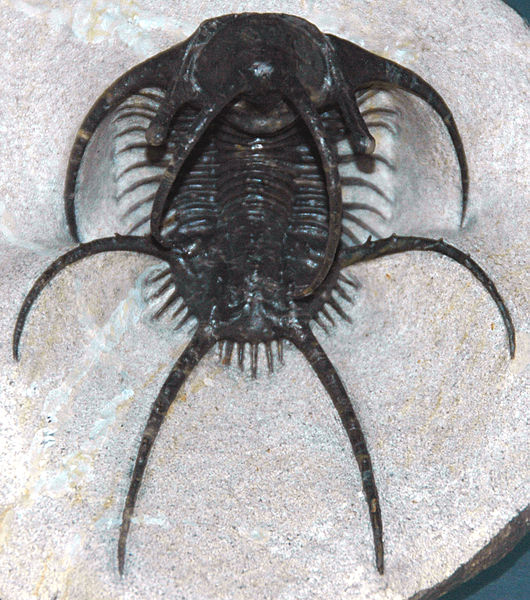
Ceratarges spinosus trilobite from Morocco (Obtained from www.wikimedia.org)

Welcome to the weekly digest of posts from around the web with relevance to natural science collections. We hope you find this useful and if you have any articles that you feel would be of interest, please contact us at blog@natsca.org


  1. One Day Conference: Curator of the Future

13th April 2015; British Museum

Synopsis

The conference will focus on three key themes:

  1. The Curatorial Survival Kit- what should be in the ‘curatorial survival kit’ to survive and thrive in the changing professional landscape?
  2. A Brave New World- what are the impacts and opportunities for curatorial practice?
  3. The Next Generation- how can we help support the current and future curatorial work force?

For further information please contact Katy Swift at kswift@britishmuseum.org


  1. Call for proposals: ‘Innovation’: The Emperor’s New Clothes?

Conference to be held on 14th May 2015 at the McDonald Institute for Archaeological Research, Cambridge.

Synopsis

Why are some projects described as ‘innovative’ while others aren’t? Have you ever been aware of pressure – from funders, from senior management, or from elsewhere – to come up with an innovative project?

Association with the innovation ‘label’ can be great in the short term for getting funding, but there is no point in ‘innovation for the sake of it’.

When you look back at all the projects described as innovative, the reality is that only some of them have brought lasting value. What does innovation mean for museums? Does it go beyond new technologies to include new ways of organising our work or interacting with audiences? How do we assess which innovations are useful and which are distractions? Do you have any examples where the term innovation has proved positive in the short term and/or in the long term? Does innovation have to be revolutionary, or can it be evolutionary? Are you aware of any innovative ways of evaluating digital projects, or evaluating projects in general, using digital technologies or methodologies?

We are seeking proposals from people willing to share their successes and failures in projects that have or could be described as innovative. However we also welcome sessions focused on debunking the ‘cult’ of innovation or addressing the questions above.

Fill in this form to submit a proposal here or contact Jessica Suess for further information jessica.suess@museums.ox.ac.uk


  1. Conference: Refloating the Ark- Connecting the Public and Scientists with Natural History Specimens

17th and 18th June 2015, 9-5pm; Manchester Museum

Synopsis

A two­‐day meeting exploring how natural history museums can contribute towards environmental sustainability, by engaging effectively with the public and the scientific research community.

For further information contact David Gelsthorpe david.gelsthorpe@manchester.ac.uk or visit the Manchester Museum website.


Compiled by Emma-Louise Nicholls, NatSCA Blog Editor