
Written by Julie Griffith, Property Experience Curator, Calke Abbey, National Trust.
Exploring the stories of Selina (1822-1905), Georgiana (1824-1910) and Matilda (1831-1899) Lovell, uncovers three curious and accomplished women. With interests in botany and conchology and stretching from Derbyshire to Australia, their story is of both individual achievement and natural history connecting sisters across the globe.
With existing narratives around Calke Abbey’s natural history collection overwhelmingly male focussed, recent research into the three Lovell sisters aims to bring women’s stories and connections to natural history into the spotlight at this country house property.


Who were the Lovell sisters?
The Lovell sisters were closely related to the Harpur Crewe family of Calke Abbey through their mother, Selina Crewe (d.1838), a daughter of Sir Henry, Calke’s 7th Baronet and Nanny, Lady Crewe. Their father, Vice-Admiral William Stanhope Lovell (c.1788-1859) was a distinguished naval officer and veteran of the Battle of Trafalgar.
As part of the Harpur Crewe family they shared mutual relatives and family friends with natural history interests, including their cousin and naturalist Rev. Henry Harpur Crewe (1828-1883) and Rev. Andrew Bloxam (1801-1878) former tutor and lifelong friend to the family.


Selina Lovell – A Streak of Unconventional Daring
Although previously unknown at Calke Abbey, Selina is recognised as a naturalist in Australia. Born in Eltham, Kent in 1822, Selina as the eldest unmarried sister seems to have spent several years caring for their father in his old age. Following his death, she emigrates to Australia aboard ‘The Light of the Age’, arriving in Brisbane, Queensland in 1864. Why she chooses to leave England is unknown but in 1863 an aunt writes to say she hopes Selina has given up all thought of emigrating, that her life will surely be wretched and dismissing Selina as simply not strong enough to survive. Yet, Selina persists. She shows herself to be a determined and resilient woman, forging a new life on the other side of the world. Fred Williams, in his text ‘Written in Sand’, describes Selina as, “… an exception in more ways than one and her timid demeanour hid a streak of unconventional daring.”
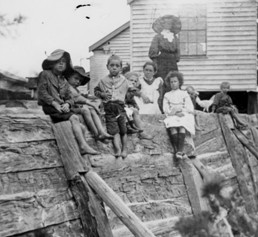
On arrival in Australia, Selina becomes a schoolteacher fulfilling posts in Brisbane, Bundaberg and finally the remote Sandy Cape, K’Gari. At this time British settlement in Queensland is still very young, with the town of Bundaberg only 9 years old when she arrives, although First Nations Australians had already lived on these lands for thousands of years. The picture below of the schoolteacher and class in Sandy Cape is slightly later than Selina’s time but gives an idea of the small community and remote nature of the place. Life seems to have been extremely difficult with Fred Williams describing bullying and brutal treatment towards Selina detailed in a school inspector’s report of 1877. Despite this she is also described as having won the affections of the children and seen as an amicable part of the community.
Credit: State Library of Queensland
While in Australia Selina pursues her interests in botany. She corresponds with the Colonial Botanist F.M Bailey and supports his work on Queensland flora, contributing specimens to the Queensland Museum. In recognition Bailey names three species of plant after her: Drosera Lovelliae, Pithecellobium lovelliae and Rhaphidophora lovelliae. The Holotype of Drosera Lovelliae still resides in the Queensland herbarium with S. Lovell listed as collector in 1892. It is thought this is not the first time Selina contributed to the work of a known botanist. Specimens in William Bromfield’s text Flora Vectensis (1856) list ‘Miss. Lovell’ as the discoverer. The date and locations correspond with Selina still being in England, while Georgiana was already married with the title of Lady Crewe, and the youngest sister is just 16 years old. This, along with her future proven interest and capability in botany makes Selina the most likely candidate.


Credit: National Trust/Julie Griffith
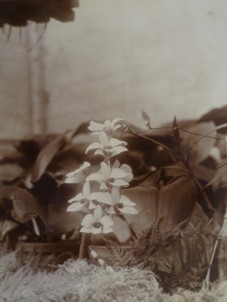
Export records show Selina sending cases of natural history specimens to Calke Abbey. Laburnum seeds, acacia, shells, opal, iron ore and orchid seeds are all posted to the Harpur Crewes. ‘Aunt Selina’s orchids’ are mentioned in family diaries, while a photograph showing Dendrobium bigibbum, or the Australian Cooktown orchid in the show house suggests these seeds were successfully grown at Calke. The sharing of specimens with her sister along with the frequent correspondence between the two women shows that despite never physically meeting again, they supported and encouraged each other’s interests. Selina clearly wasn’t merely dabbling in natural history, but shows an ongoing curiosity, extensive knowledge and capability.
Credit: Derbyshire Record Office/D2375/J/A/1/13. Derbyshire Record Office – Derbyshire County Council
It is a shame that someone clearly so capable is essentially dismissed and vilified by the public and the scientific community in later life. In 1890 Selina reports sighting a sea monster called the Moha-Moha. Part fish, part turtle, she describes the creature being enormous in size. Despite having signatures from witnesses Selina’s account was seen as nothing more than nonsensical ramblings. After that she seems to disappear into quiet obscurity until her death in 1905.
Georgiana Lovell – Thorough Cultivator and Botanist
Calke’s Australian plants were most likely grown under the watchful eye of Selina’s younger sister Georgiana. In 1845 Georgiana marries her cousin, Sir John Harpur Crewe, 9th Baronet of Calke Abbey and together they have three children.
Georgiana’s journals give a sense of an intelligent and curious woman, clearly knowledgeable about and interested in natural history. She notices and records geological formations whilst on holiday and tends to the Calke gardens, encouraging her children, affectionately called ‘the Chicks’, to do the same. Through the historic collection we see her gifting natural history books to the children, encouraging their studies and interests in this area.
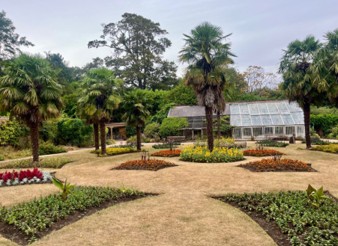
The Derby Mercury, 1882 states that, “Lady Crewe herself is a thorough cultivator and botanist…” describing her collecting plants on trips to Europe and cultivating them in the Calke gardens. Receipts and bills in the Harpur Crewe archive at Derbyshire Record Office show the wide range of plants Georgiana purchased for Calke. A letter discussing the garden’s heating system is addressed directly to Georgiana, who is clearly the authority on the gardens. Today we still see her influence in the flower garden, alternatively known as Lady Crewe’s garden.
Credit: National Trust/Julie Griffith
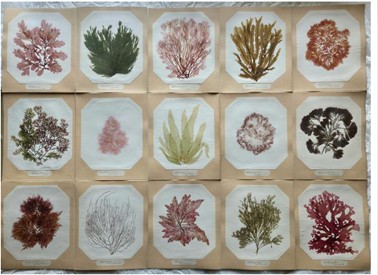
Evidence of Georgiana collecting natural history specimens is found in her correspondence with Elizabeth Jane Dyke‑Poore, a seaweed collector in Jersey. Their exchange is familiar in tone, although how they are acquainted is unknown. Letters show Elizabeth collecting and preparing seaweed specimens at Georgiana’s request. None have yet been identified at Calke, though further work on the historic herbarium may reveal them. A set of pressed seaweed specimens seemingly by Dyke‑Poore, dated 1850, survives in the National Trust collections at Osterley Park, London.
Credit: National Trust/Brenna Fraser
Identifying natural history specimens at Calke attributed to Georgiana is challenging. A case of “Indian stones,” bequeathed by a relative, may survive in the Drawing Room, and she could also be represented in the herbarium. The complication is that specimens once belonging to Georgiana may have been absorbed into the larger collection later developed by her son and thus may now be attributed solely to him. This is something we also potentially see with regards to the collections of Georgiana’s younger sister, Matilda.
Matilda Lovell – A Recognised Authority
The youngest Lovell sister is always affectionately referred to as ‘Tilly’ in family correspondence. Upon finishing schooling, she moves to Calke to live with her sister Georgiana. Despite residing with the Harpur Crewe family for over 30 years, no known portrait of Matilda exists in the Calke Abbey collection (although there is at least one that has a strong possibility of being her), and few of her personal items remain.
Matilda is best known as an authority on British molluscs. Her text ‘The Edible Mollusks of Great Britain and Ireland’ was published by Reeve & Co., a leading natural history publisher in 1867. Matilda illustrated the volume herself, with the prints produced by lithographer G. B. Sowerby II (1812-1884). Peter Dance in his articles for the Archives of Natural History notes that a second expanded edition of this book printed in 1884 suggests sustained interest in her work.
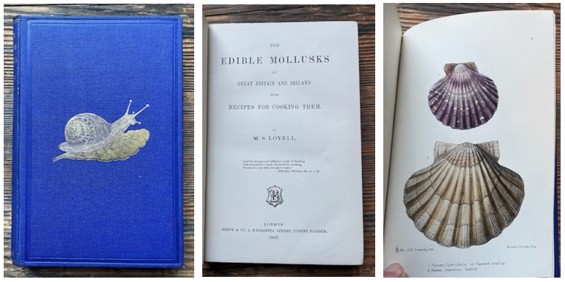
Credit: National Trust/Julie Griffith
Matilda’s book featured in the 1883 International Fisheries Exhibition. Newspaper reports record her receiving a bronze medal for mollusc specimens and note that “from Calke Abbey…rare specimens of the edible molluscs of the British Isles…have been supplied.” As Matilda is still living at Calke, the prize‑winning specimens likely came from her own collection. However, no confirmed conchological collection of Matilda’s survives. Through this research the current theory is that Matilda’s specimens may actually have been absorbed into the wider Calke collection, which has been traditionally attributed to only male members of the Harpur Crewe family. A vitrine, now in Sir Vauncey’s Boyhood Bedroom at Calke Abbey contains shelves full of shells mounted onto blue card. These are systematically arranged, purposeful and with a sense of scientific use. This is in stark contrast to the rest of the conchological collection, which is jumbled and chaotic in its presentation, seemingly valued more as a collection than for scientific comparison. It is also interesting that the blue of the mounts matches the blue of Matilda’s book cover. Further investigation and research will be undertaken this winter to try and confirm this hypothesis.


Credit: National Trust/Julie Griffith
In later life Matilda moves to the Isle of Wight, leaving Calke with her sister, now the Dowager Lady Crewe, on the death of Sir John in 1889. After this date little more is known of her. Her will suggests all her remaining personal items have been sold to raise funds for expenses and trusts for family members.
The Future
Thus far, we have just scratched the surface of understanding the Lovell sisters and their connections with the Calke Abbey collection. We are keen to continue uncovering their voices and highlighting their stories as part of our overall narrative around natural history. From focussing on Selina, Georgiana and Matilda we are also seeing glimpses of other women with natural history interests who may have contributed to the collection we see today. This is very much the beginning of our journey to uncover female histories at Calke and we would welcome any input from others in the wider community who may know more about the Lovell sisters or female natural history collectors connected to Calke Abbey.


