
Compiled by Ellie Clark, Collections Moves Team Leader at the Natural History Museum
Welcome to the February edition of NatSCA Digital Digest.
Digital Digest is a monthly blog series featuring the latest on where to go, what to see and do in the natural history sector including jobs, exhibitions, conferences, and training opportunities. We are keen to hear from you if you have any top tips and recommendations for our next Digest, please drop an email to blog@natsca.org.

Sector News
Save the Date: SPPC, June 26th – 27th 2025
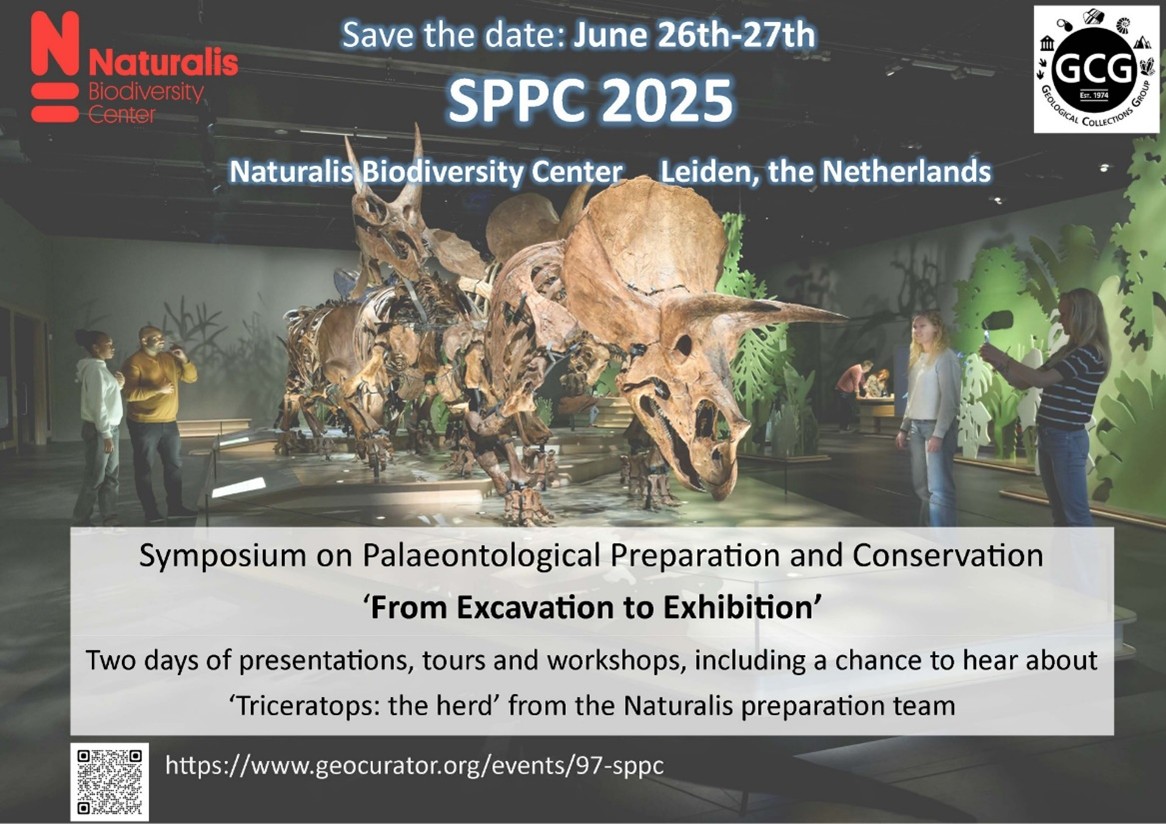
The 30th Symposium on Palaeontological Preparation and Conservation will be held in the Netherlands this year on 26-27th June.
The theme will be From Excavation to Exhibition including aspects of the story of how geological collections end up on display in our museums, as well as their conservation and preparation. A call for abstracts and registration is coming soon. For more details visit: https://www.geocurator.org/events/97-sppc
Panel Discussion “Where are we now?”: En/countering Colonialities in the Grant Museum
One year on from the re-opening of the Grant Museum following a significant collections display change, three museum specialists from the worlds of natural science and history discuss ongoing work to address colonial legacies in natural history collections since the museum’s Displays of Power exhibition (2019).
This panel event will bring together Subhadra Das, Displays of Power curator, independent writer and historian; Jack Ashby, Assistant Director of the University Museum of Zoology, Cambridge; and Miranda Lowe, Principal Curator at the Natural History Museum, London.
The panel discussion will be held on the 4th of March at the Grant Museum of Zoology. Book your free ticket here.
McGill Libraries Talk – Old books & new research: Uncovering the forgotten work of Mary Hinckley to answer new ecological questions
Amphibian populations are declining worldwide, but still little is known about the ecology of their tadpoles. Dr. Jessica Ford set out to determine what toad tadpoles were eating and how they impacted the environment, and in the process, came across unexpected results. While Ford uses many modern tools in her research, the explanation of her unexpected results instead lay hidden in older, now forgotten works by early 20th century naturalist Mary Hinckley. Register for the talk to hear about how old, obscure scientific papers can be vital in answering new research questions.
The talk will take place on Tuesday, February 25th in person and online via Zoom. All are welcome but places are limited, book your spot.
NatSCA Lunchtime Chats
The new lunchtime chats are for members only and run on the last Thursday of every month.
This series is supposed to be informal; no fancy equipment is needed; it will be put out over the NatSCA Zoom platform and there is no fixed format. For those who want to take part please email training@natsca.org to put forward your idea; if a stable internet connection for what you want to achieve is tricky, we can put up a pre-recorded video and then speakers can jump in at the end for the discussion.
Bring your sandwiches and a cuppa and we hope to see you on the day! All members will have received a link to join via Zoom (the same link works for all sessions) – if you haven’t, get in touch with membership@natsca.org.
NEW NatSCA BLOG POSTS for 2025
Do you have something exciting coming up next year that you’d like to promote? Is there a subject you’ve been itching to write about? With over 2000 views a month, the NatSCA blog is a great way of getting your work out there.
Jen is seeking blog posts for 2025, so if you have something in the pipeline that you would love to tell everyone about, drop her a line! This is an excellent opportunity to book yourself in a slot for any time in the year.
If you are interested but have any questions, please email blog@natsca.org. You can also find guidelines on how to contribute here: Guidelines for contributions to the NatSCA blog | NatSCA.
Where to Visit
Breaking Ground at the Oxford University Museum of Natural History
Explore what the colourful archives of William and Mary Buckland reveal about science, status and society. This exhibition showcases important specimens and fossils along with drawings, prints and paintings made by Mary Buckland and others, which helped spread the understanding of extinct groups of animals and plants among the 19th-century scientific community.
Breaking Ground is free and will run until 29th September 2025. See details here, and view the online exhibition here.
Wild at Manchester Museum
Will going ‘wild’ help us to tackle the climate and biodiversity crisis?
The exhibition Wild explores our relationship with the natural world and looks at how people across the globe are creating, rebuilding and repairing connections with nature. What fuels our fear of dangers that lurk in the wild? Can ‘wildness’ flourish within a city’s concrete jungle? How do we care for things we can’t see?
Wild will challenge the way we think about nature, whisking you to wild places across the world to hear a diverse range of voices, from Aboriginal elders to researchers and community activists. Find out how they’re shaping their environments and looking to wild for a more positive future.
Wild is free and will run until June 1st, 2025. Find more information here.
What to Read
On the blog we have Birds of Bolton Museum written by Lauren Field, Curator of Natural History at Bolton Museum. The blog details the success of recent exhibition, Birds of Bolton, which was inspired by the donation of a large collection of sketchbooks by Bolton-born artist and naturalist Eric Gorton.
Where to Work
Aquarium Assistant – Bolton Library and Museum Service
Bolton Library and Museum Service are seeking an Aquarium Assistant to support the Aquarium primarily on Sundays. This is your opportunity to work within a supportive and friendly Museum Access team, alongside Aquarium staff well recognised in the industry. Daily care of the fish and maintaining Aquarium life support systems are the core tasks. There will be opportunities to develop your skills. The post will help to ensure the service meets Zoo Licence standards & will assist in delivering the Bolton 2030 Vision.
Apply quickly as the closing date is 16/02/2025. Find more information here.
Senior Curator, Geosciences (Mineralogy/Geology) – Museums Victoria
Australia’s largest public museum organisation is seeking a Senior Curator, Geosciences (Mineralogy/Geology) to join Museums Victoria. The closing date is 02/02/2025. Find more information here.
PhD in Evaluating the Influence of Tangible 3D Printed Replicas on the Museum Experience – University of Warwick and Oxford Museum of Natural History
The University of Warwick, and Oxford University Museum of Natural History, are pleased to announce the availability of a fully-funded four-year (full-time) doctoral grant under the AHRC’s Collaborative Doctoral Partnership Scheme.
The project seeks to leverage user experience methods from industry to explore the use of tangible 3D printed replicas within museums. The main aims of the project are to understand how such replicas affect the museum experience and how they influence both the interpretation and behaviour of visitors. Find more information here.
Before You Go…
If you have any top tips and recommendations for our next Digest please drop an email to blog@natsca.org. Similarly, if you have something to say about a current topic, or perhaps you want to tell us what you’ve been working on, we welcome new blog articles so please drop Jen an email if you have anything you would like to submit.

 NatSCA
