
Written by Dan Gordon, Keeper of Biology, The Great North Museum: Hancock.
For as long as I’d worked at the museum, there’d always been a Coelacanth. People referred to it in passing, pointing out the large tub of orange tinted spirit where it lurked. I’d always rather taken it for granted; an interesting but rather mundane specimen, and I’d never been curious enough to fish it out of the murky liquid and examine it.
That is, until 2018, when staff at the National Maritime Museum Cornwall got in touch about an exhibition they were putting together called Monsters of the Deep. They’d asked us about Coelacanth fossils and I mentioned the Coelacanth in the fish collection, which was greeted with some surprise. A real one…Would we consider a loan? And as I thought about this, I came to realise that I knew very little about the Coelacanth at all.
There was next to nothing in the catalogue about it, so I decided, firstly, to get a better look. This was easier said than done. The Coelacanth is over a metre long and weighed over 20kg, sitting in a container of tea coloured alcohol bigger than a bathtub. Reaching in, I ran my gloved fingers over its flanks, which had the texture of coarse sandpaper. Lifting it out was like wrestling an alligator, but eventually it emerged, a gaping mouth with small sharp teeth, a ragged tear through the flesh of its head, and the huge eyes of a deep-water dweller.
It was mostly a dark brown colour, with paler flecks here and there, and a criss-cross of white thread stitching up its soft belly. Its thick body was coated with distinctive, closely overlapping, diamond shaped scales like raised cobbles. Thick spines jutted out from its famously fleshy fins. These were certainly strange to see on a fish – pressed tightly to its sides like a soldier at attention. Rust coloured oily liquid leaked from beneath the thick tail stock. A strange and rather baroque creature.
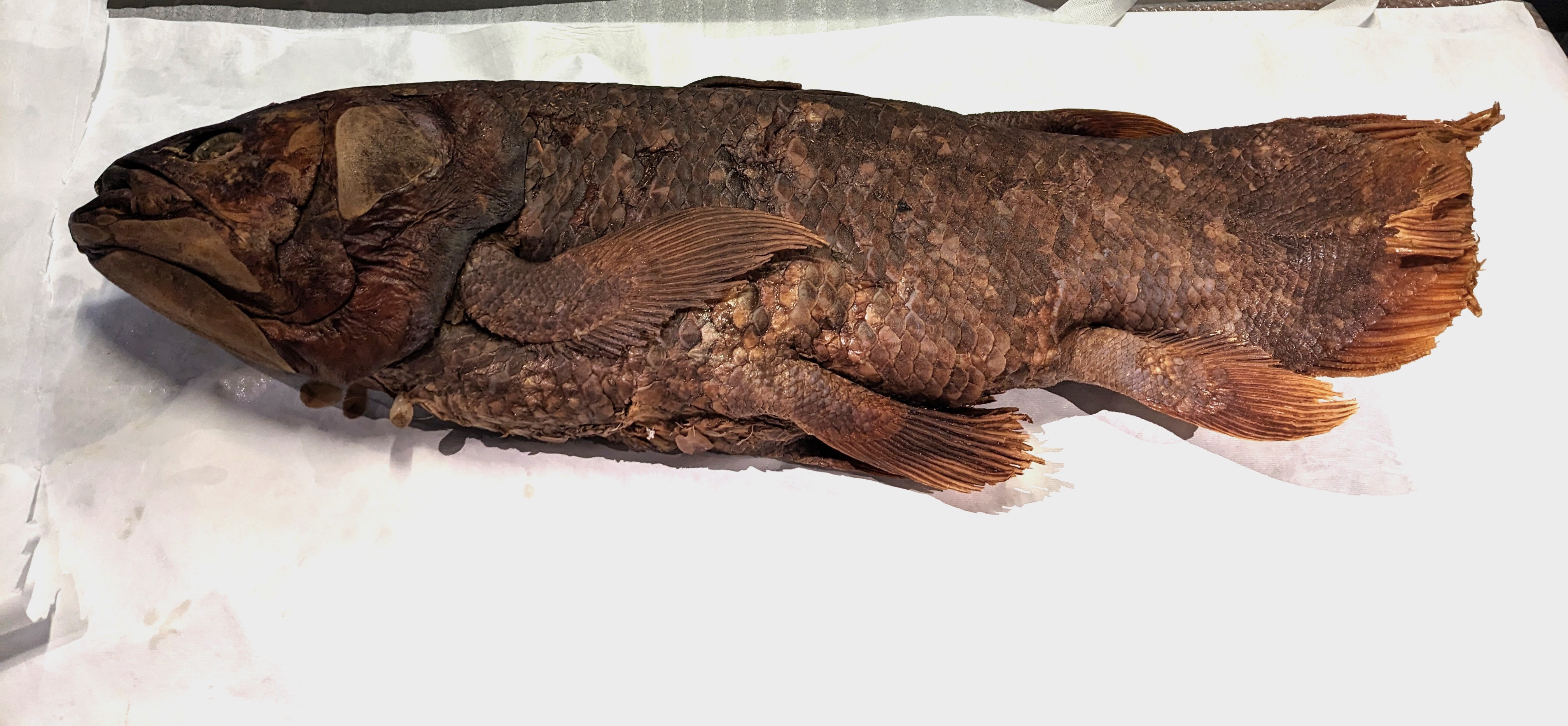
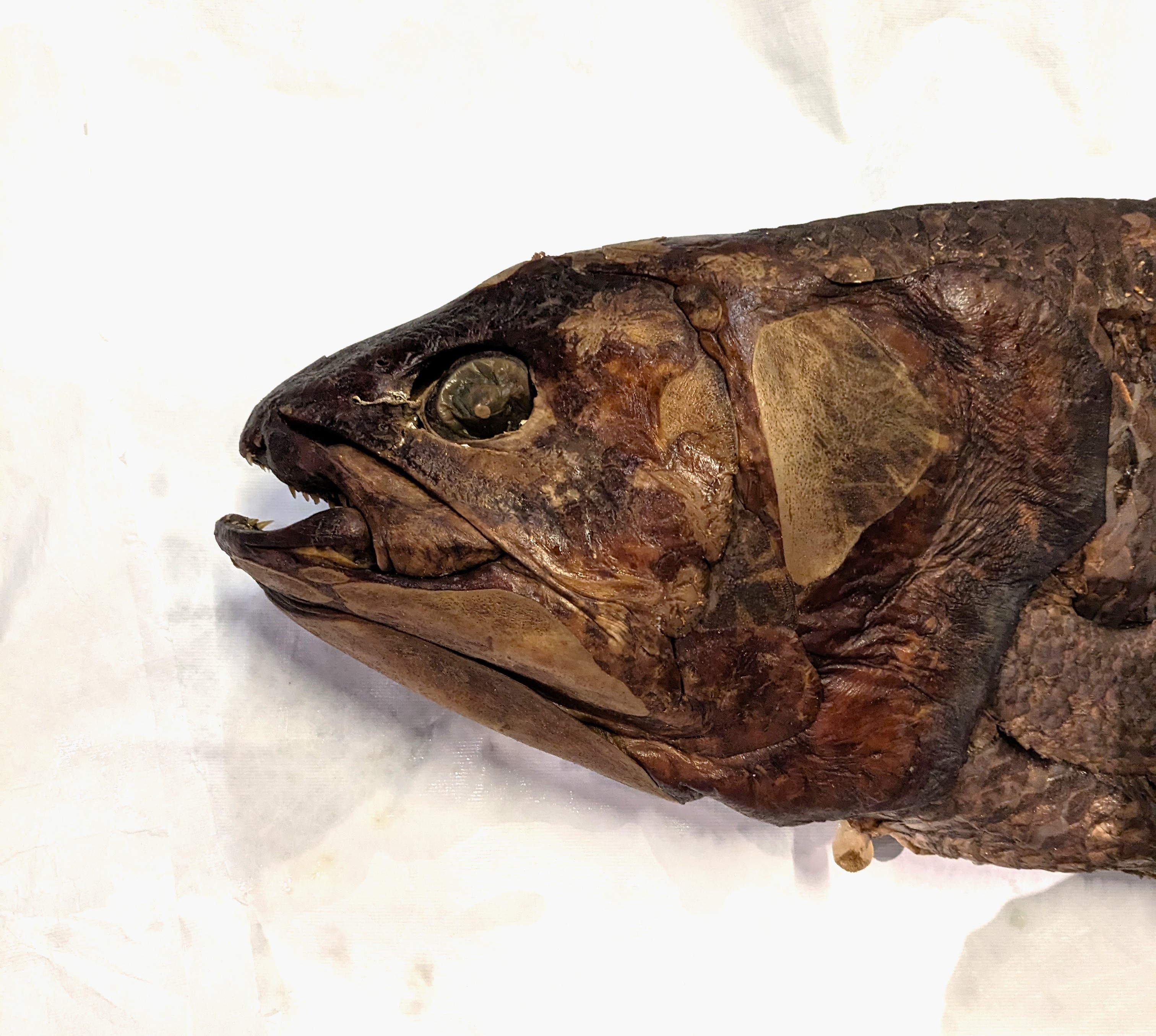
Our specimen is an African Coelacanth, Latimeria chalumnae. The species is one of just two surviving members (the other being the more recently discovered Indonesian Coelacanth) of a clade of Sarcopterygian fishes called the Actinistia. The group appears in the fossil record about 400 million years ago and the most recent fossil Coelacanths date to about 66 million years ago. The Actinisitia were thought to have vanished into extinction until Majorie Courteney-Latimer’s famous find in South Africa in 1938 (1).
The term ‘living fossil’ can be problematic (2), but the stocky, bristly creature lying in front of me certainly seemed like something from another age.
Researching the Coelacanth in preparation for the loan, it soon became clear that not much was really known about Coelacanth collections in the UK. Much of the existing work has been done by Rik Nulens, a Belgian researcher and Coelacanth expert who has spent the last several decades documenting the world’s Coelacanth collections. In 2011 he collaborated on the most recent inventory of world Coelacanth holdings (3) which recorded only 5 in UK collections, and nobody is completely sure if this is accurate. It was something of a shock – was ours on this list? Could it really be quite so rare? How did the Hancock specimen reach Newcastle? What, exactly, was the story behind it?
Reaching out to Rik Nulens, I started to piece together the story of our Coelacanth. It began with a man from Hartlepool, Thomas Westoll (4). Born in 1912, Westoll became a palaeontologist and went on to become head of the Geology Department at Newcastle University and a member of the Royal Society. Studying fossil fish for most of his career, Professor Westoll had a particular interest in the evolution of the tetrapod limb – how vertebrates moved from fins and flukes to arms and legs.
In 1972, while head of the Department of Geology, he got permission from the Comoros department of fisheries to obtain a Coelacanth. It’s worth noting that this was the same year he was elected to the Council of the Royal Society, so presumably he was quite well connected at the time, because it must have been quite a coup.
I think it’s interesting that Westoll’s Coelacanth came from Comoros. In the history of Coelacanth science, the 1938 scientific discovery inspired a feverish search for new specimens. It took a whole 14 years, but in 1952 this finally got results when news of the search reached Comorian fishermen. A large fish they sometimes caught, known as the ‘Mame’ or ‘Gombessa’ seemed to match the description of this sought after species, and once this had been brought to the attention of the scientific community, the East African islands quickly became the new focus of Coelacanth research.
We can imagine how exciting it must have been for a fossil fish researcher like Westoll to get up close to a flesh and blood example of something he’d only ever seen preserved in the rocks, and from what was at that time the only known population of the animals.
Thanks to the extraordinary work by Rik Nulens, it turns out that Westoll’s specimen was documented, but confusion at the time meant that this information hadn’t been passed on to the museum. Once it was confirmed that the Hancock’s Coelacanth was in fact the one sent to Westoll , not only could our specimen be officially recorded in the list of global collections, we were able to discover a whole new chapter in its history.
It began at 2am on the morning of 6th of July 1973, just off the coast of the island of Grand Comoro, near a village called Mitsoudjé Bangoi. A young male fish, which would become the ‘Hancock Coelacanth’ was caught on a handline baited with Escolar at a depth of 120 metres. The notes even recorded the name of the fisherman. Hauled to the surface, it was quickly killed then fixed in formalin and prepared for the long journey to the UK.
The arrival of this extraordinary specimen at the museum in Newcastle was remembered well by former curator Dr Susan Turner, who wrote to us from her home in Australia.
It arrived one day…in a lead box preserved in formalin – and guess who had to hold it for the cameras…I reeked of formalin for about 2 weeks – very hard to get rid of the smell! (5)
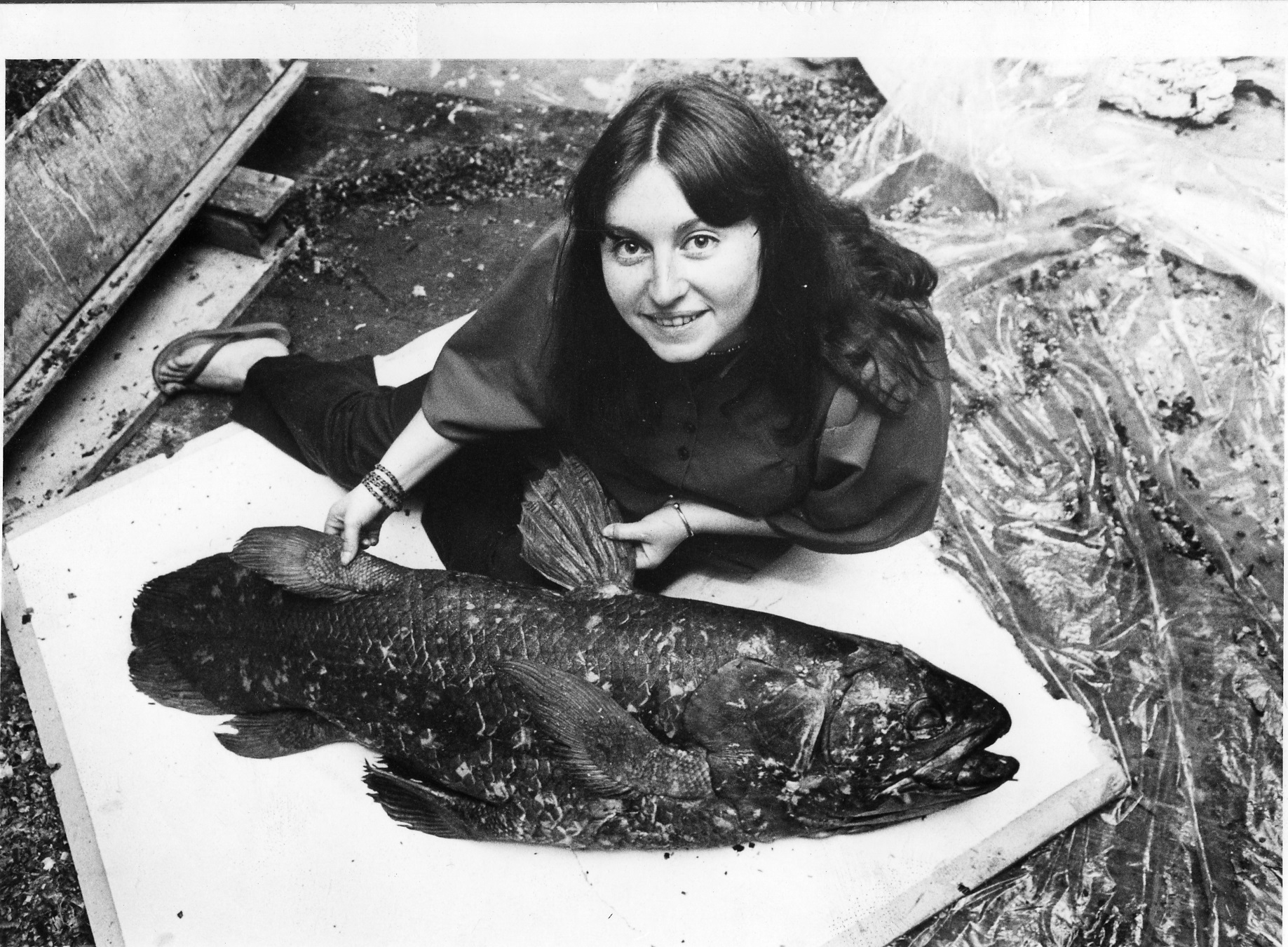
In photos from the time, excited museum staff in awesome 70s fashion pose with the beast – here looking shiny black and spiny in its lead coffin.
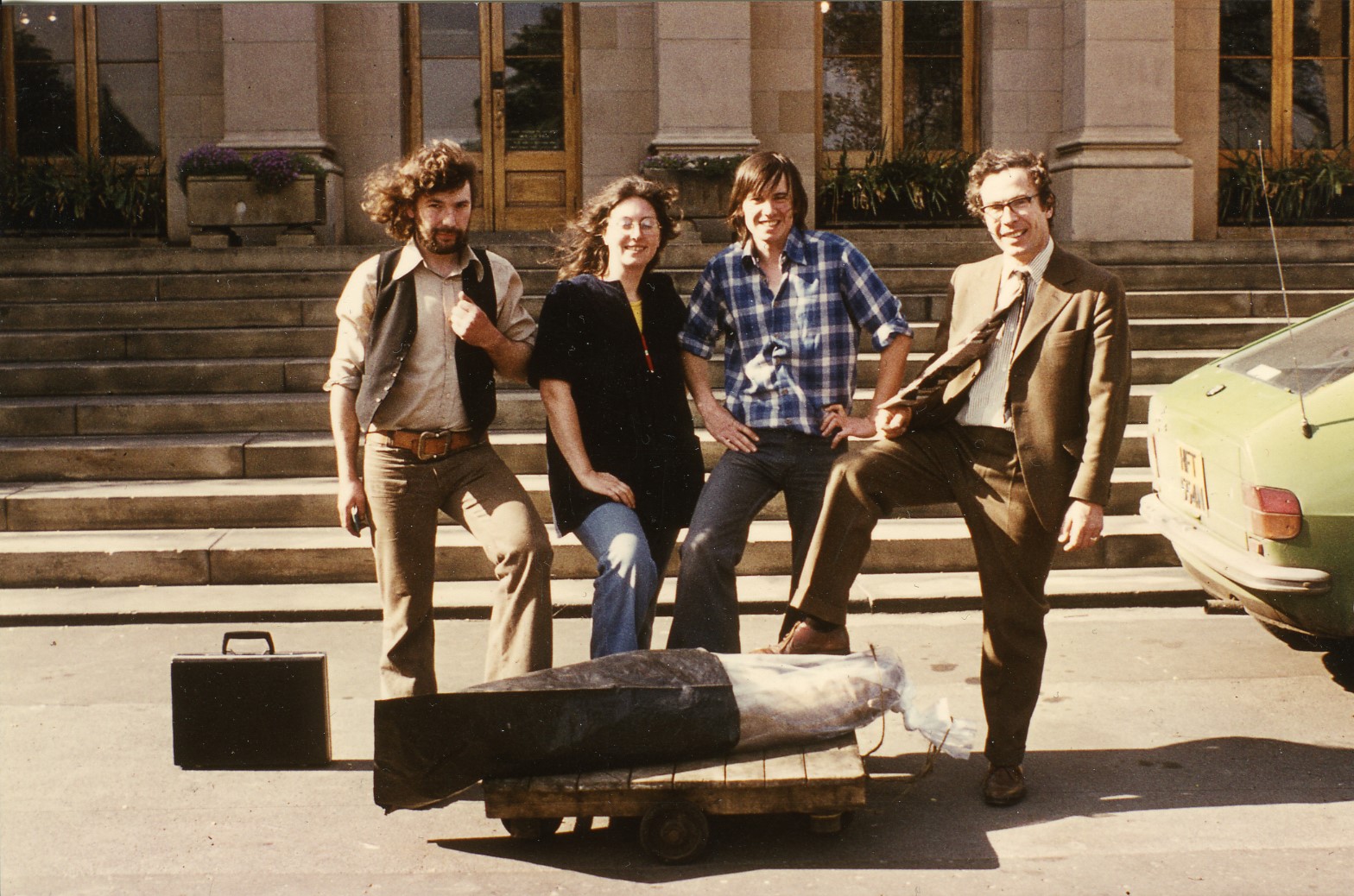
And then, like the tens of thousands of specimens before it, the Coelacanth stayed put at the Hancock Museum. Over the next few decades it was the subject of Westoll’s research, a partial dissection by a master’s student who stitched it back together, the removal of scales which were sent to Glasgow, and, in a move I don’t think I’d have agreed to, a team of researchers cut open its head to remove the unique Rostral organ (that explained the huge gash over the nares).
As staff moved on or retired, curatorial knowledge about the specimen faded away, and regrettably we lost our understanding of just how special our Coelacanth was, until it became merely a big fish lurking in a tub. In preparing it for loan, I came to realise that, not only was its story remarkable, it was a reminder that our collection is likely to be full of remarkable objects with stories we don’t fully appreciate.
- https://saafmuseum.org.za/6832/the-fish/
- https://onlinelibrary.wiley.com/doi/10.1002/bies.201200145
- https://web.archive.org/web/20220619161328/http://www.saiab.ac.za/uploads/files/spec._pub._3_-_coelacanth_inventory.pdf
- https://en.wikipedia.org/wiki/Thomas_Stanley_Westoll
- Dr Susan Turner Pers. Comm.

 NatSCA
who was the fisherman?
LikeLike
Many thanks for your question. Dan has replied saying that he was a Comorian man called Ibrahim Soilihi. He assumes he was a fisherman, but there’s no other information about him unfortunately.
LikeLike
Pingback: NatSCA Digital Digest – July 2024 | NatSCA
Pingback: 10 Surprising Facts About The Coelacanth, The Deep-Sea Living Fossil - Animalko