People and Plants Workshop Three: Sharing Knowledge in the Amazon

March 10th, 2023, Royal Botanic Gardens, Kew

Written by Fiona Roberts (Collaborative ESRC PhD student, Cardiff University & Amgueddfa Cymru-National Museum Wales) and Violet Nicholls (Assistant Curator in Herbarium, Portsmouth Museums).

This post is dedicated to Dr Dagoberto Lima Azevedo (1979-2023), Tukano researcher, translator, scholar, author and a voice for the Indigenous peoples of the Rio Negro in the northwestern Amazon.

The third and final workshop of a one-year project ran in March 2023, at Royal Botanic Gardens, Kew. The project, “People and Plants: reactivating ethnobotanical collections as material archives of indigenous ecological knowledge”, began in January 2022, and was supported by NatSCA (Natural Sciences Collections Association). Funded by the Arts and Humanities Research Council (AHRC), it was led by National Museums Scotland, the Powell-Cotton Museum and Royal Botanic Gardens, Kew. 

The workshop ran in partnership with Museu Goeldi, Brazil and the Department of Cultures and Languages, Birkbeck, University of London. It addressed the question, ‘how ethnobotanical collections in museums can best be used to support Indigenous communities?’. Dr Dagoberto Lima Azevedo, from the Federação das Organizações Indígenas do Rio Negro, and Claudia Leonor López Garcés (Museu Paraense Emílio Goeldi) travelled from the Brazilian Amazon for the event. They met with fellow panellists Professor Mark Nesbitt (Royal Botanic Gardens, Kew), Professor Luciana Martins (Birkbeck, University of London), Cinthya Lana (University of Gothenburg) and Dr William Milliken (Royal Botanic Gardens, Kew).
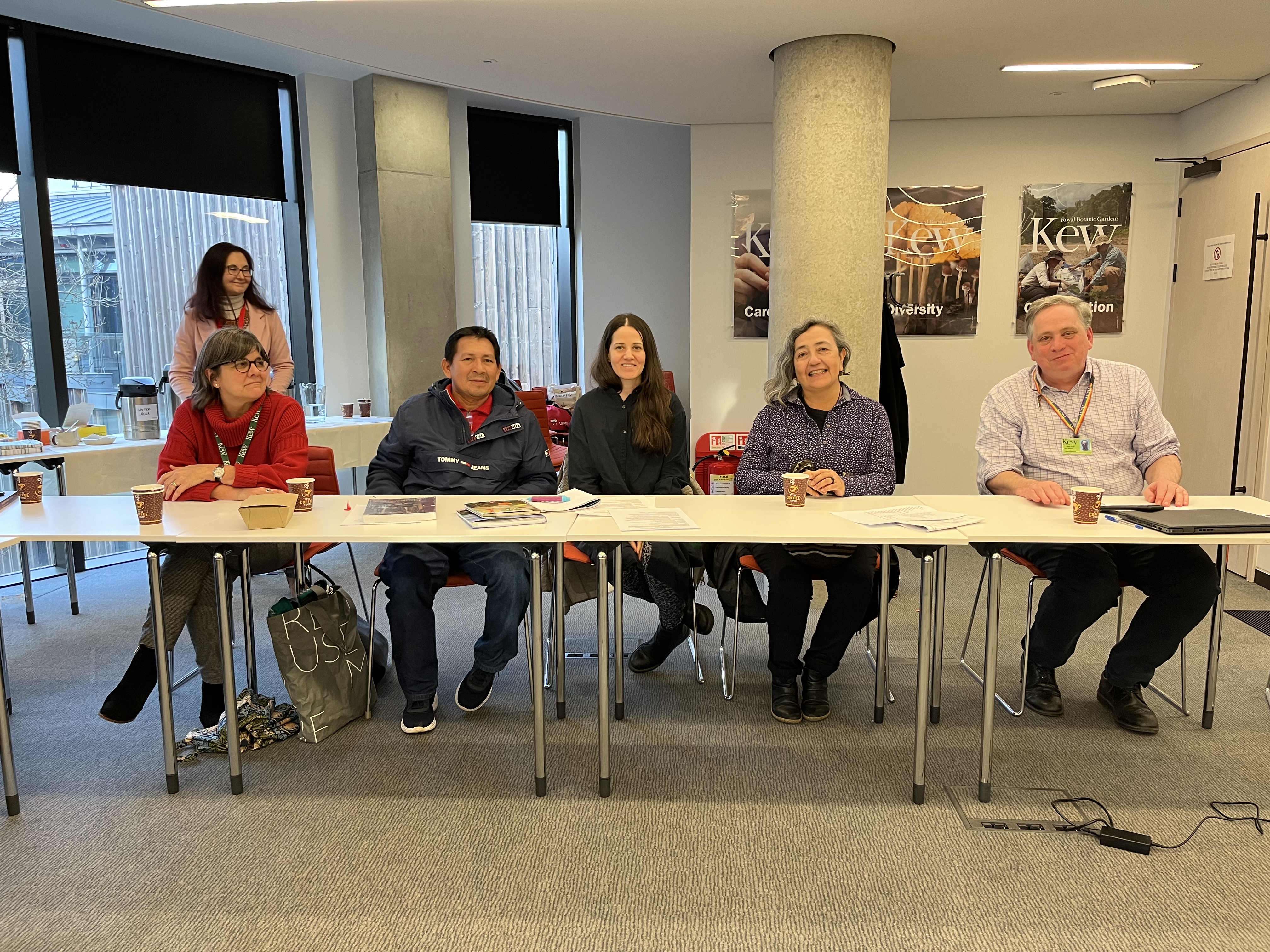
Fig. 1. Some members of the panel at the workshop with, from left to right, Cynthia Sothers, Luciana Martins, Dagoberto Lima Azevedo, Cinthya Lana, Claudia Leonor López Garcés and Mark Nesbitt. Photo by Gayathri Anand.

The Richard Spruce collection (1849-1864) was used as a case study. Spruce collected plants and recorded their uses in South America, and is considered to be an early ethnographer, as he also recorded the traditions and customs of the different communities that he met on his travels.1 He collected over 14,000 herbarium specimens in the Andes and Amazon regions, and 350 items are in his ethnobotanical collections.2

Continue reading
NatSCA Digital Digest

Welcome to the weekly digest of posts from around the web with relevance to natural science collections. We hope you find this useful and if you have any articles that you feel would be of interest, please contact us at blog@natsca.org

1. Blog: A Day Out at Tring

Amy Freeborn, Natural History Museum London

Synopsis

This blog covers some of the history of the collections at Tring, and includes some interesting historical photos of the Museum and Rothschild’s estate as it was in the early 1900s. The author had the opportunity to see the preparation lab where beetles are used to clean flesh from carcasses, leaving skeletons fit for mounting. Some ‘wow-factor’ facts regarding the content of Tring Museum’s collections are also outlined.

http://www.nhm.ac.uk/natureplus/blogs/behind-the-scenes/2014/03/14/a-day-out-at-tring

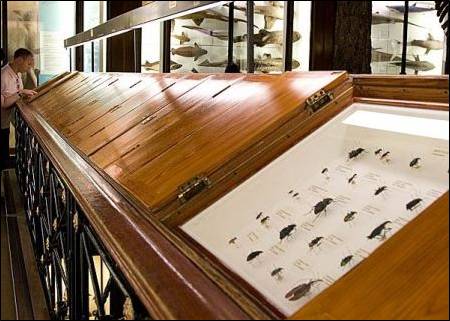
The galleries at Tring Museum. Image by Robert Stainforth. Obtained from http://www.commons.wikimedia.org

2. Blog: Testing a European Competency Framework for VET in Collections Management

National Agency for Lifelong Learning

Synopsis

Access to, and use of, natural history collections are integral in facilitating research in the sector, but the ways in which these are facilitated vary between institutions. This article looks at the application of ‘best practice’ in terms of collections management, care, and conservation and describes a project that utilises the methods developed by the Natural History Museum, London to tackle the task of creating a standard for European collections.

http://www.adam-europe.eu/adam/project/view.htm?prj=10833&projLang=en#.UvpDWvtWsfg

3. Training: Pest Identification and Trapping Study Day

The Horniman Museum, London. 15th May 2014

Synopsis

An introduction to the management of museum pests. The day comprises lectures on subjects such as Integrated Pest Management schemes, as well as practical sessions that will give attendees the skills to identify various pest species. The Horniman Museum is used as a case study to illustrate an active pest management scheme. The highlight (having attended myself previously) is a pest based treasure hunt in the natural history galleries.

There is a limited number of places on this course so please get in touch with Libby Finney for details asap if you are interested. Email: lfinney@museumoflondon.org.uk

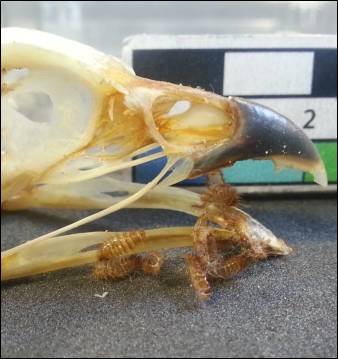
A horde of Anthrenus larvae on a bird skull. (C) UCL Grant Museum

4. Event: Geological Carbon Storage: Meeting the Global Challenge

Two day conference at the Geological Society at Burlington House. 14th-15th April 2014

Synopsis

Fossil fuels will undeniably be a significant component of energy supplies for ‘several decades at least’. This conference will focus on actions required to avoid serious negative environmental impacts caused by the burning of fossil fuels and the subsequent amount of CO2 that is released. Trapping CO2 and storing it underground (CCS) is a method of achieving this aim. Issues and policies will be discussed by delegates including members of government, industry, regulators and NGOs.

http://www.geolsoc.org.uk/carbonstorage14

Compiled by Emma-Louise Nicholls, NatSCA Blog Editor