Tetrapod Zoology Conference – Part One

20140716-171224.jpg

Tetzoocon is the brainchild of Darren Naish and John Conway. The first of its kind, Tetzoocon specialises in the earliest four-footed vertebrates and all of their descendents – no mean feat considering most specialisations limit themselves to subgroups of these, such as amphibians or birds, and even then the subject is enormous.

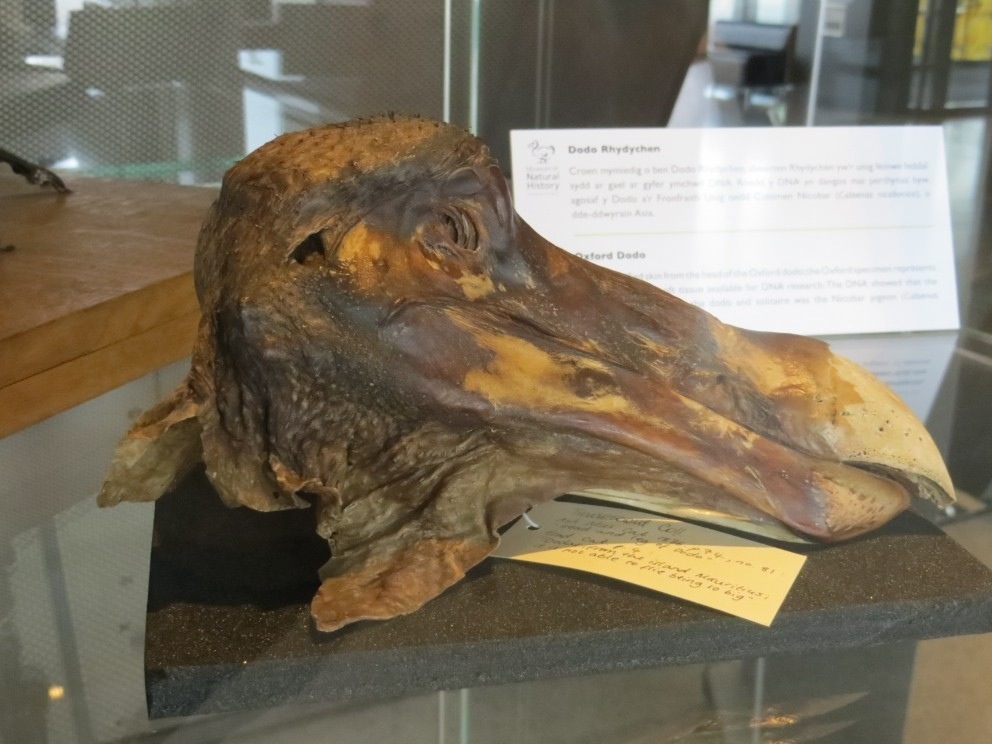
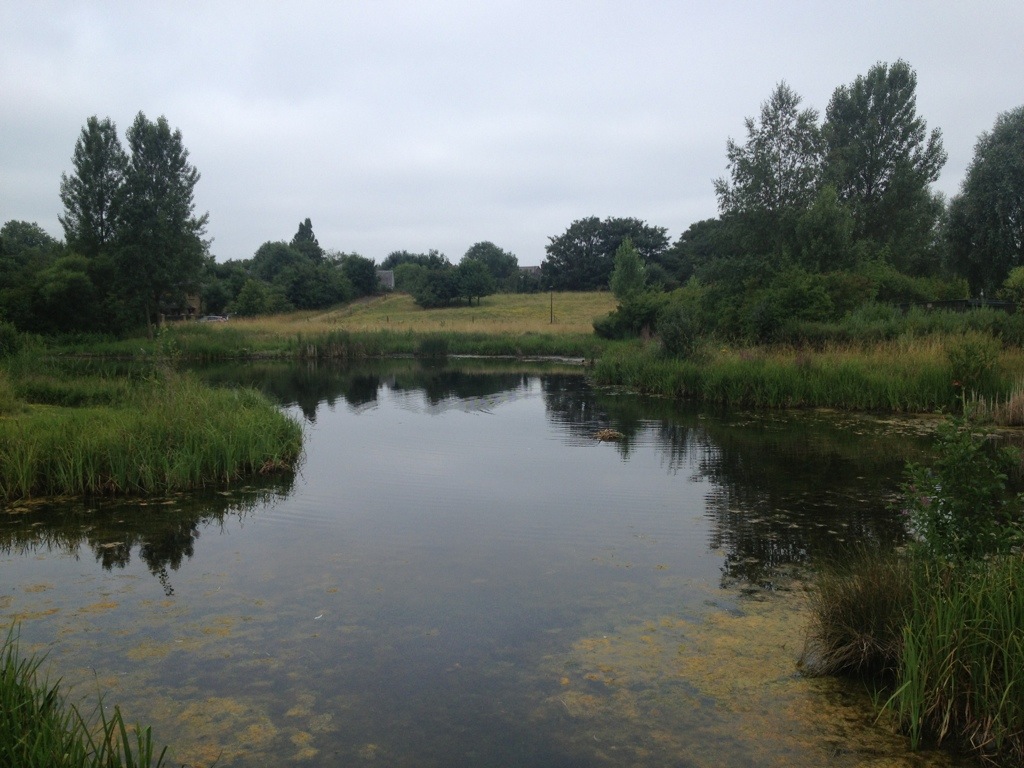
The conference was held in the London Wetland Centre near Hammersmith. A beautiful oasis of nature in a desert of buildings and airport traffic.

We’ll talk about the venue in more detail later but first: the talks.

Darren Naish

Darren opened the day with a talk on speculative zoology: a subject which covers future evolution, intermediary species of known clades, extrasolar evolution, and purely imagined beasts living within earth’s existing ecological niches. Of these, only one has testable predictive power (the intermediary specimens between known clades) and in time will be either borne out or disregarded. Needless to say that natural history collections do and will continue to play a large role in this thought experiment.

There is a long tradition of humans imagining new creatures dating back thousands of years but it has really erupted in the last few decades – from the massively influential books of Dougal Dixon to the gross box-office smash Avatar.

There is a new book out from the makers of All Yesterdays which explores speculative zoology in more detail.

Mark Witton

Renowned pterosaur palaeontologist and palaeoartist Mark Witton was next with a look at how azhdarchids have been portrayed in art since their discovery. The image of azhdarchids was all over the place for a long time – a lot of what we ‘knew’ about them appearance-wise was based on previous speculation until these beautiful pterosaurs were methodically examined and a coherent picture of what one looked like started to emerge. Today if you look at a lot of modern palaeoart you can see the family connection in the group, which is a good indicator that the artist is on the right tracks. Again the natural history collection is employed here to help artists be more accurate in their portrayal of living species. What else can I say about Mark’s talk that won’t divulge as-yet unpublished information? I’ll say this: if you’re at all interested in Mesozoic ecosystems you will attend Flugsaurier2015 and hopefully Mark’s research will be published by then. If you can’t tell already I’m really excited by this news item!

Paolo Viscardi

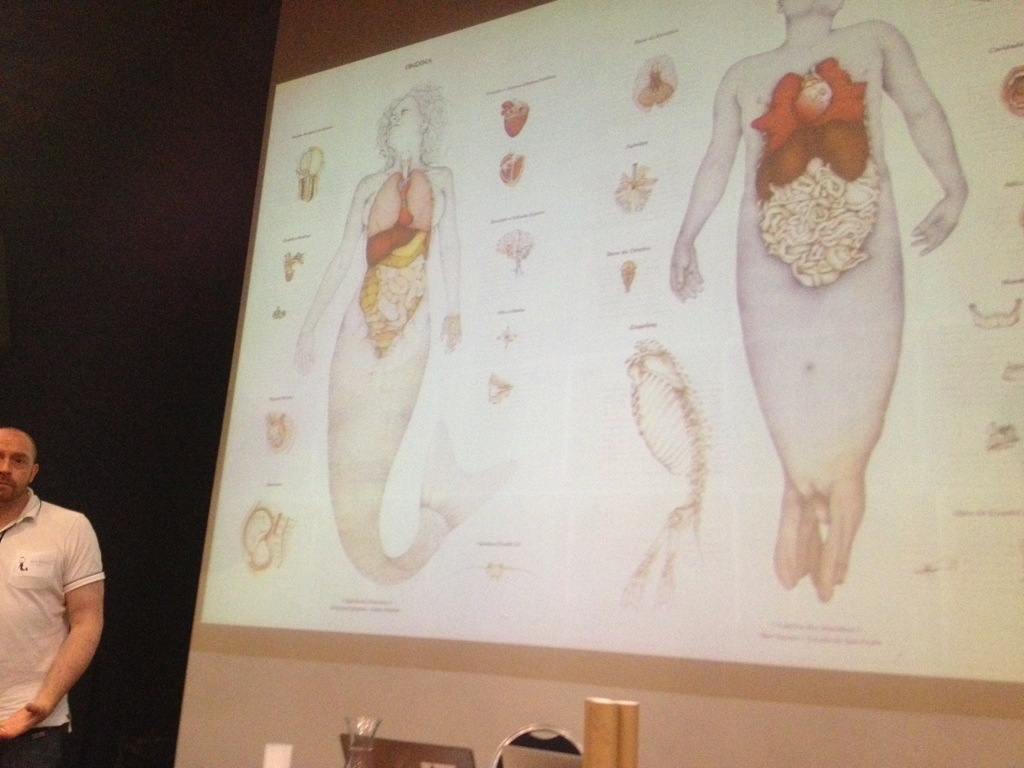
NatSCA‘s new chair Paolo Viscardi gave us the latest on mermaid specimen research: the latest news being of course that they are fabricated – often badly. Contrary to the claims of certain unscrupulous documentary makers this is all we have by way of mermaid evidence: a bunch of assorted fake specimens. There are no mystery hominid skulls with sonar adaptations or any ichnofossils of any kind to suggest that we have ever shared our planet with an ape more aquatic than a chimp.

There have been times when an animal has been thought to be a rumour/fake and then a verifiable specimen turns up. That’s the crucial factor and a vital role played by natural science collections in separating hearsay and conjecture from fact. When we talk about a new species we start with a type specimen and base comparisons of subsequent specimens against the type. With mermaids we have numerous cultural ‘eyewitness’ accounts, not all of which agree on the description. The Western image typified by films like Splash and the Little Mermaid do not describe the same animal as the Eastern description, such as the Japanese Ningyo or Gyojin – nor do they match European sailor’s eye-witness accounts which effectively resemble a manatee with a human neck and fake specimens have been made by starting with a dead manatee and working from there.

With all these fake specimens hanging about, Paolo has started sorting them into types of man-made species – a biologist’s solution to the problem of cataloging anthropological artefacts. They’re fascinating from the perspective of human history even if they aren’t a new addition to the animal kingdom.

There was way too much interesting stuff to tackle it all in a single post. Tune in later this week for part two of Tetzoocon.
20140716-171254.jpg

Uses of Natural History Collections – NatSCA2014 Meeting

20140714-084406.jpg

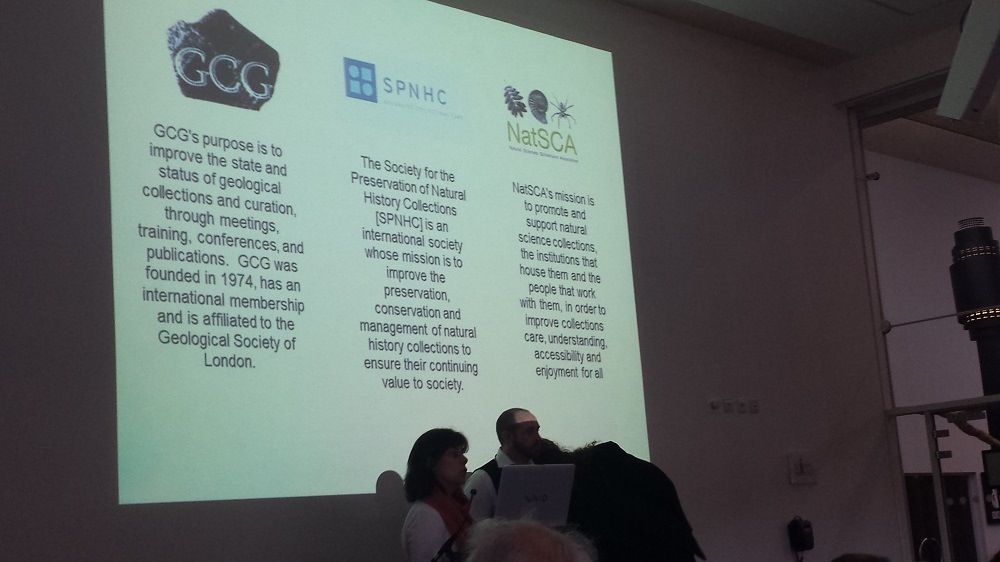
Day three of SPNHC2014 kicked off with the NatSCA conference! Clare Brown introduced the session with a brief account of the importance of NatSCA. Many non-specialist museums do not have access to staff with an understanding of science, and so NatSCA can provide support to these institutions as well as demonstrate the importance of advocating collections and the many different uses that can be made of them.

The NatSCA conference continued with a series of (strictly!) five minute presentations.

Henry McGhie, of the Manchester Museum, discussed how natural history collections are under-appreciated and underused, and how an informal partnership of museums in the North West has formed in order to aid advocacy.

Rob Huxley, Natural History Museum, London, showed that museums could be used much more by a range people, such as molecular biochemists, vets, geneticists or medical practitioners. We need to think of strategies for reaching out to many more people that could make use of the collections.

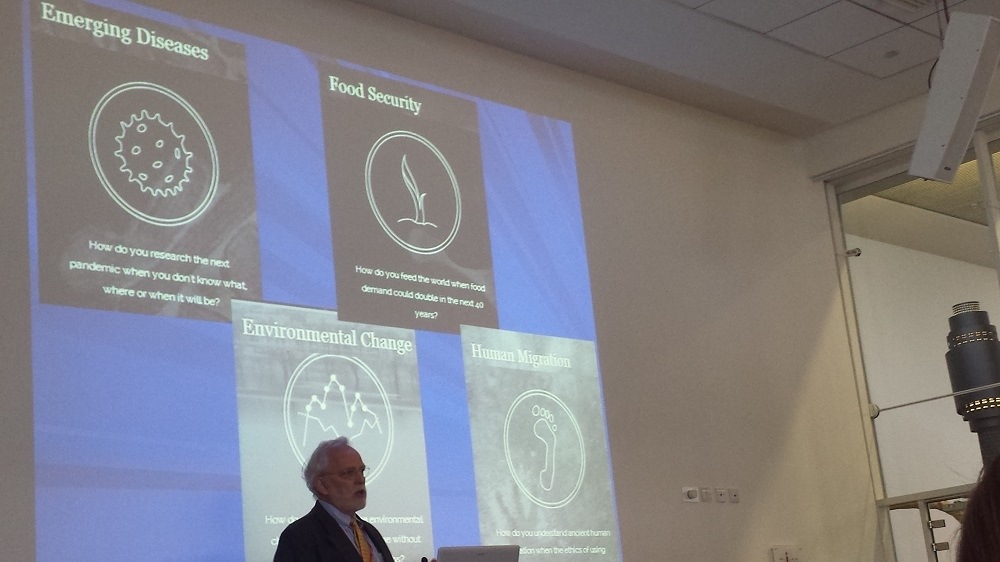
David Schnidel from the NMNH Smithsonian Institution suggested we focus on what others might want from the collections, and the new uses that could be discovered for data. Scientific collections could hold answers for research in a range of fields such as the food shortage crisis, disease research and climate change. In addition to scientific research, collections could be used for inspiration for artists, fashion designers, or even architects. With millions of objects across the UK, the opportunities for expanding the usage of our collections could be endless!

Glenn Roadley, Natural Science Curatorial Trainee

20140714-084334.jpg

Lepidoptera Project

20140711-112651.jpg

Molly and Gina work at the Oxford University Museum of Natural History on a 2 year project to re-curate the Lepidoptera collections. This involves the databasing of the entire World Moth collection in the Hope Entomology Department.

As part of our day to day routine we document drawers of moths to species level. This means we record the genus and species, the author, and how many specimens we have of each species per drawer. Another important part of our role as curatorial assistants is to repair the wings and bodies of any damaged specimens. This also involves the replacement of any old pins that are causing verdigris, which can pull a specimen apart, although we keep any pins of historic importance.

We also look for “lost” type specimens in the collection. These are types that may have been overlooked or are not immediately obvious to the casual observer. Learning to recognize handwriting is a useful skill to have when looking for types. We then check the appropriate literature to verify its type status and move the specimen to the type collections. So far we have found over 50 putative type specimens.

Type specimens aren’t the only interesting thing we find while recurating collections. Specimens collected by Charles Darwin, Alfred Russell Wallace, and Henry Walter Bates have been found in the moth collections, as well as drawings of caterpillars by Frederic Moore, 5 species of extinct moths and most recently, a butterfly from Tonga that was collected on the H.M.S. Challenger expedition in 1874.
We also are responsible for handling enquiries about the Lepidoptera collections. This includes artists, researchers, students, and interns and can be in person or via email. We have also facilitated a 6 week internship to work on the Sudanese butterfly material.

20140711-112808.jpg

Gina: At the moment I’m currently working on the family Noctuidae, which is the largest Lepidoptera family. To give you an idea of how large, I’m nearly done with this family but have documented over 30,000 specimens. My favourite aspect of this job is detective work. The handwriting on old labels attached to specimens can tell you a lot about the history of a specimen and the collector. It takes a while to learn someone’s particular style of handwriting, but once you do, it can open a world of information for you. For example, we have a lot of type specimens described by Francis Walker. By recognizing his handwriting, we know that a label marked with his hand may possibly be an overlooked type specimen. Label shape and colour can also tell you who might have handled or determined the specimen in the past. John Obadiah Westwood, the first Hope Professor of Entomology, often put blue, diamond shaped labels on specimens in his collection.

20140711-112947.jpg

Molly: Throughout the project both of us have been presented with different challenges as we are working on different families and they often require specific treatment. You can’t treat Cossidae the same as Pyralidae. Due to the size difference, although the basic requirements are the same, Cossids tend to be more robust.

I am currently working on Pyralidae and I’ve heard numerous anti-moth comments: “Didn’t realise you were such a fan of the 70’s”, “Oh look, more beige moths!” There are many more comments, including the popular reference to a drawer of Lepidoptera as “flying stamps.” Phooey. Moths and butterflies draw people in, they are family friendly and are often the first port of call for amateur naturalists. The Lepidoptera Project has over 700 followers on twitter. That works out at just over 100 new followers a month. Moths might be beige, but they sure are popular.
You can follow us Twitter: @hopeulikemoths

Digitisation

20140709-083416.jpg

Today we have Lukas Large, curatorial trainee with the Birmingham Museums Trust, on digitisation:

The theme of this year’s SPNHC2014 meeting was ‘Historic Collections: Future Resources’. Digitisation was featured as one of the main topics as this is an important way that collections are being made accessible to researchers and new audiences.

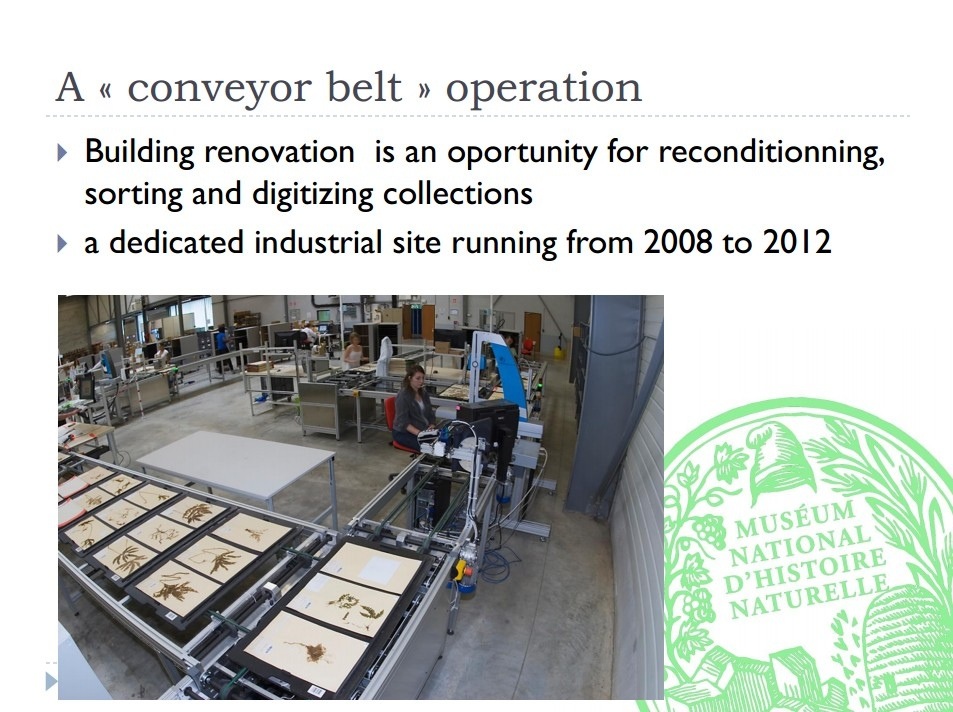
The talks described a wide variety of digitisation projects from the enormous Paris Herbarium which ran for 4 years and created images of 5.3 million specimens to Arkansas State Herbarium with 18,000. Many of the projects involved herbarium sheets as these are relatively easy to image but an amazing variety of objects have been digitised including fossils at GB3D Type Fossils, insects and even historic slide collections.

20140709-083443.jpg

Extracting the information from specimen labels is an important but potentially expensive and time consuming process so many museums have started to use crowd sourcing to perform tasks such as transcribing specimen labels. Laurence Livermore discussed several successful examples such as Herbaria@home which has been running since 2007 and has a dedicated team of digital volunteers who have contribute 135,000 transcriptions.

These new uses of collections show just how important it is that these objects are properly cared for. Without the museum staff that have looked after these objects, we would not have them to digitise. Without ongoing care, researchers will not be able to study them in the future.

Slides from the talks are available on the iDigBio website as well as detailed descriptions of the protocols and tools used by different projects which are extremely useful for anyone planning their own digitisation project.

20140709-083500.jpg

Data-less Natural Science Specimens are Useless to Science. Aren’t they?

Here we have Clare Brown, of the Leeds Museum, telling us about some devilishly exciting research:

Tasmanian Devil specimens in UK museums, with no data whatsoever, have been used in cutting edge research on devil facial tumour disease as part of the effort to save these incredible animals.
Data – when and where a specimen was collected – is vital to the usefulness of natural science collections. It is crucial for so many aspects of research that these collections are commonly used for: climate change work; biodiversity research; distribution mapping etc.
Specimens without data are usually much more problematic. At Leeds we have thousands of objects that don’t have any record of where they came from or when they were collected. The information has either been lost or never noted down in the first place. Even our scrappiest, most moth-eaten bits of taxidermy are elevated above the rest of the collection if they have associated data.
I was therefore delighted when Jeremy Austin at the University of Adelaide asked whether we had any Tasmanian Devil Sarcophilus harrisii material collected in the last 200 years. Crucially, he didn’t need an exact date or location – just a two century timespan. We’d been collecting since 1821.
Leeds, a large, rich, Victorian industrial city, spent most of the 19th century collecting scientific material from around the world. We had a ‘purveyor of Australian wildlife’ and acquired, amongst other things, two Devil mounts and a skeleton. The specimens were duly sampled and sent to Australia.

20140707-083844.jpg

The study, also using specimens from Oxford, looked at genetic diversity in a group of molecules in cell membrane proteins called the ‘major histocompatibility complex’. Low diversity in this complex has been linked to the emergence and spread of devil facial tumour disease. The team needed samples of historical and ancient Devil DNA to see how diverse the populations were before European settlement and after. The article, published in Biology Letters, can be read here.

This is a great example of how natural science specimens, whatever their ‘data status’, can contribute to scientific research at the forefront of species conservation.