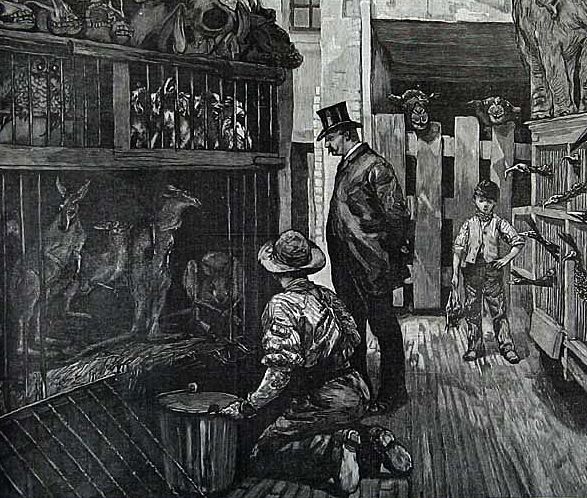
Charles Jamrach: Exotic Animal Collector

Charles-Jamrach-Shop

The week before last saw historian Elle Larsson speaking at PubSci. The talk centred around the exotic animal trade and, in particular, the life of Charles Jamrach: a trader of animal specimens – both living and dead.

Charles’ father was an entrepreneur from Hamburg who noticed that sailors were bringing back exotic animals in the hull of their ships and selling them. There was such huge interest in these peculiar beasts that sailors were able to retire from the profits. Jamrach Senior wanted a cut of the action. It soon became apparent that London was the hub of the exotic animal trade and Charles moved to London in 1840 to set up his business after the death of his father.

Charles began forming a network of contacts and runners between Liverpool, Marseilles, and Bordeaux. He was soon able to boast that he could get ‘any animal except a Koala’. The relationship between Koalas and gum trees had not been fully realised at this point and three unsuccessful attempts to secure one had resulted in failure. Jamrach was forced to concede this one shortcoming. Jamrach was buying between a shilling and five pounds, depending on the specimen. With the middle men involved it was no longer possible for a sailor to make his fortune selling exotic animals as the profit was split among too many people. Even Jamrach sometimes had to take a lower asking price for one of his animals than he had originally paid for it: He was certainly not guaranteed a better price later and the cost of keeping the animal in sellable condition was not cheap.

He sold living specimens to zoos and private collectors, dead specimens to museums. Whatever these groups turned down, the taxidermists picked up. In late Victorian London there was a fashion for furniture made from animal parts. People would choose an animal (often still alive) that they wanted turned into cutlery, a chair, or piano and the poor beast would be sent to the taxidermist for production. It is hard to imagine such a situation today, though the culinary world still has a “choose live product” remnant of these bygone days.

There’s one area in which Charles Jamrach reminds me of Archcancellor Ridcully, from Terry Pratchett’s Discworld – in the sense that they both did their bit for endangered species… by keeping them that way: in 1851 Jamrach acquired a quagga for the Zoological gardens. In 1883 the quagga was declared extinct in the wild.

The interest in unusual wildlife had a political motive in many cases: a zoo of the British Empire showcasing species from elsewhere was not just introducing the public to animals they had never heard of, it was showing the dominion that man had over the animal and the empire had over the animals’ home land. On one occasion a bengal tiger managed to back out of a poorly made transport crate and run off down the road – grabbing hold of a young boy. Jamrach managed to subdue the tiger with his truncheon but the boy’s parents still, understandably, sued. Jamrach was now famous: not only was he bringing back animals that represented empiric might, he now personally symbolised Britain beating down the tiger, symbol of rebellion against it.

Not everyone was a fan of Jamrach: awareness of animal welfare was in its infancy but this was the generation that saw it develop – the RSPCA was formed during the late Victorian era during Jamrach’s lifetime and he received a good deal of complaints abou the way his animals were treated. Complaints about Jamrach centred around the cramped transport conditions, stressed overcrowding of predators near their prey, and the malnourished states they reached London in. This was a time when the accepted wisdom for “reforming” a vicious and malnourished crocodile was to tie it down and force feed it. It is unclear whether Jamrach participated in this but he escaped criticism by dying in 1891 – the year that the practice was challenged. He left a vast sum of £7108 inheritance to his son: the equivalent of half a million pounds in today’s money.

To learn more about Elle Larsson’s research, visit the animal history museum – an online exhibition about the trade.

100 Years Aboard the Ark…

By Dr. Ebony Andrews
Calderdale Museums

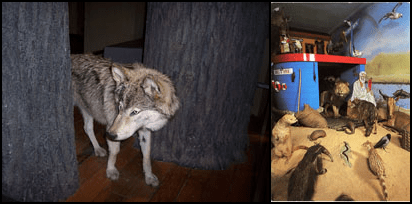
Left: An 'escapee' taxidermied grey wolf on the fringe of the 'Living Planet' gallery, Great North Museum: Hancock (2010). © Image by the author; Right: 'Abel's Ark', Hancock Museum (c.2004). © Archives of the Natural History Society of Northumbria, Great North Museum: Hancock.

Left: An ‘escapee’ taxidermied grey wolf on the fringe of the ‘Living Planet’ gallery, Great North Museum: Hancock (2010). © Image by the author; Right: ‘Abel’s Ark’, Hancock Museum (c.2004). © Archives of the Natural History Society of Northumbria, Great North Museum: Hancock.

For the past four years I have been researching changes in the use, display and interpretation of taxidermy in three regional museums in the North of England. These museums are: Leeds City Museum, Museums Sheffield: Weston Park (more commonly known as ‘Weston Park Museum’), and the Great North Museum: Hancock, Newcastle, (previously the Hancock Museum). The culmination of this research is the completion of my PhD thesis, entitled: Interpreting Nature: Shifts in the Presentation and Display of Taxidermy in Contemporary Museums in Northern England (2013).

In the study, I mapped out some of the wider trends in changes to the display and interpretation of museum taxidermy spanning roughly the last century across all three of the case study museums, but with a particular emphasis on the more recent display histories (from 1950-2013).One of the primary aims of my research was to challenge the idea that the unpopularity of museum taxidermy displays at different points in history, but particularly following the rise of the conservation movement in the UK, was exclusively related to the ‘controversial’ materials of taxidermy’s construction (ie. the use of animal derivatives). Rather, I proposed that much of the perceived ‘problem’ with taxidermy, both public and institutional in the latter part of the twentieth century, could be attributed not only to what was being presented, but also to a significant degree, to how it was being presented. In other words, how and through what mechanisms, public museums were interpreting their taxidermy collections for their public audiences.

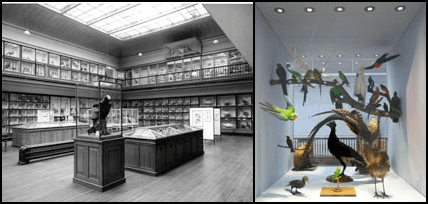
Left: The 'Bird Room', Hancock Museum (c.1966) © Archives of the Natural History Society of Northumbria, Great North Museum: Hancock; Right: 'Bio-Wall' display (detail) featuring 'Sparkie' the budgerigar (centre bottom), from 'Living Planet', Great North Museum: Hancock (2011). © Image by the author.

Left: The ‘Bird Room’, Hancock Museum (c.1966) © Archives of the Natural History Society of Northumbria, Great North Museum: Hancock; Right: ‘Bio-Wall’ display (detail) featuring ‘Sparkie’ the budgerigar (centre bottom), from ‘Living Planet’, Great North Museum: Hancock (2011). © Image by the author.

In a period where museum taxidermy is once again being afforded a considerable amount of attention, my research investigates some of questions that are now being asked about recent shifts in the use of taxidermy in museums along with some of the issues now facing museums in regard to the presentation of historical collections. My thesis is available through White Rose eTheses Online, see: http://etheses.whiterose.ac.uk/6637/ or simply go to http://etheses.whiterose.ac.uk/ and search the database by author or publication title to gain access to the complete document. Access to this resource is free, and you are not required to register your details to use it. With full colour illustrations and an extensive bibliography, I hope my thesis may be of use to those interested in the history of the display and interpretation of taxidermy, the impact of shifting cultural and ethical positions on the popularity of taxidermy, and the fascinating politics of both past and present approaches to the display of taxidermy in regional museums.

Accessing Staffordshire Lepidoptera

by Don Steward, Curator (Natural History),

The Potteries Museum & Art Gallery, City Centre, Hanley, Stoke-on-Trent ST1 3DW

email: don.steward@stoke.gov.uk

In 2013 the Potteries Museum & Art Gallery, Stoke-on-Trent Museums (PMAG) were awarded an Arts Council England PRISM Fund grant for the purchase of 4 dedicated insect storage units containing a total of 80 glass-topped entomological drawers to provide conservation quality enclosures for a collection of moths and butterflies, part of Designated Natural History collections held at PMAG. The cabinets and drawers were purchased from Preservation Equipment Ltd.

The 4 insect cabinets installed in biology store

The 4 insect cabinets installed in biology store.

Work has started on the long-term task of transferring a collection of c.8000 specimens amassed by the former Staffordshire Lepidoptera Recorder, Richard G. Warren. It is an amazing resource waiting to be utilized. Over a period of 40 years up until the late 1990s Warren collected specimens locally in this County that is pivotal in the north / south distribution of species. The data associated with these specimens is significant in plotting the distribution of Lepidoptera nationally.

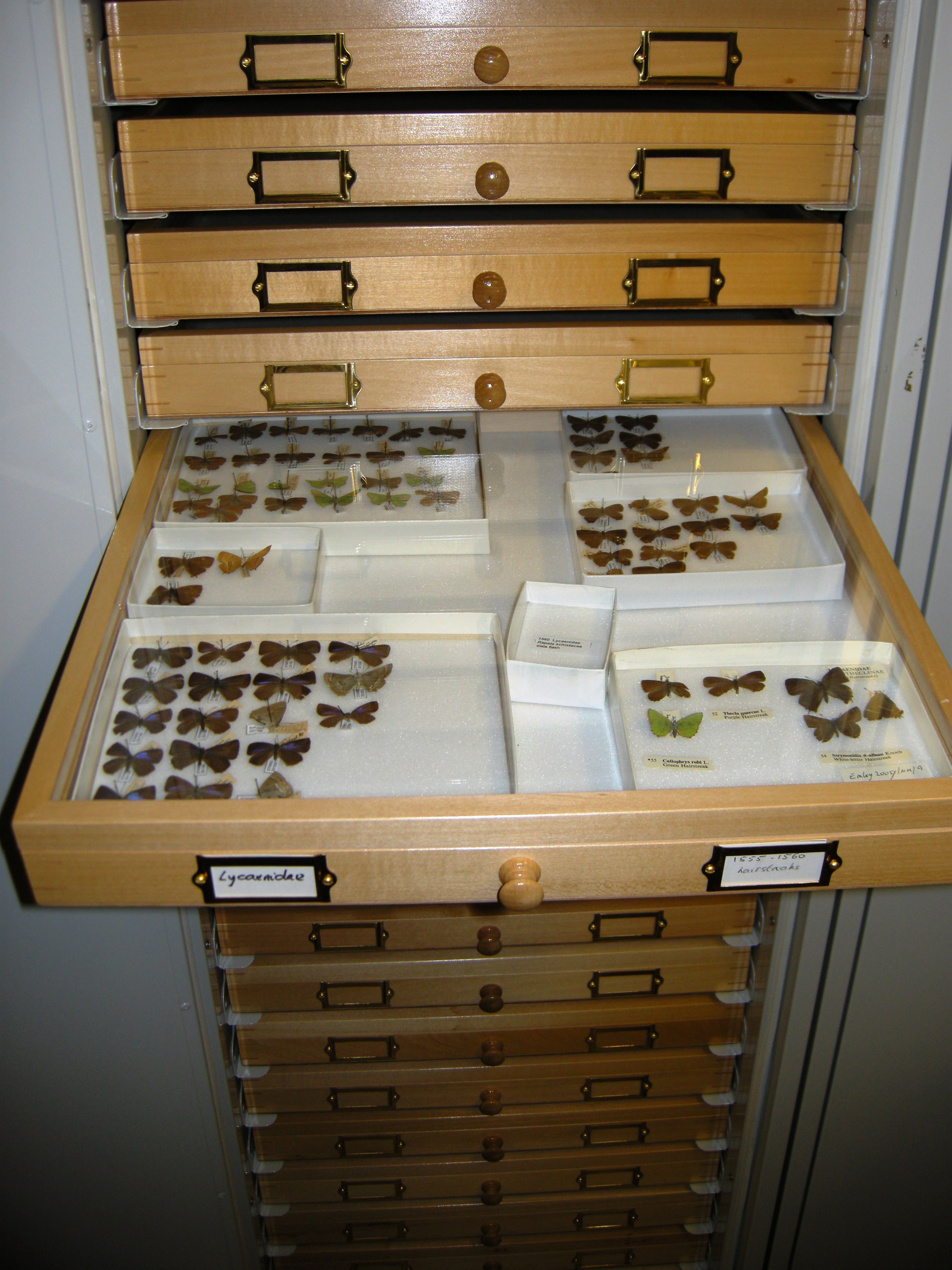
Using volunteer and core staff, the Warren collection is now being systematically moved into the new cabinets and drawers that are housed in the dedicated and environmentally controlled biology store within PMAG. The ultimate aim is for each species to be in individual Plastazote-lined card trays within the drawers. They are arranged according the Bradley & Fletcher 1986 indexed list of British butterflies and moths. Already work experience and volunteer students from the Staffordshire University MSc. course in Ecology and Conservation are involved in collection cataloguing and management to extend their taxonomic knowledge.

Lycaenidae being arranged in the new drawers.

Lycaenidae being arranged in the new drawers.

The new storage will facilitate the long term preservation of the specimens, allow access to specimens and the data associated with them. It will standardise access and we hope to continue this approach to other collections in the future to eliminate a backlog of collections held in user unfriendly hinged wooden storage boxes.

Data associated with specimens is being recorded electronically for the first time. This information will be batched in suitable units and sent to the Staffordshire Ecological Record which records and publishes species data in map form to a dedicated website and passes the data onwards to the National Biodiversity Network (NBN).

Mark Ashby, Joanne O'Keeffe and Lindsay Selmes, Staffordshire University MSc student volunteers sorting lepidoptera.

Mark Ashby, Joanne O’Keeffe and Lindsay Selmes, Staffordshire University MSc student volunteers sorting lepidoptera.

And the Winner is…

Well, there were two fantastic projects that we wanted to give the NatSCA Bill Pettit Memorial Award to this year. Here are the details:

Saving the World’s Rarest Skeleton

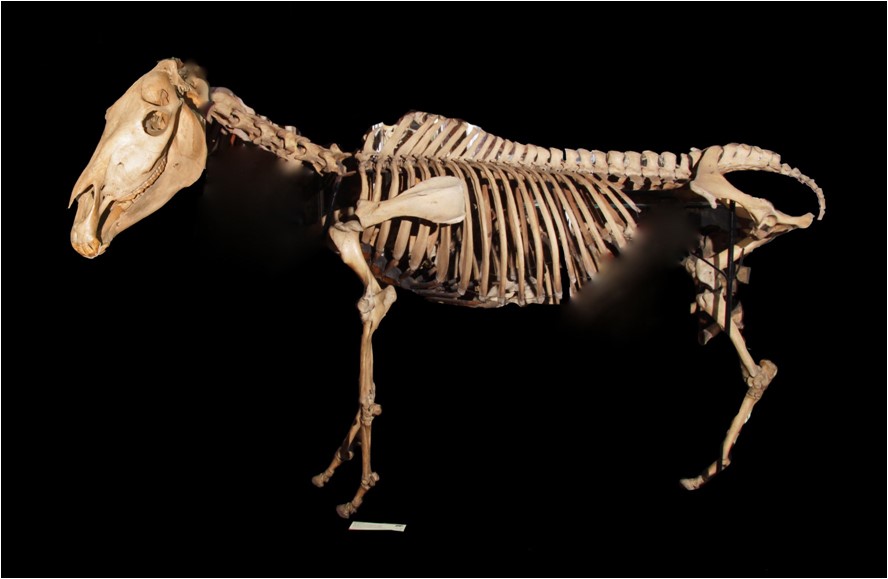
The specimen of the quagga at the Grant Museum.

The specimen of the quagga at the Grant Museum.

In 2014-15 the Grant Museum will undertake a major project in remedial conservation to disarticulate, clean and remount its skeleton of the extinct quagga. It is the only articulated quagga in the UK, and can be considered the rarest skeleton in the world. The work is intended to secure the long-term preservation of the specimen – that no subsequent work would be necessary in the future.

The quagga would be the focus – and most involved element – of a major project of conservation of 39 large specimens, many of which have been on open display for over a century without any treatment. Interventions will range from cleaning (in the majority of cases) to remounting (quagga and dugong).

As much of the conservation as possible will be performed in the public eye in the gallery, shedding light on a crucial element of museum work which gets little public attention.

Curation of Discovery deep-sea samples at the National Oceanography Centre, Southampton

The Discovery Collections are an internationally important historical collection of deep-sea marine invertebrate and fish specimens. The first samples were collected in the Southern Ocean by RRS Discovery, the ship used by Captain Robert Falcon Scott for his first Antarctic expedition in 1901. The collections are closed to the public, yet specimens are displayed and used at a variety of public engagement events (e.g. festivals, open days, school visits) by a wide spectrum of people.

This application is to support the engagement of a temporary staff member to assist in the curation and cataloguing of three large collections of deep-sea samples held in the Discovery Collections. These are the result of three major research programs: the Crozet Island collection (a 42-day cruise in 2006 on the RRS Discovery), the ECOMAR collection (a 4-year project studying the fauna of the Mid-Atlantic Ridge) and the Arabian Sea Collections (5 month-long research cruises 2002-2003). The samples are in urgent need of care and attention to ensure their future use by the scientific community.

The Bill Pettit Memorial Award

A big congratulations to the winners. If you would like to know more about the Bill Pettit Memorial Award, you can find out on our Awards and Bursaries page or read more about previous year’s winners here.

State of the Union! Natural History Museums 2014

Author Mark Carnall, Curator, Grant Museum of Zoology, UCL
#NatureData Coordinating Committee
All views are the opinion of the author. August 2014.

‘After visiting the recent natural history museum community conference in July: SPNCH 2014, Cardiff, Mark Carnall reflects on what the sector internationally is thinking and doing – in particular what’s happening digitally and what people’s thoughts are on a UK natural science database’.

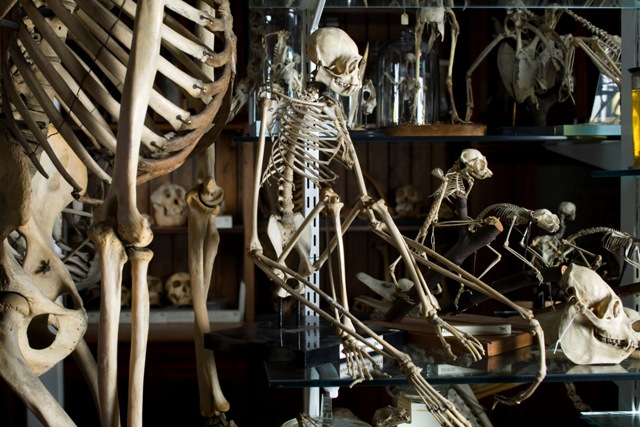
Primate skeletons in the Grant Museum of Zoology, UCL ©UCL, Grant Museum of Zoology and Matt Clayton

Primate skeletons in the Grant Museum of Zoology, UCL ©UCL, Grant Museum of Zoology and Matt Clayton

At the end of June was a rather special event; the coming together of three subject specialist networks (SSN), the Society for the Preservation of Natural History Collections (SPNHC), the Natural Sciences Collections Association (NatSCA) and the Geological Curators’ Group (GCG) hosted by Amgueddfa Cymru National Museum Wales. Between them, these three networks represent a sizeable chunk of curators, conservators, directors and educators who work in and with natural history museums and collections. Each SSN has yearly meetings but a syzygy rarely happens.

The full conference was a six day affair packed with field trips, stores tours, talks, workshops, demos, poster sessions and discussions attended by over 250 delegates from almost as many natural history institutions. This provided a great opportunity to catch up and meet friends, facilitated the catharsis in sharing frustrations unique to natural history museums and offered a rare chance to establish a sense of ‘the state of the union’ in natural history museums across Europe, North America and elsewhere.


The broad theme of the conference was historic collections and future resources and many of the presentations were about off-label uses of collections, advocacy and digitisation. Inspiringly, the conference was kicked off with a series of keynotes which carried the resounding message of “get over it” when it comes to the communities’ existential crisis in demonstrating value and worth with a rousing series of presentations from Professor Paul Smith and Dr Chris Norris setting the tone for the rest of the conference.

Off-label use of collections, a term borrowed from accidental discoveries of secondary beneficial side effects in the pharmaceutical industry, came up time and time again. Cynically, as the curator of a small museum it’s nice to finally be joined by colleagues from some bigger museums who, without having to face the “use it or lose it” challenge to keep a museum in existence, have cottoned on to the notion that perhaps collections have uses beyond the 10% of material that has a function in alpha taxonomy and (often low impact) taxonomic research. Colleagues presented example after example of natural history collections being used for research into environmental change. One question that wasn’t satisfactorily answered was about how this use of collections can be procedurally built into research. Many of the examples were incidental discoveries (hence off-label) rather than arising from researchers deliberately thinking of uses of collections in the first instance. However, advocates for the importance of natural history collections now have a new suite of examples to convince decision and policy makers about unique insights into the natural world which can only be gleaned from scrutinising collections.

When it came to advocacy, unfortunately the community fell into the trap of talking about scientific research use of collections almost to the exclusion of all other audiences. I’ve written before about how natural history museums need to celebrate and contribute more to being a part of the cultural sector, especially for museums which don’t hold scientifically important collections and specimens. Myopia aside, the community seems to have come on to some degree, telling each other how important natural history collections are, which came out in a panel discussion on advocacy. There are still a lot of stereotypes about what museums are and what they do that need to be pulled down, but there’s a danger in evangelising which can be quite divisive. Another general theme that came out across the series of talk days is that we need to get more sophisticated and generally get better at demonstrating what we do well. The finding of the NatSCA and Arts Council England study into the popularity of different kinds of museum galleries was presented, demonstrating that natural history collections are the most popular, but put some audiences off if they don’t appear to be well maintained or invested in. Natural History Near You was also presented, finally making headway into ascertaining exactly where all the natural history collections are, a fundamental piece of information that has eluded several generations of natural history collections workers. Interestingly, one of the contrasts between the UK delegates and those from the rest of Europe and North America was that with a handful of exceptions, the majority of the social media generated around the conference came from UK colleagues. It seems that social media is yet to take off as a promotional, professional networking and advocacy tool for museum professionals elsewhere.

Lastly, there was a cornucopia of presentations on digitising collections. It’s uncontroversial to say that museums in general are far from being digital – let alone post digital – and that natural history museums and collections as a group are lagging behind the rest of the museum sector. It seems that colleagues in North America and from the rest of Europe are making huge advances in all aspects of digitisation from technical advances, standards in digitisation, data capturing pipelines and networks, and databases linking specimen information. Embarrassingly, UK museums are somewhat left in the dust, contributing little to the 20 or so European and International data repositories and the data that does exist is incomplete, hard to export, manipulate or in many cases even locate – let alone scrutinise. This is in part what the #naturedata project hopes to solve, with “one portal to rule them all” in the UK at least. The need for this is even more pressing thanks to worryingly vague requirements for databases required for compliance with the Nagoya Protocol on Access and Benefit-sharing. Three conference sessions on the Nagoya Protocol valiantly tried to deconstruct the bureaucratic layers represented by this legislation but it looks like the practicalities of compliance will be causing headaches for generations of museum professionals yet.

Overall, the conference was an excellent set of days. Networking and socialising with enthusiastic, passionate and brilliant colleagues really is the best way to recharge the batteries and reinvigorate the soul. Throughout the presentations the niggling thought I kept returning to was that all the innovative, experimental and inspiring ways we use to get the most of our collections are still hamstrung by our fundamental issue of getting a handle on what we have in our collections. The curse and gift of natural history collections is their vast size, but it’s no longer good enough to use the size of our collections as an excuse for not getting to grips with every single specimen we have and making them available to the people for whom we keep them in trust.