Museum Selfie Day

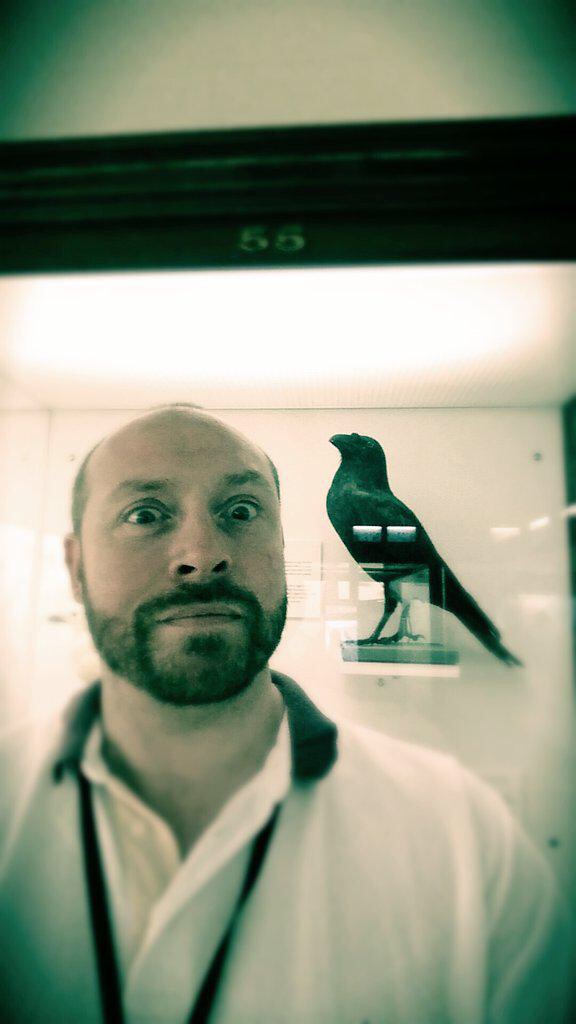
Our Chair looking Poe-faced with a Raven

Our Chair looking Poe-faced with a Raven

I freely admit that I have mixed feelings about this cultural event: I don’t take many pictures of myself except when there’s a bird perched on me. I don’t like photographs of people when they know there’s a camera on them. I do like museums though and it’s a great way to discover new ones. It’s also a great way to ensure museum visitors because you can’t take a photograph of yourself with a museum specimen unless you’re at the museum with the specimen (or very good at Photoshop but shhh – visiting a museum is quicker anyway). Since the golden years of polaroids and film rolls people have been going abroad and taken photographs of themselves at places. Who hasn’t sat through a relative’s slideshow as they talk you through their highlights: “that’s me by the Taj Mahal”; “that’s me holding a ‘Peshwari Naan'”; “That’s me in the corner”; and so on? Clearly validating that we were there fulfills some basic need in us and why shouldn’t that need be satisfied in a museum with all its fascinating specimens that a person could be “also there” with?

As long as selfies are done with respect for the irreplaceable objects you are posing with, there is no harm in it. Unfortunately that’s not always the case with some people. Remember that people will want to have their photograph taken with that awesome fossil in 100 years time and you can do your part to make sure that’s possible by being very careful.

Have a great day in the museum everyone.

Derby Museums Need You

Thanks to Jonathan Wallis for bringing this to our attention.

In 2015 Derby City Council will be cutting funding for Derby Museums by 26%. Would that it were an isolated incident for Derby, or indeed the country at large. This is not the first time that the plight of the East Midlands has been brought to NatSCA’s attention, nor the first time they’ve been discussed by the members.

There is much that needs to be done but something we can all do is sign the no Cuts to Derby Museums petition.

The financial value of museum objects

In the museum sector there’s a bit of unwillingness to discuss the financial value of objects. After all, museums are not run as salerooms and their focus is on the other sorts of value that collections hold.

Of course, for some artworks it can be hard to ignore the massive price tags that they sometimes carry and there are some good arguments that in our materialistic society, which has become increasingly focussed on economics, there are sound reasons for including financial value in considerations about collections. An interesting discussion about this between two NatSCA stalwarts, Jan Freedman and Mark Carnall, was recently published by the Museums Association.

Worth £175 million today. Card Players (5th version ca.1894-1895) by Paul Cezanne is the most expensive painting in the world. For now... (image from Musée d'Orsay)

Worth £175 million today. Card Players (5th version ca.1894-1895) by Paul Cezanne is the most expensive painting in the world. For now… (image from Musée d’Orsay)

For those of us who work in museums, we normally only consider a specimen’s price-tag when acquiring new material, deaccessioning material or dealing with insurance valuations for exhibitions and loans.

When acquiring specimens, the consideration is about whether an asking price is fair and an appropriate amount to spend in the context of institutional priorities and budget. When deaccessioning, the consideration is rather more complex and is linked to appropriate methods of disposal and the motivations for disposal. Deaccessioning shouldn’t be done in order to make money, but disposal by sale may be an option as long as the processes involved in the decision meet professional standards.

The controversial disposal by sale of the statue of Sekhemka has caused problems for Northampton Museum & Art Gallery. (Image of the statue on display c.1950s - uploaded by Bibilovski, 2012)

The controversial disposal by sale of the statue of Sekhemka has caused problems for Northampton Museum & Art Gallery. (Image of the statue on display c.1950s – uploaded by Bibilovski, 2012)

When assessing these sorts of values it can be very useful to look to private auctions for a guide, which take place every so often at a variety of auction houses. For natural history it can be worth checking Sotheby’sBonhams and Summers Place. However, auctions tend to deal with the more showy objects, rather than the scientific specimens that museum staff often have to deal with, especially for research loans.

Insurance valuations are slightly different, since these may not simply relate to the market value of an object, but could take into consideration the cost of conservation if the object is damaged, or the cost of going into the field to collect a similar specimen to replace it if it’s the sort of specimen that doesn’t come up for sale. Either of these possibilities may be far more expensive than a likely sale value.

One of the issues with putting a price on objects is that it may make them more obviously attractive to criminals. For instance, a sudden spike in the street value of illegal rhino horn in parts of Asia around 2009 led to a massive increase in the prices of antique rhino trophies at auction, until special measures were introduced to stop this loophole in trade. In addition it has led to the targeted thefts of hundreds of specimens from collections around the world.

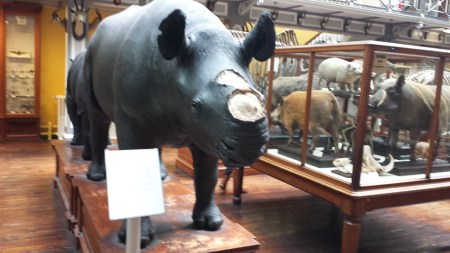
Taxidermy rhino with the horn removed and sign explaining the problem of thefts from museum specimens. (Image by Dr John Hutchinson, 2013)

Taxidermy rhino with the horn removed and sign explaining the problem of thefts from museum specimens. (Image by Dr John Hutchinson, 2013)

Of course, by being aware of the changing value of specimens and therefore the changing risk of theft, museums are able to take steps to ensure that appropriate security measures are put in place to properly care for their objects. So although the financial value of objects can be complex to address, it is clear that there is a need for museums to know how much their collections are worth, since other people may be only too aware.

The Perils of Potholing – Get Well Soon Julian Carter

Star organiser of this year’s SPNHC/NatSCA/GCG Conference Julian Carter has written a very detailed account of his recent accident while potholing in the Aven de Hures. It’s compelling and hard to read without wincing. Get well soon Julian – we all wish you a speedy recovery and are delighted to hear that you are on the mend:

The Fall
I lie confused, disorientated. The mind is furiously trying to figure out where I am, how did I get here? Involuntary groans leave my body from the shock, pain and confusion racking me…

Gradually the thinking clears and I’m looking up. I see the outline of the 40m deep shaft I’ve just fallen down. A large gaping sphere of blackness in the middle of the light coming off my helmet light which is lying just behind my head somewhere.

Amongst the first coherent thoughts are ‘I survived falling down that!?’. The next is the sudden awareness I’m at the edge of the rift that is the next pitch. Quickly my bloodied hands find the pitch rope and clip it into my chest ascender.

Read more…

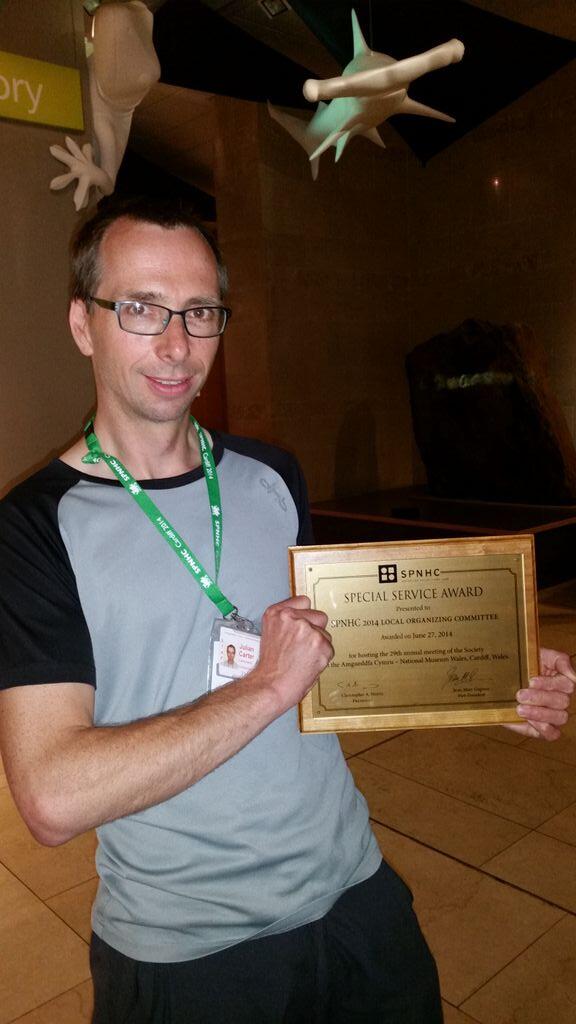
Jules receiving the Special Service Award at SPNHC2014

Jules receiving the Special Service Award at SPNHC2014

An Interview with the Next Generation

Last week we covered the history of Charles Jamrach: a Victorian animal trader who, though his methods would be considered questionable today, was nevertheless the source of many museum and zoo specimens in his day.

Today I’d like to talk about the future – specifically the fresh lay-enthusiasts who could one day be museum professionals. At the RSPB Conference last week, Nick Clegg said that “Many young people now know more about playing Angry Birds on their phone than they do about spotting real birds when they’re outside”. That may well be true but there is hope for the next generation, with lots of up and coming young naturalists.

I caught up with two of them to ask them about their passion for natural history: Melanie and Sam.
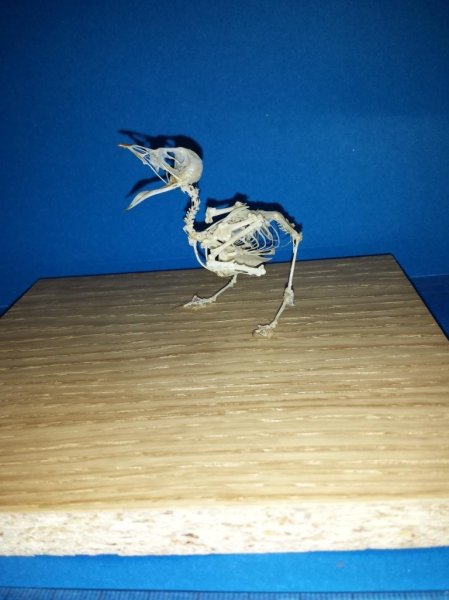
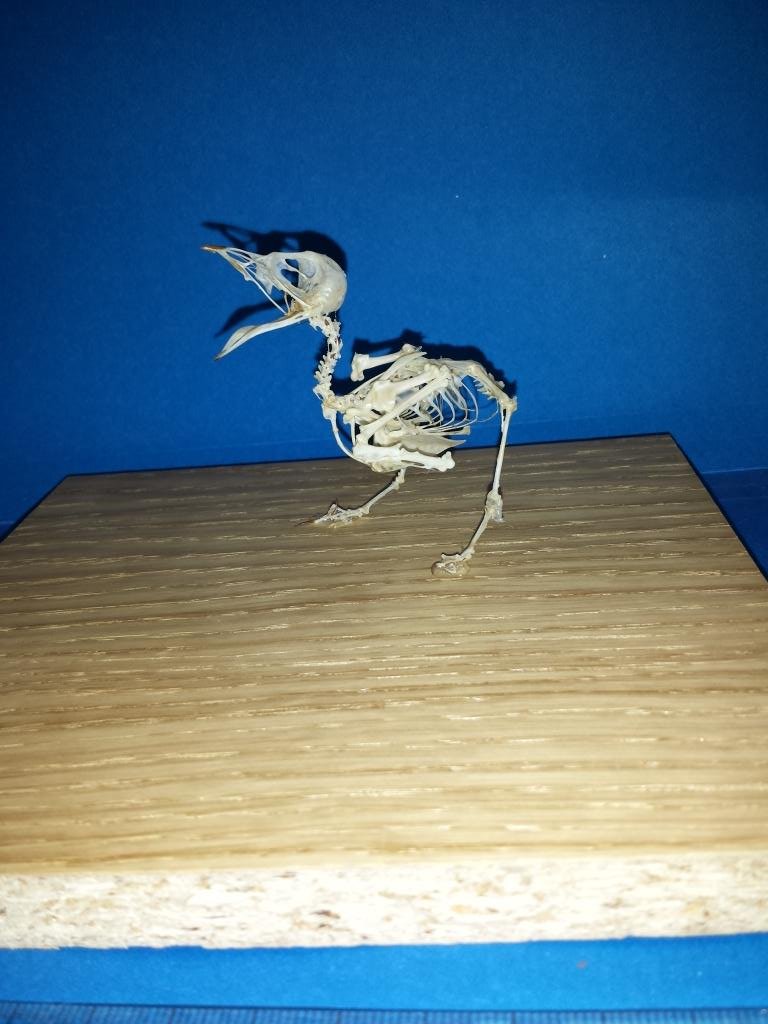
Sam's mounted swallow

Sam’s mounted swallow

1. What first got you interested in natural history collection?

Melanie:

“The thing that first really got me interested in natural history collecting was seeing Ben Garrod‘s series Secrets of Bones on tv. I was still a little bit freaked out by bones and skulls before seeing this series. This made me see bones as interesting. I have always had a massive love for animals and wildlife, so this helps me to see them from a new angle.”

Sam:

“Well when ever i see an animal i wonder how i can learn more about it, sure you can look online and in books but nothings works as well as … Looking at whats behind its beauty skills and adaptation, the bones and the feathers.”

2. How big is your collection today?

Melanie:

“My collection total stands at 70, but I am continuing to find new specimens constantly. This includes: Great Bustard, buzzard, owls, polecat, mink, African striped weasel and African pygmy hedgehog.”

Sam:

“My collection at the moment consists of 45-47 skulls, 1-5 hundred feathers and all sorts. It’s still growing.”

3. What is the specimen that you are most pleased with and why?

Melanie:

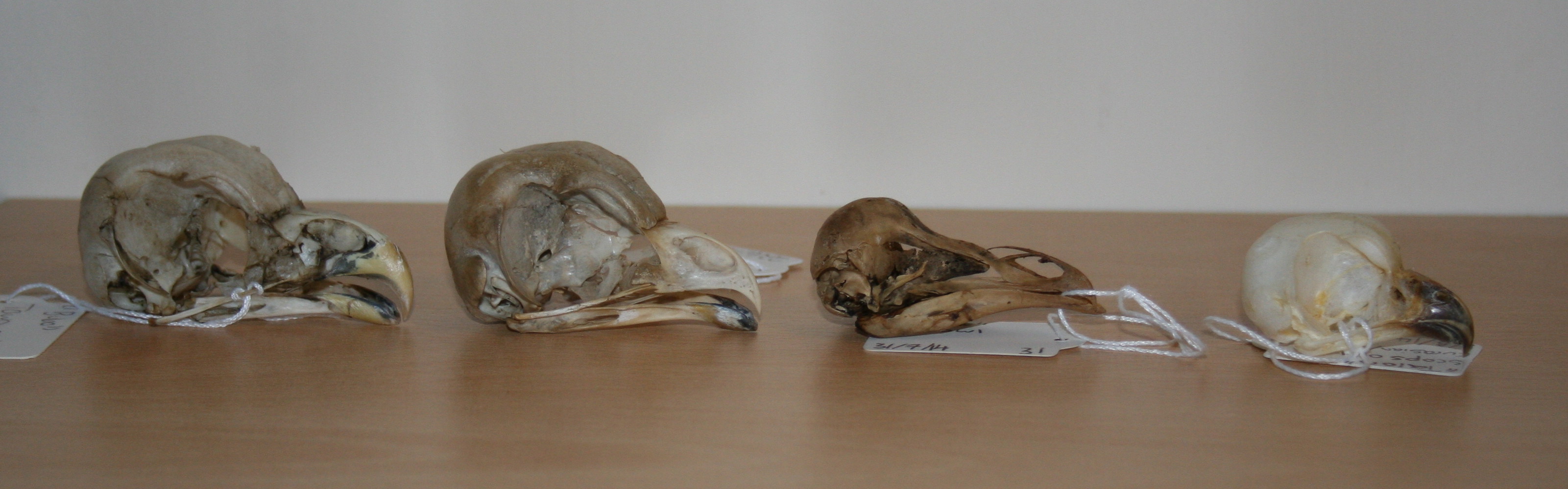
“I don’t really have a single specimen to answer this question. But I have a collection of 4 owls inside (2x tawny, 1x barn, and 1x Eurasian scops) and they are by far my favourites. I also have a third tawny owl rotting at the moment. Owl skulls are especially interesting to me as I love owls when they are alive!”

Sam

“My favourite and most amazing cleaned specimen is my swallow skeleton. I’m incredibly pleased with it as i articulated it myself and the skull is very interesting in the way it is shaped.”

4. What are the top 3 on your wish list?

Melanie:

“The top three specimens on my wish list are all owls: a snowy, great grey, and an eagle owl; but any skulls are always welcome in my collection.”

Sam

“My top 3 specimens on my most wanted list would be a puffin, a green woodpecker, and a seal.”

5. What has been the best advice that you have been given so far?

Melanie:

“The best advice I have been given so far was from Jake McGowan Lowe, he has helped me loads with my collection, from a good way of documenting it, cleaning advice, identifying and even the legal side of things!”

Sam

“I think the best advice anyone has ever given me is to simply just ignore when people say that it’s morbid to collect dead animals”
Melanie's owl skulls.

Melanie’s owl skulls.

6. How do you document your specimens?

Melanie:

“I document my specimens by giving each of them a tag with their name, English specie name, date they came into my collection, ID number and who found it. Each specimen then has half of a A4 sheet of paper with all of its details on it. Occasionally if its a rare skull it has a full A4 page of information linked to it by its ID number.”

Sam

“I keep a record of all my skulls hand written in my notebook and digitally on a record list and a picture profile.”

7. Has a student or scientist wanted to study one of your specimens as part of their research?

Melanie:

“No-one has yet wanted to study one of my specimens for research. I wouldn’t mind them coming and handling my specimens at all and would find it a complement if they wanted to know more about something in my collection. I would be careful about who takes them though: they are my pride and joy after all!”

Sam

“If someone wanted to study one of my specimens i would be happy for them to study them and not only that but i would be honoured.”

8. Do you see this as a hobby or would you like to get a natural history-related job someday?

Melanie:

“I see it as a hobby but I also would love to become a zoologist or osteologist one day! So being able to have a collection of my own specimens is really useful and I really love doing it!”

Sam

“when im older i would like a natural history related job and this is not just a hobby its my way of learning more about nature.”

9. If someone were to question whether your specimens were collected ethically, what steps are you taking to demonstrate that they are?

Melanie:

“The measures I take to prove that my specimens were ethically acquired are: take photos if I can of any injures to prove that it was not shot; write down where it was found/who I bought it from, and where it came from. I keep documents linked to all my specimens with all of this info on it, and also try to acquire only car killed or naturally found specimens. I have one grey squirrel that was shot, and have kept the bullet with it and taken notes about it. Its really important to keep all of this written down and have it to hand so that if I needed to I could prove how it died. I also do lots of research into whether or not I need any licences to be able to keep that particular skull.”

Sam:

“Well I take photos of where they are found and keep them a folder that shows where it was found sometimes who was there and proof of the death from the bones.”


So you can see there’s a lot of enthusiasm for the subject material, which should always be encouraged. The idea As long as amateur collectors are informed and guided by the subject specialists towards conscientious and ethical collecting this can only be a positive thing. If you would like to learn more about these young collectors and their collections, they are very active on Twitter and Sam’s collection has it’s own blog at Nature Based.