#NatSCA2015: The Aftermath

Another NatSCA conference is done and dusted. This year has been one of our most successful and enjoyable conferences yet, and we’d like to thank everyone who helped to organise such a brilliant event!

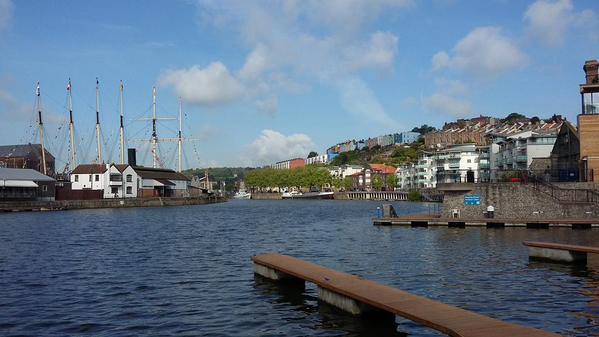
A bright Friday morning in Bristol for NatSCA 2015 (Image: David Gelsthorpe, via Twitter)

A bright Friday morning in Bristol for NatSCA 2015 (Image: David Gelsthorpe, via Twitter)

If you missed the conference, or just want to relive it, we’ve collected a selection of the live-tweets from the conference into a Storify, which you can find here: https://storify.com/Nat_SCA. There were so many tweets, we had to split it into four parts! Also check out the Storify of the Bristol Museum tours made by journalist Henry Nicholls, who was one of our speakers: https://storify.com/WayOfThePanda/natsca-tour-of-bristolmuseum.

For more conference analysis, see the write-up in the Museums Journal by Vicky Pearce of the Natural History Museum, and a piece in Museums and Heritage Advisor by Jan Freedman of Plymouth City Museum and Art Gallery.

All of our fantastic speakers will be writing up their talks for us, and these will appear soon in the Journal of Natural Sciences Collections, NatSCA Notes & Comments, and on the blog.


Rachel Jennings, NatSCA Blog Editor

NatSCA Digital Digest

Chameleon

Events

Now that the 2015 NatSCA Conference is over, the next conference for your diaries is Refloating the Ark: Connecting the public and scientists with natural history collections on 17th – 18th June at Manchester Museum. The full programme, abstracts, and booking information can be found here.

Developing Skills for Collection Managers – 28th May 2015, NHM. An afternoon seminar and workshop run by Nick Poole of the Collections Trust, providing tips on putting collection competency frameworks into practice and improving collections skills.

Jobs

Keeper, Science and Technology – National Museums Scotland. Applications close 31st May 2015.

Learning and Events Assistant – NHM, Tring. Applications close 31st May 2015.

As always, do keep an eye on the jobs page of the NatSCA website!

Around the Web

Watch the team at the Museum of Zoology, Cambridge decant their carnivore case in 2 minutes! Also check out this blog for a conservator’s-eye view of their current redevelopment project.

A good article about how the current financial crisis has left the natural history museum in Dublin in dire straits. A very sad story.

The International Institute for Species Exploration has released a list of the Top 10 New Species of 2015! The list is released on 23rd May each year, to coincide with the birthday of Carolus Linnaeus, the father of taxonomy. Happy birthday Linnaeus!

Museums Unleashed #NatSCA2015

Next Thursday NatSCA will be holding our annual conference in Bristol. This meeting tends to be the highlight of the year for many natural history collections staff – a chance to catch up with colleagues, make new contacts and help shape the direction of our sector.

NatSCA conference attendee group photo from 2012. Image by Rachel Jennings, 2012

NatSCA conference attendee group photo from 2012. Image by Rachel Jennings, 2012

This year the conference is called Museums Unleashed, and the theme is sharing collections using a variety of media – from the traditional television, radio and print to newer digital and social media. This topic has a much broader relevance to the museum sector than the usual NatSCA theme and so there will be a broad diversity of speakers from broadcasting, journalism and a variety of different museum disciplines – check out the full programme and list of abstracts.

Museums Unleashed #NatSCA2015

This broader focus of the meeting will allow the NatSCA membership to learn lessons in engaging audiences from different perspectives and really make the most of our collections in order to advocate for the ongoing use and support.

Of course, this broad speaker base will also allow non-natural-science-specialist to benefit more from the meeting, providing an opportunity for the increasing number of generalist museum staff to break the ice with specialists who can help support them in their role – be it collections focussed or more outwards-facing.

If you haven’t booked a space there is still time, as bookings close on 19th May – although spaces are running out! Just head to the NatSCA website and book online.

If you want to attend the conference meal you’d better be quick though – orders need to be with the restaurant by Wednesday.

We hope to see you there, but if you can’t makes it, be sure to follow the hashtag #NatSCA2015 to keep updated!

A Tale of Two Playing Cards

The Museum Ethnographers Group conference is being held on Monday and Tuesday at the excellent Powell-Cotton Museum in Kent. The theme is ‘Nature and Culture in Museums’, and the relationship between the two.

I am a zoologist by background, but for the last three years I have been immersed in a different world, working on a review of the Anthropology collections at the Horniman Museum and Gardens. I have learned an enormous amount about material culture from all over the world, seen some incredibly stunning objects, and been surprised by how relevant my Natural History knowledge has been. Many of our objects are made of animal materials, and it’s been a great opportunity to learn new skills in identifying ivories, bone, and antler. Only a few weeks ago I was very excited to be able to identify an Inuit flint-sharpening tool as being made of mammoth ivory!

I have also been asked to add taxonomic data to some Anthropology object records in our Collections Management System, so that we can record the species that are represented by objects. This provides richer contextual data, and links between objects that can be navigated on our website.
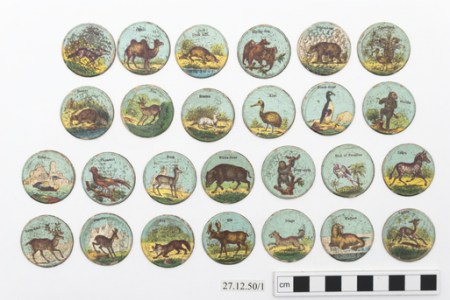
Victorian playing cards featuring exotic species (Horniman Museum & Gardens)

Victorian playing cards featuring exotic species (Horniman Museum & Gardens)

One such group of objects is this set of Victorian playing cards. They are cute: on one side is a cryptic clue to the identity of an animal, and on the other is an illustration of that animal. I didn’t anticipate how much the taxonomic information would add to our understanding of the objects, or that it would enable them to tell a story about discovery and extinction…

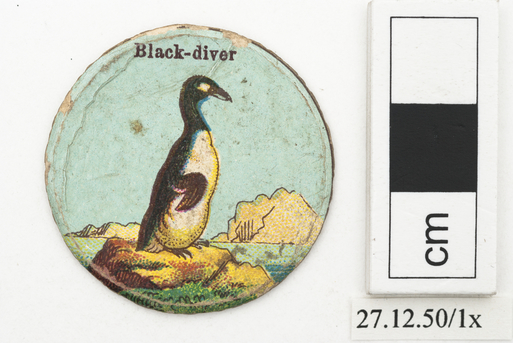
Two cards in the pack, together, tell this tale. The first is the ‘Black-diver’:
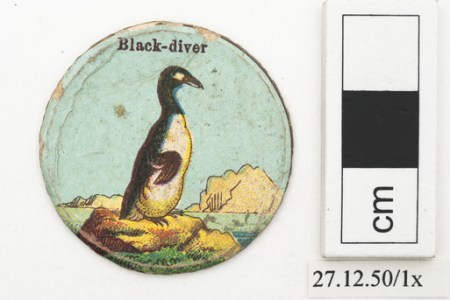
Black-diver playing card (Horniman Museum & Gardens)

Black-diver playing card (Horniman Museum & Gardens)

Mounted Great Auk specimen (Horniman Museum & Gardens)

Mounted Great Auk specimen (Horniman Museum & Gardens)

Which is actually a Great Auk (Pinguinus impennis). I have never heard ‘black diver’ used as a common name for this bird, but the likeness is unmistakable. The last recorded sighting of this species is from 1852, following the death of the last individuals to be shot, in 1844. I was intrigued to see this species represented in the pack, and was left wondering whether any of the Victorian children who played with the cards had ever actually seen a live Auk.

A second card could potentially hold the clue to this:
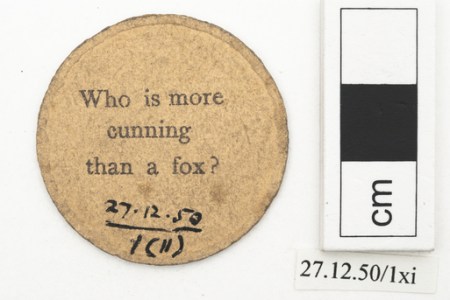
 

Reverse of animal playing card (Horniman Museum & Gardens)

Reverse of animal playing card (Horniman Museum &Gardens)
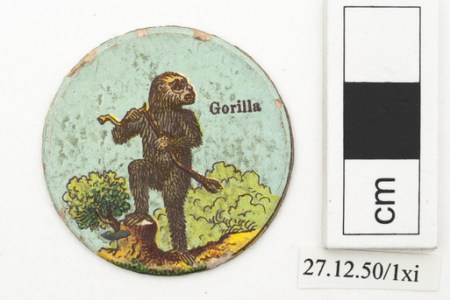
Gorilla playing card (Horniman Museum & Gardens)

Gorilla playing card (Horniman Museum & Gardens)

The Eastern Lowland Gorilla (Gorilla beringei) was not described until 1903, so it seems much more likely that this card represents the Western Gorilla (Gorilla gorilla), described in 1847.

The date of the discovery of the Western Gorilla, combined with that of the extinction of the Great Auk, could potentially narrow down the date at which these cards were made enormously: there is only a five-year period in which both species were known to exist together, between 1847 and 1852. However, the actual date of manufacture could be much later: following their discovery, gorillas were incredibly popular with the public for many years, particularly in the 1860s after the publication of Darwin’s Origin of Species in 1859, and the first live specimen reached a European zoo in 1876. ‘The Auk’ was taken as the title of the American Ornithologists’ Union’s journal, founded in 1884. So the Great Auk was clearly still in the public consciousness long after its extinction. Given this information, it seems quite possible that the original owners of the playing cards may never have seen either species in the flesh!

But that is as far as my research has taken me for now. This is a story that I hadn’t expected to find in these objects. As museum professionals, we are custodians of more than just collections: we are the keepers of specialist knowledge that we use to interpret our collections, to tell stories that will engage our audiences. Sometimes, to find their stories, you need to look at objects from more than one perspective. By working across disciplines and sharing our expertise, we can find new tales and new ways to tell them.


Rachel Jennings
Documentation Assistant, Horniman Museum and Gardens

Let’s Not Forget the Old Ways

Museums Unleashed is the conference to get to in 2015. The theme, as the title suggests, is unleashing your collections: getting them out ‘there’ using social media, blogs, TV, and newspapers. With an excellent programme of speakers, the conference will discuss inspiring new ways of sharing our collections, both to familiar audiences and new ones.

The conference will be an excellent opportunity to hear case studies on what other museums are up to and how different methods are being used. This is where wonderful, new, and exciting ideas are thought up, leading to the birth of outrageously different projects (this often happens in the pub).

As Viscardi (2012) writes, advocacy is essential for survival of the sector as a whole. We all do it, and more than we think. Probably eight or nine times a week. We talk to our colleagues and friends about our collections, or a cool specimen that we are working on. We get on the radio and talk about projects. This is great advocacy. Exciting discoveries or research in our store rooms are often accompanied by media reports highlighting the awesome museum collections.

Capricorn Beetle (Cerambyx cerdo)

Capricorn Beetle (Cerambyx cerdo) found at Plymouth University in 2007. Specimen is the first sighting of this species since 1947, and was donated to the museum. A short article was written for the local newspaper (http://www.plymouthherald.co.uk/Giant-beetle-time-Plymouth-city-native/story-23139707-detail/story.html)

As museum professionals, we should embrace new communication media without forgetting the old ways. One of the most effective means of letting staff at other museums know about your work or your collections is by writing an article for the Journal of Natural Science Collections. The Journal is fully peer-reviewed, and is written by those working with natural science collections for those working with natural science collections. This is a great way of sharing your expertise, your knowledge, and your passion for your collections with your colleagues.

All of the published articles are also made freely available online. The first two Volumes of the Journal are already available, with interesting and useful articles about conservation, collections reviews, education and the history of different collections. Some articles will be useful to your everyday work as a reference, others may spark ideas for future collaborative projects. We are now seeking contributions for Volume 3. If you have something you’d like to share, get in touch and send in an article!

The deadline for the next Volume is 15th July 2015. Please contact the Editor, Jan Freedman, for further information (editor@natsca.org). Guidelines for authors are available here, and are currently being updated.


Jan Freedman
Curator of Natural History, Plymouth City Museum and Art Gallery