NatSCA Digital Digest

ChameleonYour weekly round-up of news and events happening in the world of natural sciences

Events

8th – 15th June: The Dodo Roadshow. To mark the Oxford University Museum of Natural History’s nomination in this year’s Art Fund Prize for Museum of the Year, the Oxford Dodo is touring the country, from Land’s End to John O’Groats, in just one week, visiting museums and galleries along the way!

17th – 18th June: Refloating the Ark: Connecting the public and scientists with natural history museums at Manchester Museum. Conference looking at how natural history collections can be used to engage effectively with the public and the scientific research community.

25 June: Collection Standards Infrastructure Project – Environmental Standards at NHM, London. Talk on standards for collections, display and storage and their implications.


News

A new species of theropod dinosaur from Wales has been discovered by experts from The University of Manchester, University of Portsmouth, and the National Museum Wales.

A rare meteorite stolen from an Australian museum may have been stolen to order. Scary stuff!

A study using museum collections has found that the world’s biodiversity might not be as diverse as we thought…

The World Museum in Liverpool has added a new Octopus called Polvo to its aquarium!


Around the Web

A dinosaur reading list for every dino enthusiast in your life!

David Gelsthorpe of Manchester Museum on how the Page Museum at La Brea Tar Pits tells the story of Ice Age animals.

NHM curator Erica McAlister has been re-curating flies. Big flies.


Got a submission for the blog or Digital Digest? Email us at blog@natsca.org

Objects, Meet World! Using Tumblr to Bring Collections to New Audiences

This post is another in our series of presentation write-ups from the 2015 NatSCA Conference, Museums Unleashed!


In 1901, Victorian tea trader Frederick Horniman opened his museum (The Horniman Museum and Gardens, in London) with the ideal of bringing the world to Forest Hill. His collections were vast and varied, encompassing Anthropology, Natural History, and Musical Instruments. They have been added to extensively over the years.

In 2012, the Horniman embarked on a three-year review of our Anthropology collections, Collections People Stories, with the aim of getting a clearer picture of what we now have and learning more about our objects, in order to inform a planned redisplay of some of our galleries.

The review project was an enormous undertaking, involving staff from across the museum as well as external experts and community groups. The progress of the project was shared on the museum’s blog, but we also wanted a more informal way to share the day-to-day work of our review team, and to highlight some of the amazing objects we saw every day as we ploughed systematically through the Study Collections Centre.

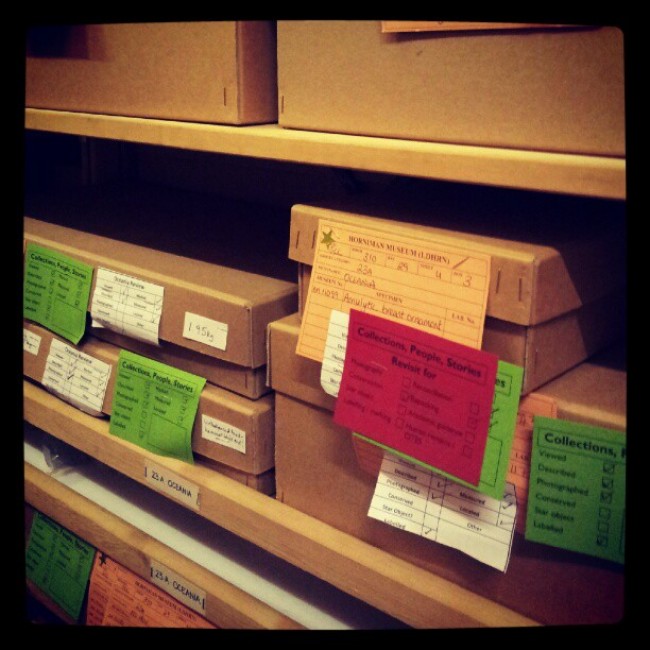
Boxes of objects in the Horniman's stored collection

A review in action: lots of coloured labels!

Tumblr fit the bill nicely: it is a microblogging (think very short-form) platform that can accommodate a variety of content, including text, pictures, video, and audio. We’ve found it works best with images, plus a small amount of text to explain what the object is and why it’s interesting. Posting is quick and simple, so it can fit into a busy workflow easily. Tumblr is also a great way of reaching a large audience with little initial effort, thanks to the snowball effect: followers can ‘reblog’ our posts, sharing them on their own page, and then other people reblog it on from there, and it can just keep going!

Our page, In the Horniman, was set up in September 2012. The review team were given control of the page, and let loose! Our agenda with Tumblr is not overtly educational; we aim simply to share our enthusiasm for the collections with our followers. We choose objects just because we like them – anything that makes us say ‘Wow, that’s amazing!’ is an instant Tumblr candidate.

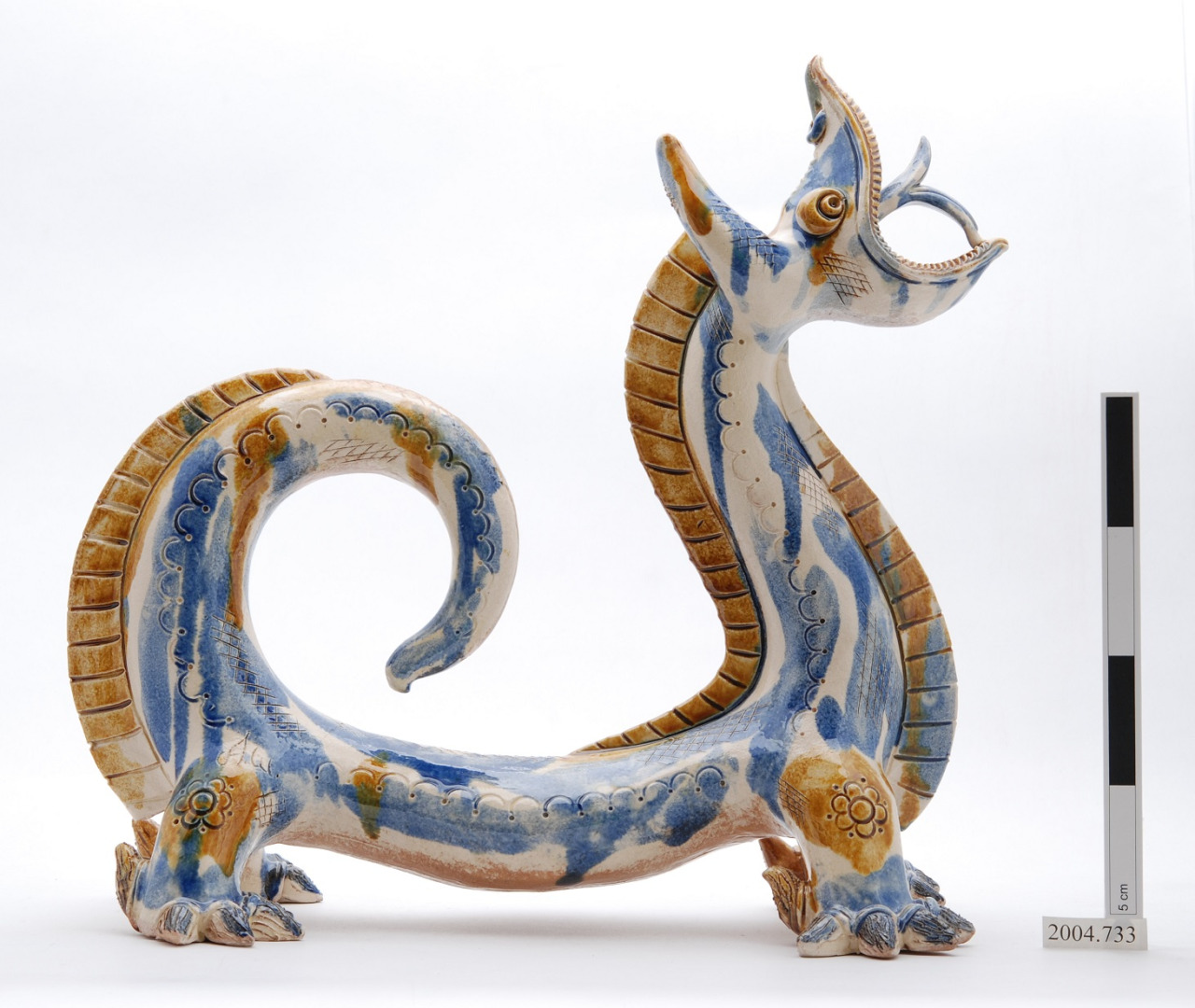
"Wow, that's amazing!" - a beautiful ceramic dragon from Uzbekistan (Image: Horniman Museum & Gardens)

“Wow, that’s amazing!” – a beautiful ceramic dragon from Uzbekistan (Image: Horniman Museum & Gardens)

We didn’t just want to share pretty pictures with our followers, though. We also wanted to encourage engagement. This is not as easy as it sounds, because of the way Tumblr works: followers can ‘like’ or ‘reblog’ posts with one click, but commenting is less common because it takes more effort. But without us even trying, it was happening: people were commenting on our posts, sometimes even telling us things we didn’t know about the objects. So we started an interactive feature called Stick of the Week, in which we share an image of a stick-like object and ask the good people of Tumblr to guess what it is. We have many such objects in the collection, and wanted to share them to highlight that any object can be interesting when you know its story! Stick of the Week sounds silly, but it has (hopefully!) got our followers looking at and thinking about objects differently, and allowed us to open up a dialogue.

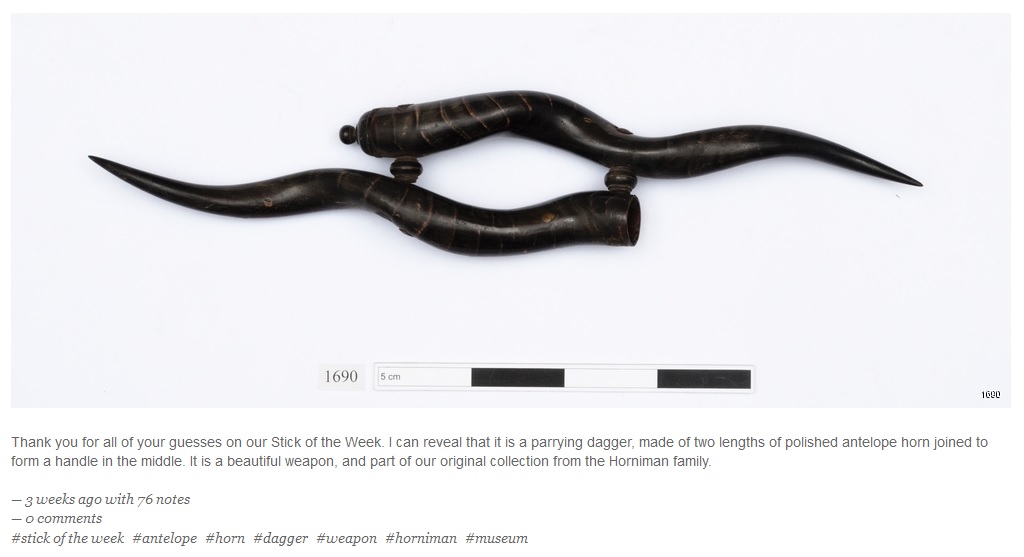
Stick of the Week: a parrying dagger made of antelope horn

Stick of the Week: the reveal (Image: Horniman Museum & Gardens)

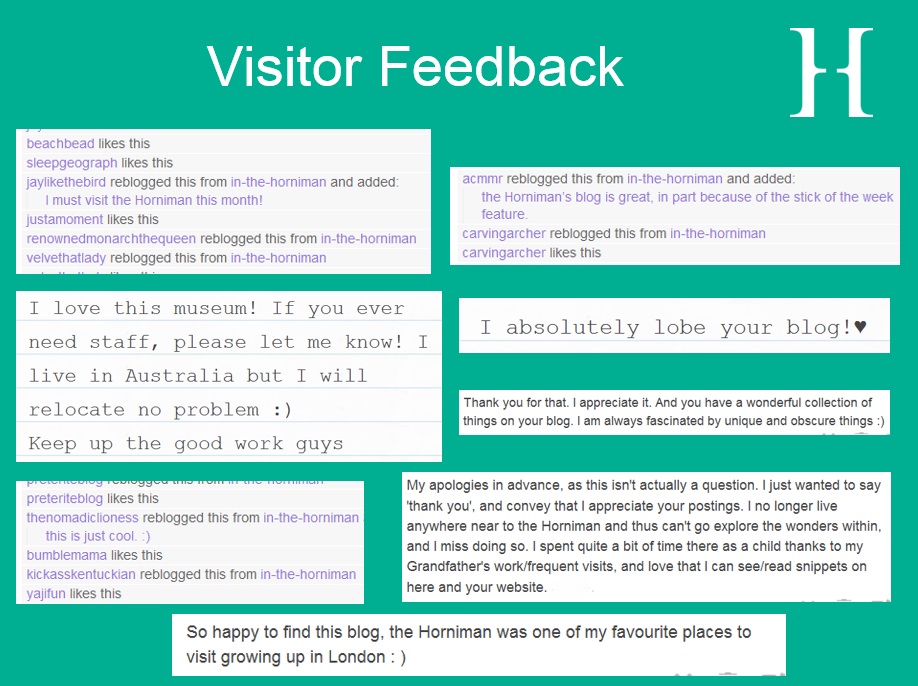
In The Horniman has achieved our aim to share the progress of the Collections People Stories review, and wildly exceeded our expectations. Since 2012 it has gained over 39,000 followers (up by 2,000 since I delivered this talk at NatSCA 2015!), received over 90,000 page views from 158 countries, and even won an award (Best Social Media at the Museums & the Web Awards 2014)! But the reason we keep doing it is the wonderful feedback from our audience:

Visitor feedback for In The Horniman Tumblr page

In The Horniman: people lobe it!

Tumblr has given us a platform to share our collections with audiences all over the world, and a new way to engage people with our objects. Mr. Horniman’s aim in founding the museum was to bring the world to Forest Hill. Through Tumblr, we are now bringing Forest Hill to the world.

Rachel Jennings
Documentation Assistant, Horniman Museum & Gardens

“This museum is disgusting, why did you kill these animals?”

This post is the first in our series of presentation write-ups from the 2015 NatSCA Conference, Museums Unleashed!


I was asked to deliver a natural history version of my social media challenge for NatSCA’s 2015 Museums Unleashed conference. The idea of the challenge, which I’ve run in the past with students and museum professionals who might be afraid of using social media, is to informally discuss how to respond, if at all, to difficult questions that might come in on social media.

Before the conference, I asked NatSCA members to suggest any real world examples of difficult comments and queries that any of them may have received through blogs, Twitter or other social media platforms that were challenging to respond to. Any museum professional worth their salt who has worked in the public galleries can very confidently deal with those tricky questions, ranging from “Did you kill all these animals?” through to “If we evolved from monkeys, why do men and women have a different number of ribs?”. However, with social media it’s different because those responses are ‘published’, and often the platform might not be best suited to dealing with complexity.

There are also considerations depending on guidelines or policies that your institution has in place; some museums seem to have a policy of broadcasting but not engaging, and others will have topics they just don’t engage in. Are you responding as the institution or is it clear that it’s your opinion? Do you have absolute freedom to say what you want on personal social media accounts, even though you may be using them on ‘work’ time (the answer is often no)?

"This museum is disgusting!" Mark lays out the challenge (Image: Grant Museum of Zoology, UCl (@GrantMuseum) via Twitter)

“This museum is disgusting!” Mark lays out the challenge (Image: Grant Museum of Zoology, UCl (@GrantMuseum) via Twitter)

The idea of the workshop was to work in teams to decide how to respond to some tricky social media situations sent in by natural history museum professionals from across the UK, and hopefully as a group show that it’s not always scary. Also, importantly, that you may not always wish to engage, but by using social media cleverly you can engage with your virtual audiences.

First up, though, were the team names. This session was the last formal session of a jam-packed conference, and it showed with the names that the UK’s best and brightest museum professionals came up with: #newbies, Team Celtic and Then Some, Is it Dead? Poke it, Social Six, Team Large, Come Back Right At You, The Con Artists, and the appropriately named Team Conference Fatigue. Exactly the mix of humour that works with social media.
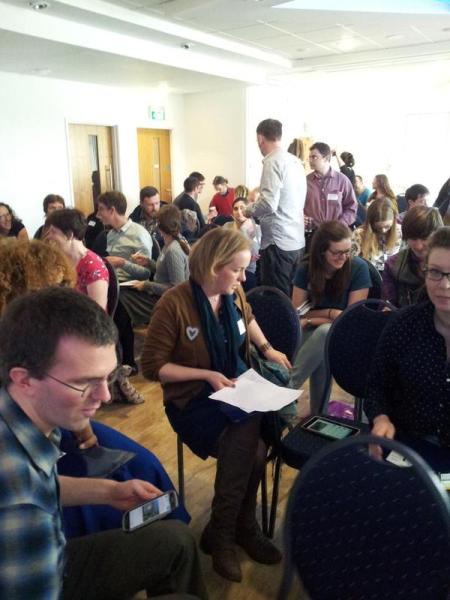
The teams assemble (Image: Justine Aw (@NotCritters) via Twitter)

The teams assemble (Image: Justine Aw (@NotCritters) via Twitter)

There were five questions the teams drafted responses to:

  1. This museum is disgusting, why did you kill these animals?
  2. Why are we wasting taxpayer’s money on research into crab sex. What about cancer and the NHS?
  3. How can you justify taking donation money from an anti-climate change lobbyist?
  4. I went to that lecture last night and thought @MusSpeaker was a rubbish speaker!
  5. The animal in this photo is a moonfish not a southern opah!

On first reflection, these questions might set you squirming. Do you engage if it’s tough to respond in 140 characters? If you don’t engage, will it look like the museum is trying to hide something? The NatSCA members rose to the social media challenge, however, and came up with a range of serious, bold, funny, and thoughtful responses. I won’t got through all the ‘answers’ here, suffice to say the merits of crab sex research were defended, there was open discussion about museum ethics (which we rarely display in exhibitions), and a number of very honest responses perhaps spurred on by conference fever.

A selection of responses, both serious and silly (Image: Mark Carnall)

A selection of responses, both serious and silly (Image: Mark Carnall)

Overall most teams decided to engage rather than ignore any of these difficult responses. One top tip was to make sure you take a step back, as sometimes a hasty or heated response could create a social media storm. Some of these comments could be prompters for policy statements, blog posts, or even exhibitions, that address head-on some of the meatier issues that we may have been reticent to engage with in the past. Some of these could result in genuine engagement, as we saw with a real example of an insect sex tweet from the Natural History Museum, London, and some are an opportunity to show the more human side of the staff that work in, and make, museums.

The workshop got a lot of positive feedback, and hopefully rounded off the two day showcase of how social media can help rather than hinder all areas of museum work, and that engaging with the social side (the hint is in the name) is something to be embraced and not feared.

Mark Carnall
Curator – Grant Museum of Zoology, UCL

#NatSCA2015: The Aftermath

Another NatSCA conference is done and dusted. This year has been one of our most successful and enjoyable conferences yet, and we’d like to thank everyone who helped to organise such a brilliant event!

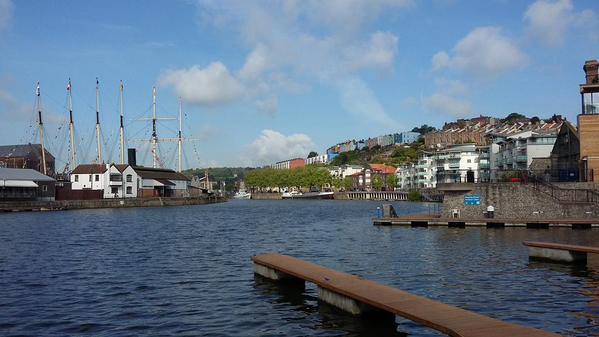
A bright Friday morning in Bristol for NatSCA 2015 (Image: David Gelsthorpe, via Twitter)

A bright Friday morning in Bristol for NatSCA 2015 (Image: David Gelsthorpe, via Twitter)

If you missed the conference, or just want to relive it, we’ve collected a selection of the live-tweets from the conference into a Storify, which you can find here: https://storify.com/Nat_SCA. There were so many tweets, we had to split it into four parts! Also check out the Storify of the Bristol Museum tours made by journalist Henry Nicholls, who was one of our speakers: https://storify.com/WayOfThePanda/natsca-tour-of-bristolmuseum.

For more conference analysis, see the write-up in the Museums Journal by Vicky Pearce of the Natural History Museum, and a piece in Museums and Heritage Advisor by Jan Freedman of Plymouth City Museum and Art Gallery.

All of our fantastic speakers will be writing up their talks for us, and these will appear soon in the Journal of Natural Sciences Collections, NatSCA Notes & Comments, and on the blog.


Rachel Jennings, NatSCA Blog Editor

NatSCA Digital Digest

Chameleon

Events

Now that the 2015 NatSCA Conference is over, the next conference for your diaries is Refloating the Ark: Connecting the public and scientists with natural history collections on 17th – 18th June at Manchester Museum. The full programme, abstracts, and booking information can be found here.

Developing Skills for Collection Managers – 28th May 2015, NHM. An afternoon seminar and workshop run by Nick Poole of the Collections Trust, providing tips on putting collection competency frameworks into practice and improving collections skills.

Jobs

Keeper, Science and Technology – National Museums Scotland. Applications close 31st May 2015.

Learning and Events Assistant – NHM, Tring. Applications close 31st May 2015.

As always, do keep an eye on the jobs page of the NatSCA website!

Around the Web

Watch the team at the Museum of Zoology, Cambridge decant their carnivore case in 2 minutes! Also check out this blog for a conservator’s-eye view of their current redevelopment project.

A good article about how the current financial crisis has left the natural history museum in Dublin in dire straits. A very sad story.

The International Institute for Species Exploration has released a list of the Top 10 New Species of 2015! The list is released on 23rd May each year, to coincide with the birthday of Carolus Linnaeus, the father of taxonomy. Happy birthday Linnaeus!