Handle with care: bringing museum egg collections to life

This post is another in our series of presentation write-ups from the 2015 NatSCA Conference, Museums Unleashed!


How can we bring museum egg collections to life?

Egg collecting is now illegal in the UK and has been for many years. Possibly because of the legal situation, and the social stigma understandably attached to egg collecting today, museums can be reluctant to publicise their egg collections, even though they are entitled to do so. For example, out of the thousands of eggs held by Glasgow Museums, only a handful are currently on public display, which is a pity as they are beautiful and fascinating objects.

These issues form the basis of my PhD, which is a Collaborative Doctoral Award with Glasgow Museums and the Geography Department at the University of Glasgow. I have been researching the cultural and social aspects of egg collecting (also known as ‘oology’), which was a very popular pastime among both adults and children from the Victorian era well into the twentieth century. I have been researching collectors’ diaries held by Glasgow Museums, and also investigating the wider world of British egg collecting via old egg collecting magazines. This material has revealed some of the people, places, and practices of egg-collecting, which could provide new possibilities for communicating the stories of the birds’ eggs held by Glasgow Museums.
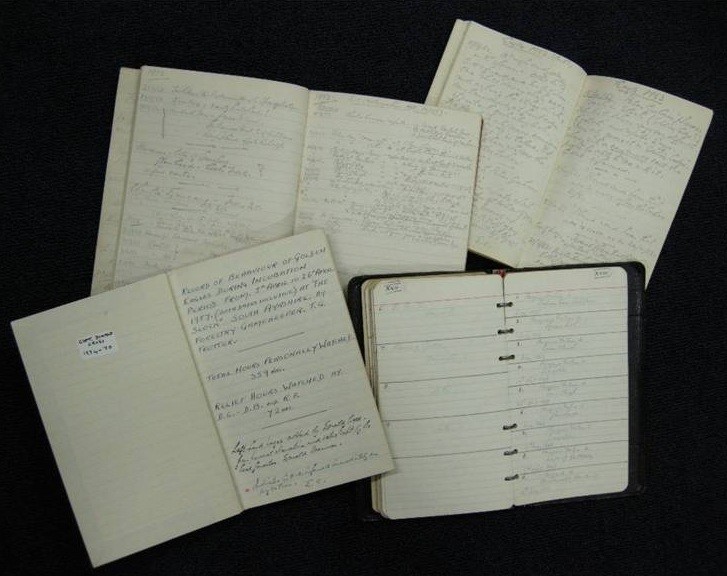
A selection of egg collectors' notebooks and diaries

A selection of egg collectors’ notebooks and diaries

Egg-collecting interconnections

One of the most striking aspects of this research has been the interconnectedness of the British egg-collecting world. These connections can take various different forms. For example, egg collections have been donated to Glasgow Museums by individual collectors who knew each other, such as Captain Donald Cross and Peter Hay, who both lived in Ayrshire in the 1940s, where Cross was a farmer and Hay was a schoolboy. Cross shared his collecting knowledge with Hay, and sometimes even gave him eggs to add to his collection.

Eggs taken by a collector called E. S. Steward over 100 years ago have arrived at Glasgow Museums by two very different routes. Some were given by Steward to his friend Robert Arbuthnott, whose son donated his collection in 1967. More recently, in 2014, we received an egg collection confiscated by police after a collector was convicted of trading in eggs, some of which were very old. A few of these eggs were also taken by Steward, and must have passed through various different intermediate collections, along convoluted geographical journeys, before arriving at Glasgow Museums.

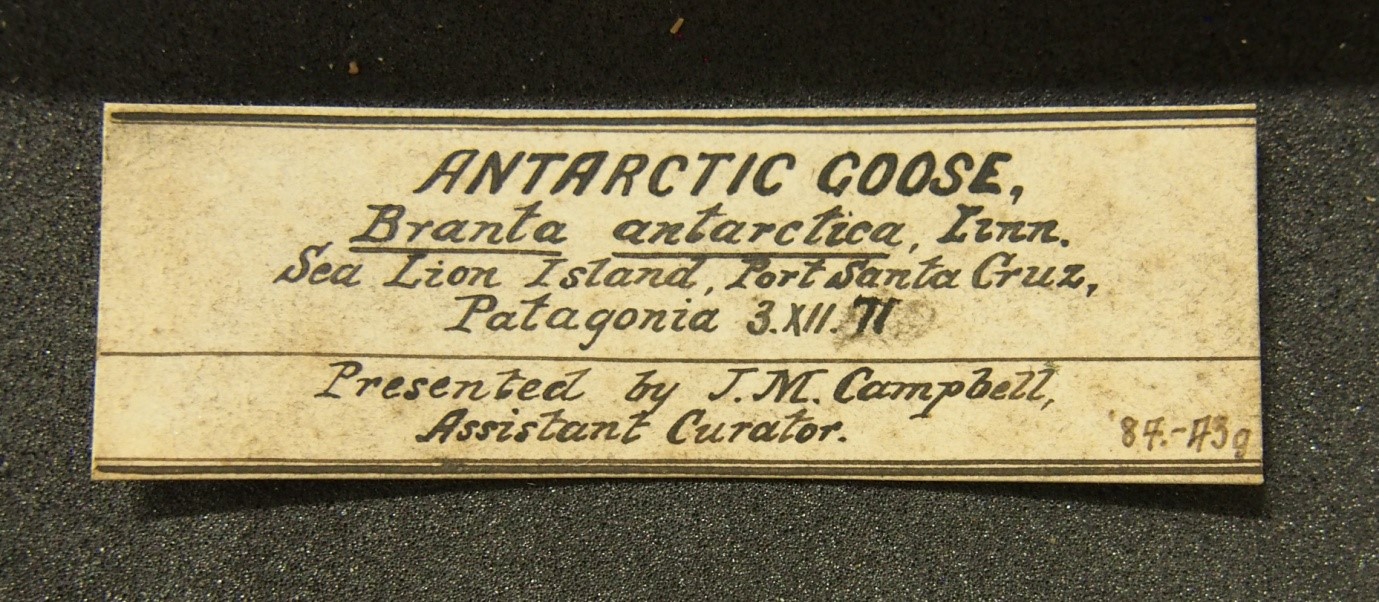
Eggs taken by another collector have ended up at different museums. On National Handwriting Day in January, the Natural History Museum’s brilliant oology Twitter feed featured a beautifully scribed red-legged cormorant egg from a collector called John MacNaught Campbell. He was the second Natural History curator at Kelvingrove Museum in Glasgow, and one of the earliest egg collectors to visit South America. Glasgow Museums also have some of his eggs, including this Antarctic goose set collected just three days after the Natural History Museum’s egg, on 3 December 1871.
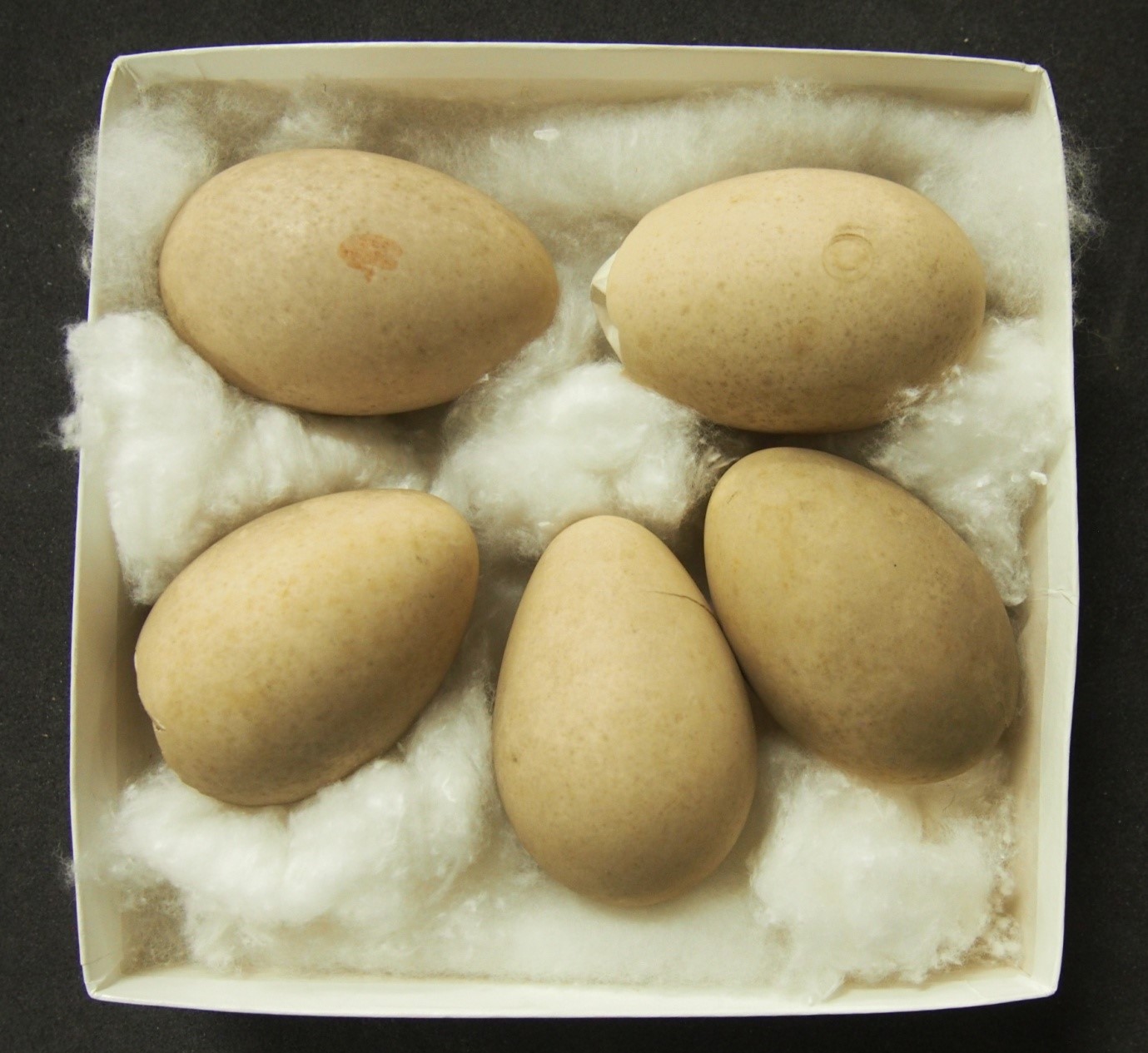
Clutch of Antarctic goose eggs collected by John MacNaught Campbell in 1871

Label for Campbell's goose egg clutch

Clutch of Antarctic goose eggs collected by J. M. Campbell in 1871

Telling the interconnecting stories of these collectors, and others, could be a way of showing the human side of egg collecting, while being careful not to encourage the practice today. This could be via traditional media, such as museum exhibitions, online catalogues, or using social media.

Finally, a request: I’m keen to trace any other eggs that were collected by ES Steward, as I’d like to see how widely his collection has been dispersed. If any of you know of any of his eggs in your collections, I’d be very interested to hear from you, at e.cole.1@research.gla.ac.uk.

 

Edward Cole
PhD student, University of Glasgow/Glasgow Museums

Leicestershire Fashion in Detail: Using social media to engage new audiences with museum collections

This post is another in our series of presentation write-ups from the 2015 NatSCA Conference, Museums Unleashed!


The Animal Kingdom

The Animal Kingdom

Why?

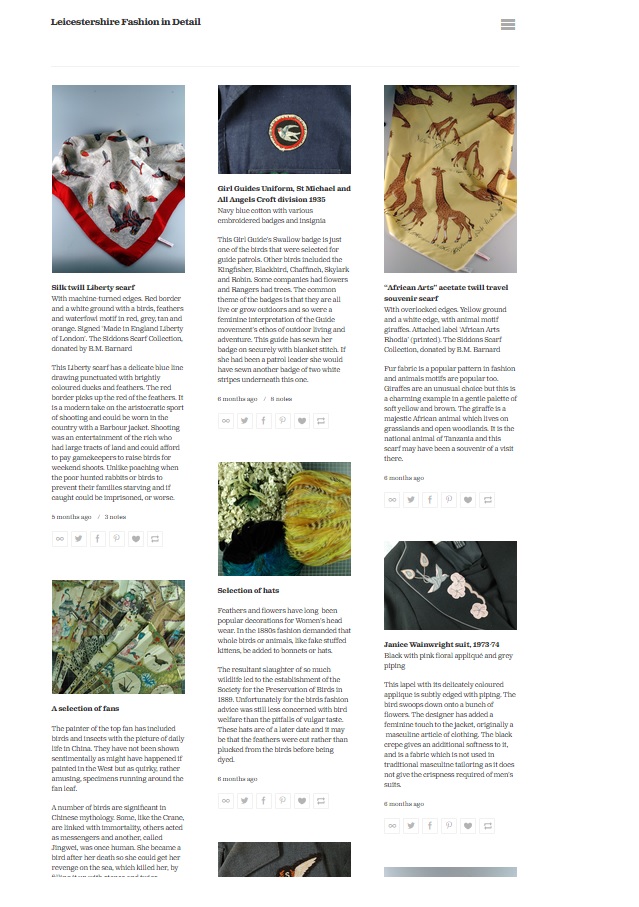
Leicestershire Fashion in Detail was part of a larger project called Click; Connect; Curate; Create. Funded by Arts Council England as part of their Renaissance Strategic Support Fund, we wanted to find out how we could use ‘digital’ (whether that be technology or content creation) to increase engagement with our sites and collections. Fashion in detail was one a number of pilot projects including 3D scanning, augmented reality and wearable tech and digital storytelling.

What did we do?

For the purposes of this project we decided to utilise a number of existing images that we had of items from the costume collection. These images are close-up photographs of objects, ranging from menswear to accessories, womenswear to shoes, dating from the late 18th century to the present day. We commissioned dress historian Clare Bowyer to curate these images into a series of themes, and to write narrative for each image and each theme.

Why publish on social media and not an online collection resource?
We were going to use our collections online website but unfortunately this had to be taken down. We did have a picture library that had just been launched but, as its primary purpose was income generation, we didn’t want to distort its purpose by uploading images that we weren’t looking to sell.

As the aim of the project was to encourage engagement with collections we thought, ‘Instead of expecting audiences to come to us, why not go to them?’, and put our content on the platforms they use.

We settled on Tumblr, after considering a number of other image based platforms (including Pinterest and Flickr), as it works well with images and has a large fashion-based following.

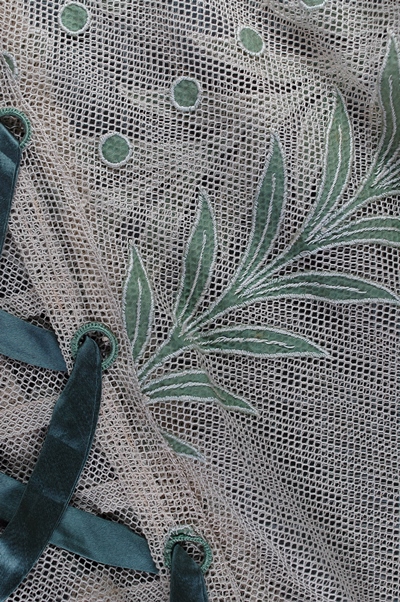
Net overdress, c1910. Image of lace detail

Net overdress, c1910. Image of lace detail

What happened?

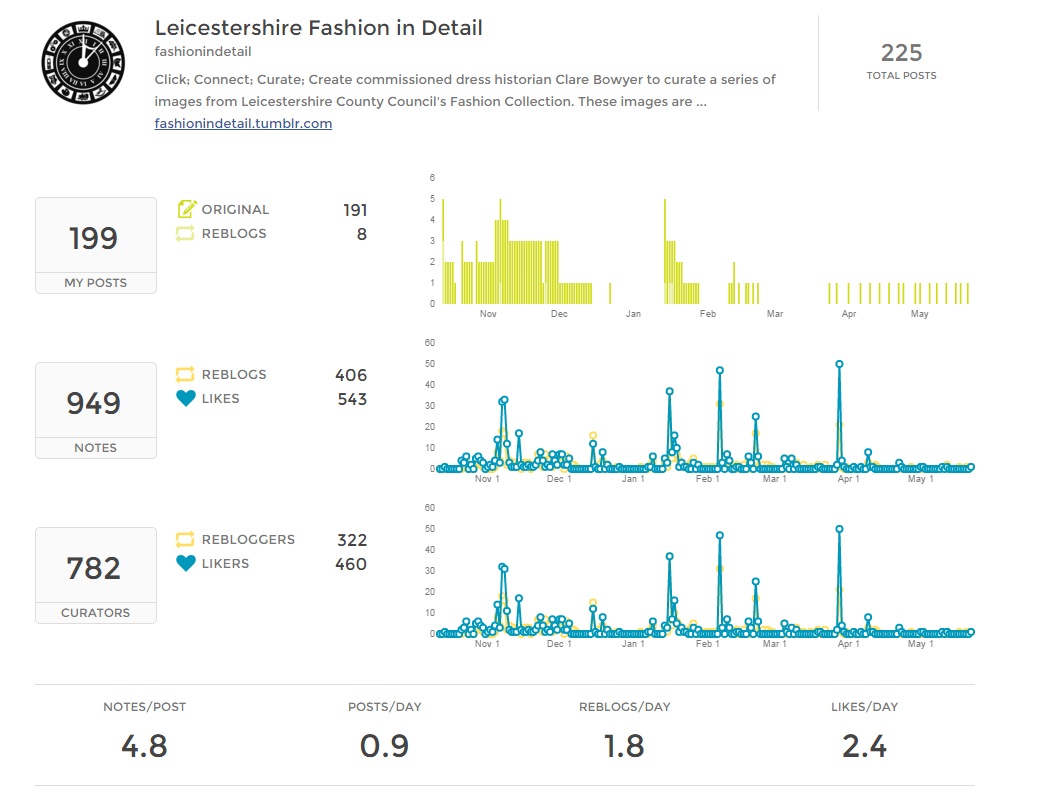
Since we began posting in October 2014, we have:

  • posted 191 images
  • received 949 ‘notes’ (these are interactions with the content in the form of likes and reblogs)
  • had 782 users interact with our content
  • gained 134 followers (and counting)

This is an average post engagement rate of 495.3%. In comparison to our picture library, our download rate is 0.98% and our average engagement rate on Pinterest is 1.47%.

Union metrics

Union metrics

Where relevant we would also link back to the collection if it was on our picture library, and as a result our social media referrals increased, not just from our own blogs but from other peoples’ too; 20% of social media referrals to our picture library are from Tumblr.

What did we learn?

1. Tag, tag, tag
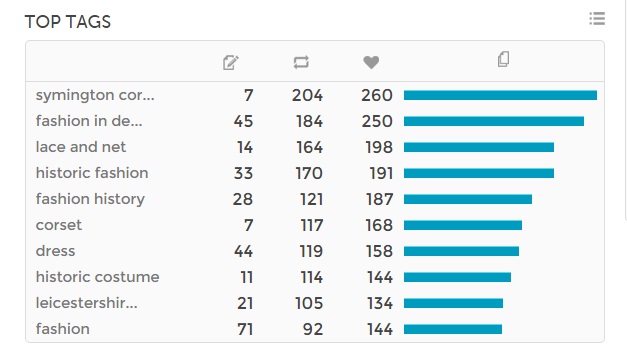
Fundamentally with all social media, it’s about being discoverable, and for Tumblr it’s about using the right tags so that users can find your content and then hopefully reblog or like your posts. Knowing the right tags to use is down to a process of trial and error, but descriptive tags work best. Do your own research on what you think are popular tags, then look at what other tags have been used for that post and use them for your own.

Top Tags

Top Tags

2. Social media is about engagement, not broadcasting
The purpose of social media is to engage with audiences, not to just broadcast about what’s going on. It was something that was picked up in our development of a social media strategy. The strongest recommendation from that was to move away from broadcasting to engaging with our audiences; telling people about our collections was a perfect way to do this.

3. Experimentation is key
As with tagging, a lot of what makes good content is trial and error. Try something, see if it works, and if it doesn’t, look at why and try it again. If it does work, look at why it did and see if you can replicate it. We saw that images of our corsets were gaining the most engagement, so we have decided to create a Tumblr about our Symington corset collection.

4. Digital vs Physical
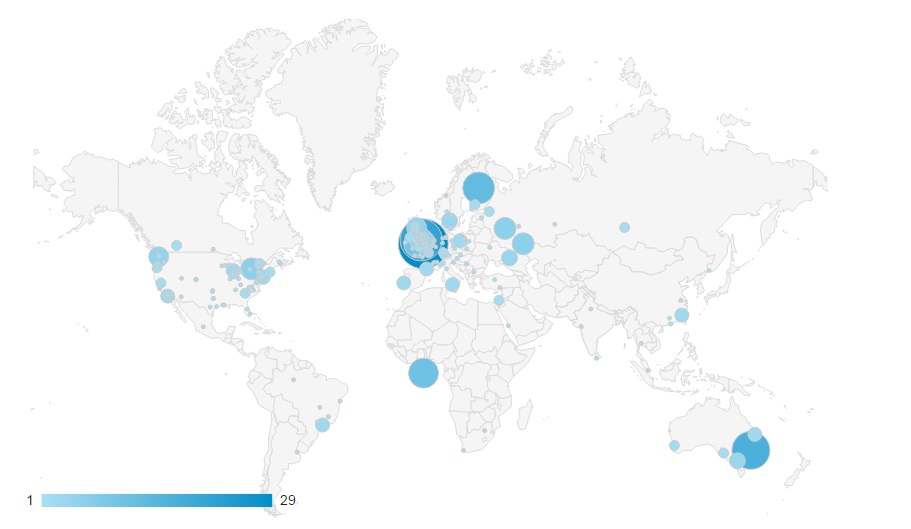
Our biggest learning outcome is that a digital visitor isn’t better or worse than a physical visitor; they are just different types of visitor. We have people from all over the world engaging with our collections who might not have found out about them if it wasn’t for Tumblr. They may never visit us in person, but at least they know we exist, and we have made our collections accessible to them and in a way that allows them to truly engage.

Session Geography - Google analytics

Session Geography – Google analytics

5. Naming your files
I didn’t mention this in my presentation, but the importance of a digital asset management strategy is key. Only some of the images used were labelled according to the garment they were from so I had to spend a month in the ‘Frock Box’ trying to identify the item from the image and updating the metadata accordingly. Whilst I relished my time exploring the collection, renaming all of the images was a pain.

What next?

Leicestershire Fashion in Detail has been such a success to us that we want to explore how we can develop it further. In regards to the overarching project CCCC, we are undertaking an evaluation and visioning exercise to see how we might be able to embed the learning from the project into the strategic delivery of the service.


Lucia Masundire
Project Manager – Click; Connect; Curate; Create
Leicestershire County Council

Lyme Regis Fossil Festival and collections advocacy: 10 years on since the birth of the greatest rock festival in history

When I say I’m going to a fossil festival, the reaction of friends who aren’t natural history geeks is often somewhat quizzical. It’s not exactly Glastonbury, is it? But I would argue that those of us who care passionately about museum collections, and return to Lyme Regis every year, are just as rock ‘n’ roll as the line-up at Glastonbury.

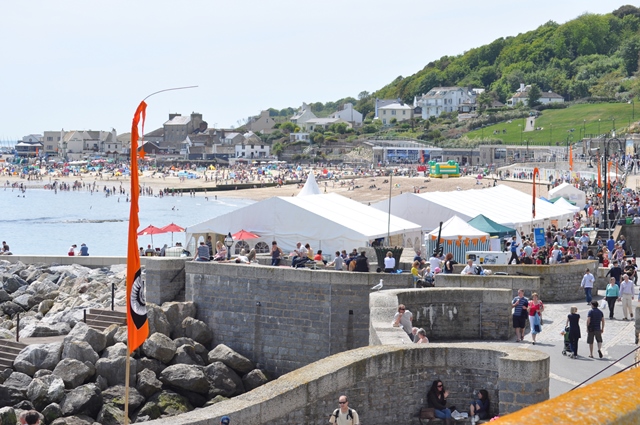
Lyme Regis Fossil Festival is one of the most successful examples of collections advocacy that I have seen, and it meets a wide variety of audiences over four days, working with Primary and Secondary schools and the general public. The fossil festival this year celebrated its 10th anniversary, and I wanted to share some examples of the good practice I’ve seen.

Lyme Regis Fossil Festival in full swing (Image: Anthony Roach)

Lyme Regis Fossil Festival in full swing (Image: Anthony Roach)

Museums are just history, right?

Luanne Meehitiya from Birmingham Museums reminded us, in her collections advocacy summary at the 2014 NatSCA conference, that the public may perceive museums as places of history, not as custodians of scientifically and culturally important collections. The surge in social media and targeted events means visitors are increasingly aware of the scientific research that takes place in museums. The Natural History Museum (NHM) and other regional museums presenting at Lyme Regis can engage audiences who don’t visit them regularly, or who see museums as simply about preserving history.

Prof. Paul Smith from Oxford University Museums also emphasised that natural science and historical collections can and should contribute to 21st century debates within society. The fossil festival doesn’t just celebrate palaeontology, and the Life Sciences team have a strong presence at Lyme, actively engaging the public with research that contributes to debates around climate change, invasive species, and the loss of biodiversity.

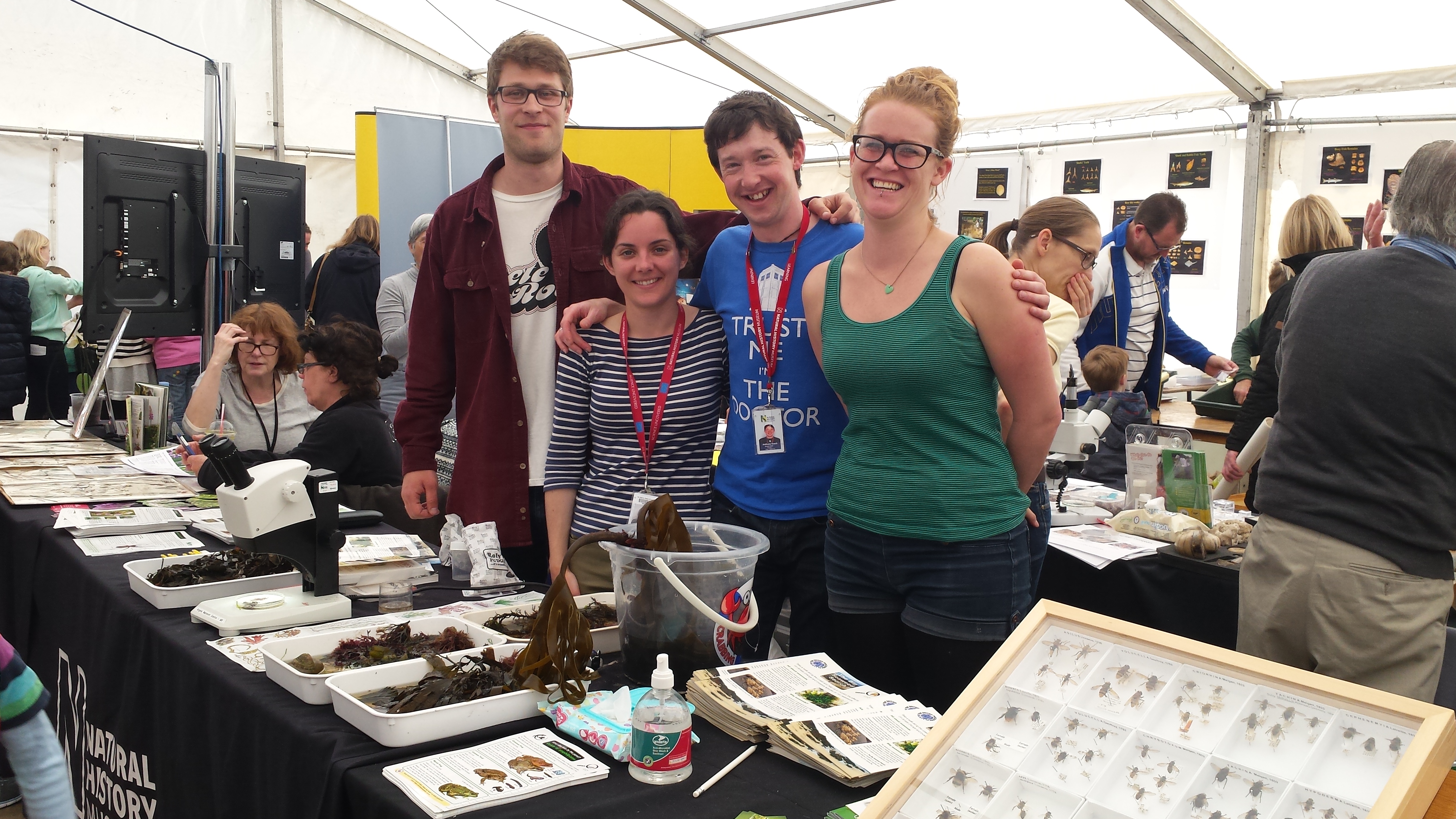
Myself and colleagues from the Angela Marmont Centre for UK Biodiversity spent time talking about a new citizen science project called ‘Orchid Observers’, which inspires visitors to look for 29 of the 56 species of orchids in the UK. By encouraging the public to record their sightings, we hope to build a dataset to see how orchids are adapting to climate change, and how this is affecting flowering times. Using original herbarium sheets, we explained how the problems of over-collecting and environmental degradation have contributed to the decline of orchids.

Members of the AMC team

Members of the Life Sciences team from the AMC from left to right Mike, Jade and Chloe on the stand (Image: Anthony Roach)

What do people in museums actually do?

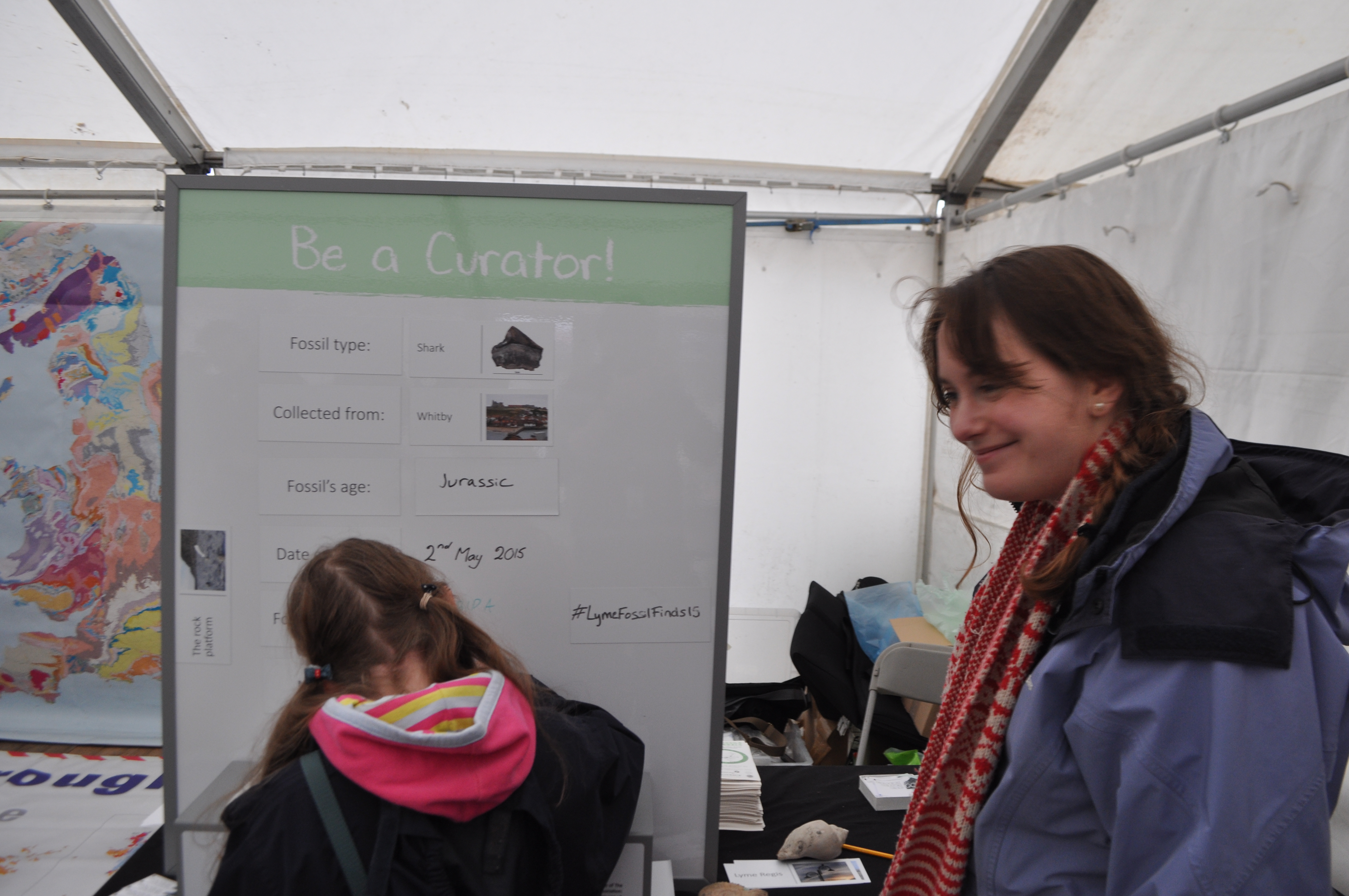
The fossil festival is great at highlighting the amazing work of curators, researchers and scientists, and promotes careers in the museum sector. An excellent example this year was Luanne and Isla Gladstone’s ‘Be A Curator’ activity, where visitors chose a specimen and then had to label it with the age, locality, date, and scientific name. Not only do young people get to meet real curators, they gain an understanding of their work too!

Luanne Meehitiya exploring curation with a young visitor to the festival

Luanne Meehitiya exploring curation with a young visitor to the festival (Image: Anthony Roach)

How can we learn more about museum specimens?

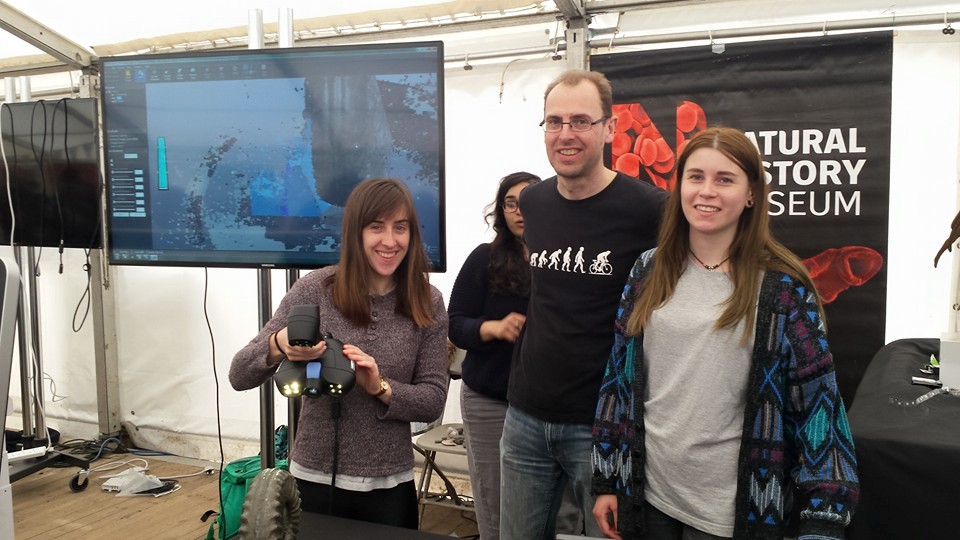
Alex Ball from the Imaging and Analysis Centre at NHM probably has the coolest job I know. He spends his days using chemical, CT, and other scanning technologies to explore natural history specimens. Alex is a continual presence at the festival, and this year he was using a structured light 3D scanner to scan museum specimens for visitors. It scans the object with several cameras and constructs a 3D model that can be examined from different angles.

CT-scanned museum objects were also displayed on screens for visitors to investigate. This technology has enabled conservators to better conserve the beautiful Blaschka glass models, because they can understand how they were made. Researchers can also learn a wealth of information – from the morphology of mummified cats to the structure of meteorites – in a way that is non-invasive and keeps the specimen intact.

Alex Ball and his team from the Imaging Lab with the structured light 3D scanner

Alex Ball and his team from the Imaging Lab with the structured light 3D scanner (Image: Anthony Roach)

These are just some of the examples from a fossil festival that places museum collections, curators, and scientists at the forefront of the visitors’ experience. The festival clearly exposes the past, present, and future use of collections and current scientific research. It also continues to remind us of the amazing scientific discoveries of people like Mary Anning and William Smith, to inspire future generations of scientists, geologists, naturalists, and artists. Long may it continue!


Anthony Roach
Angela Marmont Centre for UK Biodiversity, NHM

NatSCA Digital Digest

ChameleonYour weekly round-up of news and events happening in the world of natural sciences

Events

8th – 15th June: The Dodo Roadshow. To mark the Oxford University Museum of Natural History’s nomination in this year’s Art Fund Prize for Museum of the Year, the Oxford Dodo is touring the country, from Land’s End to John O’Groats, in just one week, visiting museums and galleries along the way!

17th – 18th June: Refloating the Ark: Connecting the public and scientists with natural history museums at Manchester Museum. Conference looking at how natural history collections can be used to engage effectively with the public and the scientific research community.

25 June: Collection Standards Infrastructure Project – Environmental Standards at NHM, London. Talk on standards for collections, display and storage and their implications.


News

A new species of theropod dinosaur from Wales has been discovered by experts from The University of Manchester, University of Portsmouth, and the National Museum Wales.

A rare meteorite stolen from an Australian museum may have been stolen to order. Scary stuff!

A study using museum collections has found that the world’s biodiversity might not be as diverse as we thought…

The World Museum in Liverpool has added a new Octopus called Polvo to its aquarium!


Around the Web

A dinosaur reading list for every dino enthusiast in your life!

David Gelsthorpe of Manchester Museum on how the Page Museum at La Brea Tar Pits tells the story of Ice Age animals.

NHM curator Erica McAlister has been re-curating flies. Big flies.


Got a submission for the blog or Digital Digest? Email us at blog@natsca.org

Objects, Meet World! Using Tumblr to Bring Collections to New Audiences

This post is another in our series of presentation write-ups from the 2015 NatSCA Conference, Museums Unleashed!


In 1901, Victorian tea trader Frederick Horniman opened his museum (The Horniman Museum and Gardens, in London) with the ideal of bringing the world to Forest Hill. His collections were vast and varied, encompassing Anthropology, Natural History, and Musical Instruments. They have been added to extensively over the years.

In 2012, the Horniman embarked on a three-year review of our Anthropology collections, Collections People Stories, with the aim of getting a clearer picture of what we now have and learning more about our objects, in order to inform a planned redisplay of some of our galleries.

The review project was an enormous undertaking, involving staff from across the museum as well as external experts and community groups. The progress of the project was shared on the museum’s blog, but we also wanted a more informal way to share the day-to-day work of our review team, and to highlight some of the amazing objects we saw every day as we ploughed systematically through the Study Collections Centre.

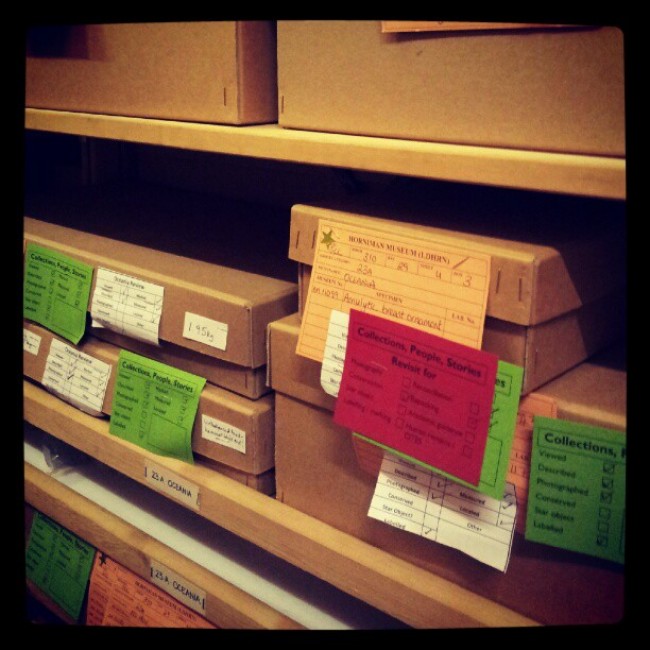
Boxes of objects in the Horniman's stored collection

A review in action: lots of coloured labels!

Tumblr fit the bill nicely: it is a microblogging (think very short-form) platform that can accommodate a variety of content, including text, pictures, video, and audio. We’ve found it works best with images, plus a small amount of text to explain what the object is and why it’s interesting. Posting is quick and simple, so it can fit into a busy workflow easily. Tumblr is also a great way of reaching a large audience with little initial effort, thanks to the snowball effect: followers can ‘reblog’ our posts, sharing them on their own page, and then other people reblog it on from there, and it can just keep going!

Our page, In the Horniman, was set up in September 2012. The review team were given control of the page, and let loose! Our agenda with Tumblr is not overtly educational; we aim simply to share our enthusiasm for the collections with our followers. We choose objects just because we like them – anything that makes us say ‘Wow, that’s amazing!’ is an instant Tumblr candidate.

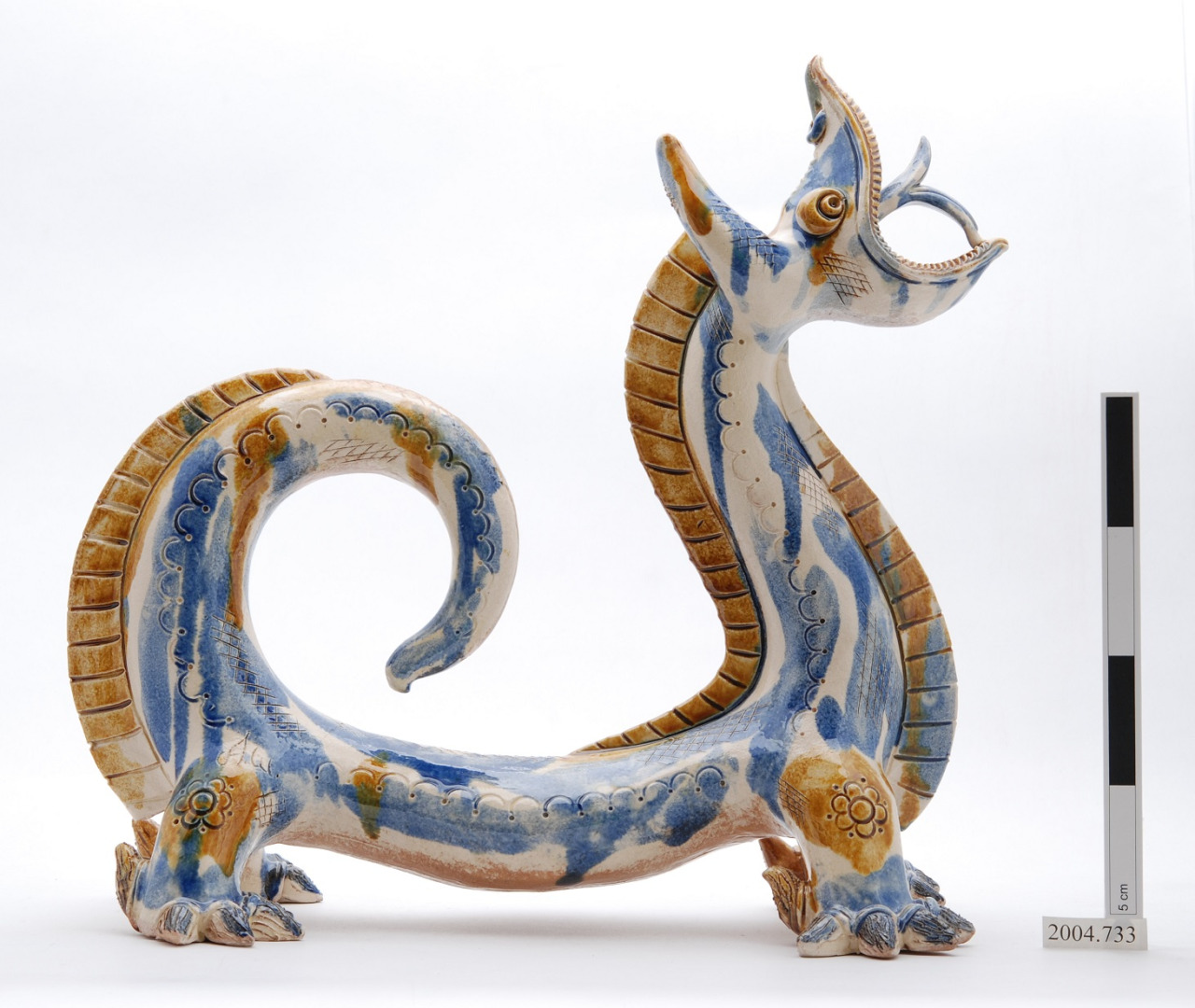
"Wow, that's amazing!" - a beautiful ceramic dragon from Uzbekistan (Image: Horniman Museum & Gardens)

“Wow, that’s amazing!” – a beautiful ceramic dragon from Uzbekistan (Image: Horniman Museum & Gardens)

We didn’t just want to share pretty pictures with our followers, though. We also wanted to encourage engagement. This is not as easy as it sounds, because of the way Tumblr works: followers can ‘like’ or ‘reblog’ posts with one click, but commenting is less common because it takes more effort. But without us even trying, it was happening: people were commenting on our posts, sometimes even telling us things we didn’t know about the objects. So we started an interactive feature called Stick of the Week, in which we share an image of a stick-like object and ask the good people of Tumblr to guess what it is. We have many such objects in the collection, and wanted to share them to highlight that any object can be interesting when you know its story! Stick of the Week sounds silly, but it has (hopefully!) got our followers looking at and thinking about objects differently, and allowed us to open up a dialogue.

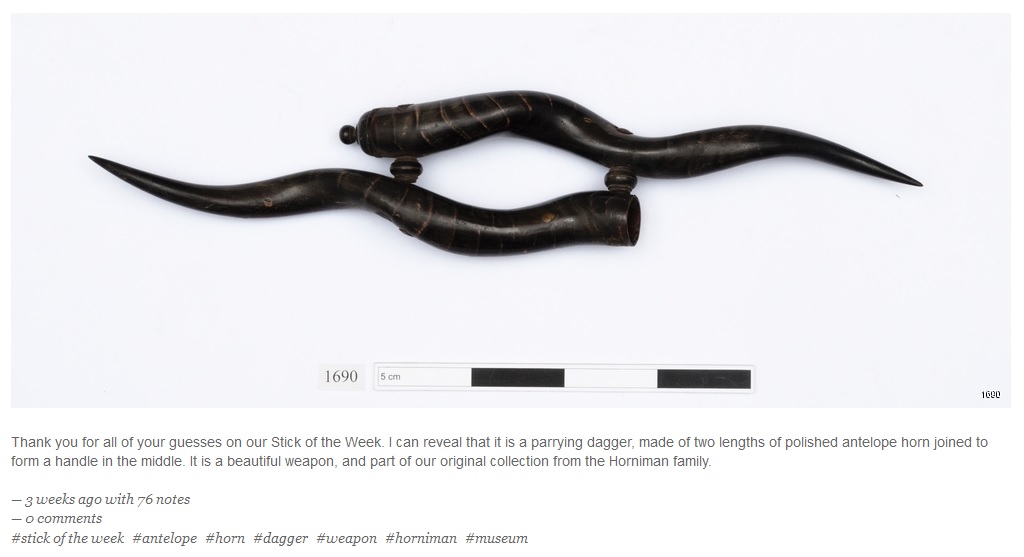
Stick of the Week: a parrying dagger made of antelope horn

Stick of the Week: the reveal (Image: Horniman Museum & Gardens)

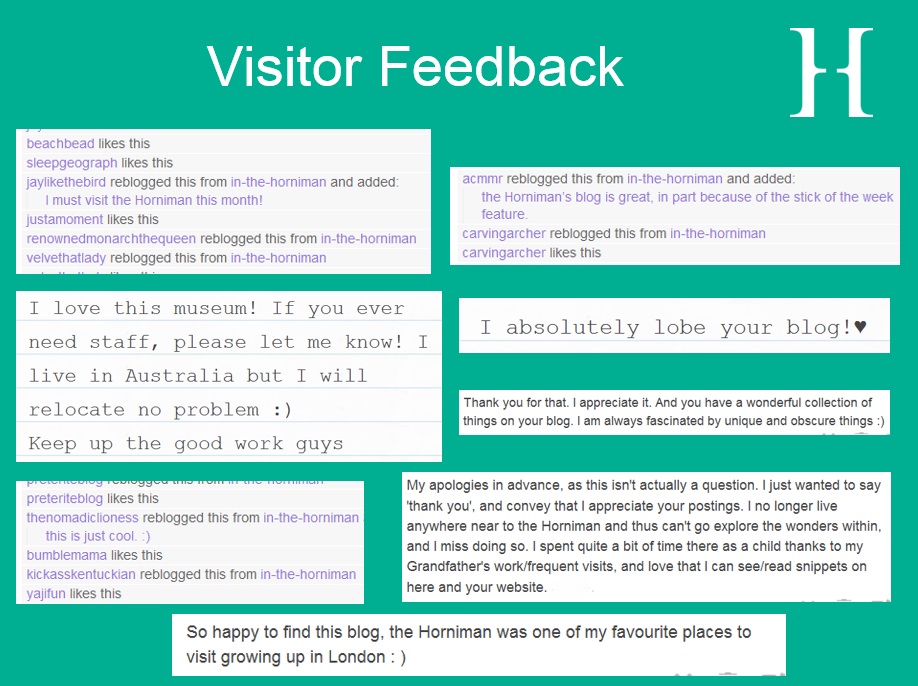
In The Horniman has achieved our aim to share the progress of the Collections People Stories review, and wildly exceeded our expectations. Since 2012 it has gained over 39,000 followers (up by 2,000 since I delivered this talk at NatSCA 2015!), received over 90,000 page views from 158 countries, and even won an award (Best Social Media at the Museums & the Web Awards 2014)! But the reason we keep doing it is the wonderful feedback from our audience:

Visitor feedback for In The Horniman Tumblr page

In The Horniman: people lobe it!

Tumblr has given us a platform to share our collections with audiences all over the world, and a new way to engage people with our objects. Mr. Horniman’s aim in founding the museum was to bring the world to Forest Hill. Through Tumblr, we are now bringing Forest Hill to the world.

Rachel Jennings
Documentation Assistant, Horniman Museum & Gardens