NatSCA Digital Digest

mothdigest

In the blogosphere

For those of us that missed the Progressive Palaeontology conference, Elsa Pancroft, aka Giant Science Lady, has done a great write-up of it. I urge you to take a look.

Delicious news for the GCG: The Geological Society are running their annual bake-off again this year. No lawyers were harmed in the making of these cakes, unless they forgot their oven mitts.


In the news

The appreciation of skeletal form is spreading: first Trafalgar Square’s Gift Horse, now the City of London Academy has unveiled a 13 metre chicken. If anything will stop a person eating meat it’s being killed by a giant chicken.


Conferences and Workshops

Today marks the first day of the Linnaean Society’s two-day Digitisation Seminar. I’m looking forward to hearing from people attending, as it fits quite nicely into this year’s NatSCA Conference theme. Also really looking forward to seeing you all there.


Content assembled by Samuel Barnett

Bringing the Dead Back to Life, with Paolo Viscardi

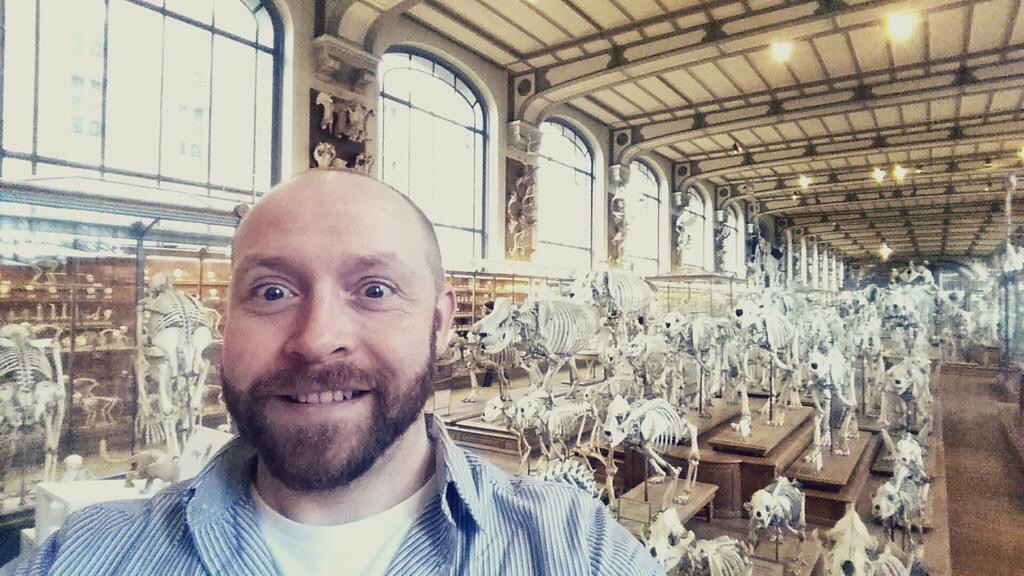
Paolo at the Museum of Comparative Anatomy, Paris

Last week saw the first PubSci talk by NatSCA Chair Paolo Viscardi since we moved venues to the King’s Arms near London Bridge. The subject, Bringing the Dead to Life, is less a Frankenstein manual and more of a description of his role as Deputy Keeper of Natural History at the Horniman Museum and Gardens. He works with dead things every day and he does so for the public’s benefit, because these collections are yours: both yours as a national collective, and yours as an individual if you want to do something with them.1

A large part of the reason we have these amazing collections is due to massive amount of world exploration by wealthy industrialists, tradesmen, and philanthropists. Frederick John Horniman was a tea trader, and collected all sorts of things in his travels. The stuff he brought back captured the public imagination because it introduced them to international cultures they would otherwise have no idea about. We take global information for granted today because we all have access to internet resources in our pockets, so it is hard for us to grasp how unusual it must have been for people in 1948 to see frescoes from Ceylon temples for the first time.

One of the fun side effects of this close encounter with the unusual is that oftentimes people preparing the specimens from overseas were only going by descriptions, and were not at all familiar with the species they were working on. A great example of this is the iconic Horniman Walrus, who was overfilled until he was wrinkle-free – in the style of a seal. There is an exhibit at the Grant Museum of Zoology at the moment discussing this phenomenon and featuring a lovely Stubbs painting of a kangaroo that resembles a giant mouse. Knowing how meticulous Stubbs was about his animal anatomy, one has to believe that this is exactly how he understood them to look and is not in any way an accident of the proportions.

The topic of proportions and measurement brings me on to a study done by Paolo et al. in 2010, looking at the variation in measurements taken of a section of owl bone, so naturally the paper was titled How long is a piece of Strix. Comparative measurement is a fundamental part of species identification, so naturally one would assume a consensus of readings taken by professionals. The results were somewhat different: when working alone, the measurements were accurate. When working as part of a team, the measurements strayed, and the more people collaborating, the greater the disparity between measurements.

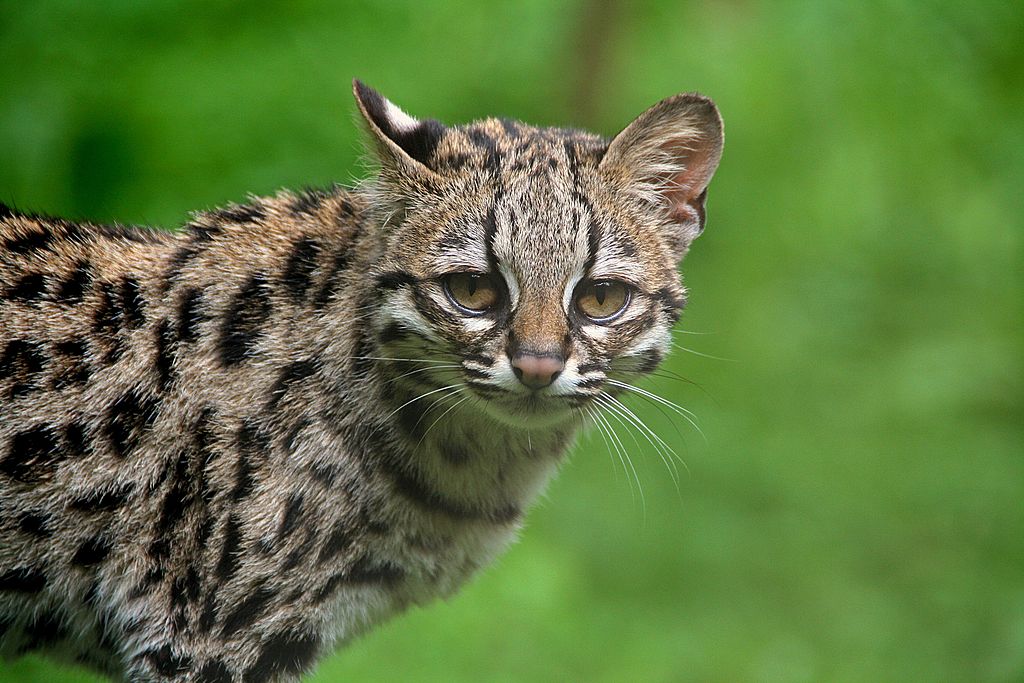
As a science communicator both at the museum and through his blog, Paolo has had the opportunity to work on some interesting projects: he has advised BBC television series such as our patron Ben Garrod‘s Secrets of Bones and he has been interviewed for The One Show to explain why cats get stuck up trees (they can’t rotate their ankles). This allowed Paolo to introduce the viewing audience to the Margay (Leopardus wiedii): a cat that can rotate its ankles. He has shared his love of osteology with 13-year-old fellow-blogger Jake McGowan-Lowe, which led to Jake publishing a book on the subject! To promote a recent Horniman exhibition on extreme animal adaptations, Paolo was subjected to the harshest elements in nature, which earned him the title ‘Extreme Curator’, and his very own Lego action figure.

Margay

Margay. By Clément Bardot (Own work) [CC BY-SA 3.0 (http://creativecommons.org/licenses/by-sa/3.0)%5D, via Wikimedia Commons

Where next for Paolo’s science communication? You’ll have to ask him at the next PubSci with Professor Ian Barnes. If you’re a fan of pleistocene megafauna (and, let’s face it, who isn’t), I wouldn’t miss it.

Sam Barnett, NatSCA Blog Editor

1. Depending on what it is you want to do with them and how run-ragged the museum staff are.

NatSCA Digital Digest


Welcome to the weekly digest of posts from around the web with relevance to natural science collections. We hope you find this useful and if you have any articles that you feel would be of interest, please contact us at blog@natsca.org

1. Job: Curator/Lecturer in Vertebrate Palaeontology

It’s your last chance to get your applications in for this one.

Deadline: 3 April 2015

Employer: University of Cambridge

Synopsis

We seek to recruit an outstanding scientist to join the staff of the Department and Museum of Zoology at Cambridge. The successful candidate will combine excellence in research with a commitment to teaching at both undergraduate and graduate levels. In addition he/she will have the ability to engage with the work of the Museum in collections development, outreach and public engagement. 

We seek a candidate with the ambition and ability to fund and lead a world-class research group. For this post, we are likely to appoint a candidate whose research is collections-based. The appointee…

Read more and apply here

2. Exhibition: Coral Reefs

When: 27 Mar 2015 – 13 Sep 2015

Synopsis

Now opened at the Natural History Museum, London. This spectacular window into a world that enriches our very existence is well worth visiting.

Click here for more details

3. Workshop: R Without Fear – Applied R for Biologists

this course is not organised by NatSCA but it could come in handy for our members.

when: 21-25 Sep 2015
where: Facilities of the Centre de Restauració i Interpretació Paleontologica, Els Hostalets de Pierola, Barcelona (Spain).

Synopsis
Introduction to the R working environment.
– Variable types in R.
– Statistical populations and samples through working examples.
– Measurements of central tendency and variability.
– Precision, accuracy and bias.
– Hypothesis testing: Falsability, Type-I and II errors and statistical power.
– Correlation and simple regression.
– P-value vs. effect magnitude.
– Linear Models: Residuals, assumptions and interpretation.
– Explained vs. unexplained variance of a model (the coefficient of determination).
– Building functions in R.
– Introduction to graphics in R.
– The concept of partial effect: Partial regression and correlation.
– General Linear Models (GLM).
– Curve fitting in linear models and General Additive Models (GAMs).
– The problem of spatial autocorrelation in ecology and evolution.
– Multicolinearity: When is there a problem?
– Additive vs. multiplicative effects: Checking and plotting interactions.
– Introduction to General and Generalized Linear Mixed Models (GLMM).
– Fixed vs. Random effects and implications for analysis: Main R functions.
– Introduction to Bayesian statistics: The function MCMCglmm.
– Practical examples in evolutionary ecology:
The study of natural selection.
Applications of linear models for quantitative genetics.
– Student’s case studies.

for more information visit their website

Compiled by Sam Barnett, NatSCA Blog Editor

NatSCA Digital Digest

Welcome to the weekly digest of posts from around the web with relevance to natural science collections. We hope you find this useful and if you have any articles that you feel would be of interest, please contact us at blog@natsca.org

1. Blog: Personal Space in Patagonian Cormorants

Chicago Professor Jerry Coyne’s blog Why Evolution is True this week contains a great example of modern technology, in this case drones, being used to observe the natural world. I wonder if drone footage will be mentioned as an example of ‘modern media’ at the NatSCA conference. I digress: The nesting sites are quite magnificent and reminiscent of frogspawn from a distance.

Synopsis

In Jerry Coyne’s own words:

From Grind TV we have lovely video and photographs of 5300 pairs of Imperial Cormorants (Phalacrocorax atriceps, also known as “Imperial Shags”) nesting en masse in Patagonia.  The nests cover an area of 2000 m², which is less than half the area of an American football field.

Follow the Link to see.

2. Event: Strange Creatures: the Art of Unknown Animals

Where: The Grant Museum of Zoology

Date: 16th March – 27th June

Open to: all

Admission: Free

Synopsis

From the Grant Museum website:

When new regions are explored and the animals in them discovered, how does the wider world get to experience these species? From the earliest days of exploration, art has been essential in representing creatures that are alien to people at home.

The Strange Creatures exhibition will explore the world of animal representations, featuring the painting of a kangaroo by George Stubbs which was recently saved for the nation. It was painted following Captain Cook’s first “Voyage of Discovery” and is Europe’s first image of an Australian animal.

Click here to find out more.

3. Job: Collections Manager (Life Collections)

Organisation: Oxford University Museum of Natural History

Salary: Grade 7: £30,434 – £37,394 with a discretionary range to £40,847

Duration: Full-time, permanent

Location: Oxford, UK

Closing date: 10th April 2015

Synopsis

Oxford University Museum of Natural History houses the University’s internationally important geological and zoological collections, which are used for research, teaching, and public engagement in science. It is seeking to appoint a new Collections Manager for the Life Collections.

The Life Collections comprise six million specimens, of which around 30,000 are zoological type specimens, and there are currently 10 staff with collection management responsibilities in this area. The collections have particular strengths in insects, crustaceans and vertebrates. The Collections Manager will work across all areas of Life Collections, but the role will have particular emphasis on the vertebrate and/or malacology collections. The successful applicant will be responsible for documentation, imaging, databases and conservation, and will facilitate research visits and loans. They will also be part of the teams developing new exhibitions and displays, and will participate fully in the museum’s outreach and public engagement programme. It is expected that the successful applicant will engage in field collecting and some collections-based research.

Click here for more details and to apply


On a different note, our very own Emma-Louise Nicholls is going to be doing the Richmond half-marathon next week. She is raising money for Save the Rhino – a cause dear to all our hearts. If you would like to donate, here’s how.


Compiled by Samuel Barnett, NatSCA Blog Editor

World Book Day

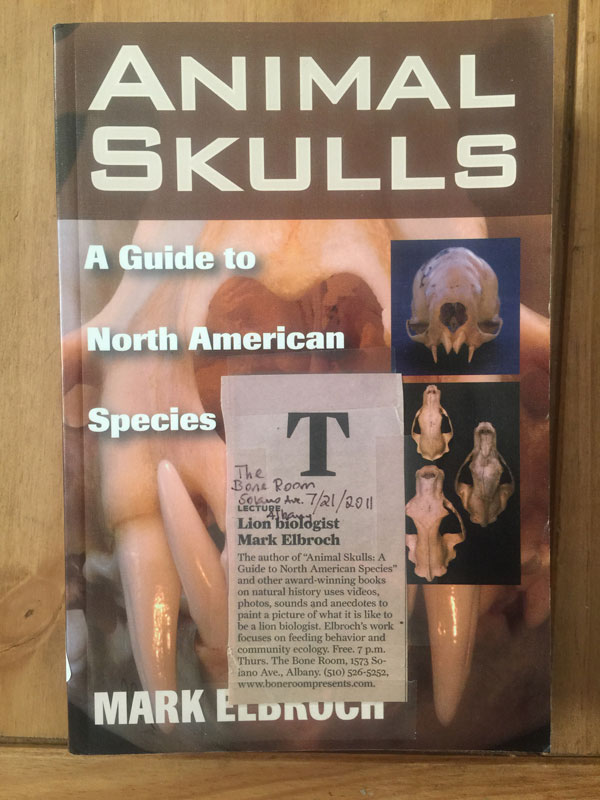
World book day is a time for sharing the books that have made an impact on you. Chances are, if you liked it, so will someone else. It has a tradition of being all about fictitious books but there’s no reason why that has to be the case. I’m going to share with you now a very interesting book that was loaned to me by Oxford Museum‘s own Gina Allnatt : the book is Animal Skulls, by Mark Elbroch. It’s a really handy resource for relative measurements of features and this particular copy came with a history: the previous owner before Gina was clearly researching big cats and had added this note to the front about a presentation by the author. There’s another note on the inside too.

Animal Skulls

A Guide to North American Species

We have some great book reviews coming in the near future so keep an eye out for those. Today I’d really like to hear what books have recently touched you – fact or fiction but specifically ones relating to natural history collections. Good books should spread faster than plagues.