Night at the Museum, Uni Week

“Every night all the specimens in the museum come alive and instantly drown in industrial methylated spirits or silently scream without flesh”

Mark Carnall, Grant Museum.

Most people’s experiences of museums after dark differ to Ben Stiller’s. Mine last night was no exception. I visited the Natural History Museum, London, to see what science’s next generation are doing with our natural science collections.

It didn’t take long to wade past the cultural historians and robot musicians to find a relevant stand:

The University of Leicester

These guys have been studying the process of organic decay. Their stand, titled “Rotten Fish and Fossils – Resolving the Riddle of our Earliest Vertebrate Ancestors”, showcased photographs of a series of exquisitely preserved fossils – many from the Royal Ontario Museum, Toronto. I was shown a 300 million year old relative of the lamprey who stared lifelessly back at me from deep time. His modern counterpart lay equally lifeless in a nearby vacuum bag.

As part of their research, the team have been deliberately decaying various modern vertebrates in an attempt to better understand the process. One thing their team found was that the order in which structures decayed seemed to be a reverse mirror of the order in which they evolved. The implication: if you don’t identify how far along something is in the rotting process, its evolutionary relationships could very easily be misdiagnosed. You can read more about this on their site. This includes citations of published material (£).

The University of Cardiff

Project Splatter is a relatively new endeavour to track the location, variation, and frequency of road kills around the UK. Roadkills are a daily occurrence and form an important part of the corvid and fox diet. The University of Cardiff are asking for your help using social media to crowd source the data.

Most of the time all they want is the species, location, and date but, if it’s a bird of prey or an otter, they need the carcass too. As we know all too well from the DDT egg shell research, if there’s toxins in the environment it’s the top predators who get the most concentrated dose. Here’s the best part: after they have finished analysing the specimens, their remains are sent to the National Museum, Scotland to contribute to their natural science collection. With around 200 otter fatalities on the road per year, the NMS is fast becoming the best place to go for otter variation studies.

You can help out via Twitter, Facebook. They even have an Android app.

Middlesex University

Andrew Greenhargh has been playing with some fun toys involving biomechanics. While his current research is predominantly aimed at humans, the technology has been used to analyse obstacle avoidance techniques in running guineafowl during his stint at the Royal Veterinary College.

Andrew was squeamish until he met John Hutchinson: one elephant dissection later and he was a new man. One thing I learned talking to Andrew is that, when you have to euthanise a sick elephant, it is important to do it in front of the remaining elephants and give them time to grieve. They are very emotional and social animals. If you don’t do this, the other elephants can often become violent. He also talked about the keepers sitting vigil with the deceased elephant: despite recent tabloid stories to the contrary, most zoos care deeply for the animals in their care.

That’s all for my round-up of natural science university research. I did take a look at the other stands ad am happy to talk about what those institutions are up to. If you missed it and want to know more, do ask.

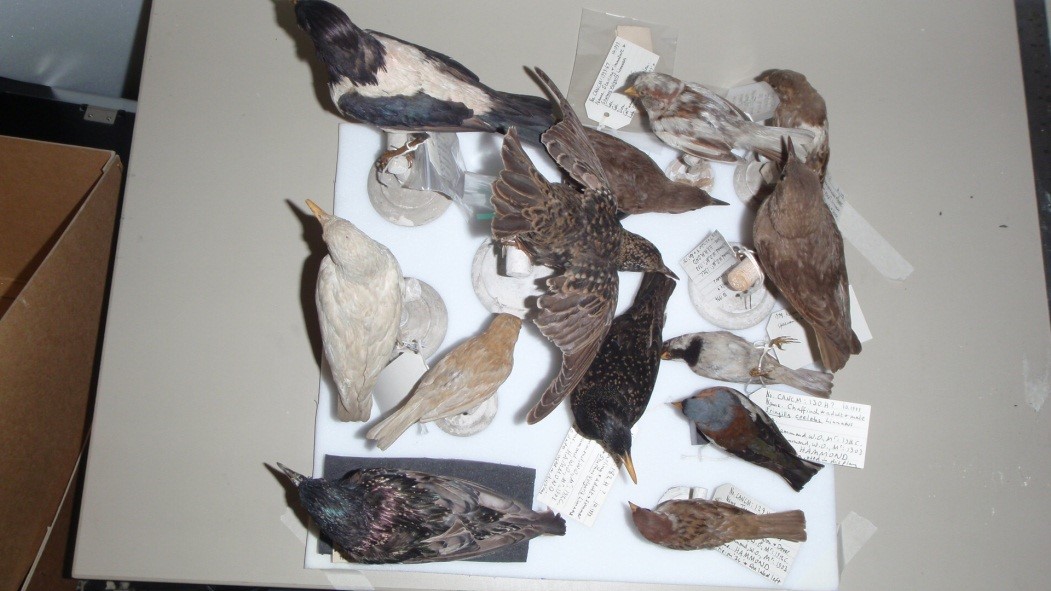
New loose taxidermy storage at Canterbury Museums

The following is a review by Philip Hadland, of a storage project undertaken by the Canterbury Museums:

Introduction

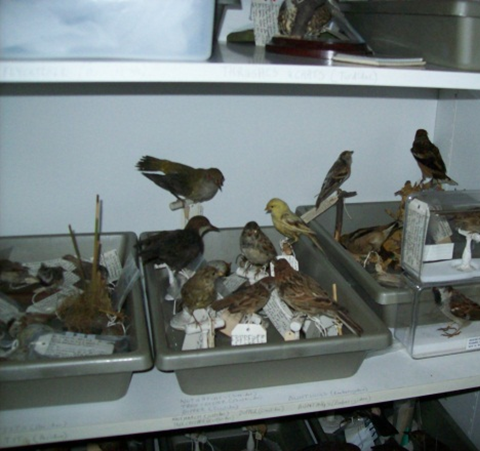
Much of Canterbury Museums taxidermy collection is loose taxidermy and is stored in shelved cupboards without any additional physical protection from handling, movement, or insect pest damage. A pilot project was carried out in 2013/14 to develop a new storage system for this section of the taxidermy collection to improve its care and management.


Aims of the Project

  1. Improve storage conditions and long term care
  2. Improve the management of the collection
  3. Free up storage space


Evaluation of Potential Storage Methods

To get a feel for what might work in practice I sent an email to the NATSCA Mailing List asking for ideas on what works well and what works not so well. Based on the plentiful feedback I received, I evaluated the advantages and disadvantages of the methods suggested.

From this initial research it is clear that there is no single method that can satisfy the needs of the great variety of sizes and shapes of taxidermy that exist in museum collections. Some methods are of course better than others in satisfying similar aims but cost is also an issue.

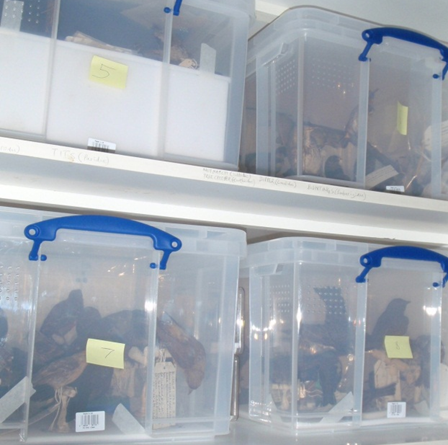
It was decided that a method based on Really Useful boxes was the best solution. The main reasons were the amount of time needed to prepare each box was minimal, there were very good offers available to acquire the boxes cheaply at the time and the sizes available matched up very well to the storage cupboards.


Method

2014-06-03_birds

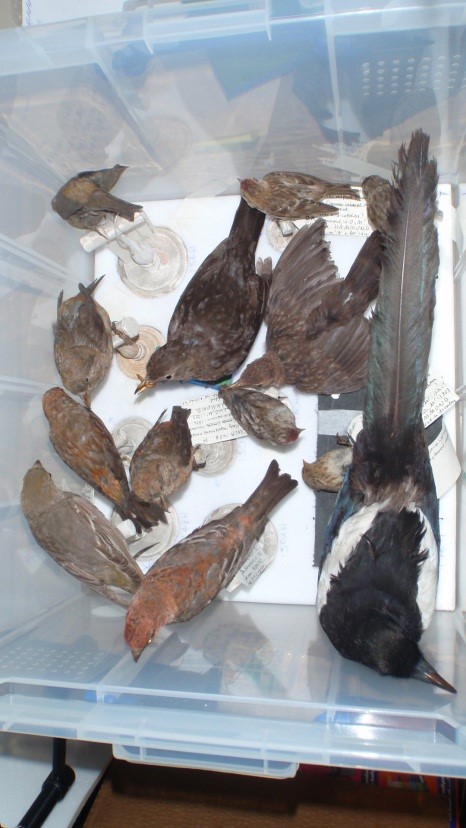
Plastazote was first cut to fit the boxes. Then the bases of specimens were drawn around in pen with the specimen number written alongside and orientation to enable easy identification of what goes where. A list was also kept of the contents of each box.

2014-06-03_cut-foam

The foam was cut using a Stanley knife and affixed to the bottom of the box using masking tape.
The birds were then carefully slotted into place and the boxes were labelled and the location documentation was updated.

Before

2014-06-03_before

After

2014-06-03_after1

2014-06-03_after2

Resource breakdown and cost

Really useful boxes x 10 £110
Approximate cost of Plastazote used £20
Fixings and adhesives £1
Mothballs £4
Total material cost £135
Curatorial time (including planning) £300
Volunteer time (for photography and documentation 10 hours
Total cost £435


Summary

127 items of taxidermy have been rehoused and are well supported in robust, waterproof and conservation standard materials that are easily moved without the birds toppling and they are transportable. This will limit damage to the collections through preventing unnecessary handling, toppling, and pest attack – increasing their long term care. Each specimen now has a specific box location linked to the database so that it can be found easily when required.


I’d like to thank my colleagues and the NatSCA community for their help with this project.

Review of a Training Course on Pesticides and the Latest Legislation

The following is a review made by Roberto Portela Miguez, Mammal Group Curator at the NHM London:

About a week ago I attended a course and talk at the Natural History Museum of London, entitled “Control of Pesticide Regulations 1986 (as amended 1997) EU Biocides Regulations 528/2012”.

I know that, even if your two passions in life are pesticides and obscure legal documents, it is highly unlikely that you would rush to sign up for it.

After attending the event I can assure you that I still do not wish to look into both topics more than I need to. I do however strongly recommend all collections management staff to attend any future opportunity to listen to Bob Child’s talk or training event on this topic.

Robert Child was formerly Head of Conservation at the National Museum of Wales, and is now a Conservation Consultant, Advisor on Insect Pests to the National Trust and Director of Historyonics.

His company, Historyonics, sells insect pest products and carries out treatments on historic buildings and collections – so he has plenty of first-hand anecdotes to illustrate the various points he makes during his talks.

His experience on these matters is vast, but possibly more important: he is a brilliant communicator that can easily turn what is a dry and dull topic into two hours of effective and entertaining training.

The course Bob runs is required training for anybody using pesticides as part of their work ( this includes volunteers ) and is based on the requirements of the Control of Pesticides Regulations 1986 (as amended), the Control of Substances Hazardous to Health Regulations 1988 (as amended) and the new Biocides Regulation 528/2012. It is further based on the HSE’s publication ‘Recommendations for Training Users of Non-agricultural Pesticides’.

The course lasts for about two hours and covers both theoretical aspects on a Powerpoint and practical demonstrations of:

  • principles of pest control and nature of pesticides
  • legislation
  • storage and transport of pesticides
  • use of pesticides (on site assessments)
  • labels and data sheets
  • safety in preparation, clean up and disposal.
  • emergency procedures
  • record keeping

Once you have gone through the training, you will be qualified to apply pesticides in your collections and, without doubt, be extremely grateful that Bob has done all the reading of the relevant EU legislation on your behalf.

I know most of us do our best to prevent infestations but, just in case, better to be prepared and qualified than …you know.

Keep checking our NatSCA website and blog for news on future workshops and training events and if you want to contact Bob to run the course at your institution, you can email him to bobchild@historyonics.com .