
Written by Sebastian Stroud, Teaching Fellow in Ecology, School of Biology, University of Leeds.
Did you ever visit the experimental gardens of the University of Leeds? For the vast majority of you, I imagine not. It’s more than likely you’ve never even heard of the old gardens, and that’s because they’ve been shut down entirely. Demolished in the mid-noughties, the collections were disbanded and moved to other institutions. A story not unheard of for university living collections.
For those interested, there exists a fascinating history – a story told by the garden’s former plantsman, Martin Lappage (Lappage and Redshaw, 2021). Although, like many of you, I never stepped foot in the old experimental garden, reading Lappage’s book conjured inspiration as though I’d been there with him. From fascinating figs and their minuscule wasp pollinators to award-winning orchid collections, the old garden was a botanist’s dream.
But this bygone botanic glory came with its challenges, so says its oral history. A primary source of strife was the garden’s location: based off campus, travelling there was less-than-convenient for staff and students who required access for teaching and study, and the garden saw even less engagement from the wider Leeds community. To function, a resource like this must serve the breadth of the work and the wider community within the University of Leeds.
Despite the historic hurdles to functionality, many of us teaching ecology and conservation have often reflected on how much value a new botanic garden would bring to the city of Leeds.
Botanical skills – particularly field skills – have increased in demand in practical, industrial and academic spaces. I discuss this extensively in my paper on the Botanical Education Extinction (Stroud et al., 2022), a slow erasure of the discipline driven by institutional policies and botanical apathy. Thankfully perhaps the tides are turning, legislation on biodiversity net gain requires the upskilling of the UK’s conservation and ecological workforce regarding species recording and surveying. More existentially, inspiring within the population a connection with nature is vital to push conservation action, and thus connecting people with surrounding plants and their planet – via access to green spaces – is critical to building an ecological civilisation with ecological values, skills and goals.
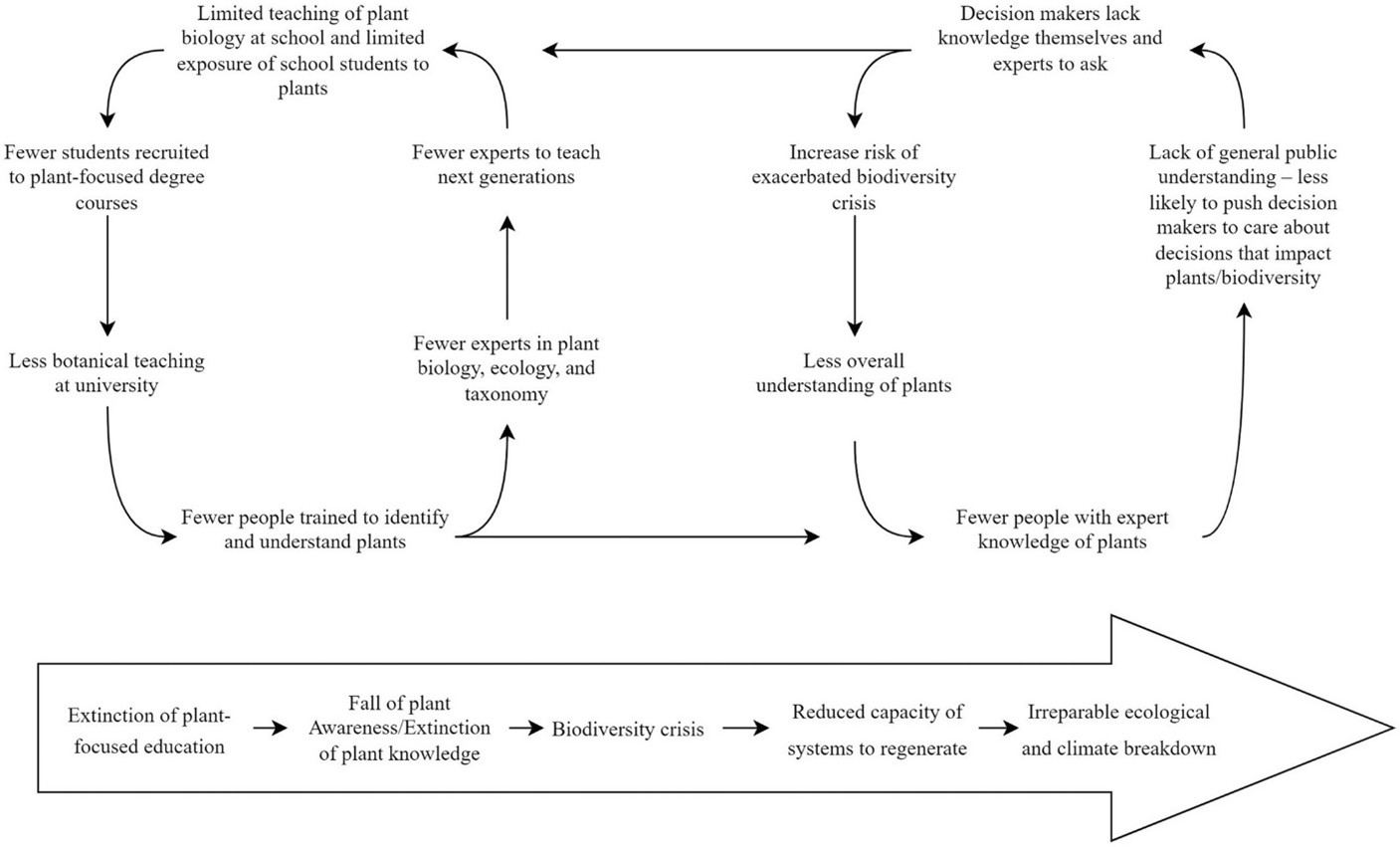
Figure 1: The fall of plant awareness and the extinction of botanical education. The decrease in plant awareness feeds into a cycle of diminishing knowledge of plants at both expert and general knowledge levels that will ultimately increase the risk of the biodiversity crisis and the potential for resilience and restoration in the face of anthropogenic global change (Stroud et al 2022)
Those readers who work extensively with biological collections might also be familiar with the “taxonomic impediment”, protecting our biodiversity means that first we must describe it, a skillset that is decidedly absent across many contemporary biological science programs. Few universities hold living collections of plants, and few modules explicitly highlight taxonomy as a hypothesis-driven science, after all species delimitation and species identity are both falsifiable with additional evidence (Stroud et al., 2026).
It was with this in mind that I first posed the idea of a new botanic garden at the University of Leeds. Not only a place for teaching, research and engagement, but a space for community. A botanic garden would generate subtle, yet profound, effects. Dr Yildiz Aumeeruddy, a botanist specialising in the Himalaya, once said: “Above all they [plants] are a source of peace. My relations with plants are made simple and calm by the feelings of shedding a universal sadness. Their simple presence is profoundly comforting and calming. To observe plants is to allow them to spread their beauty over me, of forms, colours, scents”.
What Aumeeruddy is experiencing is in no way a unique experience: many before her have taken quiet respite under the canopy of a tree, or rested a while nestled in green, but the truth of her sentiment is undeniable and concrete. A green space provides a place for wellness, thus supporting in combating the current mental health crisis affecting many sections of society.
It is therefore with great pride that I would like to introduce the first new university botanic garden in England for a century, one that is now being built here at the University of Leeds. Developed with the expertise of Re-form Landscape Architecture, the University of Leeds has committed to the creation of a dynamic space at the heart of campus, nestled between historic brutalist buildings and innovative research labs. Centred around accessibility and the landscapes of Yorkshire, the garden features a variety of spaces created to educate and inspire the University community and wider public. From our climate resilient zone featuring the plants that might grace our patios in the uncertain climates of tomorrow to the native woodland garden, featuring rare woodland natives, planted to emulate the breadth of woodland found across God’s Own County.
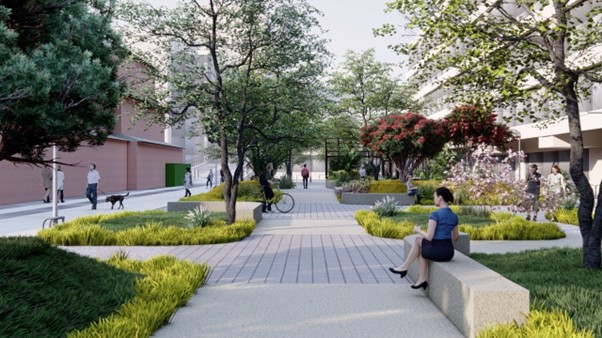
Figure 2: Rendering of the new University of Leeds Botanic garden, featuring native habitats and species of ornamental and cultural significance. Copyright at Re-form Architecture.
The Garden, which is yet to be named, will sit on what is currently a car park on campus, a dusty eyesore which runs through the heart of the institution, the project will not only revitalise this area, but connect disparate greenspaces on campus, finishing a green corridor that connects the city of Leeds to the wide countryside. The gardens will be small, less than an acre in size, but with innovative design, monitoring technology, and a passionate community, the hope is we can slowly expand across campus, naturalising current areas of non-native ground cover. It has been designed with accessibility as a core tenet, raised beds and minimal slopes allow all members of our community to access the space and experience the plants. A central community bed will be used as a space where local artists and community groups may come together to collaborate with the University. The range of beds will capture the wondrous but often unappreciated lives and diversity of plants we find all around us, whilst the greenhouse will showcase the incredible but imperilled diversity of the world tropics.
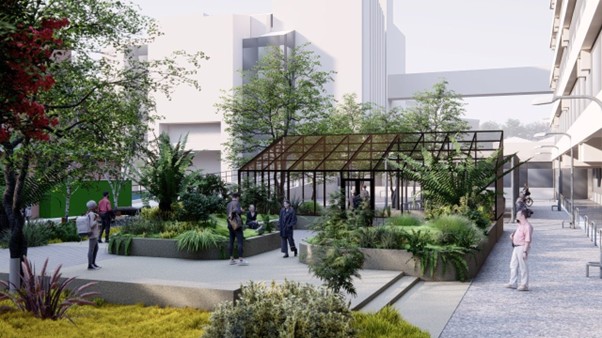
Figure 3: Rendering of the tropical glasshouse in the garden. The space utilises sustainable building principles, retaining and reusing as much material from the original site as possible to the minimise development’s environmental impact. Copyright at Re-form Architecture.
One of the core principles of my practice is that plants are relevant to everyone, most just haven’t realised it yet. The teaching within the garden mustn’t be limited to those students of environmental and biological disciplines but include students from across the arts and humanities. The stories of plants extend beyond the biological, but span across our history, from British imperialism to Roman mysticism.
Although the old experimental gardens – once tended by Lappage – are sadly gone, what will emerge on our campus will be an exciting chance to enact a bold approach to learning, ecology and the reestablishment of functional greenspaces: a legacy for the environment that begins in the creation of a garden.
For those of you interested in the journey of the garden, please follow its development on the University of Leeds Campus Reimagined pages or contact Sebastian Stroud at s.e.stroud@leeds.ac.uk.
References
Lappage, M.G. and Redshaw, K. (2021) A potted history of the University of Leeds Experimental Gardens: their people and plants. Edited by C.E. Dowman. Illustrated edn. Leeds: Leeds Philosophical & Literary Society Limited. ISBN 9781527283466.
Stroud, S., Fennell, M., Mitchley, J., Lydon, S., Peacock, J. and Bacon, K.L., 2022. The botanical education extinction and the fall of plant awareness. Ecology and Evolution, 12(7), p.e9019.
Stroud, S., Hall, H., Knapp, S., Baker, L., Mitchley, J. and Culham, A., 2026. Addressing taxonomy shortfalls requires an educational reform. Trends in Plant Science.


Pingback: NatSCA Digital Digest – May 2026 | NatSCA