
Written by Hannah Clarke – Assistant Curator (Collections Access), University of Aberdeen.
In May this year, I was given the slightly terrifying task of overseeing the removal and transportation of Aberdeen University’s much-loved Japanese Spider Crab (Macrocheira kaempferi) specimen. The crab, who is usually proudly displayed in the foyer of the University’s Zoology Building, had been requested for loan by Aberdeen Art Gallery & Museums, for their exciting new exhibition ‘Monsters of the Deep.’
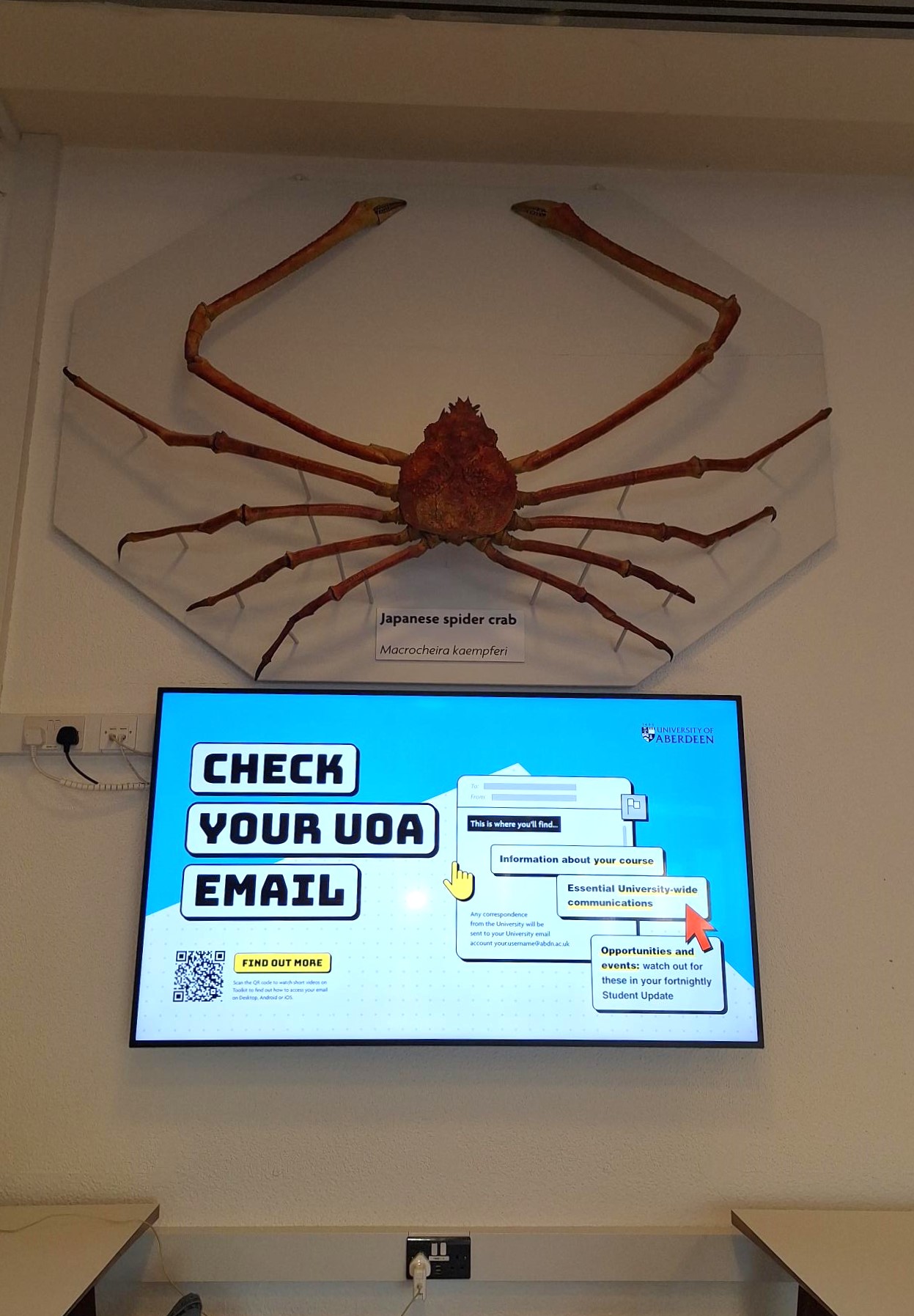
The crab had previously been removed during renovation work in 2019, without hiccup, so recalling how ‘straightforward’ this had been last time, I was confident that we could get the crab removed, cleaned, packed, and ready for transport in just under three days.
The Downs!
Well… as you may have already guessed, things did not quite go as planned!
Unfortunately, this time around, the crab proved a little more difficult to remove from the wall, which sadly resulted in the fragile specimen being damaged as it was lifted down.
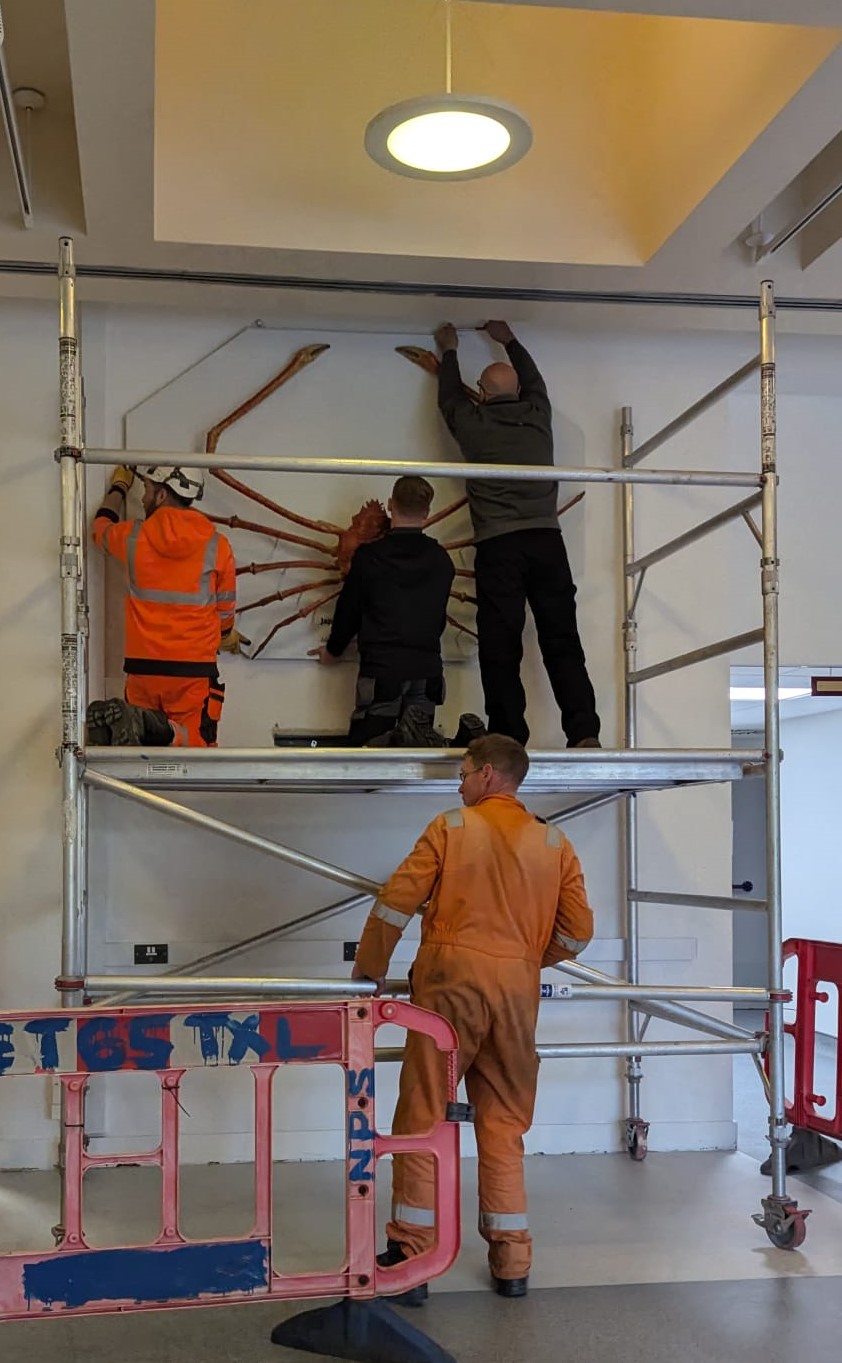
The right claw was almost entirely detached from the forearm, one smaller limb was broken in two places, and there were hairline cracks which had formed at each joint. As the crab was only mounted to the backboard via small struts and wire, the Collections Team needed to ensure that that any weakened areas were stabilised and repaired prior to its transport across the city for exhibit.
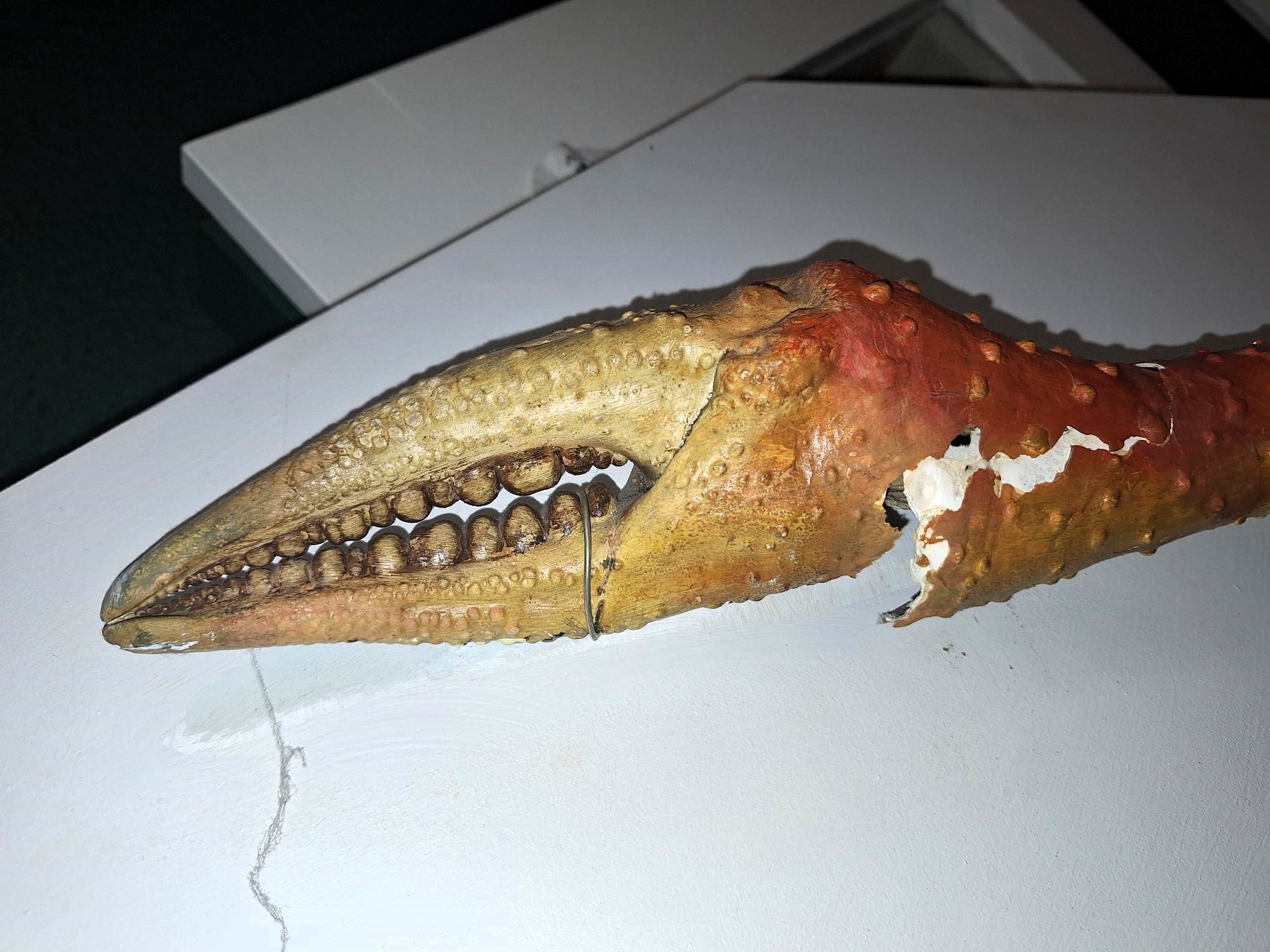
It was ‘all hands on deck’ to get the remedial work completed in just two days, but luckily for us, we just happen to have several enthusiastic conservation professionals in our team (Thank you Caroline, Izzy, and Sam!).
Firstly, the specimen was vacuumed and then given a wet clean using mild detergent to remove any stubborn areas of dirt. We strengthened and repaired any cracks and breaks with Japanese tissue paper applied using 20% Paraloid B72 adhesive dissolved in acetone, ensuring that the paper edges were feathered to blend them into the surface. In a couple of areas, we applied a thicker weight of paper or built the tissue up in multiple layers over time to ensure that the repairs would be strong enough to hold the break edges together. Once fully dried, we colour matched the repairs using acrylic paints.
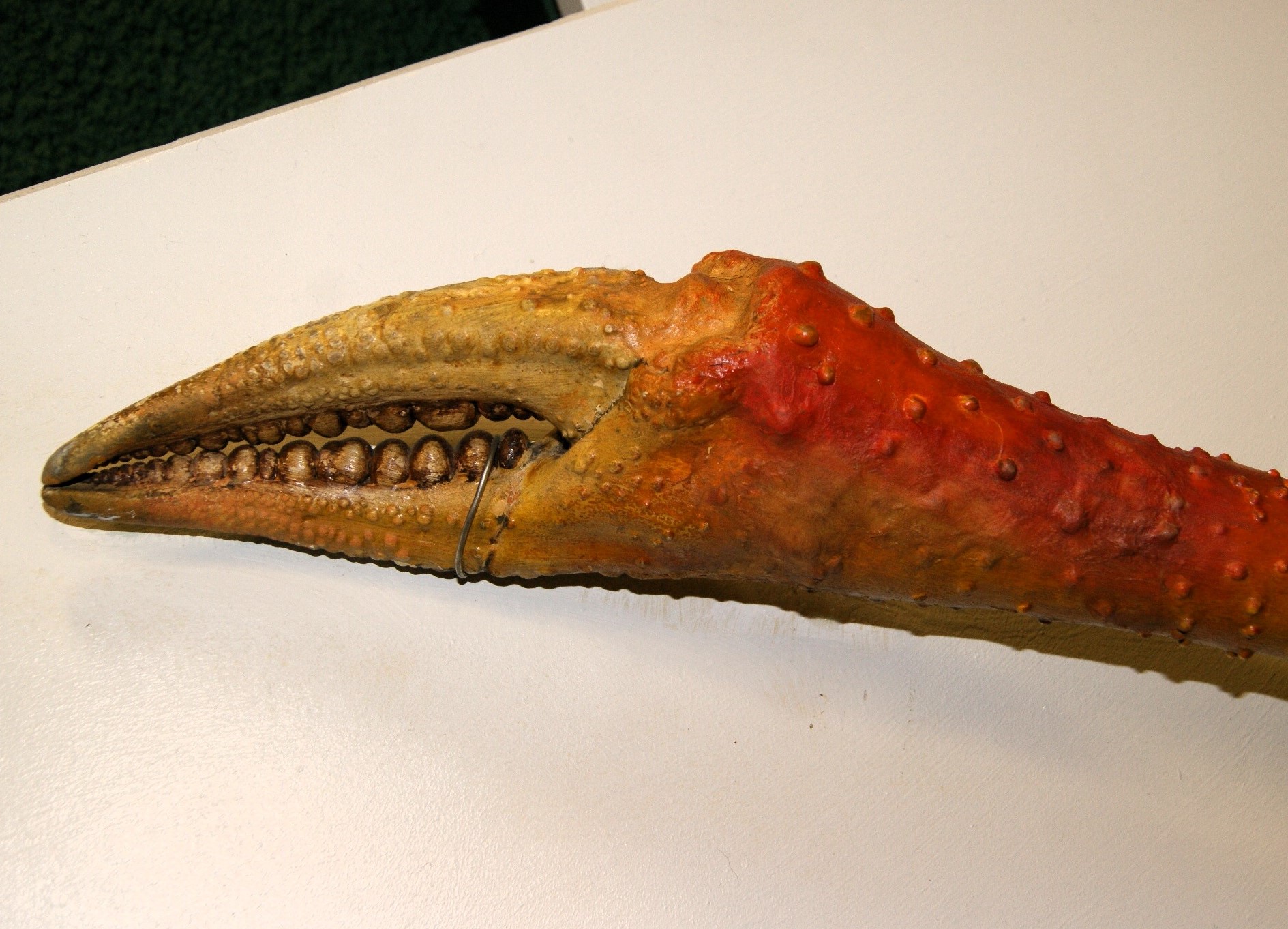
Finally, the crab was ready to be transported to Aberdeen Art Gallery, and mounted in pride of place, ready to greet eager visitors to the exhibition.
The Ups!
Before he went on his travels, I had to do a little digging into the provenance of the crab… Although we knew he had been in the collection before 1905, sadly the donor and acquisition information had never been entered into the database record.
Having spent a little while leafing through the historical catalogues from the University’s ‘Natural History Department’, now held in the library archives, I was pleased to find the entry for a ‘Large specimen of Japanese Spider Crab, ‘donated by James Bisset Esq, (Edinburgh, formerly of Japan), 1895’.
SO… who was James Bissett, and how did he get the crab from Japan to Aberdeen, I hear you ask!
Having carried out a quick desktop search, I was able to start piecing together the life of our James Bissett (1843 – 1911). James, originally from Inverurie, was a keen botanist interested in marine species, alongside his brother J. P. Bissett, who published papers on Japanese desmids.
James started out his employment with Strachan & Thomas, Merchants and Insurance Agents based in Yokohama, Japan in 1867. James did well whilst in their employment and eventually became partner in 1871, before leaving to set up his own company in Yokohama, ‘Bisset & Co’ in 1880.
During his time in Japan, James continued to collect plant specimens, publishing in the Journal of Botany (1886), becoming a Fellow of the Linnaean Society and making connections with other naturalists living and working in or around Japan. He sent material to Kew, as well as to Carl Maximowicz, and even had two species named for him Viola bissetii and Dryopteris bissetiana (Barnes, 2001).
James also became particularly good friends with his employee Henry James Stovin Pryer (1850-1888), an entomologist and ornithologist, and they would often collect specimens in the field together. Henry was particularly interested in the butterflies of Japan and spent 16 years compiling notes in preparation to publish his ‘Rhopalocera nihonica: a description of the butterflies of Japan’. After publishing part one of the book, Pryer unexpectedly contracted and died of pneumonia in February 1888, with volume’s two and three carefully prepared by and posthumously published by his friend James Bisset within a year of his death.
In 1898, Bisset and his business partner dissolved their Yokohama-based merchant company, and he retired to Edinburgh. In 1899, James obtained a Master of Arts from Oxford, and in 1900 became a fellow of the Royal Society of Edinburgh. Bisset remained in Edinburgh until his death in 1911 and was laid to rest in Inverurie Bass Cemetery at his family’s memorial site.
Mystery Solved!
And so, the mystery of the crab is no longer such a mystery, given that James owned his own merchant company in 1895, it is likely that he shipped the animal directly to Aberdeen, and that it was mounted by technical staff in the Natural History Department here at the University. Although it is exceedingly rare to discover a spider crab of this size nowadays, there are records from the 19th century of these creatures often being tangled in fishing nets off the coast of Japan.
Considering he is over 130 years old; I think you will agree that he looks wonderful up there on the wall!
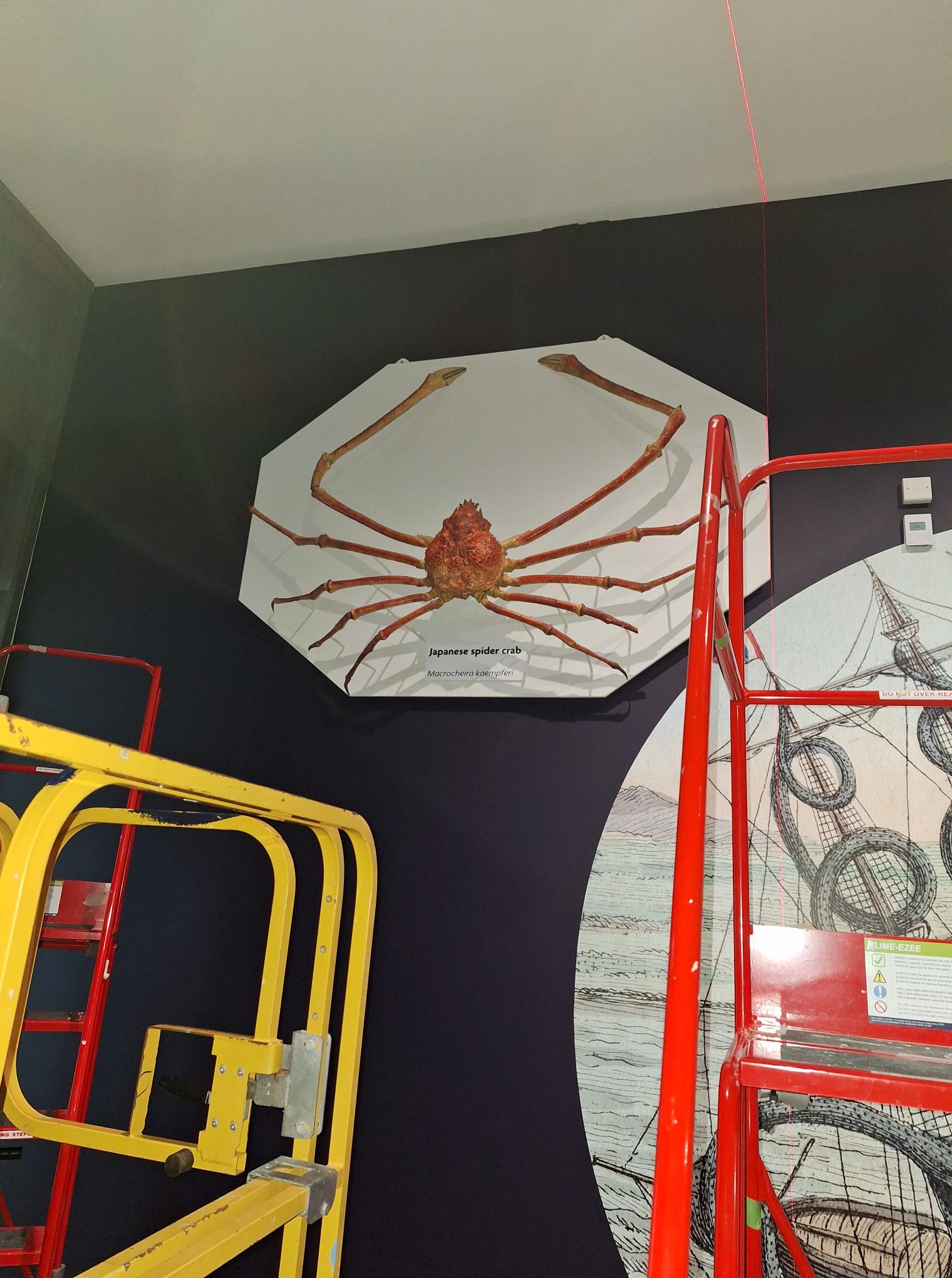
If you happen to be in Aberdeen in the coming months, ‘Monsters of the Deep: Science Fact or Fiction’ is on at Aberdeen Art Gallery and Museum until 26th October 2025 and is well worth a visit! Tickets can be found here.
And whilst you are at it, why not come along and spend an hour or so marvelling at our other intriguing specimens in the University of Aberdeen Zoology Museum, the best bit is that it’s free!

 NatSCA
Pingback: NatSCA Digital Digest – August 2025 | NatSCA
Pingback: Top NatSCA Blogs of 2025 | NatSCA