
Written by Jazmine Miles Long, Taxidermist.
When a taxidermy mount is made, the skin of the mammal (and in some cases reptiles and birds) is usually tanned. Tanning is the process of turning a raw skin into leather using chemistry. By turning the skin into leather, we are changing a fragile perusable material into something durable that can be sculpted into taxidermy and be more resistant to insect attack. Tanning the skin involves removing proteins in the skin and loosening the collagen fibres and then attaching tannins to these structures. Leather can be made with either the hair on or off the skin. When we are making taxidermy, we want the fur to stay attached to the skin and so the process is different to when the fur is to be removed. With hair on tanning, we want the pH to stay low to prevent the fur from falling out. The skin starts by going into a pickle solution of around pH 2 and after it has been through the tanning process it ends up at about pH 4.5 -5.
My tanning techniques have changed a few times over the years. Originally during 2007-2010 I tanned using Alum with varying results and a lot of slipping (slipping is where the fur literally slips away from the skin). In 2010 I learned to tan using a Formic Acid pickle and then Alum, from Phil Howard at National Museum Scotland. This created very stable results which I used for a few years. I then travelled to New York in 2012 to mount two cats for artist Stephen Lichty, I had to order my materials from Mckenzie Taxidermy Supply in the USA as I couldn’t travel with my chemicals and so this gave me the opportunity to try Mckenzie ‘safety acid’ and Mckenzie branded brush on tan. The products were so easy to use, and the results were wonderful with absolutely no problems of slipping. The lack of slipping was actually remarkable as one of the cats (hit by car) had not been frozen at all and instead had sat on dry ice for four or more days. When I got back to the UK, I ordered a huge supply and carried on with this method.
In 2021 through an Arts Council England development grant I was researching my taxidermy materials with Bethany Palumbo (Head of Conservation, NHM Denmark) and during this process I learned more about the safety of the materials I was using, such as brush-on tanning products that I naively did not realise contained very harmful chemicals. Most taxidermy products made for tanning, oiling or cleaning also contain insecticides to help prevent insect damage to the specimen. Although these chemicals were tanning the skins nicely, helping to prevent insect attack and were inside the taxidermy and supposedly not harmful to my clients I did not want to be using them myself or pouring the runoff chemicals into the water system.
So, in 2021 I went back to Aluminium sulphate tanning but this time using citric acid for the pickle and Lutan FN for the tanning agent.
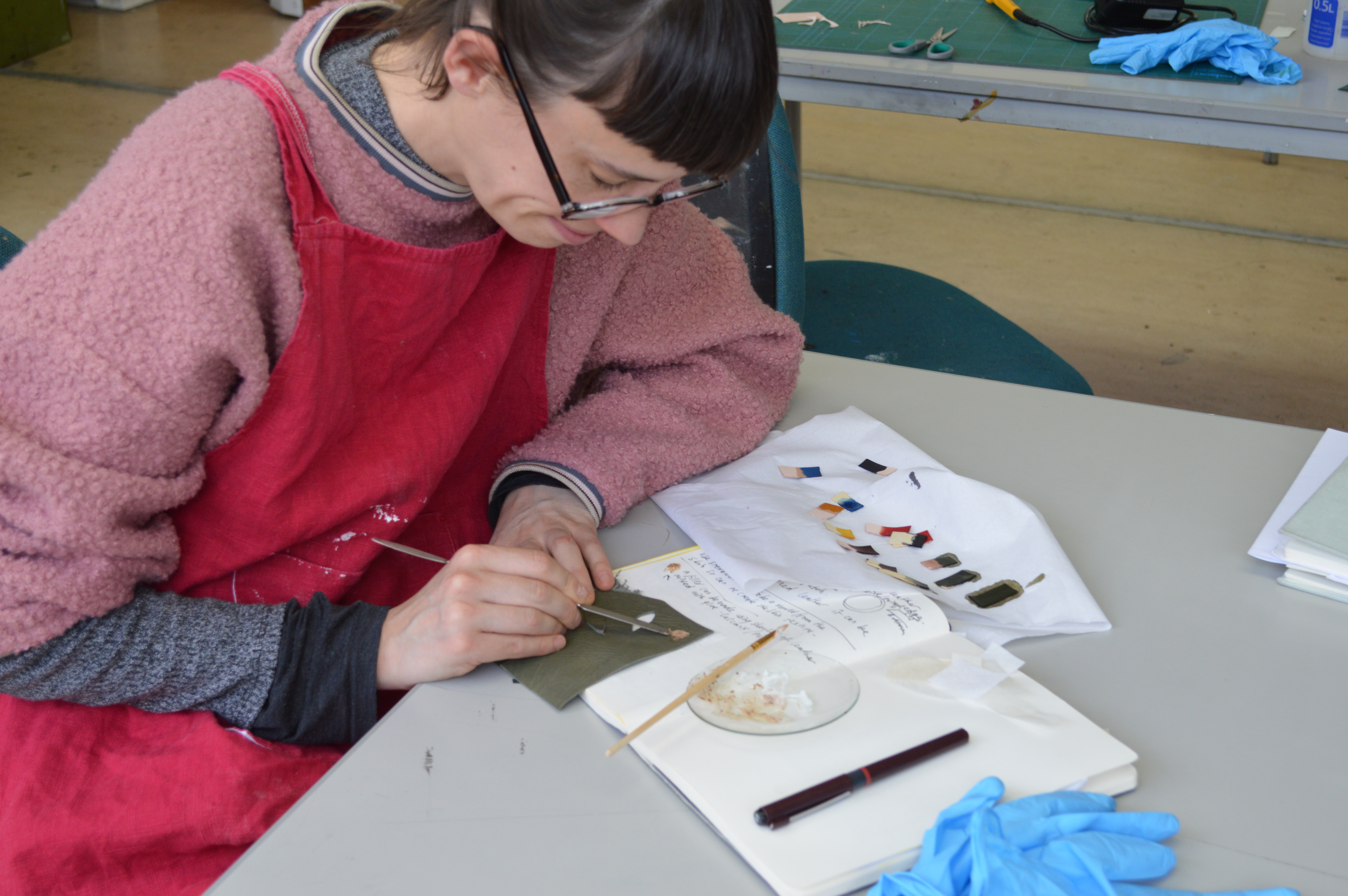
Jazmine happy experimenting with leather conservation methods at West Dean College 2024
In 2024 I attended the leather conservation course at West Dean college run by the Leather Conservation Center and Mike Redwood. My time at Westdean was paid for through my scholarship with QEST (The Queen Elizabeth Scholarship trust). I learnt so much about the chemistry of leather making, and the many industrial and historical methods used. During the course we tanned fish leather using good old builders’ tea and I was amazed! I am always trying to make my practice as natural, sustainable and ethical as possible and here I learned that the chemicals I used in tanning could potentially be replaced with the tea in my kitchen.
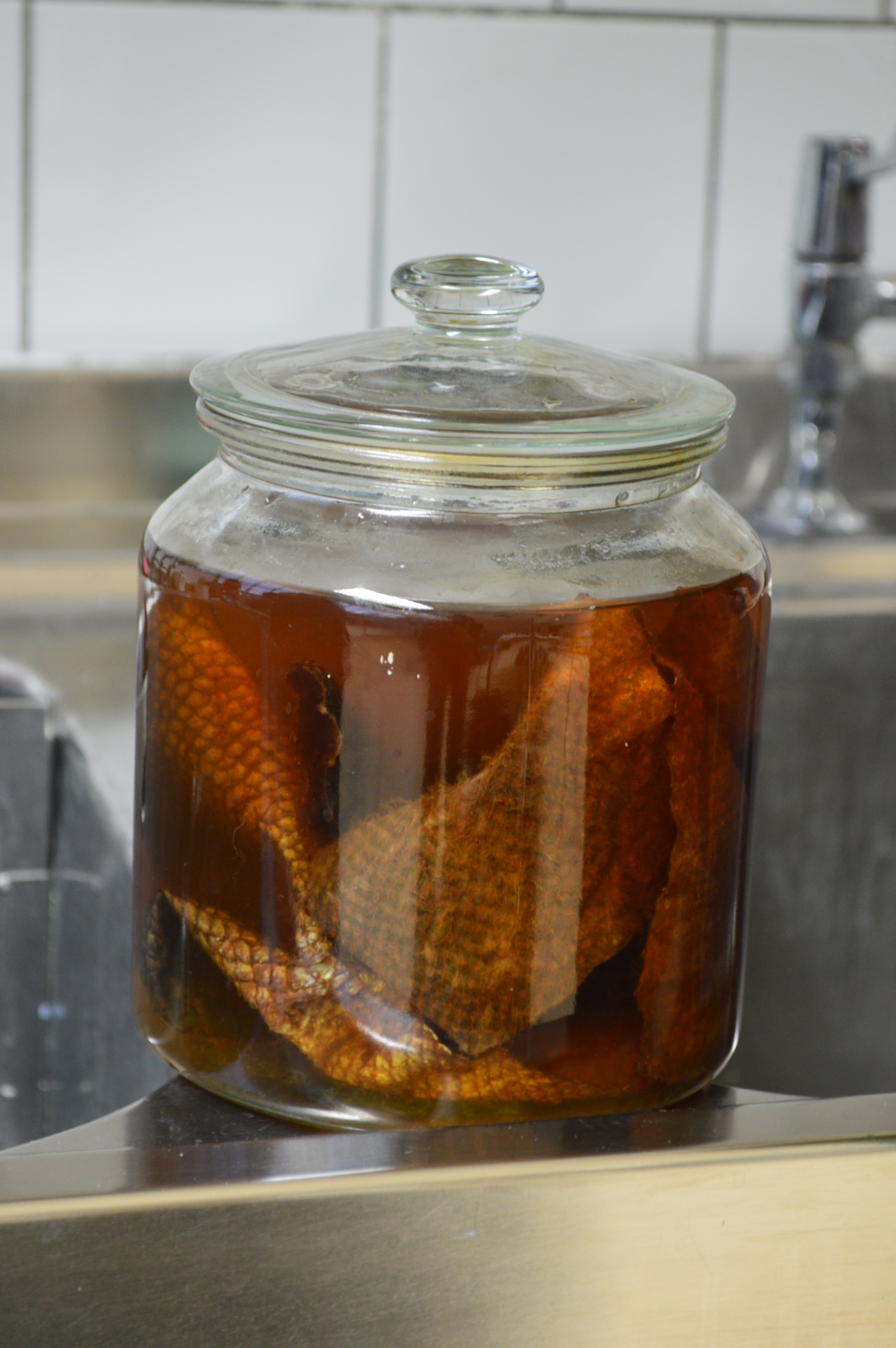
Tanning fish skin with builders’ tea at West Dean College 2024
Thoughts of natural tanning or dreams of doing so however went on hold for a while. After researching it I learned from books and online that it was a very lengthy process which would not be appropriate for hair on taxidermy skins, that the skin would be incredibly dense and that the natural tannin colour would be transferred to the fur.
Then in November 2024 Fran Richie (Conservator at National Park Service) posted on Instagram that she was tanning leather using tan oak bark and through Fran I learned about Matt Richard and his incredible natural tanning courses in the USA that are run on zoom. (More info here – https://braintan.com/)
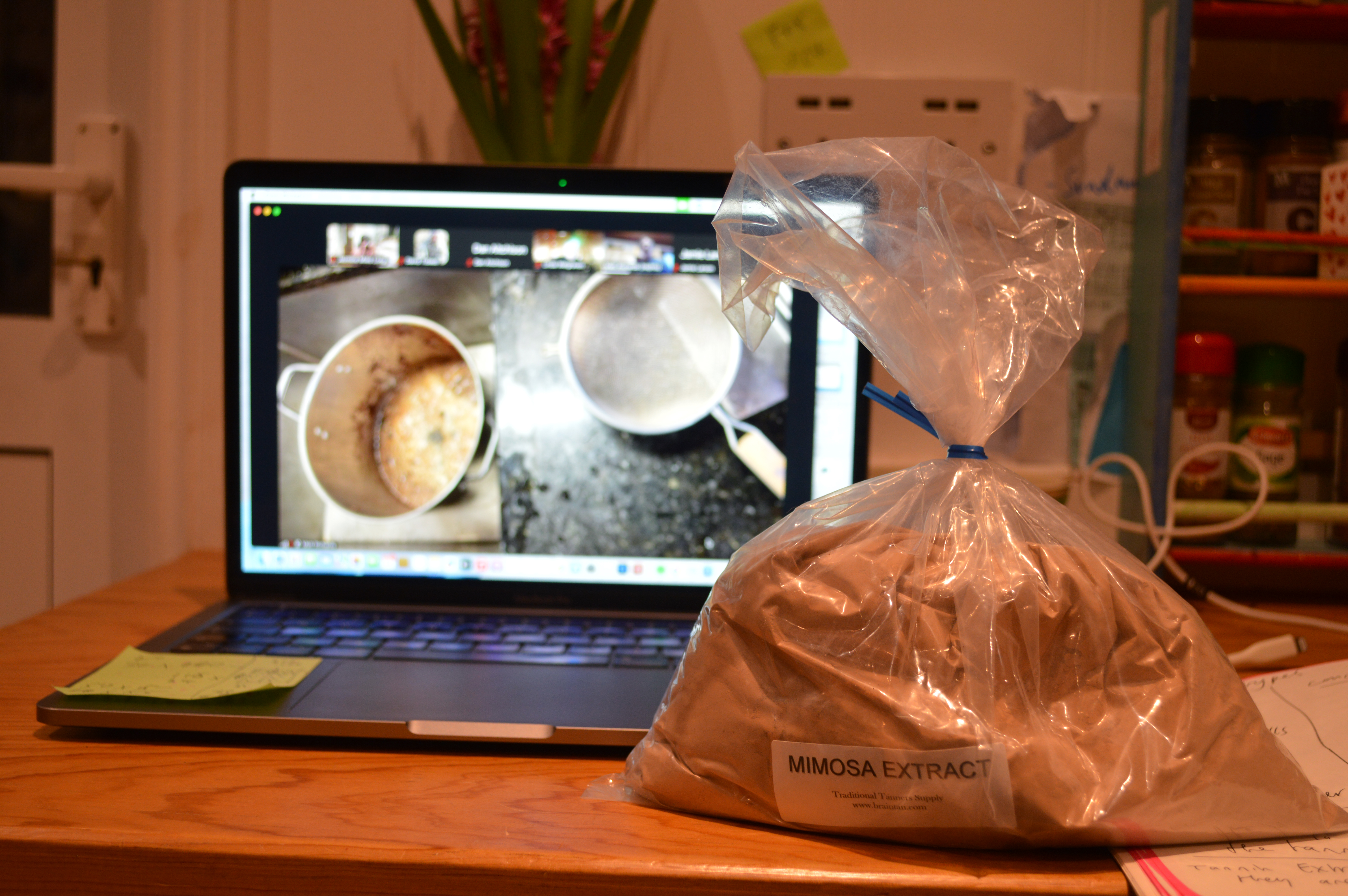
Online tanning lessons in the kitchen
Matt’s methods of hair on tanning do not take months or years which was my previous impression of veg/bark tanning. I immediately signed up and attended all three of his 2025 courses. And so, for one or two evenings a week during January through to May I have learned how to tan skins to leather only using organic natural materials in my kitchen. It was such a wonderful experience, and I feel like finally after 18 years of tanning skins I can comprehend the science behind tanning rather than just following the instructions and recipes I have followed.

Raw skin going into Tan Oak Bark tea

The raw skin taking on the Oak bark tannins to make leather
A warning – when using any hazardous tanning chemicals please be aware they are poisonous and harmful to your health so you must always use goggles, gloves and mask. However, in Matt’s class the materials were non harmful, I did not use gloves, and we were asked to actually check the tannin level of the bark tea by the ‘mouth feel’ which means tasting it! It’s so natural that you actually put it in your mouth (and spit it out again because if its good quality tannin tea it should be so bitter and dry you want to spit it out immediately, this is how you know you’ve got a good batch. Matt has taught me how to essentially go out into the wilderness ‘Bear Grylls’ style and make a fur hide from nothing but the skin of an animal, trees and running water from a stream. Absolutely amazing. It made me feel really emotional at times that I was doing a process that humans have done for thousands of years. This was particularly poignant to me as often in our modern world many of us find the idea of animal skin repulsive and in some cases prefer manmade materials and chemicals that cost the planet so much in oil use, energy and future waste. I was incredibly boring for 5 months as all I wanted to talk about was making leather and this deep connection to heritage and nature.
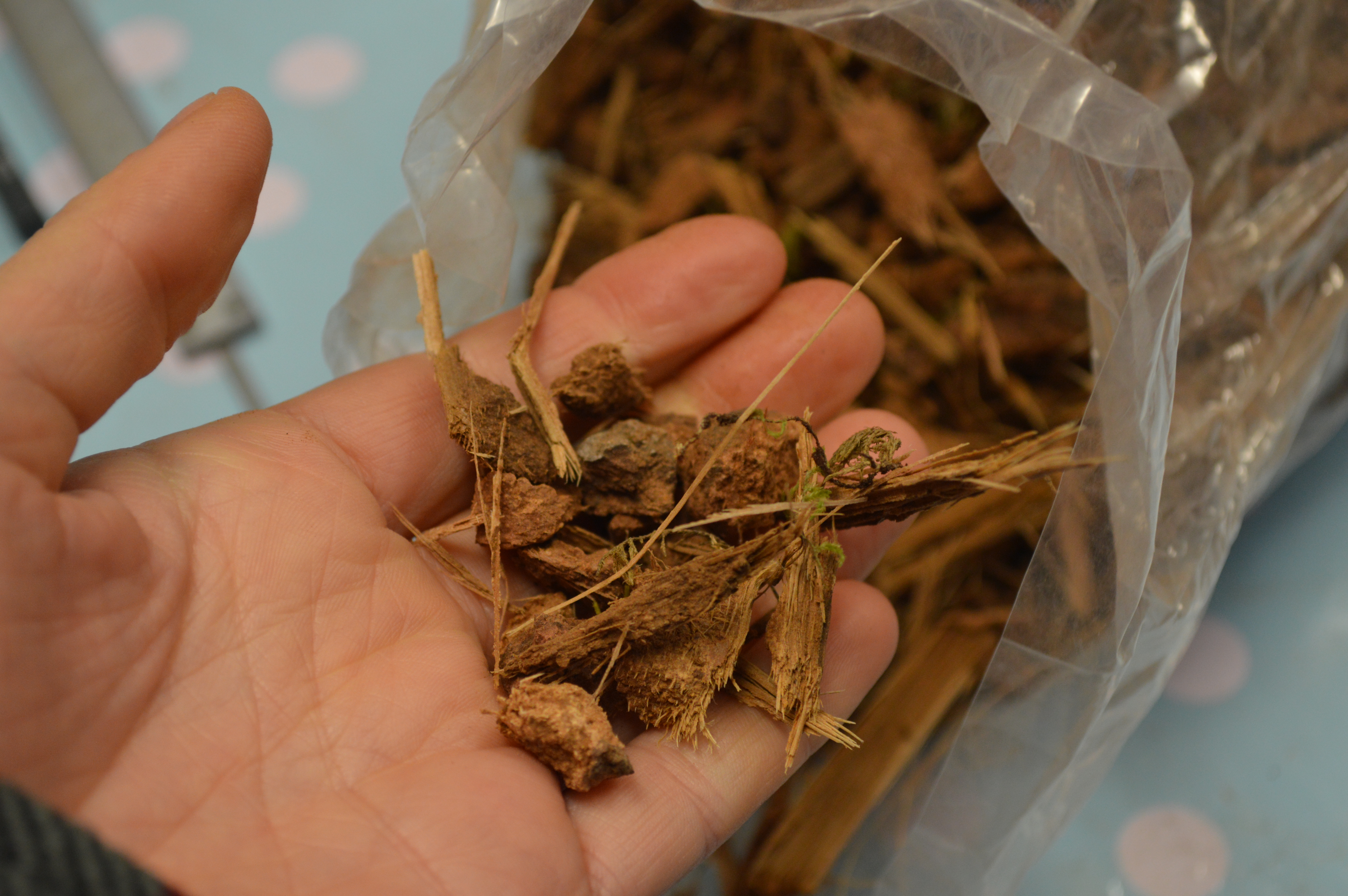
Tan oak bark
Bark tanning is on the heritage craft list of endangered crafts. You can veg/bark tan any skin into leather because of the way the tannins attach to the collegian so, bladders, frogs, fish, it doesn’t matter how fragile the skin is bark tanning adds strength.
I am not quite sure why taxidermists do not use natural tanning methods. I know that brush on tans are definitely a very quick and simple way to tan a skin but I do wonder if we as consumers are drawn to commercial branded materials simply because we trust those brands or beginners look for a method that works and stick with it which is what I did. Alum tanning (Aluminium sulphate) creates beautiful thin and supple skins, the tannins do not stain the fur, and it creates a white leather that is very easy to manipulate and mount. I worried that bark tanning wouldn’t be the right choice for taxidermy, and I do not know of any taxidermist using this method and I wasn’t quite sure why. (If you are a taxidermist reading this and you do veg tan your skins please get in touch!)
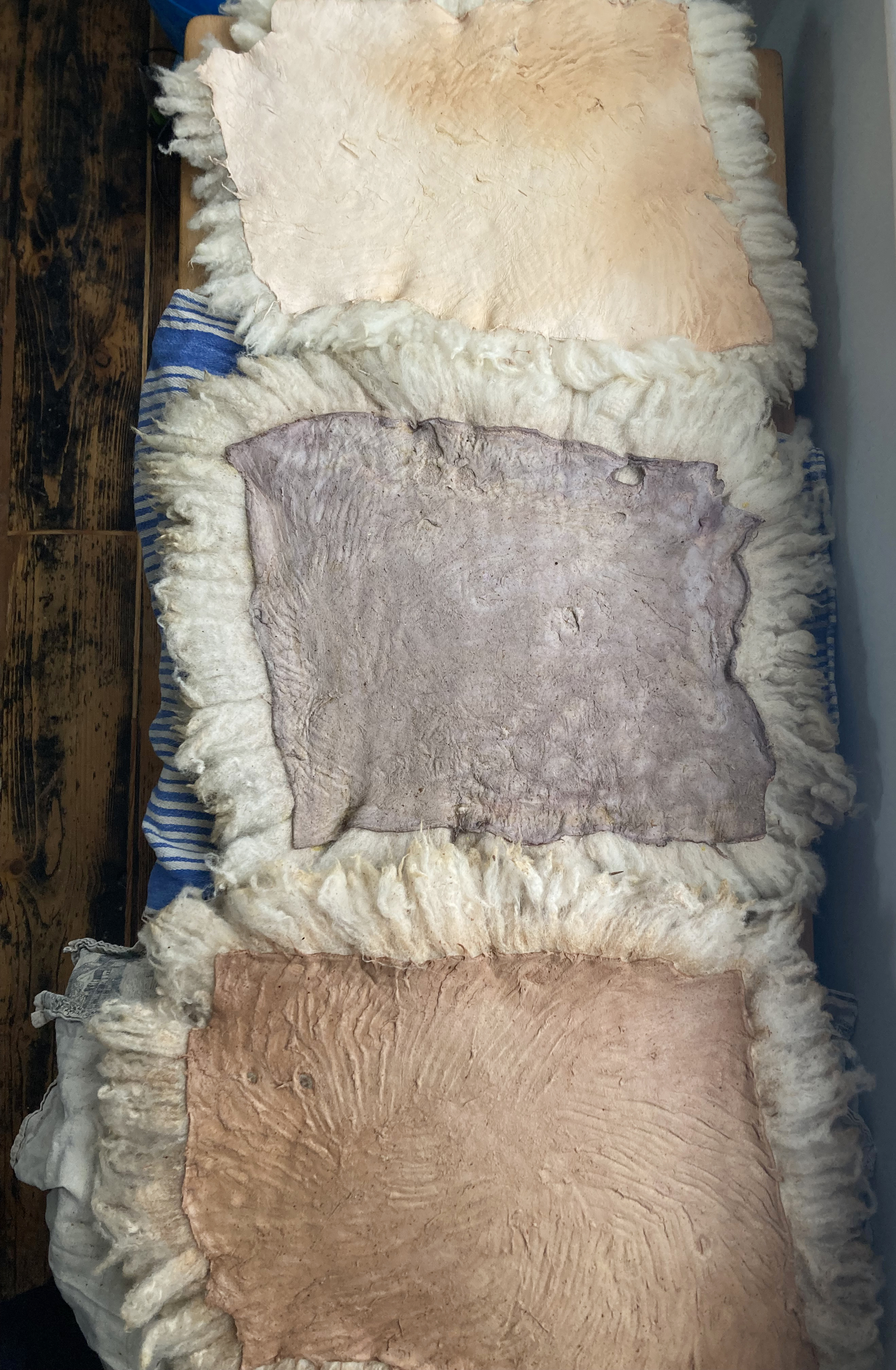
Three experiments of bark tanning a sheep skin – The top shows leather tanned with mimosa and salt – Middle was tanned with mimosa and no salt – The bottom was tanned with tan oak bark and salt
With Matt’s expert guidance I created my first experiment using Mimosa bark to tan a squirrel. Tannins are polyphenols and there are two types of veg/bark tannins hydrolysable and condensed. Hydrolysable tannins such as tan oak bark create a buff/tan colour, they extract easily in water, they make very soft leather and are slower to penetrate. Condensed tannins such as mimosa create red colours, they are affected by light and darken, they need more heat to extract, they make a tighter leather, and they penetrate faster.
Mimosa bark offers a lighter colour rather than tan oak bark which tans leather and fur to a lovely brown. Obviously with taxidermy I do not what to change the fur colour at all, so using mimosa which has a lighter colour with added salt works well. The salt is a masking agent limiting the staining of the fur and it prevents acid swelling which also keeps the skin as thin and therefore soft as possible.
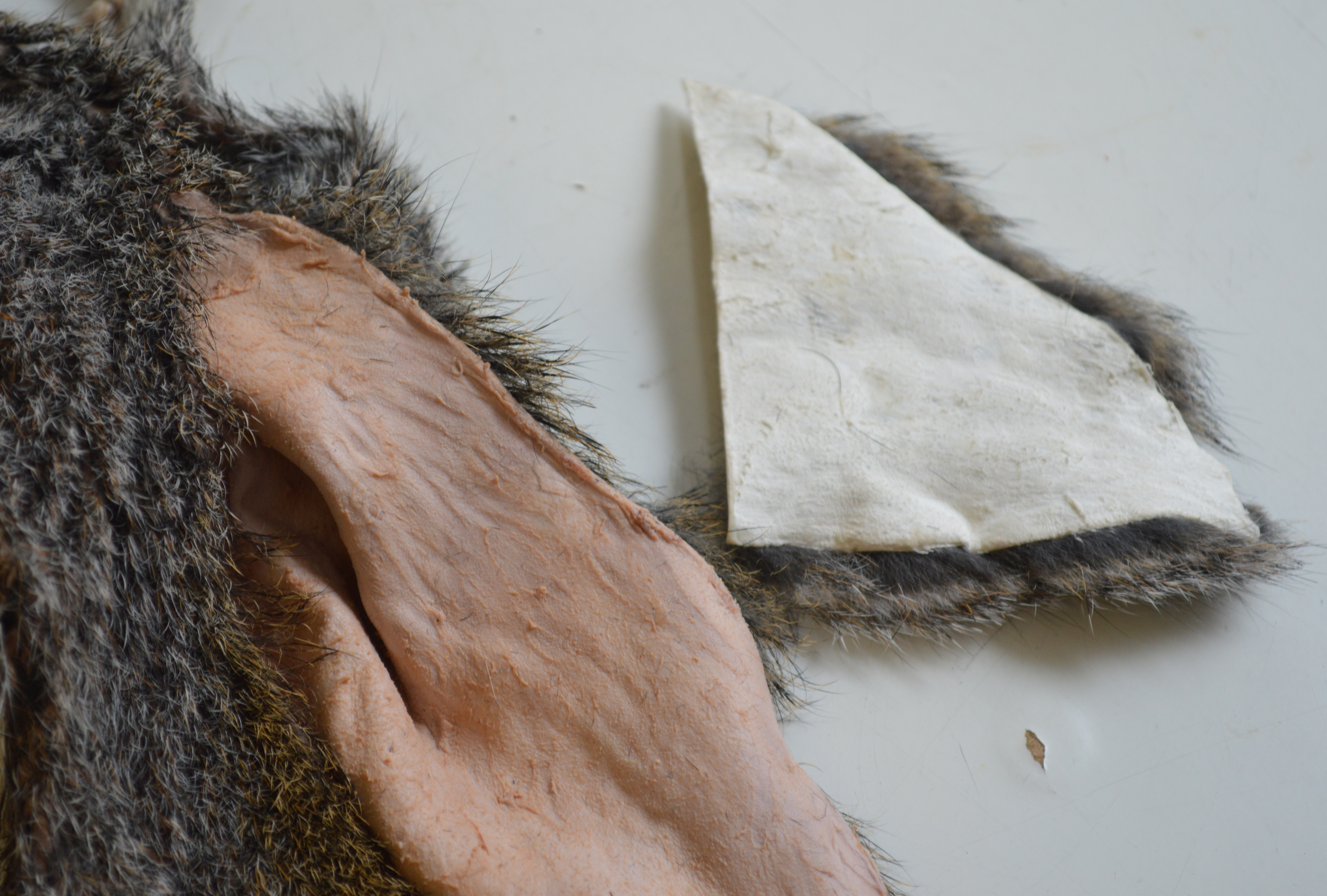
Showing two squirrel skins the pink skin has been tanned with mimosa and the white skin has been tanned with Alum
The squirrel tanned beautifully, there was no staining to the fur, but the leather itself was dyed a pink colour which is actually even better than white and creates a cute more lifelike appearance to the skin. The downside however is that the skin is thicker than alum tanned leather and so it was not possible to turn the toes back through again and so the underside of the pads had to be cut open. I do however think this would not be a problem with something bigger like a fox or if I had turned the fingers through earlier in the tanning process which I will try next time!
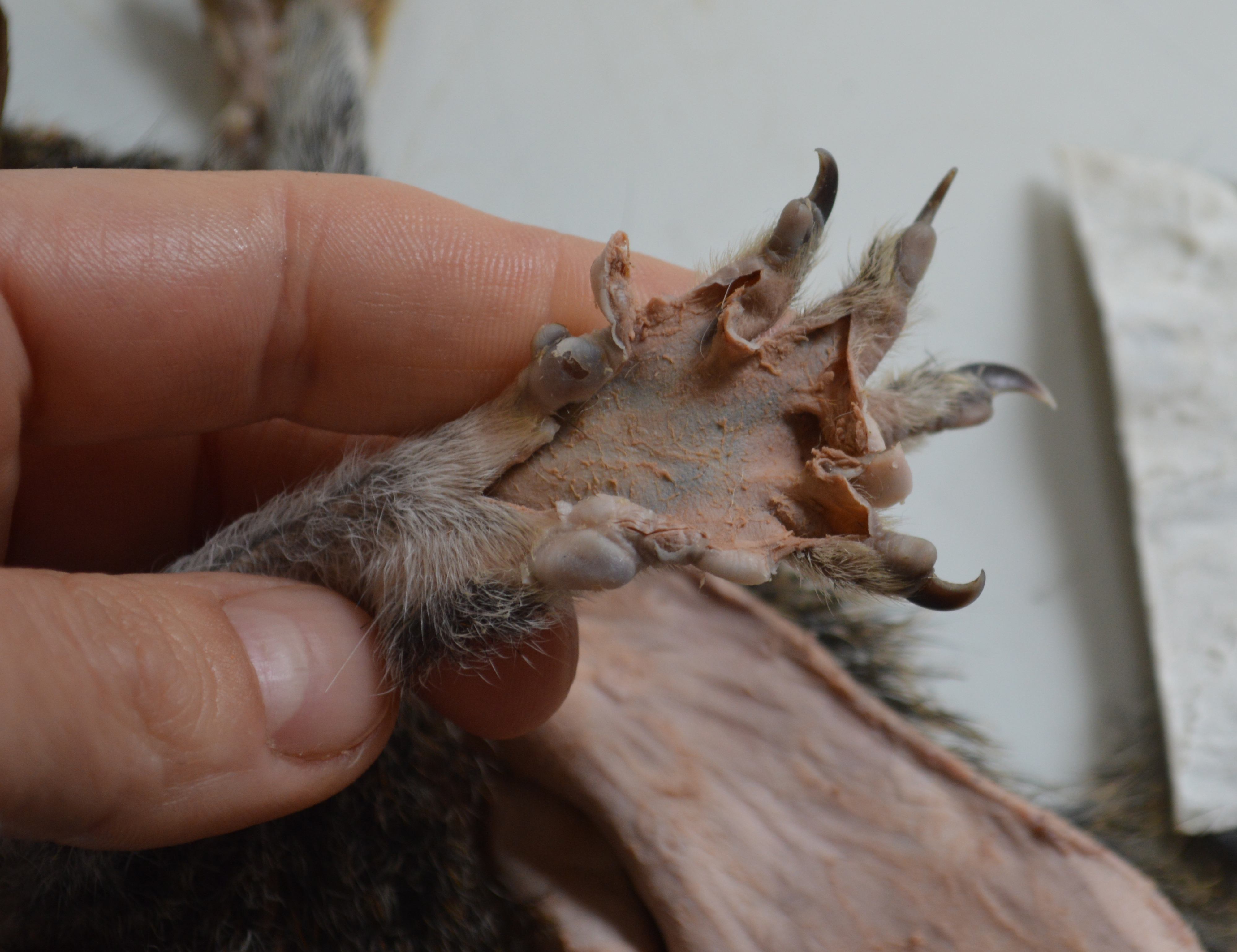
Mimosa tanned squirrel skin showing how the toes had to be cut
I then tried a mole which I have mounted for Oxford University Museum of Natural History. And the results were fantastic. I love the pink of the skin that grins through the fur giving it a more lifelike look. It also made the skin less fragile which made it easier to handle but harder to sew!
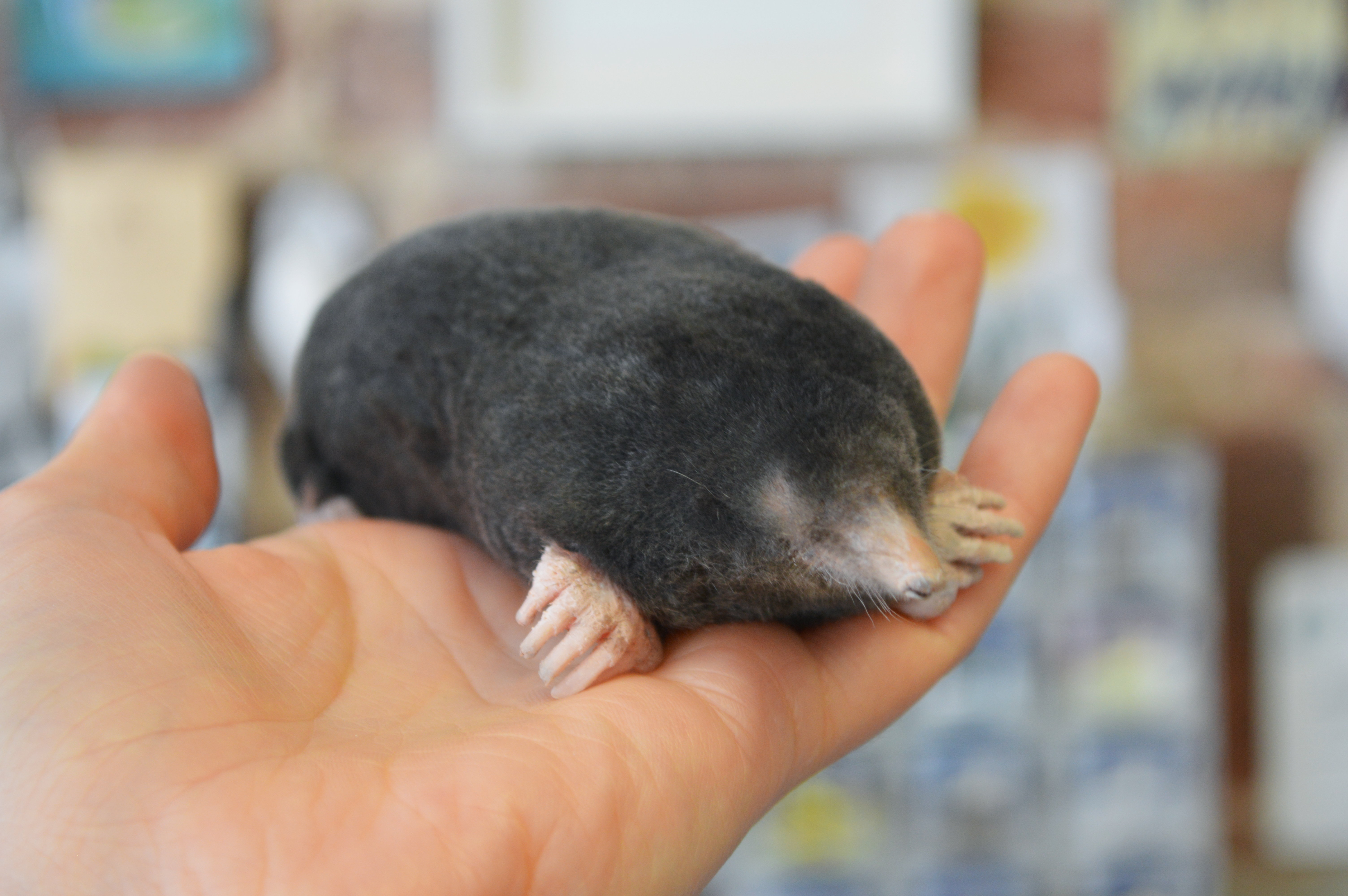
Taxidermy mole created by Jazmine using skin tanned with Mimosa tannins
Next alongside practicing with mimosa I also plan to experiment with oak galls kindly collected by my father-in-law on his local dog walks, if this works as a good tan for my taxidermy skins I can’t think of a more natural and sustainable method, so I have everything crossed!
Why Bark Tanning?
Pros of bark tanning –
- Its natural and the bark can be collected in a sustainable way!
- It truly tans the grain making it a lot less attractive to insects.
- Its permanent and means it can withstand heat.
- It adds body, so if working with a very delicate skin such as a fragile reptile, bark tanning would make it stronger.
Disadvantages of bark tanning –
- It adds colour (could also be seen as a positive).
- It adds body, making it thicker and a little harder to manipulate and sculpt.
Why Aluminium Sulphate (Alum/Lutan FN) tanning?
Pros of Alum tanning –
- It makes a very thin malleable soft leather good for easy sculpting.
- It does not take on any colour and tans the skin white.
Disadvantages of Alum tanning –
- It is not permanent and can be reversed with water. The protein in the skin stays present and is not removed by the tanning process and so this stays delicious to insects. Therefore, bark tanning may be a better choice for non-cased taxidermy to reduce the risk of pest damage.
- It is a chemical and harmful to health.
Note – a skin does not have to be tanned to be mounted into taxidermy, most of my birds and even some small mammals I do not tan because the tanning process can be risky for these tiny skins. Instead, the skin is cleaned of all membrane, muscle and fat, washed and then dried after the skin is mounted into taxidermy. Skin preserved in this way is called raw hide and is stable so long as it does not get wet or humid.
Citations
- Marion Kite, Roy Thomson (2006) Conservation of Leather and related Materials. Routledge.
- Churchill (1987) The Complete Book of Tanning Skins and Furs. StackPole Books.
- Matt Richards. Traditional Tanners, Fur on bark tanning course. https://braintan.com/product/barktanclass/
- Leather Conservation Center https://leatherconservation.org/. Leather conservation course hosted by West Dean (2024). Taught by Mike Redwood, Rosie Bolton and Arianne Panton.
- Vegetable Tanning Materials by F.N. Howes 1953.
Jazmine Miles-Long on Instagram – https://www.instagram.com/jazmine_miles_long

 NatSCA
Pingback: NatSCA Digital Digest – July 2025 | NatSCA
Pingback: Top NatSCA Blogs of 2025 | NatSCA