
Written by Callum Smart, a natural history volunteer at Bolton Museum. He works both in the stores, documenting the collections, and in the gallery engaging with visitors using the objects to start conversations. Here he shares his experience of one afternoon with a school group.
It’s Wednesday afternoon at Bolton Museum and I have just finished setting up the fossil touch tray, a selection of ancient artefacts for visitors to get hands on with. A school trip marches through the atrium, passing the gift shop with furtive glances, heading towards the wonderful Egyptian exhibits. The children clutch their worksheets, a scavenger hunt checklist filled with items from around the museum’s galleries. They whisper to each other, checking if they’ve missed anything in the Bolton’s History gallery and making bold claims over what they’ll find in the next room.
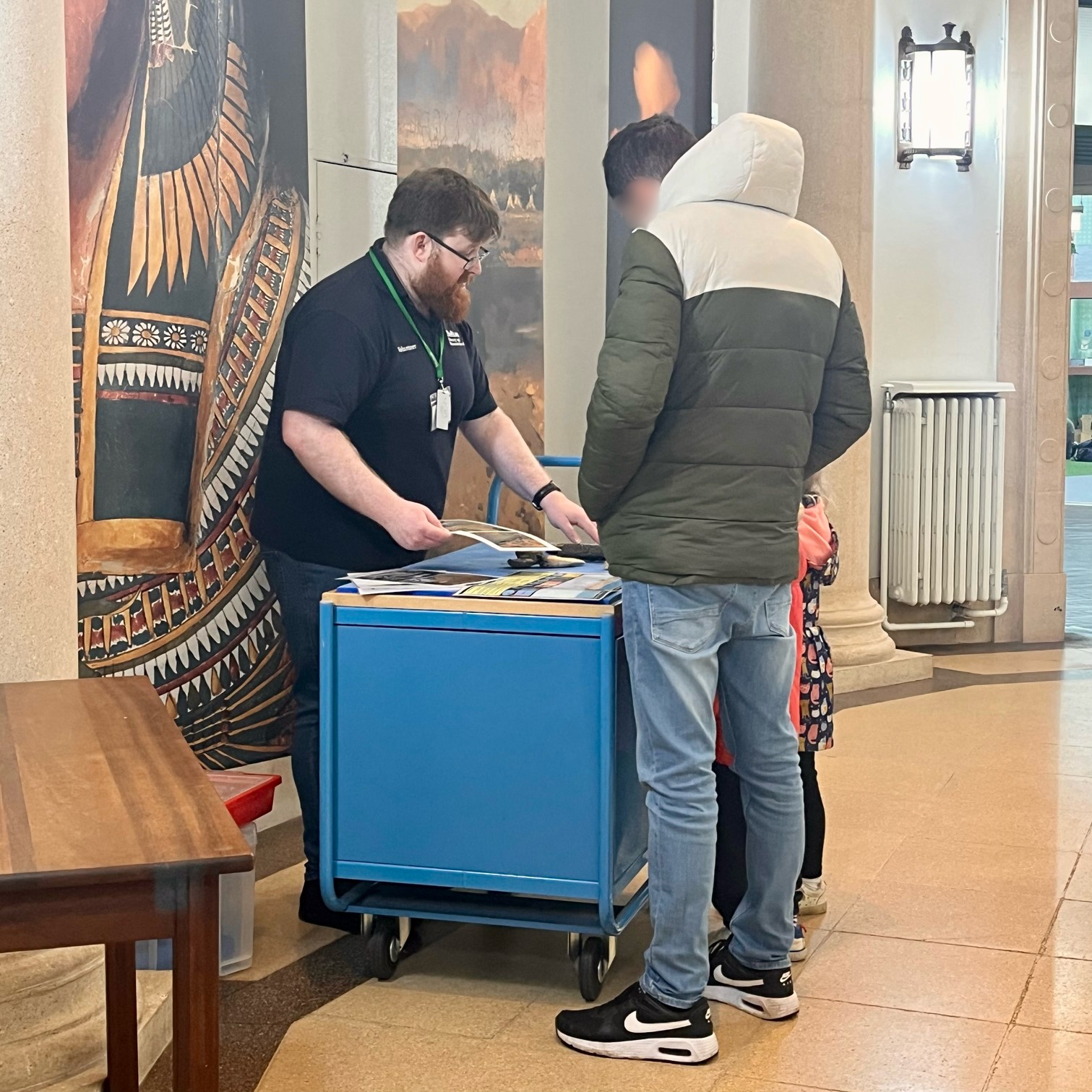
A few of them spot the fossils on my trolley and start to stop, blurting out questions, weighing up whether to reach out and touch the strange rocks. I’d love for kids to interact with the fossils, it’s why I’m there. But I also don’t want to distract them from their trip, so I’m grateful when the teacher steers them on. Their teacher asks if I would be able to talk to the children about the fossils when they finish in the Egypt gallery. “Of course,” I say, “I’d be happy to.”
I’m more than happy, elated in fact. I volunteer every Wednesday and often there are long stretches when there are only a few visitors passing by and no one stops to look. So, to secure a captive audience of school children, it’s a great start to the day. I’m also very proud of the fossil display on the trolley, it was my project to create it. I curated the selection from the museum collection, wrote out sheets of facts for each fossil, printed and laminated helpful pictures to illustrate how they looked in life and even drew a large cartoon timeline, representing the changes to life over millions of years.
The fossil tray is an excellent educational tool, representing not just unique life that is long extinct but also the processes of deep time. The trilobite fragment can represent both the rapid, radiative evolution of the Cambrian but also the Great Dying of the end-Permian mass extinction. The fossil wood of Lepidodendron is a fantastic link to Bolton’s history both as a tree 350 million years ago in a Carboniferous swamp, but also as a symbol of our more recent past as coal mines powered the Industrial Revolution and the expansion of the British Empire.
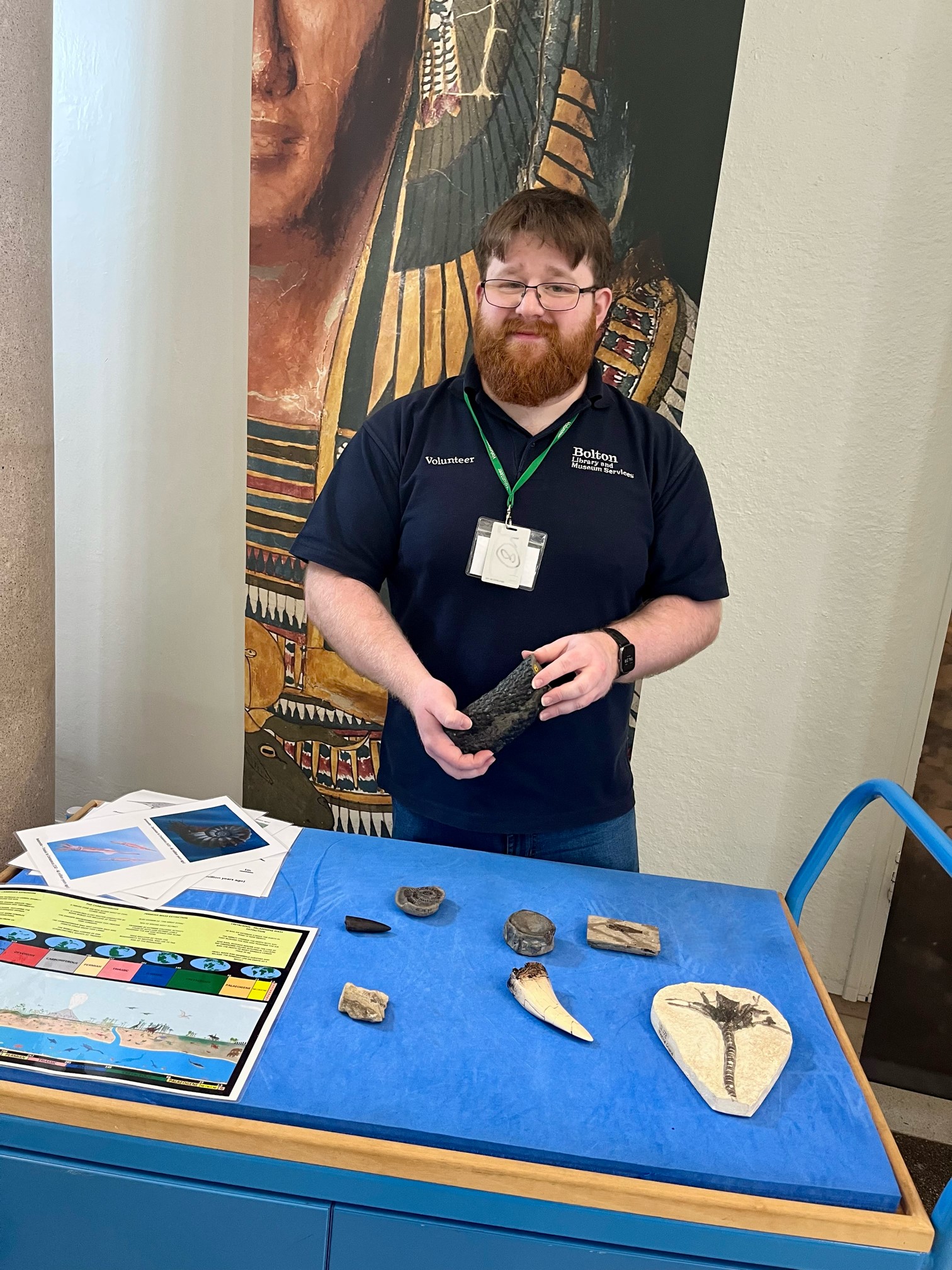
It’s one thing to design teaching aids and write out pages of facts on each of the fossils, it’s another to deliver that same information to an audience of children whose attention frantically flits from fossil to fossil. Any confidence I had quickly evaporates when more than two dozen eight-year-olds pour round the trolley, chattering like penguins and desperate to grab hold of the fossils on display. “It’s ok to touch them but shall we do it one at a time.” I work my way round the fossils, trying to make sure enough children get a chance to touch them without taking too long. It’s a difficult balance, as I hardly finish naming a fossil before several voices cry out “What’s that?” at something else. I almost can’t keep pace with the excited speed at which the crowd throw questions my way, as the children refuse to dwell on any fossil for more than a few seconds.
Fifteen minutes later I’m sweating and dry mouthed, the last child trots off with their group to get their coats and bags for the coach, and all the enthusiasm for scientific outreach and communication I possessed is, for the moment, diminished. But that doesn’t last.
Soon the exhaustion recedes and is replaced with a sense of satisfaction and pride. Though it felt frantic in the moment, I was actually able to get a lot of information across. The best method for this is asking them questions. “What do you think this is?” is the best way to open. Many of the fossils are misleading, the flower like sea-lily (crinoid) is not a plant, and it’s better to lead visitors to the answer rather than just telling them. Turning it into a game, or a challenge like “which do you think is the oldest fossil,” focuses their attention much better than regurgitating facts.
To engage people, particularly young minds, about our planet’s past, to educate them on the natural world and encourage their interests in natural history and climate awareness is why I volunteer at the museum, and there is no better resource for this than the fossil record.

 NatSCA
Pingback: NatSCA Digital Digest – March 2025 | NatSCA