
Written by Anais Ellis, Project Conservator, Nature + Love at the Horniman Museum and Gardens.
Around a year ago I concluded three years of formal training to become a conservator. At the Institute of Archaeology, University College London (UCL) the training is taught in two sequential parts. First, the MA, Principles of Conservation, grounds an understanding of conservation practice within ethical frameworks and principles. Following this, the MSc, Conservation of Archaeology and Museums, includes a year of developing remedial conservation skills in a lab and a 9-month placement in a museum or adjacent environment. The formative moment during this placement was my first experience working with natural sciences collections. There were fossils to clean, fluid specimens to top-up, and a taxidermy ringed seal with several claws missing that the curator asked to be reconstructed. Now, a year later, having finished studying and having worked consistently with natural sciences collections in the United Kingdom (UK) it feels like a good moment to reflect on these experiences. As hoped, they have been wonderful.
A big highlight has been the remedial treatment of a 4-metre Baleen plate from a Bowhead whale (Balaena mysticetus) where splits to one edge had been historically repaired with staples and Sellotape. There was also the small challenge of mounting it vertically. Learning diverse treatment approaches for various material types, thanks to the generosity and skill of other conservators, has been incredibly fun, spanning osteological material, fur, feathers and plaster casts, to name a few. As have been the opportunities to be able to wander around museum stores, sometimes with a purpose, most of the time not, and see shelves of Edward Hart taxidermy dioramas or drawers full of bird skins. Beyond remedial conservation, being exposed to processes behind projects or encountering zoological academics and then frantically Googling ‘what does clade mean?’ have also been valuable learning experiences.

As the nature of the UCL programme is multi-disciplinary, you’re able to develop a systematic approach which you can apply to range of object types and treatments. Undeniably, this has been incredibly useful with natural sciences conservation as a lot of the skills are transferable. Although, I must admit, when I started training to become a conservator, I was unaware that natural sciences conservation was a specialism, the way that textiles, paintings and paper, for instance, are considered. My opportunities to pursue natural sciences conservation as a specialism have been entirely a case of ‘right place right time’ which is unfortunately difficult to replicate. It is also important to note they have relied on an abundance of good will from colleagues. I’ve been lucky to stumble into this, others might not be – and this appears to me as a challenge to entry into the sector.

Something I also find concerning is whether there will be opportunities to continue improving my skills or whether long periods of time will pass between chances, hindering skill progression. As has become normalised due to the difficult funding environment that now characterises the UK heritage sector, throughout my admittedly short career I have solely worked on a contract basis. This environment impinges on all conservators but acutely on those of us just starting. Friends, usually from office-based sectors and always well-meaning, note that it may be considered normal to change jobs every few years. However, colour matching and being able to tease out strands of Japanese tissue for fur mimicry for instance are unfortunately not skills that are innate to me. I have found that improvement to my remedial conservation skills particularly relies on repetition: practice makes perfect.
Another sad reality comes under the guise of having to be ‘flexible’. For instance, commonly for work conservators may have to move elsewhere or endure a long commute. I understand this well having commuted to Cambridge from London for seven months. Seemingly, to thrive as a conservator there is a necessity, and often presumption, of personal and financial flexibility, which to state the obvious, favours people from certain backgrounds. Of course, the idea that being socio-economically able facilitates a career in the arts and heritage sector is not new, but it is worth emphasising that these barriers persist. It risks both preventing talented individuals working with natural sciences collections and driving them away. This is a big shame as these collections are so impressive, vital and rewarding to work on.
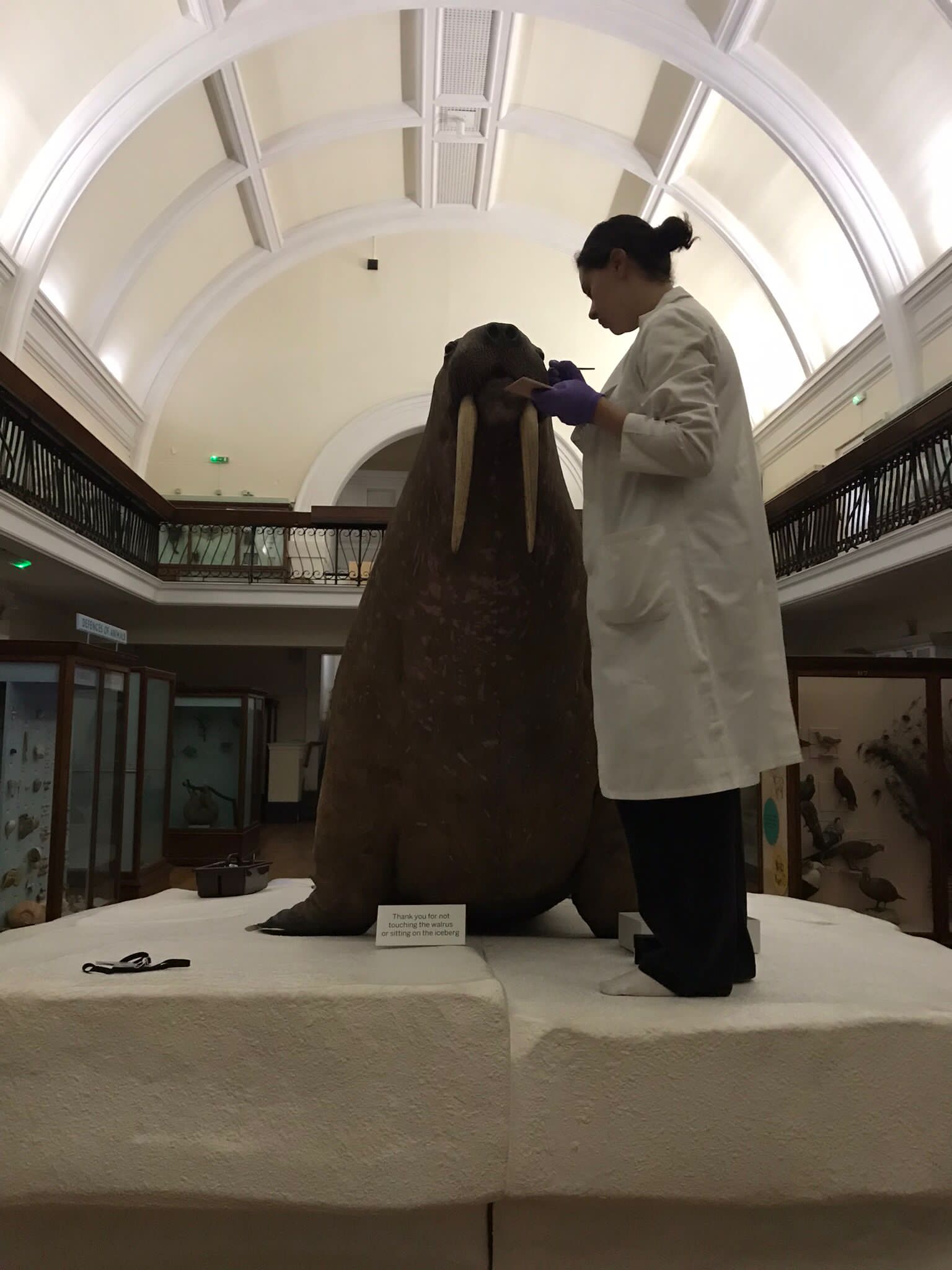
I do believe my experiences offer a cause for hope as they reflect the recognition for the need of more emerging conservators working with natural sciences collections in the UK. To be able to work with these collections offers a lot of challenges but these are mostly fun and always provide learning opportunities. Who would not want to be faced with the challenge of treating, then vertically mounting a 4-metre plate of Baleen? I look forward to continuing working with these incredible collections and sharing these experiences with others.

 NatSCA
Pingback: NatSCA Digital Digest – December 2024 | NatSCA