
Written by Patricia Francis, Natural History Curator, Gallery Oldham.
An account of ‘how to’ reuse an old, forgotten about diorama and turn it into a display highlighting a widespread and major environmental problem of today.
I first found this large sea stack diorama in a corner of a museum storeroom. The storeroom being in a basement of a building without lift access, so the display obviously had had a bit of a rough arrival to its resting place. It had been left uncovered for many years and was in a bit of a sorry state. There were a few birds left in position covered by plastic bags, sad remnants of a previous splendid display. It is a four-sided diorama and on one side at the base of the display is a ‘rock pool’ where a large sea worn pebble bears the following: Fred Stubbs, Oldham 1905.
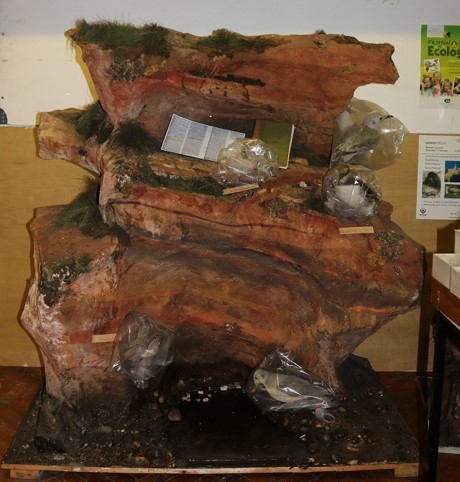
After a bit of background research, I found this exhibit had four periods when it has been displayed. Firstly, in Oldham’s first Museum which opened in 1883 and where it was made – one of four original dioramas mentioned in a notebook and in the local newspaper the ‘Oldham Chronicle’ in an article of 1909 when it was described as: ‘A splendidly conceived stack, an isolated sandstone rock in the sea…provides accommodation on its ledges for a number of seabirds…makes up a beautiful picture at once artistic and scientific’. At this time a young Fred Stubbs was a leading light in the Oldham Natural History Society. Although the Museum was overseen by the Borough Council, the Society had been charged with the day to day running and creating natural history displays.
Very strangely three of these dioramas were coastal – sea stack, salt marsh and seashore, the fourth was woodland. Quite odd for a town museum like Oldham, far from the sea and where the largest local habitat is the Pennine and Peak District moorland! The maker, Fred, was born in Liverpool – so I wondered if his continued family connections with the coast had influenced this?
The exhibit’s second period of display was in the1930s when all the dioramas moved from the town centre museum to Werneth Park Study Centre. Werneth Park Study Centre, a former mansion house in a park had been given to the Borough, where it formed the classic natural history museum in a park, so popular at the time. The only historical image of it was taken at Werneth. This building closed as a museum in 1975.

At this point a survey of the displays was commissioned by the Council to the North West Museum and Art Gallery Service (NWMAGS), a precursor of the Museum Development Network that exists now.
The survey recognised the importance of specimen – ‘…this should be kept intact, as an example of Fred J. Stubb’s work and as an item of social and historical importance…, [Fred Stubbs had been recognised as an expert ornithologist, eventually museum curator in London before returning to a senior post in Oldham Museum]. So, at this point all the other dioramas were broken up. The natural history collections moved back to 1883 building. However this item proved too large to be accommodated in storage so in 1976 was loaned to another nearby town museum. There it went straight on display where became a centre piece of a 1930s taxonomic bird room display. In the 1990s the loaning museum closed this display gallery to increase its storage area.
So, this marked the sea stack’s return to Oldham and by this point the display case was no more. It was immediately put out on display, for the fourth occasion, but into a corner of a gallery so only displaying two sides and by necessity put on open display. This marked the end of 87 years of continuous public display but where it had always been covered. I am unsure how long this last period of display was for but from there it was then moved into the storage room where I first discovered it. On this occasion most of the birds were removed and stored with other taxidermy.
2016 marked the start of a Heritage Lottery Fund for Gallery Oldham, a project for a capital spend to completely refurbish the original 1883 Museum building. Our curatorial team were asked to work up displays for galleries for this development and to additionally identify large objects for display around the building. The monies would cover restoration, cleaning and redisplay. The sea stack diorama is the largest object ln the natural history collection and as such was identified for work. This was the start of preparation for this diorama to be displayed for the fifth time. It was accessioned in 2018 to help preserve it for all the reasons given in the 1976 report.
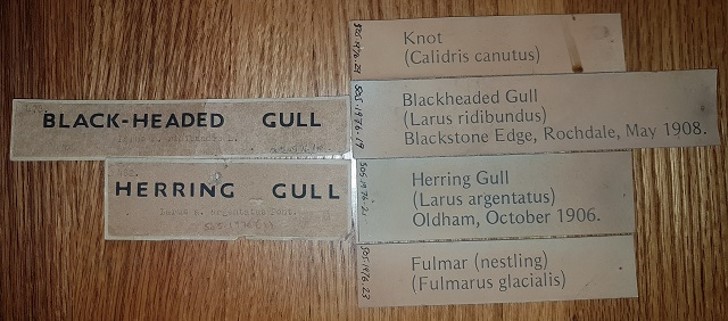
Starting to get the conservation work into motion gave me cause for further thoughts. What was the original sea stack representing? For reference I went back to the original notebook where the various specimens had been listed by Fred. Accession numbers were not use when the sea stack was first constructed so it was difficult to identify the exact specimens used but the species were listed. An additional resource were a few ‘caption labels’ that had been saved showing two different presentation ages and styles. Some specimens were certainly added after 1905 when the rockwork was made.
Most of the species are represented by individuals and at most a pair, there were ecologically unlikely species placed next to each other. Also there were a mix of plumages indicating birds in winter and breeding conditions. Some bird species listed were more associated with other coastal habitat like estuaries, for example, shorelark, turnstone, dunlin, knot, red-throated diver and different times of year, like little auk. So was the sea stack a chance to exhibit the taxidermist’s art? – certainly not to show a piece of reality. In conclusion I feel any sea birds were very loosely used, and bearing in mind where Oldham is in relation to coast, as and when they became available
The physical size of the ‘rockwork’ necessitated that all the conservation work was all done on site whereas the twenty-five bird mounts identified for conservation and for future installation on the seastack were packed for transport to the conservation studio.
Initially the new display in Gallery Oldham were scheduled to open in 2019 but for various reasons major delays occurred, one being the Covid 19 Global Pandemic. Notwithstanding the new displays were in place by January 2021. The conservation work was carried out by Lucie Mascord. After an inspection and beginning the work, Lucie made the following comment :
“After time spent working on it, I predicted it was a wooden baton framework, mainly hollow, packed out on the outside with paper to create the shape. The outer surface was built in layered paper and plaster and created a very hard shell that was actually very structurally sound. The surface was spackled plaster, with some textural additives including sand. This was damaged in many areas due to the handling when the cliff has been moved from time to time. The rock is painted in the main in a brilliant red oxide colour which is still very bright. But the rock inevitably from its years in storage had become very dusty, and the dried plants were very broken and damaged”.
I helped by collecting some replacement plants for freeze drying for eventual placement on the sea stack and took photographs of the Triassic Sandstone on the Wirral Coast for reference purposes. A new palleted base was made in-house by our gallery technician, meaning that the whole item, should it need to, can be moved without physical contact and risk to the display. This pallet is hidden within the plinth base of the new display case making the final display taller than previously.

The second part of this project is a simple, low cost one, making non-destructive additions to the original diorama. This was the addition of 21st century plastics, all collected in 2020 from the nearest rocky coast to Oldham, 38 miles away. Very easily found items were fork, cup lid, straw, wrapping, ice pop tube, vape bottle, balloon and cord. These items were all quarantined by deep freezing before simply placing on ledges and base of the diorama. Only one face of the diorama is used to hold the plastic additions, so visitors ‘find’ them in a concentrated area. The plastic items are not attached in any way so the display could be very easily returned to its original form.

As already mentioned, each bird on the diorama was originally labelled with small captions giving the common and scientific names of each bird.
My feeling was this method was very intrusive to a naturalistic display, I felt a key would be a better tool to help visitors work out the species. One of my volunteers photographed each of the four sides and then traced a simplified cliff and bird outlines from the photograph. These sketches were enlarged and then scanned, and Microsoft Publisher was used to add the bird names. The final product are four A4 laminated sheets, one for each face of the display. The rear of each sheet contains more detailed information about Fred Stubbs and aspects of the sea stacks’ history.

The sea stack now forms an impressive standalone centre piece in the Oldham Stories galley at Gallery Oldham. It not only celebrates UK seabirds but also engages audiences with the climate and biodiversity crises and is included in the Gallery’s school sessions – ‘Oldhamers by the Seaside’, ‘Observing and Classifying Animals’ and ‘Adaption and Food Chains’ all Key Stages 1 and 2.

 NatSCA
Pingback: NatSCA Digital Digest – December 2023 | NatSCA