
Written by John-James Wilson, Lead Curator of Zoology at World Museum, National Museums Liverpool & Jing Jing Khoo, Postdoctoral Research Associate at Institute of Infection, Veterinary & Ecological Sciences, University of Liverpool.
Selangor Museum was established in Kuala Lumpur by British colonial officials in 1887. A purpose-built museum building, opened in 1907, was designed by Liverpool-born architect Arthur Hubback, but there is a stronger link between Selangor Museum and Liverpool.
Selangor Museum’s early director Herbert Robinson was also born in Liverpool and had worked as an assistant at the Liverpool Museums, now known as World Museum. Selangor Museum wasn’t a large institution, with just three British curators and three museum hunters from Sarawak, one being Charles Ulok. But through the museum’s work, a European knowledge system was imposed onto the local wildlife.
The museum’s work included extensive hunting on the hill and mountains and islands of Malaysia, Thailand and Indonesia. The museum soon ran out of storage space in Kuala Lumpur and specimens were routinely sent to England. Hundreds of specimens were sent to Robinson’s former workplace, World Museum, in 1914.
https://archive.org/embed/from-selangor-museum-to-liverpool
Click link above for 3-minute video about Selangor Museum and its connection to Liverpool made for the Green Representatives Network at Monash University in Selangor.
In January, we received a small grant from NERC for cross-disciplinary research for environmental sciences discovery focussed on the Selangor Museum collections in Liverpool. We began adapting our existing research expertise, parasitology and DNA barcoding for species identification and taxonomy, to work with the collections.
To find ectoparasites on museum study skins apparently you just need to look really hard and carefully. We are still searching through the skins and will publish when we find any. We visited the Wildlife DNA lab at Aberdeen University to optimise our molecular methods for DNA extraction from historic specimens starting with swiftlets, a taxonomically confusing group of birds.


Our main goal is to connect people from the specimen’s source countries with the Selangor Museum collections, both in Southeast Asia and the Southeast Asian community in Liverpool.
We held a virtual roundtable with the Green Representatives Network at Monash University in Selangor. Using Google Jamboard, we discussed questions such as: Why do natural history museums exist? What are museum specimens useful for? Who should be able to access and use museum specimens?
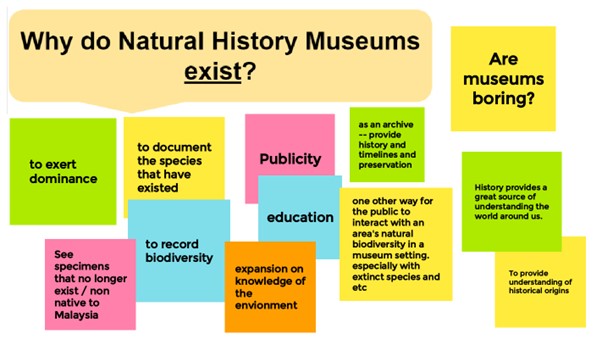
The Malaysian students were generally more interested in current research with the collections and their value to ‘science’ rather than the historical context.
During an event at World Museum members of Liverpool’s Southeast Asian community were invited for a tour of the zoology stores and introduction to a display of the Selangor Museum collections. The display in the Clore Natural History Centre showcases research happening with the collections, as suggested by the Malaysian students. We added content to the Selangor Museum and the 1905 expedition to Gunung Tahan Wikipedia pages, then used QRpedia so visitors can easily access information in their own language.


At the NatSCA 2023 conference it was very inspiring to hear the experiences from other museums with similar projects engaging source countries and communities with collections held in provincial museums. We came away full of ideas around how to continue this work and welcome any suggestions, questions and feedback.

 NatSCA