#MuseumWeek on Twitter – what’s the point?

The last few days have seen Twitter alive with activity centred on museums, with the 2015 #MuseumWeek hashtag providing an opportunity to celebrate culture using images, videos and a maximum of 140 characters.

MuseumWeek

This Twitterstorm in a teacup may seem a bit pointless to some, but it’s difficult to fully appreciate the value of social media until you really use it and experience the benefits first hand.

That’s why this year’s NatSCA conference ‘Museums Unleashed’ is partly about getting everyone up to speed with what’s out there, how it works, and what people are using it for – to make sure that our members aren’t left behind as the museum sector increasingly embraces the digital age.

natscabristol2015

Social media provides an incredibly powerful medium for communicating with other subject specialists, and it also provides a mechanism for developing genuine dialogue with audiences. Hashtags like #MuseumMonday and #FossilFriday allow objects from behind the scenes to be shared around the world quickly and easily, bringing otherwise hidden collections into the public consciousness.

The playful and informal nature of these online interactions may be a significant departure from the authoritative and reserved image projected by some museums, perhaps causing a little discomfort for some, but that informal interaction is the very thing that makes social media such a fantastic mechanism for developing dialogue and bouncing ideas between peers.

Finally, it never pays to underestimate the power of the public as advocates for your collections. A museum with a facilitative approach to social media in its gallery spaces can benefit from the buzz created by people wanting to create and curate their own digital content, inspiring others to visit and generating a deeper interest in the museum’s activities – with minimal input required from staff.

I strongly suggest that you take a look at the various interesting subthemes within #MuseumWeek to see if you can contribute. Today is #familyMW, Saturday is #favMW (for your favourites) and Sunday is #poseMW (maybe put that selfie stick to good use?), so you still have time to get your phone out and get involved!

NatSCA Digital Digest


Chill out with NatSCA's Digital Digest. Binturong (C) Emma-Louise Nicholls

Calm down and chill out with NatSCA’s Digital Digest. Binturong /Arctictis binturong/ (C) Emma-Louise Nicholls

Welcome to the weekly digest of interesting things from around the web with relevance to natural science collections. We hope you find this useful and if you have any articles that you feel would be of interest, please contact us at blog@natsca.org


1. Conference: A Question of Ecology: Answers from Biological Recording

23rd – 25th April 2015

Synopsis

‘Biodiversity information is crucial to understanding ecological relationships and supporting conservation effort in a changing climate. Use of volunteer-collected biological records by the professional scientific community is widely encouraged and celebrated, but much interpretation of biological records is carried out by amateur naturalists, who are uncovering new ecological knowledge from their own records and sharing that knowledge with others.’ ~ National Forum for Biological Recording

Click here for more information.

2. FREE Course: Behind the Scenes at the 21st Century Museum

Starts 1st June 2015, lasts 6 weeks, all online

Synopsis

‘How can we understand museums today? Who makes the decisions about what to put in them and whose stories they tell? Who are museums for and why are they working to engage new audiences? How do we respond emotionally to museum objects and spaces? And how can museums play a role in the pursuit of social justice, human rights, or health and wellbeing?’ ~ Future Learn

Click here to find out more.

3. Event: An unconquerable aversion to Piccadilly”: Charles Waterton, traveller, taxidermist and pioneer conservationist

31st July to 1st August 2015

Synopsis

‘The Annual General Meeting or the Society for the History of Natural History will be held in association with a one day conference of talks celebrating the life and work of Charles Waterton and a second day with related excursions around Wakefield in West Yorkshire.

The Wakefield Museum, at Wakefield One, is currently hosting an exhibition “The extraordinary world of Charles Waterton” and the Society’s meeting will take place at a venue within easy reach of the Museum and will include a visit to the exhibition’ ~ Society for the History of Natural History

Click here for more details and to apply


Compiled by Emma-Louise Nicholls, NatSCA Blog Editor

Getting Funding for Natural Science Collections

With the current financial year almost at a close, many of our thoughts are firmly on next year’s budget. With this in mind, here is Clare Brown with some advice on obtaining funding for work on your collections:


The 2014 Geology Curators’ Group conference and AGM dealt with how to raise money for natural science collections. The first speaker of the day was Nick Poole, CEO of the Collections Trust. He gave a great talk on where to look for funding, and how to get it once you’ve found it. I’ve converted my notes from his talk below, and the slideshow of his presentation can be found here (the slides are comprehensive and brimming with tips).

Screenshot of Nick Poole's web article on obtaining funding

Nick Poole’s advice on applying for grants

Sources of Funding

Nick Poole mentioned that the National Council for Volunteer Organisations has a good website for looking at who funds what, but after a bit of clicking around I couldn’t turn up anything particularly useful. If I’d had more time, and perhaps a membership number, I might have had a better experience.

A great resource is Funding Central. This website allows you to search 4,000 potential funders using the criteria of your choice.

At present the Heritage Lottery Fund (HLF) is in a cash-rich situation. However, they are concentrating on funding projects concerned with social utility or financial resilience. It’s quite hard to squeeze collections into those two titles.

At the end of Nick’s slides he has listed several organisations that fund UK museum projects and collections (slides 39 – 45). It’s well worth taking a look at. If you are lucky enough to work in London, Kent, Surrey, Birmingham or Manchester, the Fidelity UK Foundation also funds museum projects.

How do I get Funding?

When considering applying for a grant, only ever apply for money for a project that is consistent with your museum’s aims, otherwise delivering it will be hell.

Be prepared before the funding call goes out. Have a variety of projects ready to go, with need/scope/budget/supporting evidence available.

When writing a grant:

  1. RTFM (read the … manual).
  2. Give yourself time.
  3. Produce a good solid ‘hearts and minds’ story, with hard evidence to back it up.
  4. Many funders have one eye on the press release. Believe it or not, the projects with great names do seem to get funding. Create drama and make it unique and compelling.
  5. Don’t focus on your collections as a problem – focus on the problem to which your collection is the solution.
  6. Be realistic about cost.
  7. Understand how your proposal will be assessed.
  8. Always quote the funders to themselves: “As you yourselves said …”
  9. Don’t be insecure. Use the word ‘successful’. Don’t keep writing ‘if we get the grant’; write ‘when we get the grant’.
  10. Don’t bother with hubris (unless they ask for it). Avoid death by citation and focus on outcomes, not process.
  11. Build your reputation: become well known for delivering great projects.

If at first you don’t succeed, then ask for feedback, adjust your technique, and try again.


Clare Brown, December 2014

NatSCA Digital Digest

Gorilla skull on a black background

Your weekly round-up of news and events happening in the wonderful world of natural sciences!


Jobs

Unusually, there are a few natural science jobs out there in the UK at the moment:

Curatorial Assistant (Human Remains and Repatriation) – Natural History Museum. Applications close 29th March.

Curator/Lecturer in Vertebrate Palaeontology – Cambridge University. Applications close 3rd April.

Several interesting posts at Royal Botanic Gardens, Kew, including an Assistant Curator (applications close 7th April).

And, just in case you haven’t already seen it:

Collections Manager (Life Collections) – Oxford University Museum of Natural History. Applications close 10th April.

Events

Simon Moore’s renowned fluid preservation course will next run on 1st – 4th June at the Horniman Museum & Gardens. The four-day course costs £300 (NatSCA members can apply for a bursary). See here for details and booking.

A fluid-preserved specimen in a jar is held up to the camera. Image: Russell Dornan

Learn the skills to care for fluid-preserved specimens (Image: Russell Dornan)

The Society for the History of Natural History (SHNH) has put out a call for speakers for their annual conference, to be held at Wakefield Museum on 31st July – 1st August.

The Museum Ethnographers Group (MEG) 2015 conference is entitled Nature and Culture in Museums, and will explore the relationship between natural science and ethnography. It takes place at the Powell-Cotton Museum on 20th – 21st April, and booking is open now!

In the Media

Today is Taxonomist Appreciation Day, a holiday devised by Dr Terry McGlynn, of California State University Dominguez Hills, to highlight the decline in taxonomic skills and the importance of museum collections.

These taxonomists definitely deserve some appreciation: A census of all known marine life by WoRMS (the World Register of Marine Species) has added many new species and removed 190,400 duplicates!

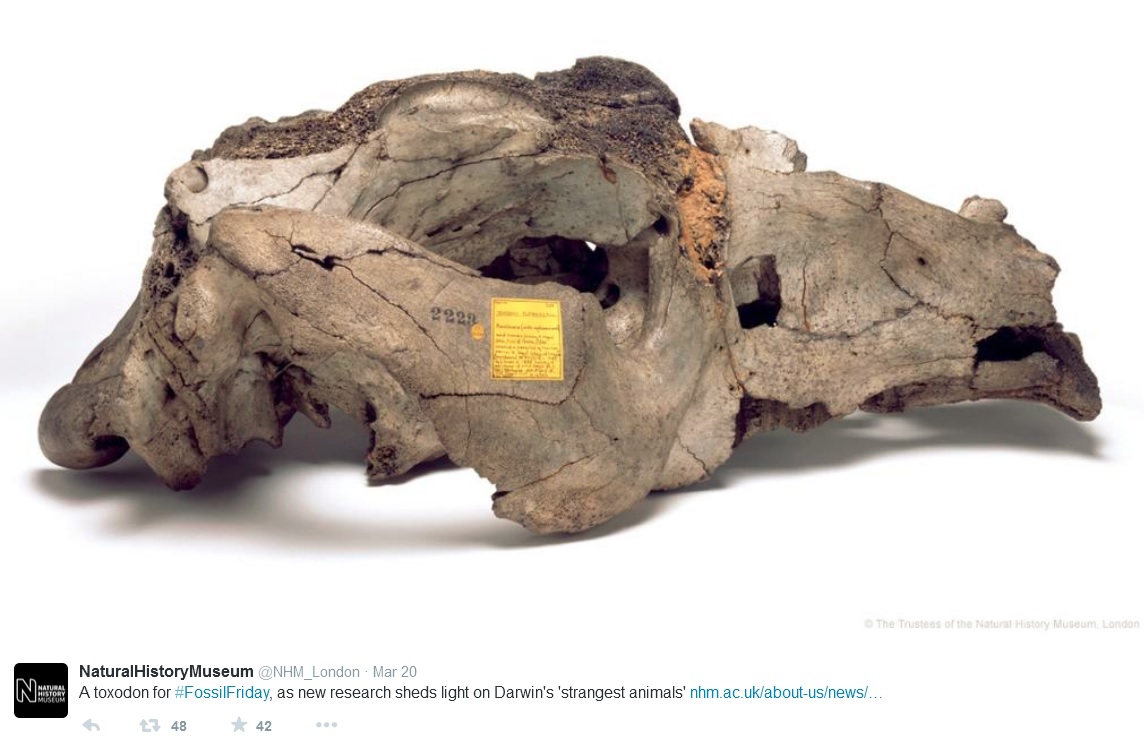
Darwin’s ‘strangest animals ever discovered’ finally find their place in the tree of life.


Got a submission for the blog or Digital Digest? Email us at blog@natsca.org!

Curating a Deep Sea Fish Collection at Glasgow’s Hunterian Museum

Hunterian Zoology Museum, Glasgow University. Photo: Glenn Roadley

Hunterian Zoology Museum, Glasgow University (Photo: Glenn Roadley)

The third week-long placement of my HLF Natural History Curatorial Traineeship took place at The Hunterian Zoology Museum, part of the University of Glasgow’s impressive campus. I had visited The Hunterian in Glasgow once before, in November, as part of a meeting with my traineeship mentor, Maggie Reilly, the Curator of Zoology. While before I only had time for a quick tour of the museum galleries, this time I was able to get hands-on with a full project.

Shelves of fluid-preserved animal specimens in jars, in the Hunterian's spirit collection. Photo: Glenn Roadley

The Hunterian’s spirit collection (Photo: Glenn Roadley)

During 2011, a research team from the University of Glasgow set out to trawl the Porcupine Abyssal Plain, ~4800m deep in the Atlantic Ocean, as part of an investigation into the effect of commercial fishing on the marine ecosystem. As fish stocks are depleted, commercial fisheries are trawling deeper and deeper. Much of life on the sea floor is unknown, and investigating the diversity of deep sea organisms will help us to understand the potential effects of deeper trawling. The fish collected during the research cruise were measured (body length, head length, tail length and wet weight), assigned a unique number, labelled, and preserved in a formalin solution. These were then transported to the Hunterian Zoology Museum, to be added to the spirit collection. The fish had been identified as well as possible, rinsed of the formalin, and transferred to 70% ethanol solution, but still needed to be separated out by taxon, stored in their own jars (rather than plastic buckets), and added to the museum database. This was to be my task.

A toothy anglerfish: a gloved hand holds a fluid-preserved specimen of an anglerfish. Photo: Glenn Roadley

A toothy anglerfish (Photo: Glenn Roadley)

Deep sea fish are definitely a bizarre and fascinating lot. The collection I was working with contained a wide range of taxa, with ghostly-looking members of the genus Coryphaenoides occurring particularly often. Anglerfish and common fangtooth also stood out for their menacing looks – the former rather closely resembling a scrunched up bin-liner with teeth. Some had been identified all the way to species level, while others were yet to be identified. Who knows, maybe I handled a yet-undescribed species during my time at the Hunterian?

After preparing a large batch of 70% ethanol solution, in which the fish are preserved, I set about recording them on the Hunterian’s database, KE Emu. Pulling a specimen from a bucket of mixed fish and laying it onto a tray, I was able to use the unique collection number and site of collection on the label to match it to the records on the research cruise data sheets, which contained the exact location co-ordinates, date, species ID, and measurements. I could then enter this data into KE Emu and assign the fish a unique museum accession number. Once the fish label had dried (though care had to be taken not to let the specimen dry out too), it could be permanently marked with the accession number, before the specimen was sorted into a jar of ethanol by site and species ID.

Coryphaenoides leptolepis: a fluid-preserved specimen of a fish sits in a clear container. Photo: Glenn Roadley

Coryphaenoides leptolepis (Photo: Glenn Roadley)

It was fascinating to work with such a wide range of rarely seen species, and served as a good boost to my knowledge of fish taxonomy. Most importantly, I was able to see the true context of the collection – working from start to finish to accession the collection – while using the cruise research data and reports to populate the database enabled me to really understand where these specimens had come from and their value to science. These deep-sea fish will now be housed in the Hunterian Museum, accessible for further scientific research for decades to come.

Glenn Roadley
Natural History Curatorial Trainee
batdrawer1.wordpress.com