NatSCA Digital Digest

NatSCA polar bear

Jobs

Education Assistant – National Museum of Ireland – Natural History

Duration: Permanent

Closing date: 5th June 2015

To apply, click here

Conferences and Workshops

A few exciting talks are coming up at the Natural History Museum soon, which I thought would be worth highlighting for you. The first is the Annual A. R. Wallace Lecture which this year will take place on the 2nd June 16:30-17:30. The subject is ‘Wallace, Darwin, and Spiritualism: The Trial of the Spirit-Medium Henry Slade, 1876’. For more information, click here.

On the 24th July at 16:30, the SciFri Seminar series brings to you ‘The Greatest Living Naturalist- The Life and Conflicts of Professor Richard Owen’, in celebration of Richard Owen’s birthday. It will be in the Neil Chalmers Seminar Room. For more information, click here.


Exhibitions

The long awaited ‘Power of Poison’ exhibition has opened at the Old Truman Brewery in London. The website invites you to ‘discover the alluring, seductive and terrifying role of poison and how it affects our everyday lives through nature, myth, medicine and healing’ and of course, will contain spiders, snakes, and other lovelies. For more information, click here.

Content assembled by Emma-Louise Nicholls

Understanding Museum Taxidermy: Construction, Care and Commissioning

Taxidermy, the art and science of preserving an animal by placing the skin around an artificial body, has always been an important part of natural history collections. During the Victorian era, explorers would bring large and exotic animals back from their long voyages: the mounted skins would be displayed, enthralling the Victorian public, who had never seen creatures such as gorillas and giraffes before. While we thankfully no longer hunt and kill animals for display in museums, taxidermy is still as important as ever for teaching about the natural world – probably more so now as more and more species are threatened with extinction. While there has been a resurgence in the popularity of taxidermy, it is still the case that the number of experts capable of producing and preserving taxidermy is dwindling (in the UK, at least). With this in mind NatSCA, in association with Lancashire Conservation Studios, ran a day of talks and hands-on sessions, entitled ‘Understanding Museum Taxidermy: Construction, Care and Commissioning’, on the 1st April.

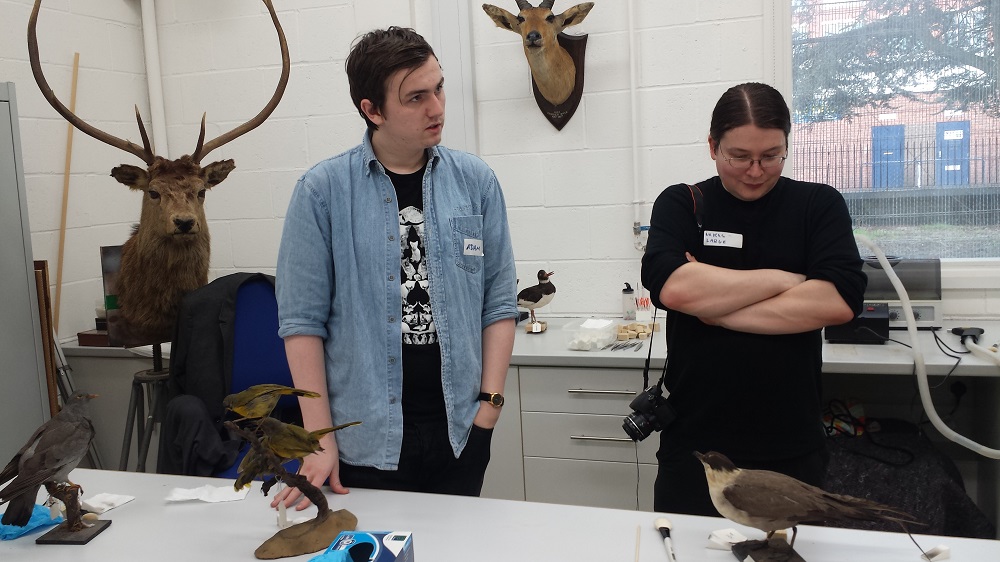
The day was led by Lucie Graham, Natural History Conservator at Lancashire Museums. Lucie began by demonstrating how taxidermy can be prepared using a wide variety of different methods, with internal moulds being formed from wood wool, balsam carvings, plaster and more. Taxidermy is an art, and each artist has their own methods. Lucie then went on to discuss how taxidermy can fall into disrepair if not properly cared for or prepared in the first place. We were able to get a close look an assortment of suffering taxidermy from Lancashire Museums, and discuss how we might treat each one to allow it to be better used and conserved. We had an adorable fox cub on our table, which had suffered from some fading, surface dirt and some loose digits on one paw. A bit of a clean and some adhesive to fix the paws, and this little cub could be looking much better!

taxidermy day3

Next we went through to the conservation lab for some cleaning demonstrations, where many of us were amazed to find out that simple cosmetic sponges get thick dirt off taxidermy effortlessly! We were also shown how to preen and straighten the feathers of a taxidermy bird, using steam to ease the process.

taxidermy day2

Finally were talks from a couple of the country’s leading taxidermists. James Dickinson discussed how museums can go about commissioning taxidermy. The Guild of Taxidermists can offer lists of accredited practitioners, ensuring that museums are able to make informed decisions and seek the services of the best person for the job. Jack Fishwick, judge at international taxidermy competitions, showed us a sample of his vast collection of bird photographs, which he uses for inspiration and feel for a bird’s shape and movement in life – vital for producing realistic taxidermy. The day finished with passionate discussion about the shrinking pool of skilled taxidermists – Jack and James warn that we may have no dedicated taxidermists left within the next two decades, which could be a disaster for museums wishing to expand and preserve their collections.

Glenn Roadley
Natural Science Curatorial Trainee

NatSCA Digital Digest


Chill out with NatSCA's Digital Digest. Binturong (C) Emma-Louise Nicholls

Calm down and chill out with NatSCA’s Digital Digest. Binturong /Arctictis binturong/ (C) Emma-Louise Nicholls

Welcome to the weekly digest of interesting things from around the web with relevance to natural science collections. We hope you find this useful and if you have any articles that you feel would be of interest, please contact us at blog@natsca.org


1. Conference: A Question of Ecology: Answers from Biological Recording

23rd – 25th April 2015

Synopsis

‘Biodiversity information is crucial to understanding ecological relationships and supporting conservation effort in a changing climate. Use of volunteer-collected biological records by the professional scientific community is widely encouraged and celebrated, but much interpretation of biological records is carried out by amateur naturalists, who are uncovering new ecological knowledge from their own records and sharing that knowledge with others.’ ~ National Forum for Biological Recording

Click here for more information.

2. FREE Course: Behind the Scenes at the 21st Century Museum

Starts 1st June 2015, lasts 6 weeks, all online

Synopsis

‘How can we understand museums today? Who makes the decisions about what to put in them and whose stories they tell? Who are museums for and why are they working to engage new audiences? How do we respond emotionally to museum objects and spaces? And how can museums play a role in the pursuit of social justice, human rights, or health and wellbeing?’ ~ Future Learn

Click here to find out more.

3. Event: An unconquerable aversion to Piccadilly”: Charles Waterton, traveller, taxidermist and pioneer conservationist

31st July to 1st August 2015

Synopsis

‘The Annual General Meeting or the Society for the History of Natural History will be held in association with a one day conference of talks celebrating the life and work of Charles Waterton and a second day with related excursions around Wakefield in West Yorkshire.

The Wakefield Museum, at Wakefield One, is currently hosting an exhibition “The extraordinary world of Charles Waterton” and the Society’s meeting will take place at a venue within easy reach of the Museum and will include a visit to the exhibition’ ~ Society for the History of Natural History

Click here for more details and to apply


Compiled by Emma-Louise Nicholls, NatSCA Blog Editor

Science and Museums with Erica McAlister

It’s been a little quiet around here so today you’re getting two posts to make up for it. This afternoon we’re going to have a guest post by Plymouth Museum’s very own Jan Freedman but first let’s talk about bugs:

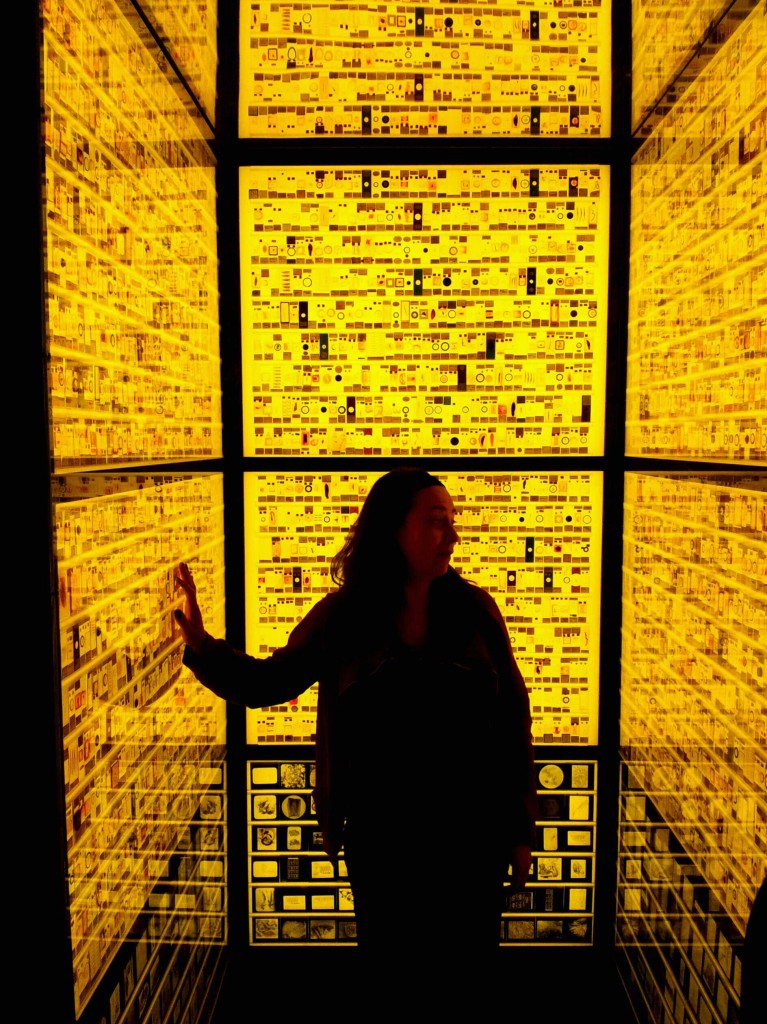
Erica McAlister visits the Grant Museum

Erica McAlister visits the Grant Museum

London’s Natural History Museum houses an impressive natural history collection. It has millions of specimens ranging from amoebae to blue whales. For Dr. Erica McAlister, an entomology specialist at the museum, the most important part of the collection are flies. Many of us relate to flies as a nuisance that needs to be swatted away from our sandwiches but, to Erica, they represent an amazing resource of information. Last month Erica agreed to come and talk to the good people of PubSci about her research.

There are two primary frontiers of insect research: new areas of investigation; and cleaning up the mess Walker left behind. We’re going to talk more about the new areas but I’m sure Erica would be happy to tell you about Walker’s legacy if you’re not already familiar with it.

New areas include a recent trip to the Ethiopian church forests. This is an interesting phenomenon – deforestation for farming has decimated the Ethiopian forests but, due to their reverence for the church buildings, the forests have been left unscathed in a radius around them. This may be the last hope for many of Ethiopa’s native species. Flies are a major contributor to pollination – three of the six top UK pollinators are flies. What Erica wanted to know was whether the speciation at the edges differed from the core. She went out there and, despite some regional obstacles such as children stealing pan traps, managed to recover a huge amount of data – which has since been published.

Another major area of investigation has been identifying fly larvae: we may have over 100 000 described species of fly but we only know 4% of their larvae. The importance of this cannot be stressed strongly enough: if you cannot tell apart a disease carrier from a pollinator you may be shooting yourself in the foot however you tackle them. Furthermore their presence at the developmental stages of a crime scene could drastically alter your prediction of how long ago the crime took place if you do not get the species right.

Flies are used as an arctic bio-indicator of climate change because certain species of chironomids (non-biting midges) are ctenothermic and can only exist in very specific temperature ranges. There now exists a ‘chironomid thermometer’ due to this phenomenon.

Suitcase ecology is another area of crime scene investigation. It was once believed that the age of a body couldn’t be as accurately determined if the body was stowed away in a suitcase because flies cannot get into and out of it. Further study has revealed a pattern of egg-laying on the zip, through which the larvae may pass when they hatch. This now gives us a better picture of the circumstances of the murder than ever before.

There are lots of fly behaviours that touch upon our daily lives in ways we don’t even appreciate and understanding these is essential to our continued way of life. For example the very fact that we have chocolate is wholly due to fly pollination. Without them, we wouldn’t have it. Furthermore we can use flies as a source of chemical research – fly venoms used for biological control, for example. We need them to tell us whether the climate is changing and to help us catch murderers but, more importantly, we need people like Erica who can make sense of their behaviour and present it in a way that makes us forget our instinctive “ugh, flies” reaction. There aren’t many people who would be prepared to trawl through cow pats and fetid carcasses in the name of science but somebody has to. When someone steps forward and shows enthusiasm for this we should wholeheartedly encourage it.


PubSci is a pet project of NatSCA Chair Paolo Viscardi. If you’re in London tomorrow evening I highly recommend you come along. We will be talking about the history of natural history collecting and trade with Elle Larsson, University of London postgrad. I am sure it will be terrific.

Review of a Training Course on Pesticides and the Latest Legislation

The following is a review made by Roberto Portela Miguez, Mammal Group Curator at the NHM London:

About a week ago I attended a course and talk at the Natural History Museum of London, entitled “Control of Pesticide Regulations 1986 (as amended 1997) EU Biocides Regulations 528/2012”.

I know that, even if your two passions in life are pesticides and obscure legal documents, it is highly unlikely that you would rush to sign up for it.

After attending the event I can assure you that I still do not wish to look into both topics more than I need to. I do however strongly recommend all collections management staff to attend any future opportunity to listen to Bob Child’s talk or training event on this topic.

Robert Child was formerly Head of Conservation at the National Museum of Wales, and is now a Conservation Consultant, Advisor on Insect Pests to the National Trust and Director of Historyonics.

His company, Historyonics, sells insect pest products and carries out treatments on historic buildings and collections – so he has plenty of first-hand anecdotes to illustrate the various points he makes during his talks.

His experience on these matters is vast, but possibly more important: he is a brilliant communicator that can easily turn what is a dry and dull topic into two hours of effective and entertaining training.

The course Bob runs is required training for anybody using pesticides as part of their work ( this includes volunteers ) and is based on the requirements of the Control of Pesticides Regulations 1986 (as amended), the Control of Substances Hazardous to Health Regulations 1988 (as amended) and the new Biocides Regulation 528/2012. It is further based on the HSE’s publication ‘Recommendations for Training Users of Non-agricultural Pesticides’.

The course lasts for about two hours and covers both theoretical aspects on a Powerpoint and practical demonstrations of:

  • principles of pest control and nature of pesticides
  • legislation
  • storage and transport of pesticides
  • use of pesticides (on site assessments)
  • labels and data sheets
  • safety in preparation, clean up and disposal.
  • emergency procedures
  • record keeping

Once you have gone through the training, you will be qualified to apply pesticides in your collections and, without doubt, be extremely grateful that Bob has done all the reading of the relevant EU legislation on your behalf.

I know most of us do our best to prevent infestations but, just in case, better to be prepared and qualified than …you know.

Keep checking our NatSCA website and blog for news on future workshops and training events and if you want to contact Bob to run the course at your institution, you can email him to bobchild@historyonics.com .