Using Social Media as part of a Curatorial Traineeship

This post is another in our series of presentation write-ups from the 2015 NatSCA Conference, Museums Unleashed!


It felt like I was up there for hours when it was happening, but then it was over with a massive sense of relief. That’s how I’d summarise my first presentation in front of fellow NatSCA conference attendees.

We (myself and another two Natural Science Curatorial Trainees, Glenn and Lukas) had been asked to prepare a talk fitting with the conference theme of ‘Museums Unleashed’.  The conference was to focus on sharing collections using digital platforms, television and other forms of media, so we decided to present on our own use of Social Media throughout the 12 months of our Traineeships.

The presentation we came up with explored our use mainly of Twitter and WordPress throughout our year (other social media platforms are available), which we used to document our experiences and engage with the wider museum community. We were able to speak about things such as how fun Social Media can be when it’s used well, and how good of a platform it can be to engage with members of the public in order to (hopefully) dispel some of the myth about museums being so exclusive.

Presenting in full flow! (Image from Clare Brown @CuratorClare)

Presenting in full flow! (Image from Clare Brown @CuratorClare)

We also got to speak about how Social Media (from our perspective as trainees) could be used for our host museums. For example, showing the support of an institution or organisation for a trainee by letting them be there, working with collections and allowing them to further advocate said collections.

Our presentation allowed us to touch on some things that can make Social Media a challenge too, such as building a following. This can be difficult, especially when trying to expand outside the ‘Museum bubble’ – it can be hard to find those who may be interested in a particular discipline or hashtag.

Finally, I would like to take this opportunity to thank everyone at the conference who gave us great positive feedback about our talk, as especially for myself being so nervous, it was great to hear I wasn’t a complete mumbling wreck! And thanks again to NatSCA and its members for its support of myself, and my fellow trainees whom it has helped support over the years of the HLF Skills for the Future
programme.


Adam Peel, Curatorial Trainee Natural Science, 2014 – 2015

NatSCA Digital Digest

A mounted skeleton of a fruitbat leers at the cameraYour weekly round-up of news and events happening in the world of natural sciences

Jobs

Research Assistant, Vertebrate Palaeontology – University of Birmingham. 12 month post researching 375 million years of the diversification of life on land!

Curator of Microlepidoptera – NHM, London. A great opportunity for any fans of minimoths!

Curator of Natural Sciences and Collections Access ManagerTullie House Museum. Still a couple of days to apply for these two. The deadline is 10th August.

As always, see out jobs page for more opportunities.

Events

‘Digitisation’ seems to be the keyword for September…

NBN Crowdsourcing Data Capture Summit. The National Biodiversity Network is holding a one-day meeting on digitising specimen data through crowdsourcing, at Manchester Museum on 25th September.

iDigBio Vertebrate Digitization Interest Group will be holding a 4-part webinar series entitled The Value of Digitizing Vertebrate Collections. They will be held on Tuesdays in September at 3 – 4 p.m. EDT (7 – 8 pm GMT).

All webinars are 3-4 p.m. EDT and accessible at https://idigbio.adobeconnect.com/vertdigitization. Here is the schedule:
September 8: The Value of Digitizing Mammal Collections, Cody Thompson, University of Michigan
September 15: The Value of Digitizing Fish Collections, Andy Bentley, University of Kansas Biodiversity Institute and President of SPNCH
September 22: The Value of Digitizing Herpetology Collections, Chris Phillips, Illinois Natural History Survey, University of Illinois
September 29: The Value of Digitizing Bird Collections, Carla Cicero, UC Berkeley and Lead PI for Vertnet

Around the Web

Time to re-curate those canid specimens? Genetic evidence indicates that the African golden jackal is a distinct species from the European golden jackal, and is actually much more closely related to wolves! And new genomic research has clarified the status of Eastern wolves and other North American canids.

'But I'm still a fox, right?'

‘But I’m still a fox, right?’

Working with the Public: How an Unusual Museum Enquiry Turned into Travels Through Time and Space. A great example of how engaging with enquiries can lead to fascinating insights into the past.

…And Finally

A request: We would love you to get involved in the NatSCA blog! It’s been rather quiet of late. I know you’re all probably off enjoying yourselves on holiday, but if you happen to visit a museum or an interesting exhibition while you’re away, why not review it for us? We’d love to hear tales of your adventures! And don’t forget, if you’re working on any projects or specimens that you think other people would be interested in, then the blog is the perfect place to share! Email submissions to: blog@natsca.org

NatSCA Digital Digest

A mounted skeleton of a fruitbat leers at the cameraYour weekly round-up of news and events happening in the world of natural sciences

Jobs

Curator of Natural Sciences, Tullie House Museum. Fixed term for 12 months (with potential for extentsion). Tullie House is also looking for a Collections Access Manager at the moment.

Operations and Project Officer, Lyme Regis Museum. A great opportunity to work on the iconic Jurassic Coast.

UK Flora Collections Assistant, Royal Botanic Gardens, Kew. An interesting role combining field work, lab work, and collections!

As always, see out jobs page for more opportunities.

Events

SVPCA (The Symposium of Vertebrate Palaeontology and Comparative Anatomy) is coming up on 29th August – 4th September. This year it is to be held at the National Oceanography Centre in Southampton.

#AskACurator Day is back on Twitter on 16th September. It’s a great way for people to talk to museum staff who are normally ‘behind the scenes’, and for us to get exposure for the amazing work we all do with our collections.

Around the Web

Dinosaurs on tour: Dippy the Diplodocus will be leaving his home at the NHM for a holiday, and the museum is looking for host venues. Must have large gallery.

The genome of the kiwi (Apteryx mantelli) has been sequenced, revealing insights into its strange physiology.

Giant animals that are almost impossible to find! Did you know that the largest stick insect recorded is in the collection of the Natural History Museum (NHM), and is over half a metre long?

Brymbo Fossil Forest in Wrexham has been designated as a Site of Special Scientific Interest (SSSI), protecting the future of its precious 300 million year-old fossils. Sadly, many fossils were lost in arson attacks on the site last year.

Museums Unleashed: Using traditional and social media to reach audiences, build communities, and transform hearts and minds

This year’s NatSCA conference at Bristol’s M Shed brilliantly championed the ways in which TV, storytelling, and social media can engage and inspire the public with fantastic natural history content, and make museum collections come alive. Wendy Darke, head of the BBC Natural History Unit, opened the conference with a moving presentation on the enduring power of the BBC Natural History Unit to produce jaw-dropping films that stir our hearts, like Life Story and Frozen Planet, versus shows like the Lost Land series that appeal to those of us who want to understand more about nature and expand our minds.

The equally inspiring Sara Zeidler, Social Media Manager at BBC Earth, discussed how the team have built an impressive global community of 4.85 million fans across six social media platforms including Twitter, Facebook, and Instagram. The popularity of the Natural History Unit filming in all corners of the globe has allowed the public to connect to the researchers and filmmakers, places and wildlife being filmed in real time through #EarthCapture and #Earthonlocation. Sara emphasised that nature content that is positive, surprising,and emotional provides the best hooks for audiences.

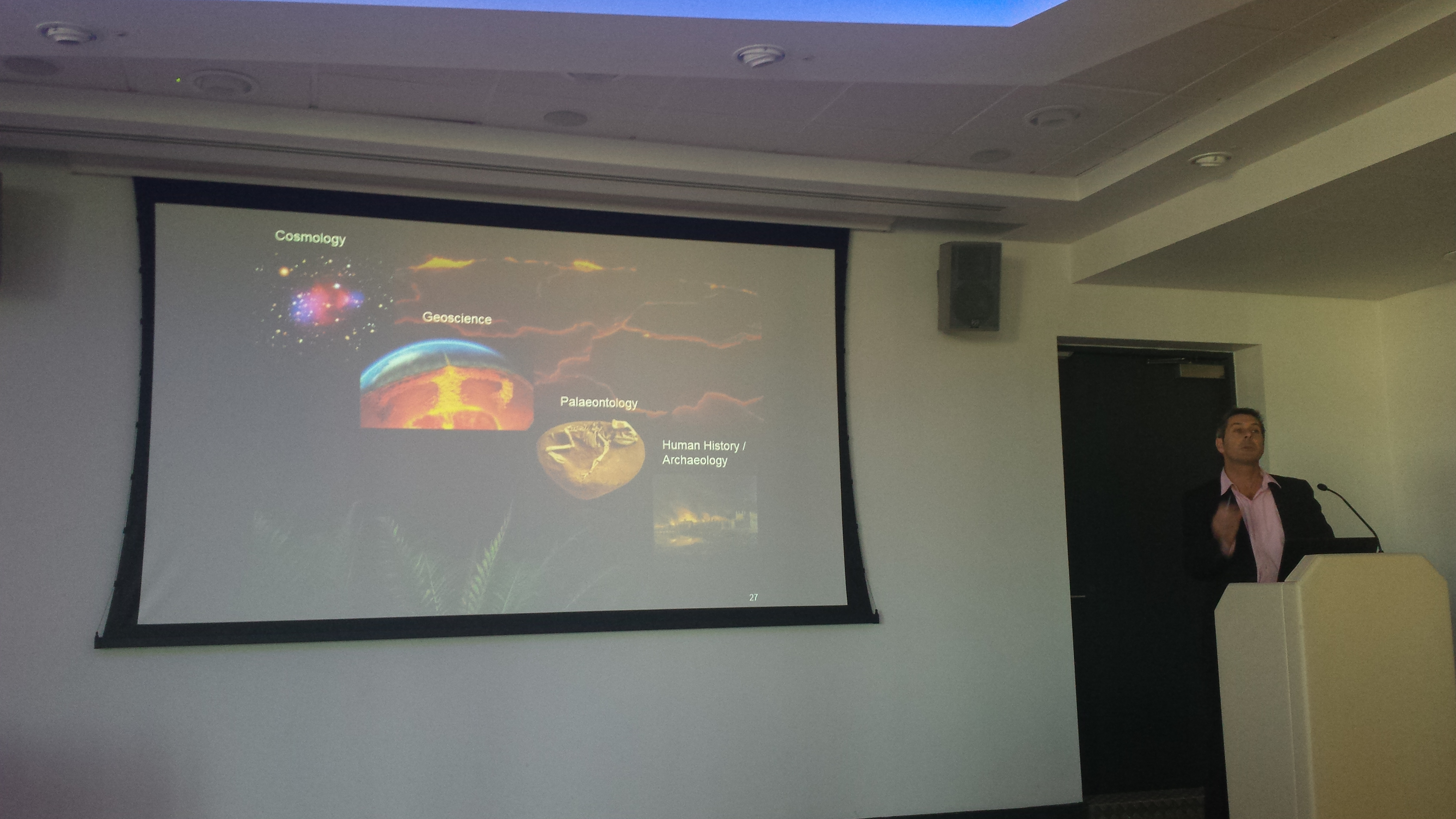
As an archaeologist who is passionate about geology, Prof. Iain Stewart is one of my heroes of popular science. A passionate academic, like Prof. Alice Roberts, he has successfully communicated the stories of geoscience for over a decade, from Earth: The Power of the Planet, to the more recent Rise of the Continents. In his talk, ‘50 Shades of Grey’, he explained that geology works on TV because it deals with ‘Big Histories’ that ultimately help tell our human story. Iain passionately believes in science for society, and raised the important question of how to maintain meaningful public engagement with increasingly disparate audiences in a world where the Internet has overtaken TV as the main source for the dissemination of scientific knowledge.

Prof. Iain Stewart explains the continuum of science programming. (Image: Anthony Roach)

Prof. Iain Stewart explains the continuum of science programming. (Image: Anthony Roach)

Iain’s research into audiences explained that many of us fanboys and fangirls are of course continually engaged in science programmes, events, and activities. We also see the benefits of science in solving societal issues. But Iain raised the strong need to find new ways to reach those who are disengaged in science (either because they lack interest, do not see the relevance in their lives, or perhaps just don’t make the time for science), and move away from ‘disasters and dinosaurs’ TV.

The second half of the conference displayed the shared passion of museum professionals who were inspired by their collections and wanted to ‘be where their audiences were’. @oisinthedeer at Warwickshire Museum was a superb example of how museum mascots can be used as a springboard for a museum looking outwards to its audiences. The composite Irish Deer skeleton has been at the centre of a successful twitter campaign that has given the museum a voice to promote its collections, events, and activities, and ‘build the buzz’.

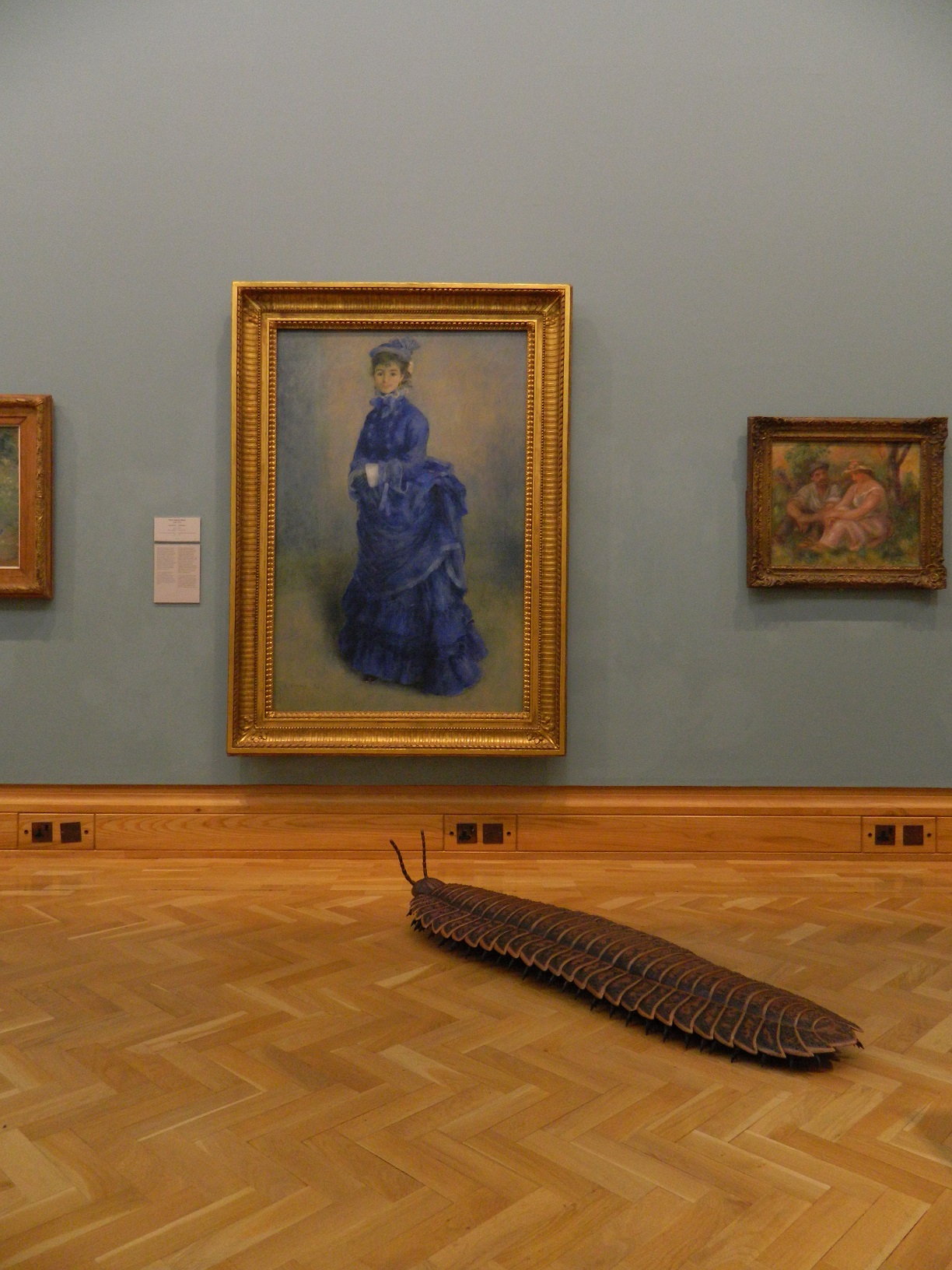
I enjoyed hearing from Kate Mortimer about the National Museum of Wales’ joined up approach to social media to improve the visibility of their amazing collections. The use of ‘tweet guides’ has allowed colleagues across the museum to co-ordinate the scheduling of tweets, such as #MolluscMonday and blog posts about specimens. My personal favourite being that of the conservation of Arthur the Arthropleura. Kate explained the added longevity that Storify brings to their social media platforms through curating particular tweets and posts. This strategy has enabled colleagues to build deeper public engagement with their diverse and beautiful collections.

Arthur the Arthropleura visits the impressionists (Image source: http://www.museumwales.ac.uk/blog/2014-11-11/The-Adventures-of-Arthur-the-Arthropleura-/)

Arthur the Arthropleura visits the impressionists (Image source: http://www.museumwales.ac.uk/blog/2014-11-11/The-Adventures-of-Arthur-the-Arthropleura-/)

My overall favourite for the innovative use of social media to engage audiences with collections projects was ‘Objects, Meet World!’ by the Horniman Museum and Gardens. Rachel Jennings explained the benefits of Tumblr as a micro-blogging platform to upload multimedia object content during the Horniman’s major review of their anthropology collections. The platform is quick and easy to use, and allows users to put together an interesting story about the object in a few sentences. As a result of their sterling work, the site has generated interest world-wide, gaining a whopping 39,000 followers in under three years. And if you’re a fan of sticks, just check out their ‘Stick of the Week’.

Thanks to Bristol Museums and NatSCA for organising a brilliant conference and set of collections tours, and I look forward to seeing what museums will unleash next year!

Anthony Roach, NHM

NatSCA Digital Digest

ChameleonYour weekly round-up of news and events happening in the world of natural sciences

Jobs

Curator, Grant Museum of Zoology, UCL. It’s here! The job I’m sure you’ve all been waiting for. Just make sure you get your applications in by 3rd August 2015!

Interpretation Producer, Kew Gardens. Closing date: 5th July 2015.

Conservation and Documentation Manager, Bristol Museums, Archives and Galleries. Closing date: 19th July 2015.

See the job page of the NatSCA website for more exciting opportunities!

News

The deadline for submissions to the next issue of the Journal of Natural Science Collections is 15th July 2015. Get writing! Guidelines for authors are available online, and please send your submission and any queries to Jan Freedman (editor@natsca.org).

Around the Web

Donna Young of Liverpool Museums has been busy digitising Brendel plant models.

A look inside the collections of National Museums Scotland.

North America’s herbarium collections are under threat due to funding cuts. The article is also a nice piece of collections advocacy for herbaria.

New research from the American Museum of Natural History shows that the teeth of Smilodon fatalis grew rapdily, but took years to mature.

The rise and fall of the barbary lion. Could it help to save other species from beyond the grave?