
Written by Hideko Yamamoto (former Volunteer, Natural History Museum, London) with input from Jovita C. Yesilyurt (Senior Curator, General Herbarium, Natural History Museum, London).


For centuries, a quiet corner of the Natural History Museum has concealed a secret: a previously undocumented historical seed collection. Hidden in locked cabinets, hundreds of small paper packets hold botanical specimens—and unanswered questions. This article offers a glimpse into this overlooked collection, the detective work behind its investigation, and the exciting possibilities that still lie ahead. The mystery remains unsolved—for now.
A Vast Botanical Treasure
The Natural History Museum’s botany collection contains more than five million specimens gathered worldwide over 300 years. These range from herbarium sheets and carpological (fruit) collections to microscopic slides, wet specimens, and seeds (Fig. 1). Ideally, each specimen carries detailed scientific and historical information, allowing researchers to reconstruct past ecosystems, track species distributions, and study evolutionary and climate-related change over time.
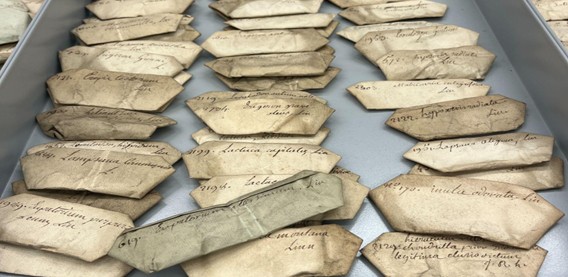
Figure 1: Tray with one of the sets of the seed collections
Equally important is the historical context: who collected the specimen, under what circumstances, and how it entered the Museum. Such information brings collections to life, revealing the people, motivations, and networks behind scientific discovery. Yet many specimens lack this documentation. Among them are seed packets stored quietly in locked cabinets of the herbarium.
Seeds in the Shadows
While the herbarium primarily houses dried, pressed plants, it also contains other botanical materials, including fruits, slides, bottles, and bound volumes. In one locked cabinet, we encountered hundreds of folded paper packets containing seeds, some dating back to at least the eighteenth century. A few include notes about origin, species, or illustrations; others provide little more than a name—or nothing at all.
Most intriguing was a subset of several hundred packets, meticulously numbered from 1 to nearly 3,000. Each packet is folded from thick, high-quality paper into a self-locking envelope. Despite variations in paper type—some watermarked, some pale blue, some reused—the format is strikingly consistent: a number and a species name, written neatly in ink. Many packets show signs of age: fading, staining, or torn folds, with seeds occasionally spilling out.
Yet there are no signatures, dates, or explanatory documents. Who assembled this collection? When, and for what purpose?
Linnaeus at the Core
A closer look revealed a crucial pattern: nearly all species are attributed to Linnaeus, indicated by “L.”, “Lin.”, or “Linn.” A few packets even use pre-Linnaean descriptive names, could this be a suggestion that the collection was assembled close to the period when Linnaean taxonomy was still being established? The species span many plant families but are almost entirely herbaceous, and also, they seem to be from various parts of the world. Would this be because it would make them easier to cultivate?
This degree of organisation strongly suggests an intentional, large-scale scientific project rather than a private hobby. The absence of trees or woody plants further hints at practical considerations related to seed handling, cultivation and/or horticulture.
Historical Context
The eighteenth century was a golden age of botanical exploration. Between 1760 and 1840, the number of plant species known to European science expanded dramatically. Collecting plants was risky, expensive, and slow; specimens were shipped as dried plants, seeds, or saplings, often over months-long voyages. While many plants were destined for private gardens, others entered institutional collections.
The Museum’s botany holdings trace back to the collections of Sir Hans Sloane and Sir Joseph Banks, whose materials formed the foundation of the British Museum’s natural history collections. Britain became a global centre for botanical research, supported by institutions, gardens, and international networks of collectors.
Piecing Together the Puzzle
We reorganised the packets according to their original numbering and recorded the species names. Of the collection, 748 packets have been located so far, numbered between 2 and 2,799. Deciphering faded handwriting proved challenging, even with modern plant-name databases (Fig. 2).


Figure 2: a) Image showing the detail of one of the self-locking fold (back side) of a seed packet. The handwritten note on the packet says: “949 Myosotis scorpioides”. b) : Image showing the detail of one of the self-locking fold (front side) of a seed packet. The handwritten note on the packet says: “769 Heliotropium peruvianum”.
To find clues, we consulted archival records relating to early British Museum acquisitions, compared the collection with other historic seed sets, and examined some letters, and written notes, including those from herbarium specimens, and visited the collections at the Linnean Society. Despite these efforts, no definitive list corresponding to this numbered collection has yet been found.
Clues and Speculation
Several patterns stand out. The uniform format, Linnaean focus, and sheer scale suggest the collection was assembled by someone with scientific training, resources, and access to living plants and/or seeds. This points toward an institutional context rather than an individual enthusiast.
Possible origins include the Royal Botanic Gardens network, the Chelsea Physic Garden, or the extensive botanical operations managed by Sir Joseph Banks. Some species originate far beyond Europe, implying access to global plant networks.
One particularly intriguing possibility is that the handwriting belongs to Samuel Törner, a Linnaean naturalist employed by Banks between 1792 and 1797. Certain letterforms and numerals resemble those in Törner’s archival documents, though further evidence is needed (Fig. 3). A more speculative—but tantalising—idea is a connection to Linnaeus himself or his garden in Uppsala, though this remains unproven.


Figure 3: Packets showing handwriting with some of the peculiarities, such as: a) the unique “down-facing 3” (1339. Salvia canariensis Lin), as it has been seen on many of the seed packets (e.g. Fig. 5d); b) unique details of the letter “T” (802 Tragopogon dalechampii, L.); c) unique details of the letter “P” (2427 Perilla ocimarra, Lin (ocymoides); d) Unique details of the letter “E” and number “4” (2734 Erigeron graveolens, Lin).
Why It Matters
Museum collections are repositories of raw data that can become powerful knowledge—if their stories are uncovered. This seed collection has survived for centuries, yet its origins remain unknown. Properly documenting it could enrich our understanding of botanical history and illuminate how scientific knowledge was created and shared.
Digitisation and modern analytical tools, including handwriting analysis and AI-assisted comparison, may help unlock these secrets. Even small inconsistencies—spelling variations or classification quirks—could prove helpful and decisive.
The Journey Continues
This research was carried out during my volunteer work in the Algae, Fungi and Plants Division at the Natural History Museum, under the supervision of Dr Jovita C. Yesilyurt. What began as curiosity grew into deep appreciation for the meticulous work of past curators—and for the many mysteries still waiting in museum cabinets.
Perhaps someone reading this will recognise a detail or hold a missing piece of the puzzle. The hunt continues, and with the right insight, this collection may finally reveal its story.
If you would like to contribute or discuss the project, please contact Dr Jovita C. Yesilyurt at j.yesilyurt@nhm.ac.uk.
This work forms part of an ongoing research project. Please note that all images have been taken by J.C.Yesilyurt, and © copyright The Trustees of the Natural History Museum, London.

 NatSCA