
Written by Sonal Mistry (Masters Students in Scientific Illustration, Zuyd University of Applied Sciences, the Netherlands) and Olivia Beavers (Assistant Curator of Vertebrate Zoology at World Museum, National Museums Liverpool).
Last year, Sonal approached the vertebrate zoology team at World Museum Liverpool to see the Nicobar Pigeon taxidermy mounts, study skins, as well as the Liverpool Pigeon study skin and dodo skeleton to use as reference for her work. From the first meeting, it was fascinating to see the detailed nature of her initial sketches and how quickly she worked.
World Museum has received requests from wood carvers and illustrators to access the osteology collection, taxidermy mounts and/or study skins as a reference for their work. The in-person visits help them to create more accurate drawings and carvings compared to using 2D images for reference.
Collaborating with researchers of a particular species or family broadens our understanding of the collections. For example, Sonal’s explanation of her university assignment shed light on the endangered status of Nicobar Pigeons and the unconventional use of their gizzard stones in jewellery which I was unaware of.
Sonal is currently pursuing a master’s degree in Scientific Illustration, at Zuyd University of Applied Sciences in Maastricht, the Netherlands. Her passion for the sciences and the arts enriches her illustrations with a unique quality that is evident in her diverse projects, showcasing a blend of creativity and scientific accuracy.
Project Insight and Final Outcome
My fascination with the Nicobar Pigeon was sparked by an intriguing university assignment, that allowed us to delve into the anatomy of a chosen animal through dissection. This opportunity enabled us to explore a species in great depth and convey our findings through an infographic. Given my longstanding passion for birds, my attention was naturally drawn to the pigeon. My love for Indian birds ultimately led me to discover the magnificent Nicobar Pigeon. Unfamiliar with this species prior to this assignment, I was captivated once I discovered it, instantly becoming enamoured with its beauty and grace.
While pigeons often carry a negative connotation in western cultures as “flying rats,” I was strongly motivated by the chance to alter this perception through illustrating this majestic bird. The first-hand examination of the study skins and mounts proved invaluable in accurately reconstructing the species. Sketching from direct observation allowed for a nuanced understanding of the species’ characteristics and habitat, even in the preserved specimens. As an illustrator, access to museum collections is essential, as they provide a tangible connection to the natural world beyond mere online information retrieval.
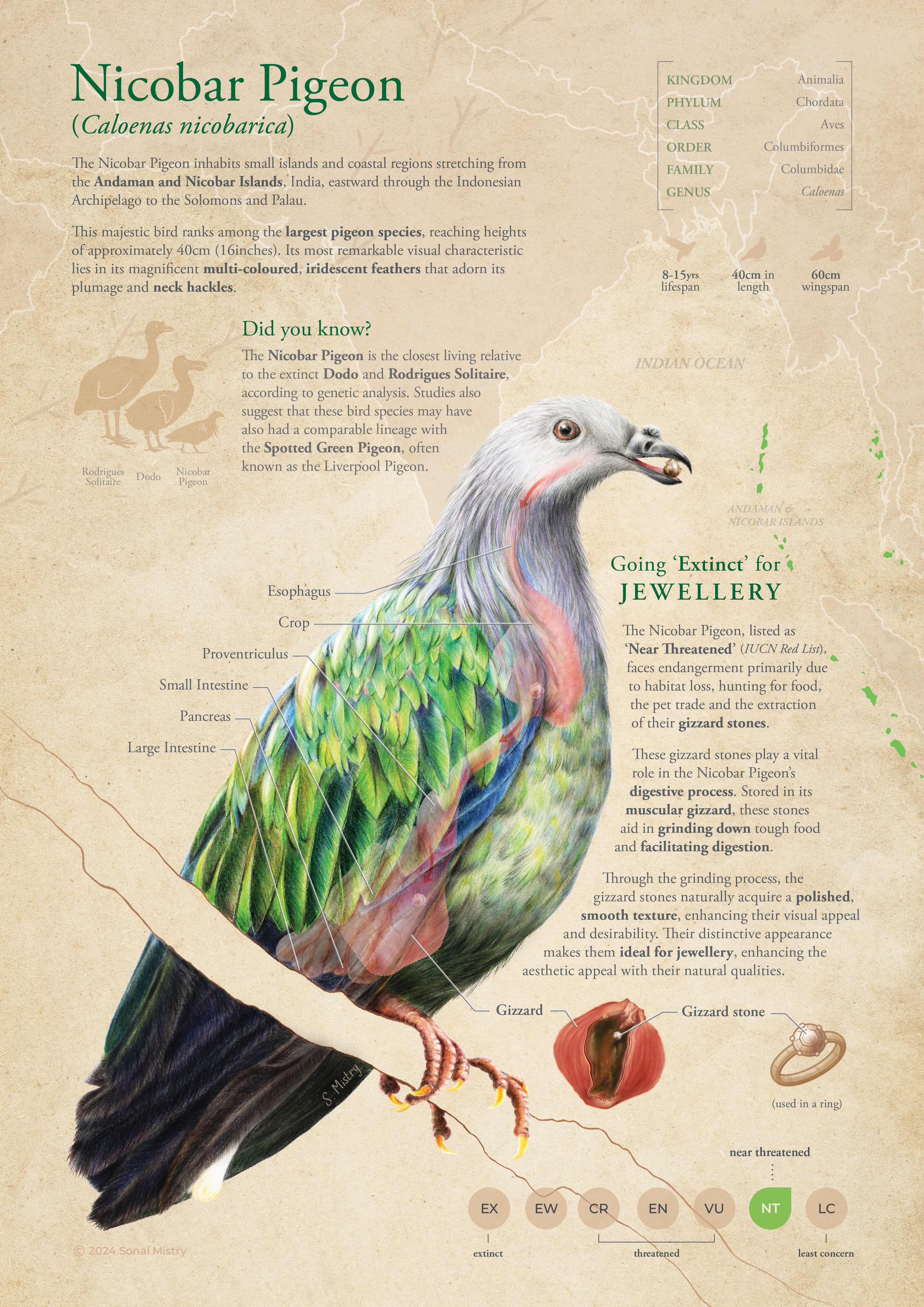
Despite living in an era of instant information access, nothing compares to the immersive experience of studying and observing our natural world in three dimensions. Through my infographic, I aim to not only inform and educate my audience about the Nicobar Pigeon, but also to raise awareness about its conservation status and the threats it faces. Focusing on the pigeon’s digestive tract, particularly the gizzard, my artwork sheds light on the species’ vulnerability. The pigeon’s gizzard stones, which are hunted for their polished and smooth texture to use in jewellery, pose a threat to the species’ survival. By highlighting this I hope to underscore the importance of preserving the Nicobar Pigeon and its natural habitat.
The Nicobar Pigeon holds a special place in the avian world as the closest living relative to the famously extinct Dodo and the Rodrigues Solitaire. This magnificent bird can be found inhabiting small islands and coastal regions from the Andaman and Nicobar Islands, India, east through the Indonesian Archipelago, to the Solomons and Palau. Its striking appearance is characterised by vibrant, iridescent feathers adorning its plumage and neck hackles, which make it one of the most colourful birds in the avian kingdom.
Despite its beauty and historical significance, the Nicobar Pigeon faces threats that have led to its classification as a ‘Near Threatened’ species. This serves as a poignant reminder of the urgent need to advocate for the preservation of not only this remarkable bird but also the delicate ecosystems it inhabits. By raising awareness and taking action to protect the natural world around us, we can contribute to ensuring the survival of species like the Nicobar Pigeon and safeguarding the biodiversity that enriches our planet.

Future Projects and Aspirations
Throughout my studies, I have honed my skills in translating intricate scientific and anatomical knowledge into visually compelling and coherent illustrations, that are not only informative but also aesthetically pleasing to the viewer. The course’s unique blend of art and science immediately captured my interest, as it offered me a platform to integrate my passions into a harmonious creative endeavour.
While my current focus is on birds, my curiosity and passion extends across the entire animal kingdom. Nature serves as a boundless wellspring of inspiration for me, propelling my relentless pursuit of knowledge and artistic expression. I am always eager to delve deeper into the realms of science and art, and I am constantly seeking new avenues for exploration and growth.

Figure 5. Locomotor system of the lion projected inside a graphite pencil render of the plaster cast of the muscles, designed in Adobe Illustrator © Sonal Mistry
My goal is to seamlessly integrate art and science by crafting illustrations that are visually stunning and educational, thus providing viewers with a fresh perspective on the beauty of our natural world. I hope to collaborate with esteemed curators and dedicated field researchers and work with museum collections to inspire a deeper appreciation and awareness of the wonder of our environment.
If you are interested in potential collaborations or simply wish to share insights and ideas, I welcome the opportunity to connect and exchange thoughts. The intersection of art and science is a realm brimming with endless possibilities, and I am excited to contribute to this rich tapestry through my artistic endeavours. To view more of my artwork and learn more about me, please visit my website www.itssmistry.co.uk.

 NatSCA
Pingback: NatSCA Digital Digest – August | NatSCA