
Written by Olivia Beavers, Assistant Curator of Vertebrate Zoology at World Museum, National Museums Liverpool.

August celebrates Jamaican independence, so what better way to celebrate than to talk about a Jamaican collector from the 1800s whose contributions to understanding Jamaican biodiversity are not yet fully recognised.
I recently finished the project stage of the Associateship of the Museum Association (AMA). My project focused on helping to tell untold stories of the collections held at World Museum.
Through trial and error, I started to look through World Museum’s database and Google the names of collectors to see if we had collectors who had black or brown heritage – with a focus on collectors with specimens from the Caribbean. I ended up finding William Thomas March. Only two previous papers were written about him, both by Catherine Levy (Managing Director of Windsor Research Centre, former President of the Caribbean Birds, and of BirdLife Jamaica).
To coincide with the research and my project, I created a new dataset titled ‘Bird skins from Jamaica in the collections of World Museums Liverpool’ – now available on the Global Biodiversity Information Facility (GBIF) website. It includes specimens from William Thomas March.
Introduction
William Thomas March (1804 – 1872) was born a free Jamaican black man from St. Catherine, Spanish Town, Jamaica. During the mid to late 1800s, he was a well-known and respected collector who corresponded and worked with Sir William Jackson Hooker, Charles Darwin, Phillip Henry Gosse, Richard Hill and Spencer Fullerton Baird. William Thomas March had an abundance of knowledge on Jamaican and regional flora and fauna, which helped these well-known naturalists with their research. Sadly, very few people know of William Thomas March and his contributions to Jamaican botany and zoology, despite his enormous contribution to European and North American understanding of Caribbean biodiversity.
Through years of correspondence, March developed a working relationship with Spencer Fullerton Baird (the Secretary of the Smithsonian National Museum of Natural History (NMNH)) which led to him gathering specimens for the Smithsonian Institution. Baird corresponded with March to tap into his knowledge of Jamaican flora and fauna. In 1863, Baird honoured William Thomas March’s work by naming Melanospiza bicolor marchii (Baird, SF 1864), the Black Faced Grassquit (marchii), in his honour. He stated:
“If, as I think most probable, the Jamaican species is thus without a name, to no one could it be dedicated with more propriety than to Mr. March, who has done so much towards extending our knowledge of the natural history of his island.” – S. F. Baird, (March,1863).
Biological data on endemic bird species which included their feeding, breeding habits, and habitats was lacking in the 1800s and March was one of the first naturalists from the Caribbean to provide it. He published ‘Notes on the birds of Jamaica Part i and ii’, in Proceedings of the Academy of Natural Sciences of Philadelphia in 1863 and 1864. He included detailed descriptions of migrant, resident and endemic species.
William Thomas March’s specimens are distributed all over the world. I have located his specimens in National Museums Liverpool (see Figure 1), Smithsonian National Museum of Natural History, National Museum of Ireland, Natural History Museum Tring, American Museum of Natural History, Royal Botanic Gardens, Kew, Missouri Botanical Garden, The Bavarian Natural History Collections (Staatliche Naturwissenschaftliche Sammlungen Bayerns, SNSB), Centro Internacional de Agricultura Tropical CIAT, Naturalis Biodiversity Center, Museum of Biological Diversity – The Ohio State University and the Natural History Museum of Denmark, to name a few. There most certainly are more locations to be discovered.
An issue with the spelling of William Thomas March’s name has made it harder to locate specimens. Abbreviations and incorrect variations include W.J. Marsh, W. (T.) Marsh, W. E. Marsh, W.W. Marsh and Mr. Marsh, to name a few. After putting a call-out over the NatSCA JISC mail I was able to receive confirmation of my initial findings and even more background information on his collections and their whereabouts from enthusiastic curators that care for them.
Bird Skin Types
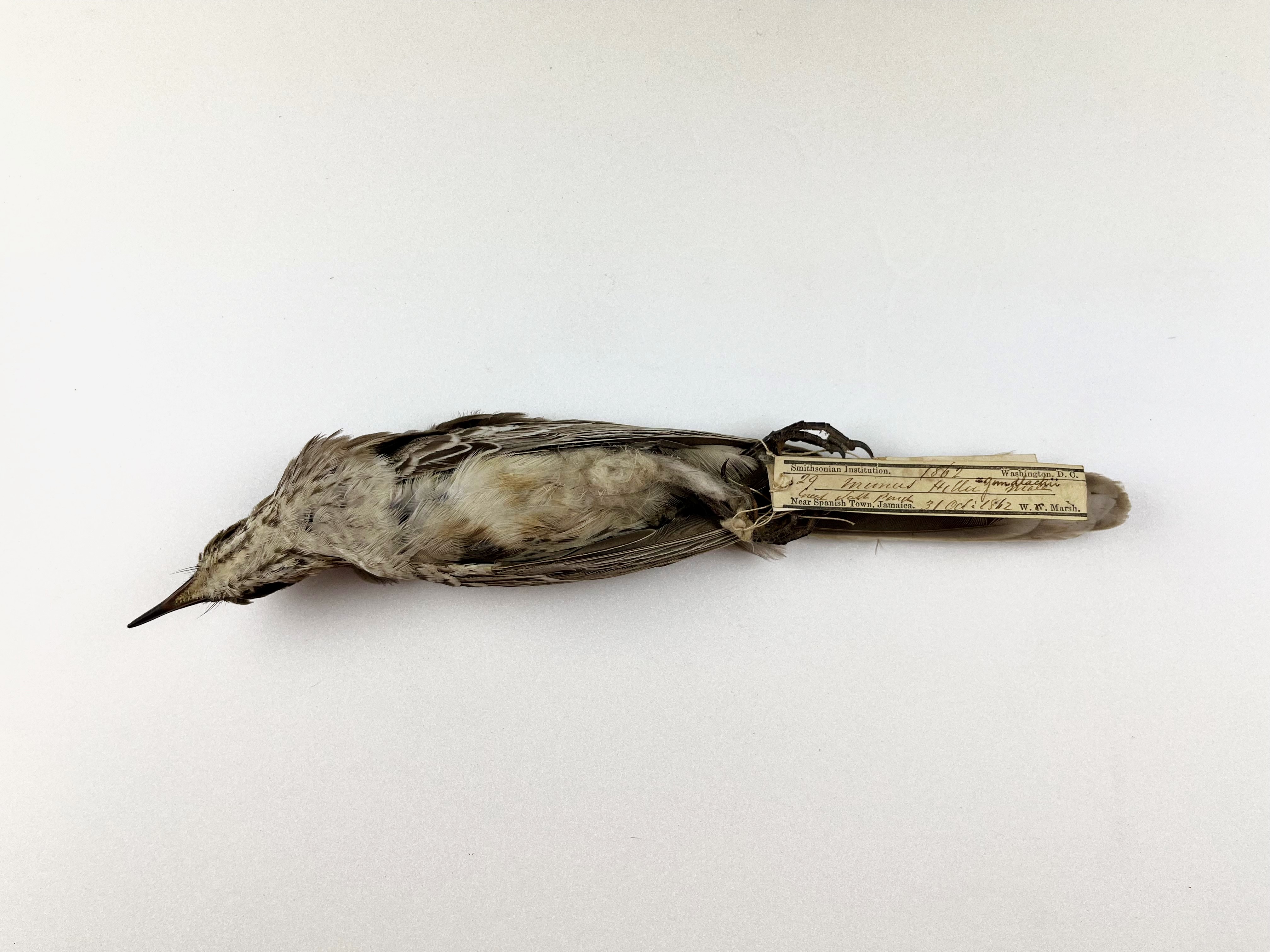
Within World Museum I found that one of March’s birds, in Figure 2, was a co-type from the Smithsonian Institution’s collection, based on its original label and publication reference from Proceedings of the Academy of Natural Sciences of Philadelphia 1863. The specimen is a syntype of Mimus gundlachii hillii (Bahama Mockingbird) which March described in Proceedings of the Academy of Natural Sciences of Philadelphia in 1863. Four of the syntypes were originally held at the Smithsonian NMNH and one was re-located to World Museum as a gift presented to Canon Henry Baker Tristram.
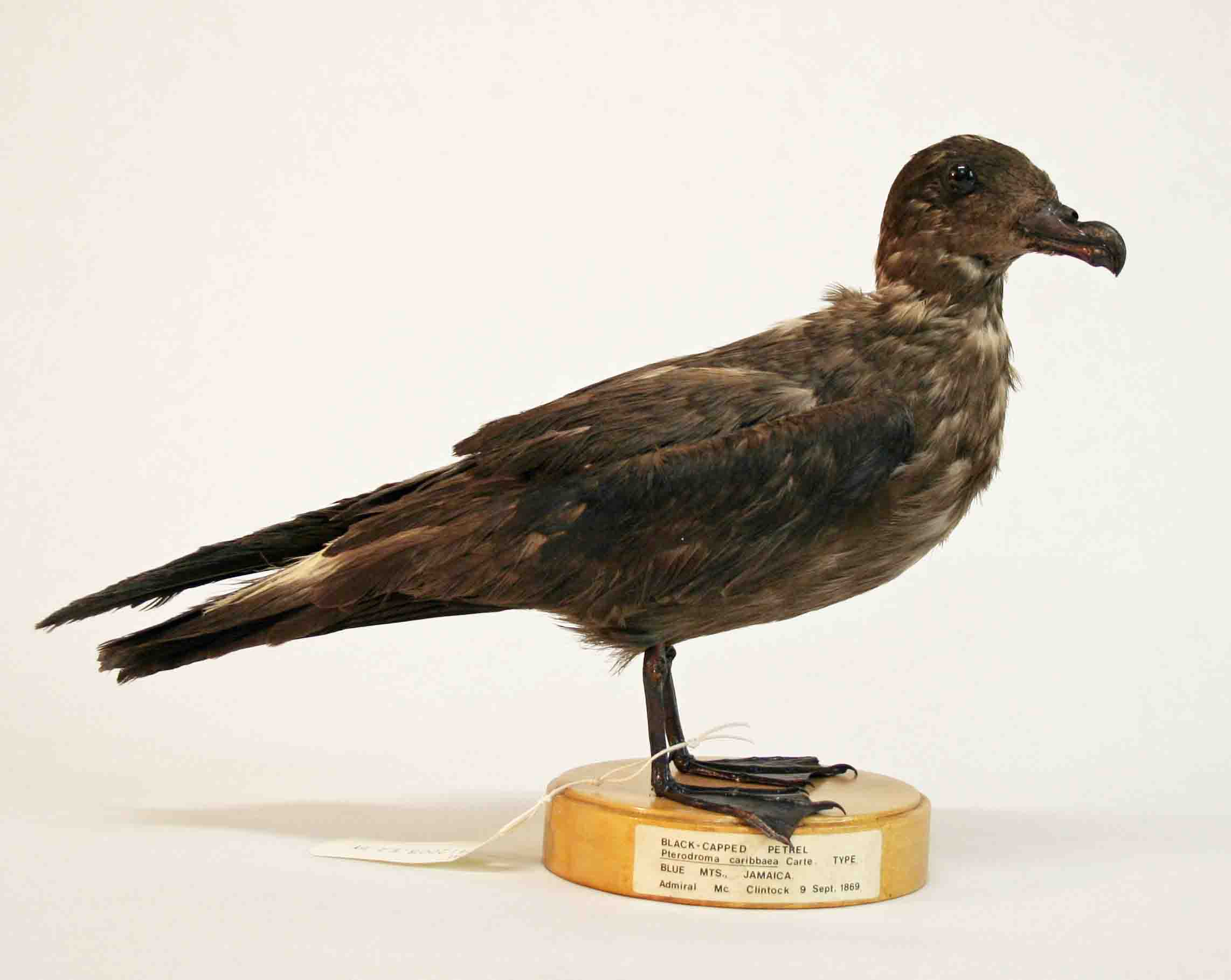
The Royal Dublin Society had a type and co type of the Blue Mountain Duck or Jamaican Petrel (Pterodroma caribbea) sent over by William Thomas March which were later described by Dr. Alexander Carte. An illustration by Joseph Smit also featured in Proceedings of the Zoological Society of London (Figure 3). March wrote to Baird in 1861 saying:
“The burrowing duck mentioned by Mr. Hill is Prion caribea I think, they are difficult to be got, being only found in the Blue Mountains but I will try for a pair for you – I sent a pair to Dublin some time ago to be identified, but I have not yet heard if I am correct in the name”.

As part of my research, I contacted Paolo Viscardi, Keeper of Natural History at National Museum of Ireland. He confirmed that even more of March’s specimens are in their collections. Regarding the types, there has been past confusion on whether the birds, one pictured below in Figure 4, are the original specimens collected by William Thomas March or different specimens collected by Admiral Leopold McClintock. Without a doubt, the original type specimens were collected by William Thomas March but whether these specimens now labelled as the type and co-type in the collections are the original specimens, is yet to be confirmed. As Paolo Viscardi communicated:
‘All labels now with the specimens are post-1877 so original labels that would identify these as March or McClintock acquisitions are absent. As there are only two birds in the collection and not four as indicated from the publication by Carte combined with the register entry from 1869 – the possibility that the two birds are entered twice in the system must be considered.
It is worth noting that the specimens described by Carte in 1866 were the ones sent by March to the Royal Dublin Society, which rather coincidentally McClintock (who was Commodore of the Jamaica Division at the time) was elected to in 1865. It is possible that although the specimens have an entry for September 9th in the 1869 donation book they may have been the same specimens that were sent by March via McClintock and there was simply a delay in formally registering the donation (although it is also possible that the original specimens were destroyed and McClintock acquired replacements)’ (personal e-mail correspondence, Paolo Viscardi to Olivia Beavers, January 2023).
Aside from his interest in birds, March collected and supplied insect specimens to Darwin and sent botanical samples to Sir William Jackson Hooker. It is documented that March’s true passion was botany and he was ‘one of Jamaica’s leading botanists’.
To date, I have been able to find that March collected 118 type specimens of birds, mammals and botanical specimens. There could be more of his specimens located in stores across the globe since William Thomas March’s name was not always clearly documented as the source.
Botanical Specimens and Connection to Sir William Jackson Hooker
William Thomas March originally sent around 2000 botanical specimens to Sir William Jackson Hooker (Director of Kew Gardens 1841-1865). Today, March’s botanical specimens have ended up in various institutions including Royal Botanic Gardens, Kew (an example in Figure 5), Missouri Botanical Garden, The Bavarian Natural History Collections (Staatliche Naturwissenschaftliche Sammlungen Bayerns, SNSB), Centro Internacional de Agricultura Tropical CIAT, the Naturalis Biodiversity Center and the Natural History Museum of Denmark. Some were labelled as Lectotype, Syntype, Type, Isolectotype and Isosyntype. Confusion over William Thomas March’s name led to some herbarium sheets being recorded as collected by M. March, Mr. March or Marsh.
In letters between Hooker and March, I learned that they exchanged plant material and knowledge on specimens held at Royal Botanic Gardens, Kew in England and the Bath Botanic Garden in Jamaica. In 1853, March pitched an idea of publishing his own Botanical Magazine with coloured plates in England and even had a Jamaican lithographer Miss C. Dubuisson ready to create lithographs. Sir William Jackson Hooker had also agreed to offer his assistance to help March with ‘a handbook of [Jamaica] ferns’, which March was encouraged to publish by his friends, according to letters from 7th February 1861 and 19th April 1861.
Through an advanced search online via the Natural History Museum (BM) database, William Thomas March is acknowledged as a ‘plant collector’ and his biography reads:
“Lawyer in Jamaica. March lived at Spanish Town, where he had a fine garden. He sent specimens to Kew which have not since been found growing wild on the island and were therefore probably garden-grown. He also supplied insects to Charles Darwin via the naturalist Richard Hill, another resident of Jamaica, and birds to the Smithsonian Institution. March was Secretary to the Governor of Jamaica in 1868”.
There is also acknowledgement of him often being mistaken for William Thomas Marsh instead of March.

Other Accomplishments
Aside from his endeavours in natural science, March was the Island Secretary or Secretary to the Governor of Jamaica in 1868. He had many other accomplishments to his name, as detailed in Catherine Levy’s William Thomas March, 1804-1872 . He was an Attorney at Law, an elected member of the House of Assembly for St. Catherine in 1837, a Treasurer of Beckford’s Free School in 1841, a Trustee of the Spanish Town Savings Bank, a Vestryman in St. Catherine between 1839 and 1854 and went on to become the Deputy Clerk and then a Clerk of the Supreme Court.
He was a member of the Council of the Royal Society of Arts in Jamaica – whose ‘principal objects were to encourage the development of the productive and industrial resources of the colony, and to endeavour to turn them to substantial account in the great marts of the world’s commerce’.
Further Reading
Catherine Levy has published two papers worth reading if you want to learn more about William Thomas March, his life and contributions to our understanding of Jamaican flora and fauna.
Levy, C. 2008. History of ornithology in the Caribbean. Ornitologia Neotropical, 19: 415-426, 2008 [Online]. Available at https://www.researchgate.net/publication/288628656_History_of_ornithology_in_the_Caribbean
Levy, C. 2013. William Thomas March, 1804-1872. BirdLife Jamaica, 96 [Online]. Available at https://www.academia.edu/3993413/William_Thomas_March_1804_1872
This NatSCA blog post is a brief introduction to a paper currently under peer review which details more in-depth information on William Thomas March’s collections and their whereabouts.
Image credits:
Royal Botanic Gardens, Kew. 2021. Lectotype of Stemodia durantifolia (L.) Sw. var. angustifolia Griseb. [Online]. Available at http://specimens.kew.org/herbarium/K000528934 (Accessed 08 May 2023).


Pingback: NatSCA Digital Digest – September 2023 | NatSCA
What an interesting and informative article, which I tremendously enjoyed reading! Thank you!
LikeLike
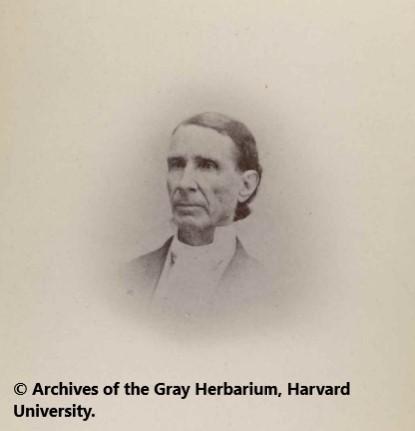
Can this article find a picture of William Thomas March to associate with his work? How prejudice is the system not to include his picture because he was of a biracial heritage, to show his name represented by birds while his white associates have their pictures 😞🤔☹️
LikeLike
Reply from author: Hi Fay, prejudice and biracial heritage are not the reasons that his picture was not published. The reason a picture wasn’t included was because it took me until December 2023 to actually find a picture in a University library/archive.
Little is known about him and his work and if I had come across a photo sooner at the time of publishing this blog, it would’ve been included. I had been searching for months to find his picture and this was finally included in the main article that was published in December 2023 due to copyright. Please see the link to this paper: https://ttfnc.org/livingworld/index.php/lwj/article/view/beavers2023 . Happy to talk further if you wish: olivia.beavers@liverpoolmuseums.org.uk. Please note I am a black curator myself so I would not have hesitated to post his photo if I had had a copy of it at the time.
LikeLike
Dear Olivia Beavers,
Thank you very much for finding a picture of my great great grandfather. My mother who is 94 years, was quite happy to see this picture of her great grandfather. She does not have a picture of her parents as they got lost in various hurricanes. She grew up with her aunt who looks much like William Thomas March. She died in 1977 so I also know her. I see the resemblance. My mother and the rest of our family really appreciate this article with a picture attached. May you be blessed for this research. Fay
LikeLike
hi! I am connected too! His great-great-great grandchild.
LikeLike
This is amazing information! This is actually my great-great-great grandfather. My family and I have been searching for more information about him. Appreciate your research on his amazing contributions.
LikeLike
Hello Olivia,
How are you doing?
I previously thanked you on LinkedIn, but not on this site for making it possible for my family, friends and I to visit the museum when we docked in Liverpool on May 8, 2025. You gave us the grand tour and everyone still remembers your hospitality.
How are things there now? Do stay safe and well.
Warm regards and much cheers,
Fay
LikeLike