By Mark Carnall, Grant Museum of Zoology
You may have figured from the title of this blog but I’m going to take a bit of time to talk about when specimens go missing from a museum collection. It can be a difficult thing for museums to talk about as most museums operate to care for the specimens and objects that are given in trust to them often for perpetuity, or more practically until the death of our part of the Universe. Currently a lot of my work here involves relocating our specimens following the move of the stores and museum a couple of years ago and trying to work out what happened to a missing specimen involves a bit of detective work, so I thought I’d offer an insight into the process.
Missing Specimens- The Prime Suspects
Collectively, museums look after billions of objects. The Grant Museum contains roughly 68,000 specimens which may sound like a lot but natural history collections regularly number in the millions. Even keeping track of a mere 68,000 of them can be problematic enough. Here’s the mental checklist I go through when a specimen can’t be located.
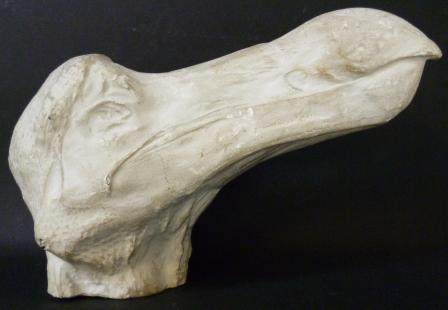
1. Somebody* put it back in the wrong place. A little known fact about museums is that under English law it is still possible to punish a museum professional with death if they commit this crime. Putting a specimen in drawer 43 instead of drawer 44 may sound trivial, but if it’s one of 200,000 superficially identical butterflies that’s been misplaced….. Of course, naturally you search the nearby area but if it isn’t immediately findable the next step is to organise a search committee and comb the museum inch by inch until it is located. Sometimes this is how half dodos are rediscovered.
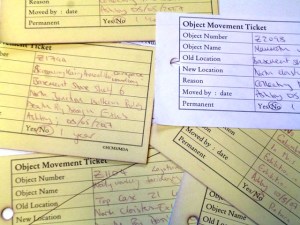
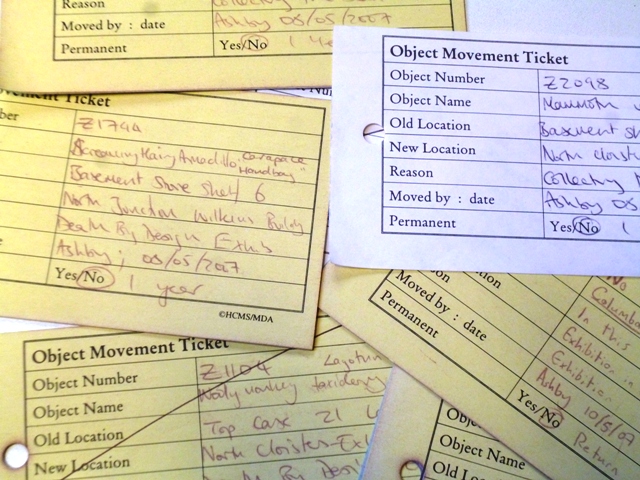
Good old object movement tickets. They still work when the servers don’t. (C) UCL Grant Museum
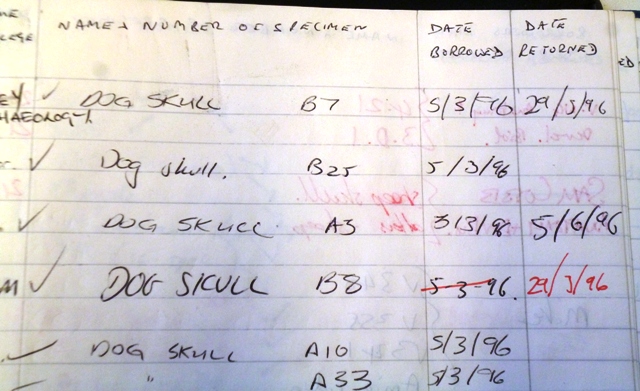
2. It’s temporarily somewhere else. At the Grant Museum, we use our specimens a lot. On any given day we’ve got specimens out for researchers, specimens on loan across the department and to other institutions, specimens being photographed and documented and our own rotating and temporary displays. For longer term movements, the ever useful object movement record should be where the specimen normally lives and the temporary location will be recorded on the database. For shorter term movements this won’t be the case and it’s true to say that with higher-than-you’d-expect regularity two people will need the same specimen at once. As for loans to other institutions it used to be common place to loan specimens on ‘permanent loan’ so some specimens have been temporarily somewhere else for 20, 30, 40 and even 60 years and before the current museum good practices and standards the loan agreement may or may not have been written down anywhere… There’s a good reason why ‘permanent loans’ have been all but outlawed in museums.

A page from one of the Grant Museum loan books. Note how some of the unnumbered ‘Dog skulls’ don’t appear to have a return date. SAD SMILEY FACE. (C) UCL Grant Museum
3. The specimen never existed in the first place. Many museums have gone through a number of phases in the attempt to catalogue every single object and specimen in the collection. Sometimes two or more people are documenting the same objects at the same time. This results in duplicate or ghost records appearing for the same object. Over time, and I can testify to this happening, you can be in the situation whereby you’ve got to try to work out whether the 20 physical dog skulls you have before you are the 20 records on the catalogue or not. Another complication is that we appear to have older catalogues of the collection which were part descriptions of the physical collection and part ‘wishlists’.
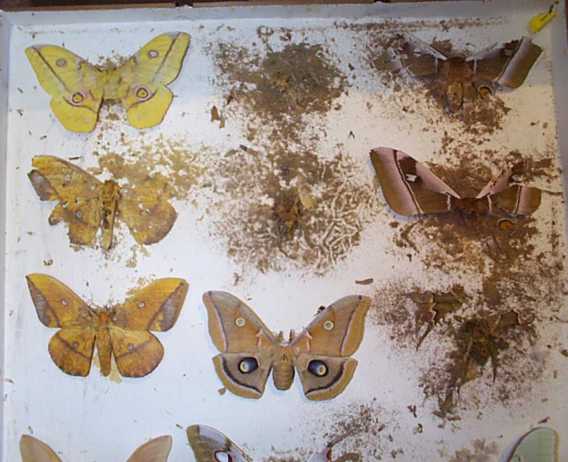
4. The specimen has been destroyed. Without constant monitoring and conservation work, sadly specimens may be degraded past the point of being recognisable, safe or otherwise usable. In addition specimens may be actively destroyed for the purposes of sampling or other investigation. Today we’d record a specimen as being disposed of and the method by which it was destroyed but in the past this may or may not have been recorded so you’ll be looking for objects that haven’t existed for a long long time.

Pest damage to entomology collections results in the disintegration of specimens. (C) UCL Grant Museum
5. The specimen was part of the ‘curator’s collection’. If you’ve been following my colleague Emma’s series on previous Grant Museum curators you will have read how some of our previous curators didn’t appear to leave much of a material trail in the museum. This is because in the past the boundaries between what belonged to the museum and what belonged to individuals was, how shall we say it, very fluid. When the curators moved on to other institutions they sometimes took their own collections with them or donated their important specimens to the Natural History Museum. Frustratingly, they didn’t always record that this had happened.
6. Stolen. Whether it’s innocent 5 year olds pocketing a handling specimen, a professional scientist accidentally retaining specimens sent to them or your organised criminals stealing to order it’s a sad fact of life that museum specimens do get stolen. There’s at least a bookshelf of literature on art thefts over the years, rhino horn thefts are at an all time high and then there’s the more run-of-the-mill smash and grab jewellery thefts. The real issue is at what stage the theft is noticed. Gallery display thefts tend to be obvious but if it’s one of 40,000 specimens in a storeroom that’s gone missing it can be months or years before it’s noticed. More often than not it’s when specimens come onto the open market that it’s realised it’s no longer in the museum.
7. Misidentified. The classification of animals is constantly changing. In older collections you’ll have the full spread of names an animal has ever been known by that may be completely different to the current ‘consensus’ (which can be in a state of flux for 150 years and counting). Furthermore, depending on who has been documenting a specimen, your non specialist may get as far as bones, your generalist natural historian as far as lion and your carnivoran expert down to population you may be looking for a bag of bones labelled lion or looking for a lion labelled as a bag of bones.

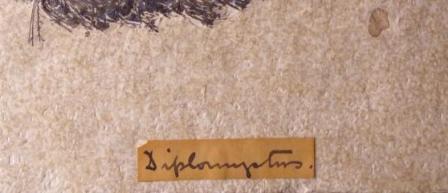
A great example of the kind of handwriting you can expect to find on older specimens. Diplommyotns, Diplomyctus, Diplonijotus, Diplonnystus? Suggestions on a postcard please. (C) UCL Grant Museum
8. Human Error. I don’t know if there’s a ‘background rate’ for errors that people make but when you scale museum staff adding up to 200 different fields of information (number, description, location, etc.) for thousands or hundreds of thousands of different specimens the inevitable fallibility of humans starts to add up. Couple this with the fact that, like GPs, scientists tend to have awful handwriting and you can be looking for a Z300 instead of an S800.
So that’s the mental checklist I run through when a specimen can’t be located and it can be very heartening to relocate a missing specimen but ultimately some specimens end up recorded permanently as lost in the hope that at some point they’ll be rediscovered.
Mark Carnall is the Curator of the Grant Museum of Zoology
* For diplomacy I use the generic somebody here. In reality it’s always Mr. Nobody who takes responsibility for this.