An Audience with Lyuba – the Mammoths come to London

20140622-100639.jpg

What better way to spend a gloriously sunny day than to wander around a museum exhibition indoors? Doesn’t sound ideal? How about if I rephrase it: what better way to spend any day, regardless of the fickle favours of weather, than to stand in the presence of a 40 000 year-old baby mammoth! Considering she died at the tender age of one month, Lyuba has had a very eventful ‘life’: discovered by a reindeer herder; sold to a nearby shop; worried by local dogs; and now she’s travelled thousands of miles to be the centrepiece of the Natural History Museum‘s latest temporary exhibition: Mammoths – Ice Age Giants.

Taking photographs of Lyuba was prohibited, so you will have to see her. Fortunately the rest of the exhibition was a photography free-for-all. There were some lovely members of the elephant’s ancestry present, including my favourite: the shovel-faced gomphothere Platybelodon. Flora and fauna that shared their world with the mammoth also made an appearance, including a staggering reconstruction of a rearing cave bear. It is easy to see why Neandertal culture was so obsessed with them.

The whole exhibition is well worth seeing. You can tell people how big mammoths are but, until you stand under their tusks it is hard to conceptualise. The real reason to go is of course to see Lyuba. Lyuba has told us so much already: the gestation period of mammoths (22 months, similar to a modern elephant); that mammoth mothers probably fed faeces to their young, just as modern elephants do, to aid in the cultivation of digestion-assisting bacteria in the gut; that mammoths have brown fat at the back of the neck…

The Americans were not so lucky and had to make do with a model of her. The guys on the door speculated that she came here because the museum sent a specimen on loan to Russia in return – the moon rock perhaps. Whatever the circumstance, we are lucky to have her. For some of us this may be the only chance we get to see her: to gaze upon the underside of her trunk and observe just how… Elephant-like her trunk wrinkles are; to see the little tufts of hair surviving in her inner ear.

20140622-100825.jpg

Autism and Museums

Today we have Claire Madge, museum volunteer and mum of three, who kindly agreed to let me interview her about autism and museums.

Claire Madge's blog - Tincture of Museum

Claire Madge’s blog – Tincture of Museum

Q. How aware were you of autism before your daughter was diagnosed?

A. I wasn’t really aware of autism before my daughter was diagnosed in 2012, certainly not the way it affects individuals and the impact it has on the whole family.

It took a year from first asking for help to receiving a diagnosis. For many years I just thought my daughter was ‘difficult’ and I was a ‘bad mother’ for struggling to cope. She is my eldest, so I had nothing to compare her to, I certainly wasn’t aware of the signs. I remember buying many books like ‘How to raise a happy toddler’, desperately trying to find out what I was doing wrong.

Q. She has Aspergers is that right? How does this differ from other forms of autism?

A. She officially has a diagnosis of Autistic Spectrum Disorder or ASD, sometimes this is also referred to as Autistic Spectrum Condition or ASC. It is a lifelong developmental disability that affects how she communicates and relates to other people, it also impacts on how she makes sense of the world. Because it is a spectrum condition it affects individuals in very different ways. They can be non-verbal with profound learning disabilities needing full time care, whilst some can lead relatively independent lives.

Aspergers is a form of autism, individuals can have average or above average intelligence with no delay in language development but may struggle with social communication, interaction and social imagination.

Q. What sort of challenges does a parent of an autistic child face when taking them out for the day?

A. Autistic children take comfort from routine and familiar surroundings. Going anywhere new, or changing that routine can be challenging and cause anxiety. If we are going out to a museum we haven’t visited before, if we are going on holiday or anything different we have to prepare my daughter by talking about what we will be doing and, where possible, showing her pictures of where we are going and what we will see when we get there.

Autistic children often have sensory sensitivities including sounds, sights and smells, this can also make getting out and about very difficult and stressful.

It can be hard to anticipate problems, which can make planning a successful day out really hard. We took a trip to a museum that had a faint tweeting bird song sound track, my daughter started screaming that it was hurting her ears, and she had a panic attack. We hadn’t really experienced anything like that with her before and it was very frightening.

Sometimes if she is anxious it seems to heighten these sensory sensitivities, which can makes life very unpredictable.

Q. You have said in the past that most museums often don’t cater for the needs of autistic visitors. Is that specifically children or do you feel that they are not catering for adults with autism either?

A. Museums in general don’t really cater for adults with autism. There may be the occasional specialist event or programme, but not a consistent approach, even within museums that run these events. Autism is a lifelong condition, children will not grow out of autism, they become adults with autism who need support, help and opportunities to live their lives to the full. According to a recent study, over 600,000 people are in the UK are living with autism, more than 1% of the population and they are not being catered for in museums1.

Q. What could museums be doing better for these visitors?

A. Basic, simple steps can make a massive difference for autistic visitors, so awareness and understanding of how autism affects the visitors to your museum is a great first step. It is not about radically changing your gallery spaces and the programmes that you run. It is about preparing autistic visitors with visual stories on your website, warning visitors if exhibitions have bright lights or loud noises. Providing quiet spaces with minimal sensory stimulation.

It is not just about autistic visitors, but volunteers too. Only 15% of people with autism are in full time employment, despite the fact that 79% of people with autism who are on out of work benefits want to work2. Welcoming autistic volunteers is one way museums can help, providing fantastic opportunities for individuals to get work experience in a supportive environment.

People with autism often have obsessions. Common examples include: computers; trains; cars; historical events; dates; and science. Obsessions often provide order, structure and predictability, they can be a route to relaxation and a conversation starter that aids social interaction. Ultimately I would like to see museums thinking creatively about using their collections to actively engage with autistic visitors who will often know more about collections than the curators!

Q. Which museums, if any, are getting it right?

A. There were a number of museums mentioned recently in the Museums Association Journal article3 who are running great programmes to engage autistic visitors and volunteers, including the Mary Rose Museum, the Museum of London and the Museum of Oxford.

From my own experience the Science Museum run a fantastic ‘Early Birds’ programme, where they open up the museum at 8.30am, exclusively for autistic children and their families. Many families are visiting the Science Museum for the first time because of the Early Birds events, they are reaching families who are isolated and feel they can’t visit museums during normal opening hours. We went together as a family and it was the first time we had all been to the Science Museum, it was a wonderful, memorable morning that my children won’t forget.

I have spent time talking to staff who run and work the Early Birds events and what impresses me is that they want autistic visitors to feel welcome and relaxed in the museum environment. It is not an event that ends and families have to leave, they are encouraged to stay, as the museum opens to the public, if they want to. It is a truly inclusive approach that I really admire.

I can’t explain how important it is to be able to go out as a family and visit a museum. It seems like a simple thing, but to have a day out together, in a supportive environment, is important not just for my 10 year old autistic daughter but for my 6 year old and my 3 year old too who so often miss out on the kind of experiences that other families take for granted.

Science Museum by Christine Matthews, 2008

Science Museum by Christine Matthews, 2008

Q. What do you think is the biggest obstacle to making improvements in this area?

A. The mistaken belief that it will cost a lot of money to welcome autism into your museum. The Science Museum do receive funding to run their Early Birds programme but not all museums are as busy as the Science Museum. Sometimes it can be as simple as putting up on the museum website when the quiet times are or which are the quieter galleries.

Putting a visual story on your website is not an expensive exercise but can really benefit autistic visitors. Some good examples are listed below4.

Ultimately there seems to be a fear of the unknown – autism is a wide spectrum and it can be hard to tailor events to cater for everyone. The reality is that you can’t cater for everyone with one event. You can only consult with local autism groups, listen to what they need, see what you can do. If you do run events, evaluation is absolutely crucial and the best way to see what works and what doesn’t.

If you just share with your staff information about what autism is and how it affects individuals, the problems they can face when visiting your museum, then that is a massive step forward. Awareness really helps, a bit of understanding goes a long way and costs absolutely nothing.


I’d like to thank Claire for taking the time to talk to us about this subject. I highly recommend her blog for more on this and her museum volunteering adventures. I’d also really like to hear from you all: does your museum have any interesting autism-related projects that we should know about?

References

  1. http://www.lse.ac.uk/newsAndMedia/news/archives/2014/06/Autism.aspx
  2. http://www.autism.org.uk/Working-with/Employment-services.aspx
  3. http://www.museumsassociation.org/museums-journal/features/01022014-welcoming-autistic-visitors (requires Museums Journal subscription)
  4. V&A Museum of Childhood Making SENse pre-visit booklet; London Transport Museum Social Story

Vikings: Life and Legend – a Review

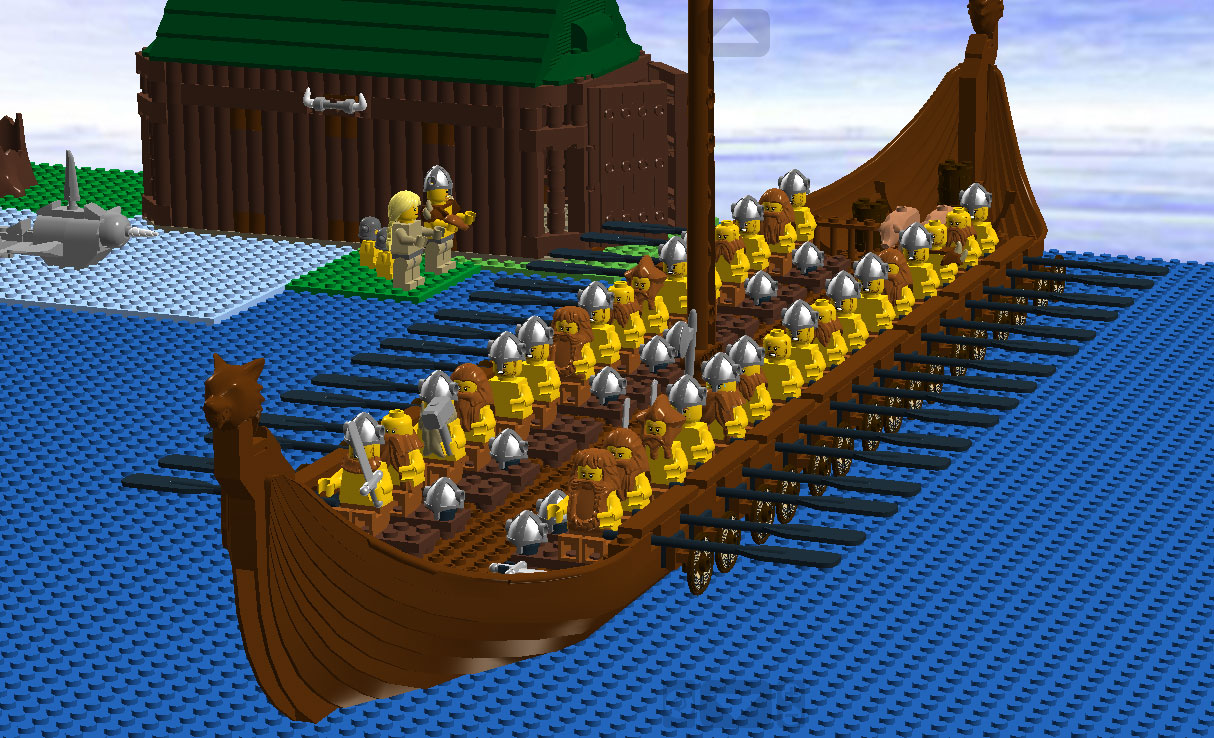
This post will be accompanied by LEGO illustrations as we were not permitted to take photographs inside the exhibition.

Viking-Roskilde-6

When it comes to archaeology / anthropology exhibits I’m not the easiest audience to please. Unless the people in question had some serious interaction with the local wildlife I lose interest fast. Fortunately the Scandinavian people do not disappoint in this regard. As soon as you enter the first room you are greeted by a pair of walrus tusks, representing the primary source of Viking ivory, which they carved into all manner of things from game pieces and dice to religious objects and scabbard decorations. They traded ivory, pretty stones such as Jet, and furs – across Europe, the Middle East, and North America. There were some lovely black fox skins available for stroking. One can only imagine how quickly these will be reduced to a sticky mess. Their tools were often fashioned from animal parts too: the whale baculum (penis bone) was used as an axe handle.

We normally associate the Vikings as loud, war-obsessed drunks but their culture seems to have abhorred loud, idiotic behaviour. They did have a proud warrior tradition, in which it was noble to die in battle and shameful to die in bed. A child would be given an unsheathed sword from his father and told that his sole inheritance was whatever he could gain with this sword. Most of our English mediæval ancestors would have associated with the Vikings as raiders – even the word means “raider” or “pirate”.

They were by no means invincible: in Weybridge there were found some 30-35 Viking men, buried unceremoniously together. Carbon dating puts them near 1000 AD and it seems these men were the entire crew of a Viking raiding party that lost. Some of the bones are on display in the exhibition – including one hyper-arctic adapted chap with a very robust femur compared to his friends. According to written accounts of Vikings going to battle, they were often accompanied by ravens, which they referred to as the “wound-grouse” (fantastic name). The ravens got food in abundance from this arrangement but I wonder what was in it for the Vikings.

The centrepiece of the exhibit is of course the large longship Roskilde 6, according to some sources the largest Viking vessel of its kind. The norm seems to be 16 pairs of oars and shields, which is why I depicted this in my illustration, rather than almost double that, aka Roskilde 6. She’s an impressive ship. The Vikings made lightweight ships that could be carried over small obstacles, row into shallow water down to a metre deep, and can be reversed easily by simply rowing in the opposite direction, as the stern cut the water just as easily as the bow. It seems modern ships have made a commitment to going one way and turning is a much more difficult enterprise than it used to be. I have a question for any maritime engineering experts we may have reading this: what have we gained in sacrificing these benefits? I’m assuming there’s a trade-off there somewhere.

If I had criticisms, they would be the flow of traffic round the first room, and the use of microphones on the fire alarm which, in some areas, was barely comprehendable due to vocal distortion plus echo from the building acoustics. In conclusion, if you haven’t got yourself down to the British Museum and seen it yourself yet I would recommend it. It’s finishing on the 22nd of this month so do head down there sooner rather than later.

NatSCA Digital Digest

Welcome to the fortnightly digest of posts from around the web with relevance to natural science collections. We hope you find this useful and if you have any articles that you feel would be of interest, please contact us at blog@natsca.org

1. Blog: Night at the Museum, Uni Week

Synopsis

The next wave of young scientists have been on their feet this week showing us all their exciting research. Yours truly went down to the Natural History Museum, London to see how collections are being used right now.

Night at the Museum, Uni Week

2. Conference: NatSCA / SPNHC / GCG Conference, Cardiff 2014

22-28 June 2014

Synopsis

Time is running out to book your place for the Cardiff conference. If your team can spare you for that long it’s going to be a great week. You can book your place here.

3. Training: Taxidermy Seminar

18 July 2014
UCL Room G10, Chandler House, 2 Wakefield Street, London, WC1N 1PF

Synopsis

For folks that can get into London next month we have a great seminar lined up for you with seven speakers spanning a number of taxidermy-related disciplines. Book fast, spaces are limited.

TaxidermySeminar

4. Lecture: Indefatigable Naturalists. Wallace and Darwin on the Evolutionary Trail

30 July 2014
Flett Events Theatre, Natural History Museum, South Kensington, London

Synopsis

Professor of Biology Dr. Jim Costa discusses the life and works of naturalist Alfred Russell Wallace. The annual Wallace lecture is organised by the NHM’s Wallace Correspondence Project.

How to book

Compiled by Samuel Barnett, NatSCA Blog Editor

Night at the Museum, Uni Week

“Every night all the specimens in the museum come alive and instantly drown in industrial methylated spirits or silently scream without flesh”

Mark Carnall, Grant Museum.

Most people’s experiences of museums after dark differ to Ben Stiller’s. Mine last night was no exception. I visited the Natural History Museum, London, to see what science’s next generation are doing with our natural science collections.

It didn’t take long to wade past the cultural historians and robot musicians to find a relevant stand:

The University of Leicester

These guys have been studying the process of organic decay. Their stand, titled “Rotten Fish and Fossils – Resolving the Riddle of our Earliest Vertebrate Ancestors”, showcased photographs of a series of exquisitely preserved fossils – many from the Royal Ontario Museum, Toronto. I was shown a 300 million year old relative of the lamprey who stared lifelessly back at me from deep time. His modern counterpart lay equally lifeless in a nearby vacuum bag.

As part of their research, the team have been deliberately decaying various modern vertebrates in an attempt to better understand the process. One thing their team found was that the order in which structures decayed seemed to be a reverse mirror of the order in which they evolved. The implication: if you don’t identify how far along something is in the rotting process, its evolutionary relationships could very easily be misdiagnosed. You can read more about this on their site. This includes citations of published material (£).

The University of Cardiff

Project Splatter is a relatively new endeavour to track the location, variation, and frequency of road kills around the UK. Roadkills are a daily occurrence and form an important part of the corvid and fox diet. The University of Cardiff are asking for your help using social media to crowd source the data.

Most of the time all they want is the species, location, and date but, if it’s a bird of prey or an otter, they need the carcass too. As we know all too well from the DDT egg shell research, if there’s toxins in the environment it’s the top predators who get the most concentrated dose. Here’s the best part: after they have finished analysing the specimens, their remains are sent to the National Museum, Scotland to contribute to their natural science collection. With around 200 otter fatalities on the road per year, the NMS is fast becoming the best place to go for otter variation studies.

You can help out via Twitter, Facebook. They even have an Android app.

Middlesex University

Andrew Greenhargh has been playing with some fun toys involving biomechanics. While his current research is predominantly aimed at humans, the technology has been used to analyse obstacle avoidance techniques in running guineafowl during his stint at the Royal Veterinary College.

Andrew was squeamish until he met John Hutchinson: one elephant dissection later and he was a new man. One thing I learned talking to Andrew is that, when you have to euthanise a sick elephant, it is important to do it in front of the remaining elephants and give them time to grieve. They are very emotional and social animals. If you don’t do this, the other elephants can often become violent. He also talked about the keepers sitting vigil with the deceased elephant: despite recent tabloid stories to the contrary, most zoos care deeply for the animals in their care.

That’s all for my round-up of natural science university research. I did take a look at the other stands ad am happy to talk about what those institutions are up to. If you missed it and want to know more, do ask.