The HMS Challenger Project – putting the voyage back together

The Challenger voyage and the project

Professor William Benjamin Carpenter and Charles Wyville Thomson came up with the idea of exploring life deep in the ocean. The HMS Challenger expedition (1872 – 1876) was the first around-the-world expedition to discover life, the chemistry, and the physics of the deep sea.

A lot of you NatSCA readers will have heard about the HMS Challenger Project run by Holly Morgenroth, the natural history curator of the Royal Albert Memorial Museum (RAMM) in Exeter. I am Heather, her trainee. I am helping to communicate with and visit museums around the UK and further afield to discover where the thousands of zoological, botanical, geological, and ethnographic specimens have got to, as well as any other bits and bobs related to the expedition, such as scientific equipment, documents and photographs.

Heather working at Bristol Museum

Heather working at Bristol Museum

What happened on the HMS Challenger?

The HMS Challenger set off from Portsmouth on 21st December 1872 and visited about 360 stations, going around all the oceans except the Arctic. At each station, there were trawls or dredges to collect specimens and bottom deposits. Temperature, depth, and specific gravities were all recorded, as well as the composition of the water at many stations.

Throughout the voyage, collections of material dredged or trawled from the ship were sent to William Turner of the University of Edinburgh, who examined their condition and looked after them until the ship returned in May 1876. Although the voyage focused on deep sea collections, the naturalists on board also collected specimens on land – birds, insects, mammals, and plants. They met the inhabitants of the many islands that they visited, some of whom gave the crew members souvenirs, and sold or gave them specimens that they had found on the island.
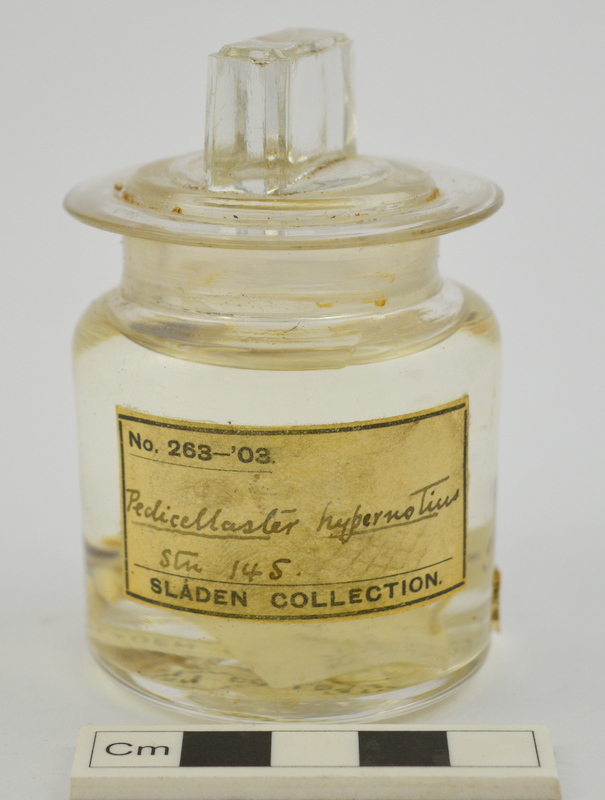
Jar containing starfish in from station 145 (at RAMM)

Jar containing starfish in from station 145 (at RAMM)

So what happened to the collected material?

Once the voyage returned, specimens were sent to numerous scientists specialising in certain areas of natural history. Once sorted through, all of the type specimens were supposed to be sent to the Natural History Museum, then the British Museum (Natural History), and the duplicates were supposed to be returned to Wyville Thomson at the Challenger office in Edinburgh. Sadly, Thomson died in 1882, before a lot of the reports were published. John Murray took over and, from what I have gathered, some duplicate sets that were returned were then distributed to people and museums who took an interest, and some of the scientists studying the material just kept it themselves. In 1918, a few years after Murray’s death, a person called R. Dykes sold off the material that remained at the Challenger office in Edinburgh.
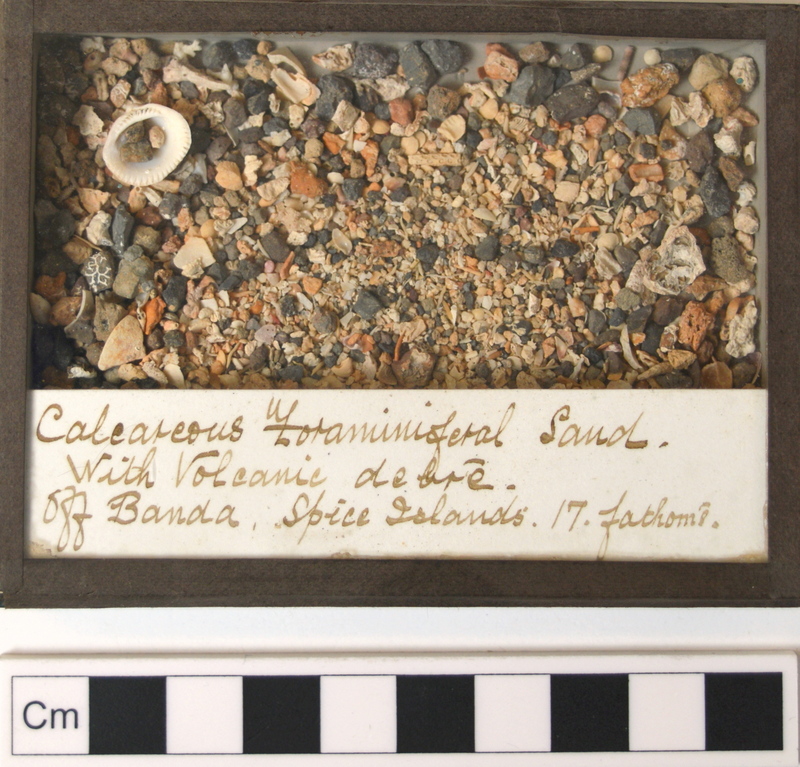
Bottom sediment (from Bristol Museum)

Bottom sediment (from Bristol Museum)

Where is the Challenger material and what is happening at RAMM?

It is everywhere – from Exeter to Dundee, to Ireland, the US and Australia! We are building an online database, onto which we will put as much Challenger material as we can find. This is for researchers, who can find out where they need to go to look at certain material, and for members of the public with a general interest in the voyage. The Challenger expedition was a hugely important voyage in science, discovering thousands of new species. It is important to bring all the material back together!


Heather Davies, Museum Trainee – HMS Challenger Project

Royal Albert Memorial Museum

NatSCA Digital Digest

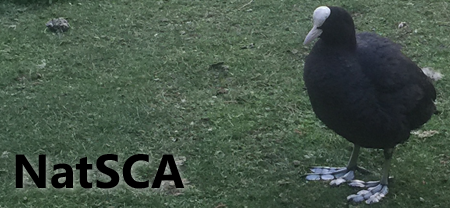
Coot

Jobs

Curator of Pleistocene Mammals at the Natural History Museum

Duration: fixed term (12 months)

Closing date: 27th May 2015

To apply, click here

Conferences and Workshops

This will be the last NatSCA Digital Digest before Museums Unleashed begins next week in Bristol. It’s set to be a great event with Some terrific speakers. Don’t forget to be a part of it. Those of you that really can’t go can follow the live tweets at #NatSCA2015. The conference lasts for two days from the 21st May but, if previous years are any indication, the fun will start the night before.

We also have an Osteology Workshop coming up in Cambridge on the 8th September 2015. If you’re still in two minds about going, why not ask some of the people who will be speaking? I’m sure they would be happy to answer any questions you may have – either online or in person next week if you’re in Bristol.

The Museums Association Conference will be with us on the 5th and 6th of November but the Early Bird booking ends on the 7th August. The theme this year is “Radical Futures”. For more information, click.

Exhibitions

The Oxford University Museum of Natural History is featuring an art exhibition of New World Vultures by Nigel Hughes in the Café Gallery. There is also a talk this evening about the exhibition by the artist if you’re in the area.

In Other News

If you’re in London this evening, come down to the RSPB’s Summer Party, featuring guest speaker Darren Naish. You can find out the details of the event here. You don’t have to be an RSPB member but it helps.

Content assembled by Samuel Barnett

NatSCA Digital Digest


Welcome to the weekly digest of posts from around the web with relevance to natural science collections. We hope you find this useful and if you have any articles that you feel would be of interest, please contact us at blog@natsca.org

1. Job: Curator/Lecturer in Vertebrate Palaeontology

It’s your last chance to get your applications in for this one.

Deadline: 3 April 2015

Employer: University of Cambridge

Synopsis

We seek to recruit an outstanding scientist to join the staff of the Department and Museum of Zoology at Cambridge. The successful candidate will combine excellence in research with a commitment to teaching at both undergraduate and graduate levels. In addition he/she will have the ability to engage with the work of the Museum in collections development, outreach and public engagement. 

We seek a candidate with the ambition and ability to fund and lead a world-class research group. For this post, we are likely to appoint a candidate whose research is collections-based. The appointee…

Read more and apply here

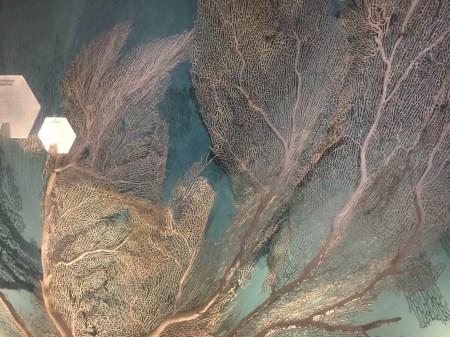
2. Exhibition: Coral Reefs

When: 27 Mar 2015 – 13 Sep 2015

Synopsis

Now opened at the Natural History Museum, London. This spectacular window into a world that enriches our very existence is well worth visiting.

Click here for more details

3. Workshop: R Without Fear – Applied R for Biologists

this course is not organised by NatSCA but it could come in handy for our members.

when: 21-25 Sep 2015
where: Facilities of the Centre de Restauració i Interpretació Paleontologica, Els Hostalets de Pierola, Barcelona (Spain).

Synopsis
Introduction to the R working environment.
– Variable types in R.
– Statistical populations and samples through working examples.
– Measurements of central tendency and variability.
– Precision, accuracy and bias.
– Hypothesis testing: Falsability, Type-I and II errors and statistical power.
– Correlation and simple regression.
– P-value vs. effect magnitude.
– Linear Models: Residuals, assumptions and interpretation.
– Explained vs. unexplained variance of a model (the coefficient of determination).
– Building functions in R.
– Introduction to graphics in R.
– The concept of partial effect: Partial regression and correlation.
– General Linear Models (GLM).
– Curve fitting in linear models and General Additive Models (GAMs).
– The problem of spatial autocorrelation in ecology and evolution.
– Multicolinearity: When is there a problem?
– Additive vs. multiplicative effects: Checking and plotting interactions.
– Introduction to General and Generalized Linear Mixed Models (GLMM).
– Fixed vs. Random effects and implications for analysis: Main R functions.
– Introduction to Bayesian statistics: The function MCMCglmm.
– Practical examples in evolutionary ecology:
The study of natural selection.
Applications of linear models for quantitative genetics.
– Student’s case studies.

for more information visit their website

Compiled by Sam Barnett, NatSCA Blog Editor

Museum Selfie Day

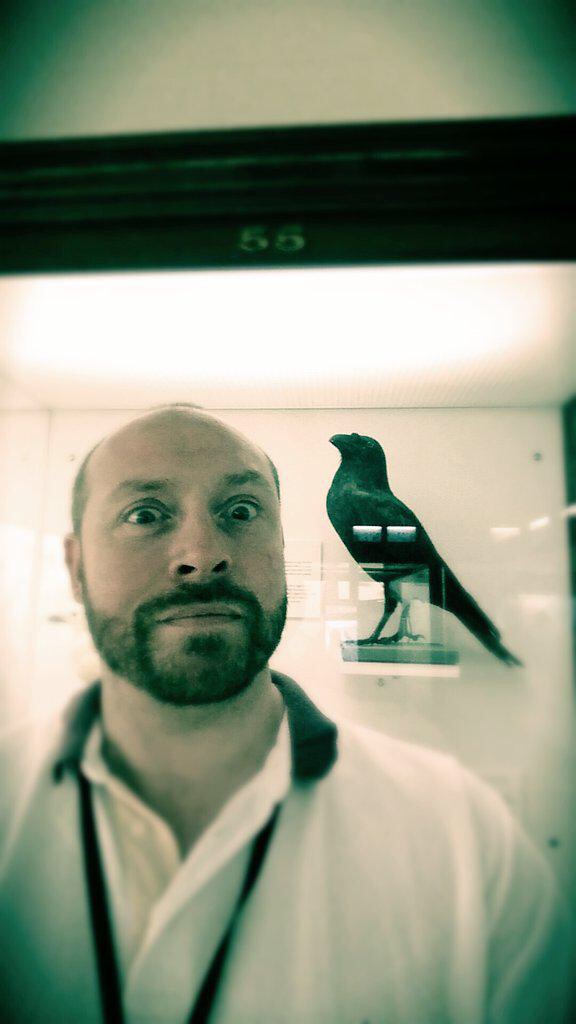
Our Chair looking Poe-faced with a Raven

Our Chair looking Poe-faced with a Raven

I freely admit that I have mixed feelings about this cultural event: I don’t take many pictures of myself except when there’s a bird perched on me. I don’t like photographs of people when they know there’s a camera on them. I do like museums though and it’s a great way to discover new ones. It’s also a great way to ensure museum visitors because you can’t take a photograph of yourself with a museum specimen unless you’re at the museum with the specimen (or very good at Photoshop but shhh – visiting a museum is quicker anyway). Since the golden years of polaroids and film rolls people have been going abroad and taken photographs of themselves at places. Who hasn’t sat through a relative’s slideshow as they talk you through their highlights: “that’s me by the Taj Mahal”; “that’s me holding a ‘Peshwari Naan'”; “That’s me in the corner”; and so on? Clearly validating that we were there fulfills some basic need in us and why shouldn’t that need be satisfied in a museum with all its fascinating specimens that a person could be “also there” with?

As long as selfies are done with respect for the irreplaceable objects you are posing with, there is no harm in it. Unfortunately that’s not always the case with some people. Remember that people will want to have their photograph taken with that awesome fossil in 100 years time and you can do your part to make sure that’s possible by being very careful.

Have a great day in the museum everyone.

The Perils of Potholing – Get Well Soon Julian Carter

Star organiser of this year’s SPNHC/NatSCA/GCG Conference Julian Carter has written a very detailed account of his recent accident while potholing in the Aven de Hures. It’s compelling and hard to read without wincing. Get well soon Julian – we all wish you a speedy recovery and are delighted to hear that you are on the mend:

The Fall
I lie confused, disorientated. The mind is furiously trying to figure out where I am, how did I get here? Involuntary groans leave my body from the shock, pain and confusion racking me…

Gradually the thinking clears and I’m looking up. I see the outline of the 40m deep shaft I’ve just fallen down. A large gaping sphere of blackness in the middle of the light coming off my helmet light which is lying just behind my head somewhere.

Amongst the first coherent thoughts are ‘I survived falling down that!?’. The next is the sudden awareness I’m at the edge of the rift that is the next pitch. Quickly my bloodied hands find the pitch rope and clip it into my chest ascender.

Read more…

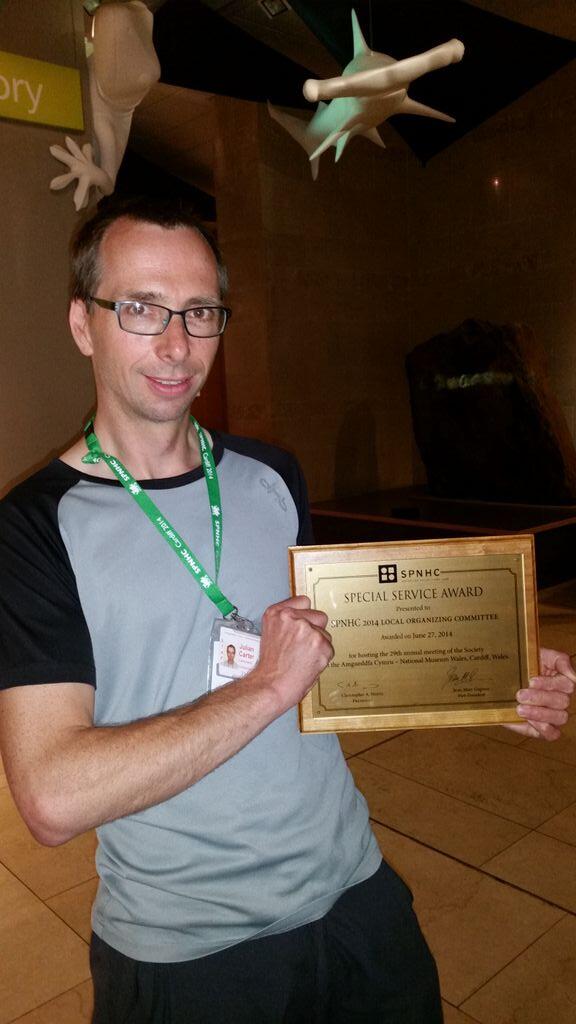
Jules receiving the Special Service Award at SPNHC2014

Jules receiving the Special Service Award at SPNHC2014