Curating a Deep Sea Fish Collection at Glasgow’s Hunterian Museum

Hunterian Zoology Museum, Glasgow University. Photo: Glenn Roadley

Hunterian Zoology Museum, Glasgow University (Photo: Glenn Roadley)

The third week-long placement of my HLF Natural History Curatorial Traineeship took place at The Hunterian Zoology Museum, part of the University of Glasgow’s impressive campus. I had visited The Hunterian in Glasgow once before, in November, as part of a meeting with my traineeship mentor, Maggie Reilly, the Curator of Zoology. While before I only had time for a quick tour of the museum galleries, this time I was able to get hands-on with a full project.

Shelves of fluid-preserved animal specimens in jars, in the Hunterian's spirit collection. Photo: Glenn Roadley

The Hunterian’s spirit collection (Photo: Glenn Roadley)

During 2011, a research team from the University of Glasgow set out to trawl the Porcupine Abyssal Plain, ~4800m deep in the Atlantic Ocean, as part of an investigation into the effect of commercial fishing on the marine ecosystem. As fish stocks are depleted, commercial fisheries are trawling deeper and deeper. Much of life on the sea floor is unknown, and investigating the diversity of deep sea organisms will help us to understand the potential effects of deeper trawling. The fish collected during the research cruise were measured (body length, head length, tail length and wet weight), assigned a unique number, labelled, and preserved in a formalin solution. These were then transported to the Hunterian Zoology Museum, to be added to the spirit collection. The fish had been identified as well as possible, rinsed of the formalin, and transferred to 70% ethanol solution, but still needed to be separated out by taxon, stored in their own jars (rather than plastic buckets), and added to the museum database. This was to be my task.

A toothy anglerfish: a gloved hand holds a fluid-preserved specimen of an anglerfish. Photo: Glenn Roadley

A toothy anglerfish (Photo: Glenn Roadley)

Deep sea fish are definitely a bizarre and fascinating lot. The collection I was working with contained a wide range of taxa, with ghostly-looking members of the genus Coryphaenoides occurring particularly often. Anglerfish and common fangtooth also stood out for their menacing looks – the former rather closely resembling a scrunched up bin-liner with teeth. Some had been identified all the way to species level, while others were yet to be identified. Who knows, maybe I handled a yet-undescribed species during my time at the Hunterian?

After preparing a large batch of 70% ethanol solution, in which the fish are preserved, I set about recording them on the Hunterian’s database, KE Emu. Pulling a specimen from a bucket of mixed fish and laying it onto a tray, I was able to use the unique collection number and site of collection on the label to match it to the records on the research cruise data sheets, which contained the exact location co-ordinates, date, species ID, and measurements. I could then enter this data into KE Emu and assign the fish a unique museum accession number. Once the fish label had dried (though care had to be taken not to let the specimen dry out too), it could be permanently marked with the accession number, before the specimen was sorted into a jar of ethanol by site and species ID.

Coryphaenoides leptolepis: a fluid-preserved specimen of a fish sits in a clear container. Photo: Glenn Roadley

Coryphaenoides leptolepis (Photo: Glenn Roadley)

It was fascinating to work with such a wide range of rarely seen species, and served as a good boost to my knowledge of fish taxonomy. Most importantly, I was able to see the true context of the collection – working from start to finish to accession the collection – while using the cruise research data and reports to populate the database enabled me to really understand where these specimens had come from and their value to science. These deep-sea fish will now be housed in the Hunterian Museum, accessible for further scientific research for decades to come.

Glenn Roadley
Natural History Curatorial Trainee
batdrawer1.wordpress.com

Unidentified, Not Unloved: On New Species and Stewardship

There are hundreds of millions of specimens held in natural history collections in museums worldwide, collected over centuries by thousands of experts and enthusiasts. It should come as no surprise, then, to learn that new species are ‘discovered’ in museums on a regular basis. These discoveries generally fall into two categories:

  1. Specimens that have never previously been identified
  2. Specimens that have been re-identified

All museums have unidentified and misidentified material in their collections. It is inevitable, given the enormous number of specimens and species that are involved. These are all potential new species, just waiting to be described.

Since I took on the voluntary role of Facebook Editor for NatSCA last year, I’ve read a lot of news stories while searching for content to share on the page, many of them about new species being found in museum collections. And I’ve been more than a little disappointed at the language chosen by the journalists to describe the specimens. The words ‘forgotten’ and ‘overlooked’ crop up frequently in headlines, and stories often describe specimens as having been ‘ignored’, ‘languishing’ in collections, or left ‘sitting in boxes’. This choice of words adds drama to a story for the papers, but it reflects poorly on the museums involved, and the inherent implications of neglect are both unfair and untrue. Having unidentified or wrongly identified specimens in a collection does not imply a failing on the part of the curatorial staff; nobody can be an expert in everything, and to identify one specimen among thousands as belonging to a previously unknown species requires an enormous amount of specialist knowledge and lots of research (often taking years). The important thing is that the specimens are preserved and cared for, so that experts are able to come in and examine them.

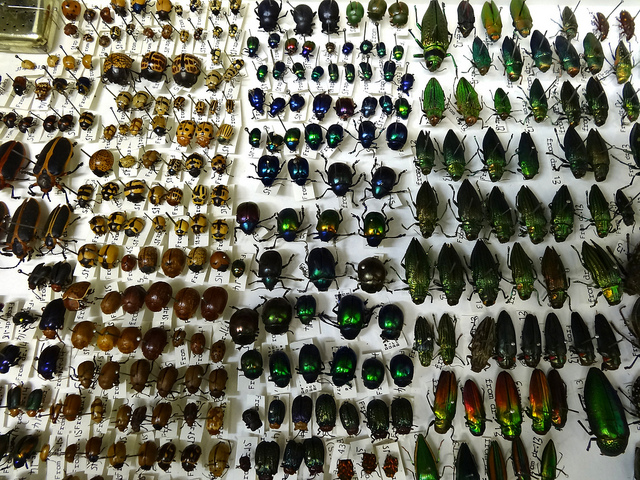
Drawer of various brightly coloured beetles, organised in neat rows with labels

Things Organised Neatly: Stewardship is fundamental to curatorship

Stewardship is the fundamental responsibility of the curators in charge of their collections. An unidentified specimen has not been forgotten. The average ‘shelf life’ of a specimen belonging to a new species, from discovery to publication, is over 20 years, and can be more than 200 years! This is due to the sheer volume of material that is collected in the field and donated to museums every year, and the expertise needed for identification. As the study of biodiversity (and the loss thereof) becomes more important to conservation efforts, more academics are turning to museums for data on population trends over time. The negative language used in these news articles could harm this relationship, and possibly deter specialists from engaging with museums. And with budget cuts increasingly affecting museum resources, curators want to engage with academics, artists, and other users, now more than ever.

The good news is that this problem is not entirely universal: recent news coverage of the discovery of a new species of ichthyosaur in Doncaster Museum was generally very positive about the value of natural history collections, mainly due to the enthusiasm of the researchers, which came across strongly in their quotes.

Rachel Jennings
NatSCA Facebook/Blog Editor