
Written by Rachel Wood, Associate Professor, Oxford Radiocarbon Accelerator Unit, School of Archaeology, University of Oxford.
Radiocarbon dating is routinely used to work out the age of archaeological and palaeontological sites, and often pops up in news articles and TV dramas. But some substantial problems remain. One of these is the calibration process, which allows us to convert the ratio of 14C (“radiocarbon”) and 12C (the common stable form of carbon) to an age estimate. This is particularly challenging when we are trying to date marine shells or any animal that has eaten food from the marine system. This means that it can be difficult for us to get an accurate age for a sample that should be straightforward – for example, the skeleton of Medieval person or a Mesolithic dog.
The Oxford Radiocarbon Accelerator Unit is starting a project looking for samples of marine shells to help resolve this problem (Fig. 1). Natural history collections in museums are key to its success, and we would be very grateful to hear if anyone has a collection of pre-1950 marine bivalve shells.
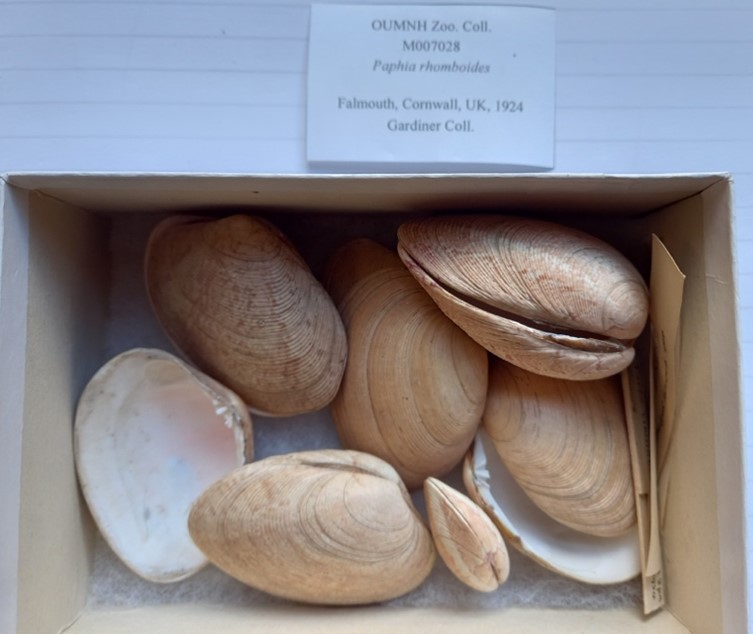
The Problem
At school, we are taught that radiocarbon dating works because radiocarbon decays radioactively at a known rate. By comparing the amount of 14C to a stable form of carbon called 12C, we can work out the age of a sample (Fig. 2). This is true, but only partially so because the starting 14C:12C varies. To get around this problem, we need to calibrate radiocarbon dates. Most 14C is produced in the upper atmosphere, and is incorporated into plants by photosynthesis and then passed through the food chain. This means, that if someone is eating terrestrial food – they will have a similar 14C:12C ratio in their bodies as in the atmosphere.
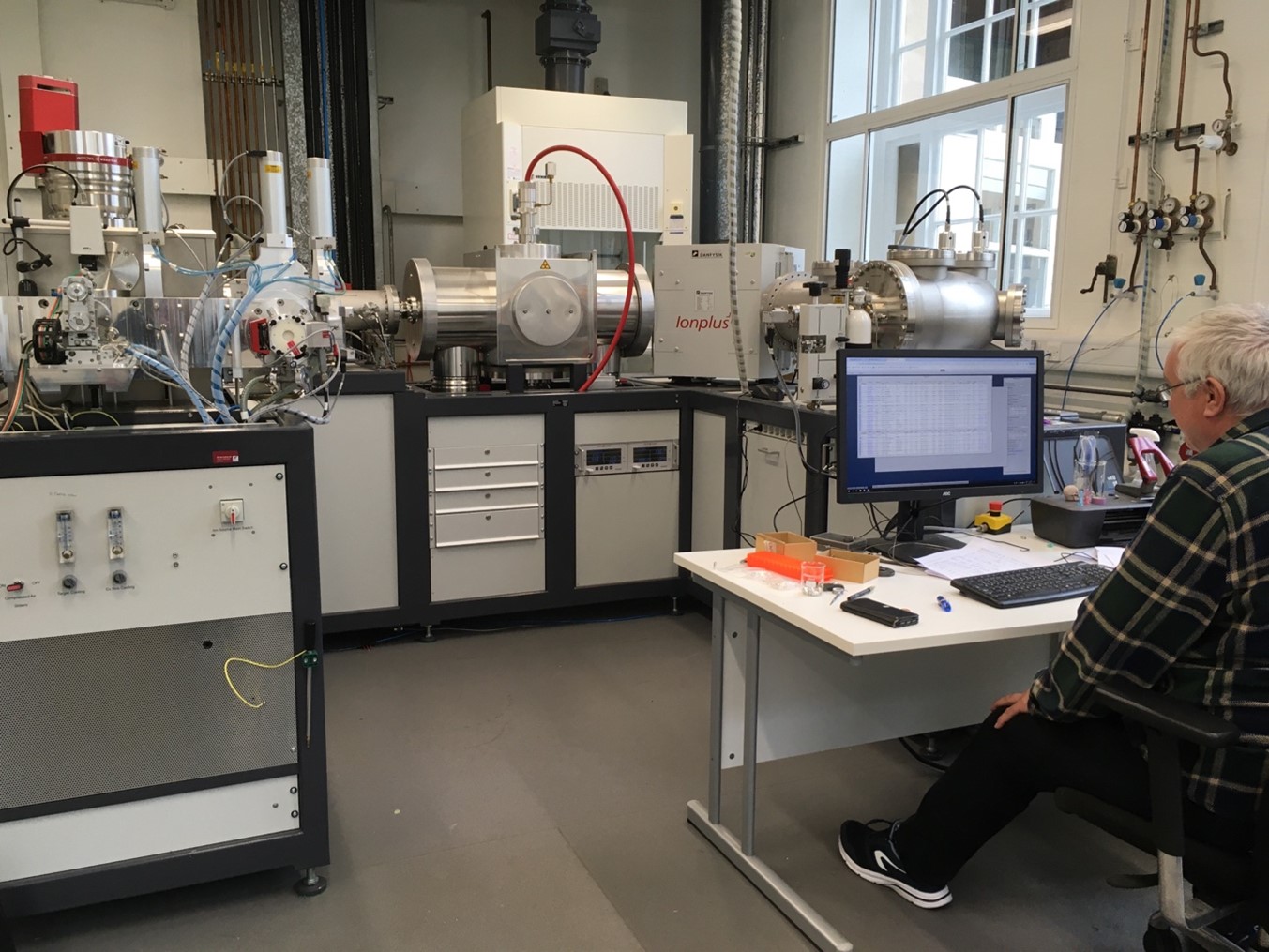
What happens when people or animals eat food from the oceans? Now their carbon is coming from a much more complex system. The oceans are often considered the world’s lungs, as huge volumes of gases move between the ocean and atmosphere. 14C in the ocean comes from the atmosphere as it diffuses into the surface water.
But the 14C:12C ratio in the surface water is not the same as in the atmosphere. Ocean circulation means that surface waters are ‘downwelled’ to huge depths where they can no longer exchange carbon with the atmosphere. This means that 14C is not replaced as it decays, so it will start to look older in radiocarbon terms. For example, if we were to radiocarbon date a living sperm whale, it may look 1500 years old as it eats animals living and feeding at huge depths. Ocean circulation patterns mean that this water is later bought to the surface where it starts to exchange carbon dioxide with the atmosphere once again.
So, on average the ocean water is about 500 years older than the atmosphere, but there is a lot of spatial variability depending on how well ventilated the water is. This spatial variability is increased by the addition of freshwater from large rivers around the continental margins.
We have a calibration curve which can tell us about the average size of this reservoir effect around the world, but we need to measure the local offset to this curve.
The Solution
The easiest way to measure the offset is to date shells that were collected before we doubled the amount of 14C in the atmosphere through above ground nuclear testing in the 1950s and 60s. This allows us to look at the variation in the marine reservoir effect around our coasts – the most likely place ancient populations caught fish and collected shellfish to eat.
This provides us with a starting point to better calibrate radiocarbon dates in the recent past. We know that ocean circulation patterns have changed through time, and that the reservoir effect can change, but having modern values is a really useful starting point.
The University of Belfast have collated a database of measurements on marine shells (Fig. 3). Whilst we have quite a lot of data points around the west coast, thanks to work done by the radiocarbon labs in Belfast and Glasgow, we have no data points between Plymouth and Edinburgh. When calibrating dates from southern England, we need to rely on measurements from northern France. In eastern England the situation is even worse as we have no nearby data.
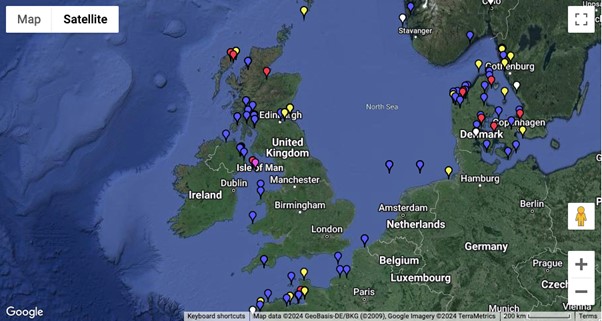
We are currently trying to find bivalve shells collected from the coasts of Cornwall to northern England to fill this gap. We have some pretty specific criteria, which make this a bit challenging. The bivalves need to have
- a known collection year
- been collected live or shortly after death; they should have a pair of valves or some of the organic material or animal preserved.
- a known collection location
- be a filter/suspension feeder
- be suitable for destructive sampling; we need about 20mg to date from the outer edge of the shell (a strip about a cm long and a few mm wide).
We have looked through a few collections, and found that most shell collectors in this period collected from Cornwall, the Solent and the Chanel Islands. We have so far only found three suitable shells from the east coast, all from the Leeds Museum and Galleries.
If anyone knows of a collection which may contain something suitable – particularly if it from the east coast, please do get in contact. We love visiting museums, and would be delighted to help come and look through a collection with you.
You can find out more about the project on our webpage: https://c14.arch.ox.ac.uk

 NatSCA
Pingback: NatSCA Digital Digest – May 2024 | NatSCA