
Written by Laura McCoy, Curator of Natural History, Manx National Heritage.
The Manx Museum, part of Manx National Heritage, is both the national museum and part of the National Trust of the Isle of Man, which is technically not a part of the UK, it is a Crown Dependency. Its collecting focus is to represent the Island and its history, similar to county museums in the UK. No other museum represents our Island better and that is our strength. When accessing our material, researchers are looking for something relating to the Island itself or how it sits in context to a wider geographical area. We are an Accredited museum and, like many others, we have a collections development forum, made up of curatorial and collections management staff, through which any new proposed acquisitions have to be assessed – but this has not always the case. We still have objects within the collection which would not pass our collections development policy today.
There were three main collectors that helped contribute to our early herbarium from the mid-1800’s to the mid-1900’s – Theophilus Talbot, George Alfred Holt and Cyril Ingram Paton, and when their collections and papers were donated after their deaths they were given in their entirety. As with many enthusiasts, their passion for collecting went with them wherever they went, so these collections also represented their travels and plants were collected all over the British Isles; the Manx material was separated out to make it easier to use and the British and Irish herbarium sheets were later flagged for future disposal by my predecessor. This ‘foreign’ material made up around a third of the botanical collection but could not reach its full potential, as the Isle of Man is not a place where researchers come to study non-Manx biology and ecology.
Our museum has a disposals policy that incorporates the Spectrum standards, which was followed when planning this activity. After confirming our ownership and the source of the collections we needed to know what we had and, including Covid closures, it took nearly four years to go through, clean, stabilise and database over 2,750 specimens. To process the collection I was fortunate to find a volunteer who is an accomplished amateur botanist in her own right, so I gave training in how to prepare and repair herbarium specimens and how to navigate online resources to check scientific nomenclature. There was a lot of material from Cyril Paton in particular that had not even been mounted and was still wrapped in the original newspapers, bakery bags and printed circulars that he reused. Cyril Paton was fond of cakes! A couple of the local bags were accessioned into our archive and I sent other items to archives in the UK.
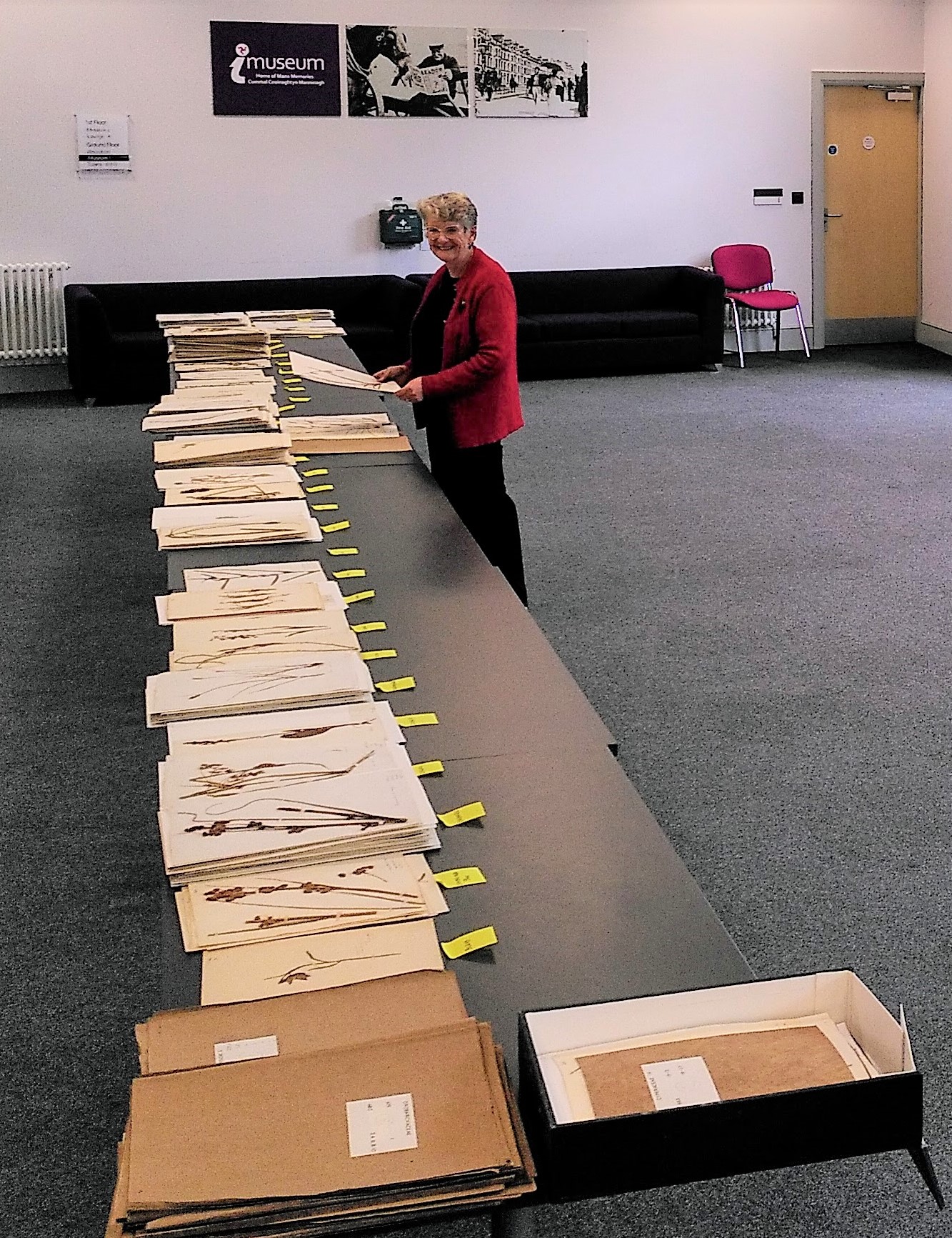
Enquiries were made to contact the relevant regional or national museums that already housed herbaria and I managed to find public institutions for all of the material. One specimen went to a local natural history society, which, although it is not a public museum, will use this material to benefit the public and it will be accessible. All of the data from the specimens was entered onto a spreadsheet and sent to the Botanical Society of Britain and Ireland (BSBI), allowing the biological records to be available to the wider online community for conservation and education.
Our collections development forum unanimously agreed to the deaccessioning and rehoming of the collection in question, and so did the Trustees. The material was directly transferred to the identified institutions using our exit and their entry procedures, the process was documented and material was packed in consultation with our paper conservator. Looking at how we have received material in the past from other museums, as the sender we assumed responsibility for the postage and packaging.
Access is much improved now these specimens are housed in collections known for already having established herbaria representing those localities. Each specimen is still fully traceable and we feel that this is a positive story of responsible collections management that we can share with the public and stakeholders.

 NatSCA
Devon specimens taken by RAMM are already available online https://rammcollections.org.uk/collections/?s=&filter%5Bcumulation.collector.summary.title.keyword%5D%5B%5D=Manx+National+Heritage++%28from+the+collection+of%29
LikeLike
Congratulations — you did such a thorough, professional, and responsible job with this. And this post describes a master class in stewardship. Well done.
LikeLike
Pingback: Care - Collections | Pearltrees