Celebrating the mundane

This article is reposted from the UCL Museums blog.

By Mark Carnall, Curator of the Grant Museum of Zoology, UCL

Earlier this month I was lucky(?) enough to have a spot on the excellent Museum Mile Museums Showoff special as part of the Bloomsbury Festival. For those of you who don’t know, Museums Showoff is a series of informal open-mic events where museum professionals have nine minutes to show off amazing discoveries, their research or just to vent steam to an audience of museum workers and museum goers. My nine minutes were about the 99% of objects that form museum collections but you won’t see on display. They fill drawers, cupboards, rooms and whole warehouses. But why do we have all this stuff? Who is it for? In my skit on Tuesday I only had nine minutes but I thought I’d take the time to expand on the 99% and the problem of too much stuff (particularly in natural history museums) and what we can do with it.

Tip of the Iceberg

Museums often display only the tip of the iceberg when it comes to collections. Here at the Grant Museum we have about 7% of the collection on display and it tends to be the Hollywood Animals that make the cut. At larger museums it can be less than 0.1% of the collection that makes up the public facing galleries. In my relatively short career as a museum professional I’ve been very fortunate to see behind the scenes in more museums than most and boy, there is a lot of stuff. Even though I love natural history and am very passionate about museums and the future of the museum sector sometimes I do wonder why do we have all this stuff?

In natural history, the obvious and often made, argument is that our collections can tell us about global challenges that affect us all including climate change, organisms that cause or spread human diseases, extinction, agriculture and aquaculture and from geology the exploitation of fossil fuels. Natural history collections are the only record of life on Earth and if we are to make any models or predictions we need to dip into the data enshrined in objects.

However, there are large portions of natural history collections which could never contribute to those agendas. All the ‘Raggy Doll‘ specimens without data for example. All those specimens that require four text books of explanation. Most fossil specimens can be used to reconstruct the past with only limited impact on what’s happening in the present. There are rooms and rooms full of bad taxidermy and taxidermy dioramas that for reasons of taste, health and safety and changing scientific ideas never see the light of day. Even something as simple as an animal not having a common name (to put on a label) can keep a specimen off display There are large chunks of the animal world which simply aren’t being actively studied (for now). Lastly there are all the models, casts and those dreaded boxes.
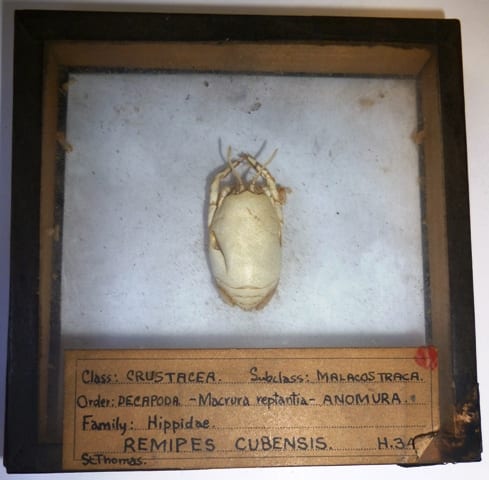
Image of a specimen of the crab Hippa testudinaria

Spare a thought for specimens like this. Dusty, pest attacked, wrongly named crabs. SAD SMILEY FACE.

So how do we make the most of the 99% now especially if they aren’t saving the world? Well, in short, it shouldn’t matter how important our specimens are to science. Every specimen has a story to tell.

Museums of Inspiration? Continue reading

NATURAL HISTORY MUSEUM BINGO!

This article is reposted from the UCL Museums blog.

By Mark Carnall, Curator of the Grant Museum of Zoology, UCL

My colleague Jack Ashby alluded to the Natural History Bingo Card in a recent blog post so I thought I’d take the time to present it to the wide world! Natural history museums are funny places. Despite the millions of species of animals and the enormous variation within species between broods, sexes, life stage, populations and seasonal variations you’d expect that you could visit every natural history museum in the World (finances allowing) and never see the same thing twice. You might think that, but the truth is many natural history museums have the same stuff on display whether you’re at the Grant Museum, the Natural History Museum London or in Paris, New York, Prague or Plymouth.

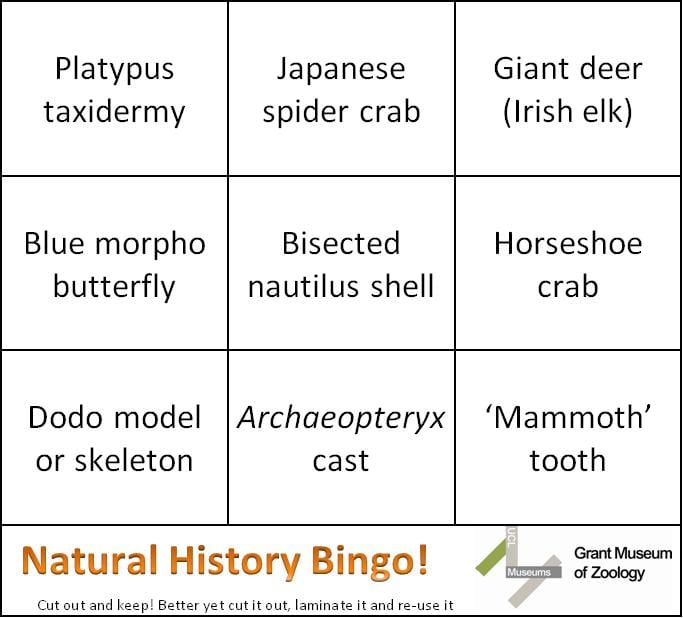
In fact, some specimens are so common, you can go around a natural history museum with this handy NATURAL HISTORY MUSEUM BINGO* and nine times out of ten you’ll have seen most of these specimens before you get to the gift shop. So what gives?

Natural History Bingo Card
Click to embiggernate & cut out and Keep! Natural History Bingo modified from the version in Carnall, M.A (2011): Completely Rethinking the Organisation of Natural History Museums: A Taxonomically Arranged National Collection. NatSCA News:21

I originally published the above figure in a paper looking at why natural history museums are all the same and what, if anything, could be for natural history museums to make the best use of their vast collections. You can tell from this Microsoft Paint produced chart that tongue was firmly in cheek but why does the Bingo hold true (go ahead and try it next time you are museuming)? It’s partly because, unlike other kinds of museums, natural history museums by and large have the same remit and are collecting and presenting the same thing (the natural world). But with so many different species and shapes of organisms why are the same specimens used as the public face of biology (specifically zoology) here? Continue reading

‘Crap in the Attic?’: the management and use of natural history collections

20 November 2013, 10.30-17.15, Oxford University Museum of Natural History

Oxford University Museum of Natural History, in partnership with Oxford ASPIRE, would like to invite colleagues from organisations with natural history collections in the region to ‘Crap in the Attic?’: a symposium on the challenges facing natural history collections in the region, the role of natural history collections within the wider sector, and what the region needs in order to ensure the future of these significant collections.

Book your free place at http://oxfordnaturalhistory.eventbrite.co.uk/

The best natural history specimen in the world (did not get thrown on a fire)

This article is reposted from the UCL Museums blog.

Last week I saw something that had never occurred to me might be possible to see. Through the years I have learned a lot about this object – I knew where it was, I knew where it came from and I certainly know its place in the pantheon of the history of natural history. We even have a cast of it in the Grant Museum.

If you had asked me what the best natural history object in the UK was, most days I would tell you it was this one. I had just assumed that seeing it wasn’t something that ever happened, even for people who run university zoology museums.

The Grant Museum team an a sperm whale jaw at the OUMNH (they're closed for roof repairs)Last Wednesday the staff of the Grant Museum went on an expedition to the Oxford University Museum of Natural History (OUMNH), which is closed for roof repairs until 2014. On a visit to the zoology section a cupboard was opened before us, it was filled with skulls, dried fish and a couple of boxes. As the history of this cupboard was explained – it was Tradescant’s Museum – the oldest in the country – it suddenly dawned on me what was in those boxes. And that we were going to see it.

We were going to see the only soft tissue of a dodo anywhere in the world. Continue reading

Natural Science and the National Curriculum

Last week the UK Government released the new National Curriculum for England, which includes the following section about evolution for Year Six (10-11 year-olds):

Evolution and inheritance

Pupils should be taught to:

  • recognise that living things have changed over time and that fossils provide information about living things that inhabited the Earth millions of years ago
  • recognise that living things produce offspring of the same kind, but normally offspring vary and are not identical to their parents
  • identify how animals and plants are adapted to suit their environment in different ways and that adaptation may lead to evolution

Notes and guidance (non-statutory)

Building on what they learned about fossils in the topic on rocks in year 3, pupils should find out more about how living things on earth have changed over time. They should be introduced to the idea that characteristics are passed from parents to their offspring, for instance by considering different breeds of dogs, and what happens when, for example, labradors are crossed with poodles. They should also appreciate that variation in offspring over time can make animals more or less able to survive in particular environments, for example, by exploring how giraffes’ necks got longer, or the development of insulating fur on the arctic fox. Pupils might find out about the work of palaeontologists such as Mary Anning and about how Charles Darwin and Alfred Wallace developed their ideas on evolution.

Note: at this stage, pupils are not expected to understand how genes and chromosomes work.

Pupils might work scientifically by: observing and raising questions about local animals and how they are adapted to their environment; comparing how some living things are adapted to survive in extreme conditions, for example, cactuses, penguins and camels. They might analyse the advantages and disadvantages of specific adaptations, such as being on 2 feet rather than 4, having a long or a short beak, having gills or lungs, tendrils on climbing plants, brightly coloured and scented flowers.

This provides a fantastic opportunity for natural science collections to support the new curriculum. If you are based in a museum, now would be a great time to start making contact with your Learning / Education departments to discuss how your collections might feed into their support of school groups; if you are in a smaller organisation, or have greater autonomy regarding your collection, you may want to start thinking about what you could do to support schools with your collections. For many of you this advice  will be as useful as an egg-sucking seminar for Grandmothers, but hopefully it will be useful for some.