NatSCA Digital Digest

Welcome to the weekly digest of posts from around the web with relevance to natural science collections. We hope you find this useful and if you have any articles that you feel would be of interest, please contact us at blog@natsca.org

1. Blog: Lyme Regis Fossil Festival

Lil Stevens, Natural History Museum, London

Synopsis

The Lyme Regis Fossil Festival took place in Dorset on 2-4 May 2014. Our palaeontologists Lil Stevens and Zoe Hughes report back from a weekend of sun, sea, fossils and fun.

On the right hand side of this page, you will find links to two other blogs, Lyme Regis Fossil Festival Day 1 and Day 2, which outline the activities of the weekend.

Lyme Regis Fossil Festival

2. Conference: Woodward 150 Symposium: Fossil Fishes and Fakes

Natural History Museum, 21st May 2014

Synopsis

‘Arthur Smith Woodward contributed widely to our knowledge of fossil fish, extinct animals and regional geology. This symposium considers his influence on palaeontology and the legacy of his work at the Museum.’

Woodward 150 Symposium

3. Exhibition: Nature, not just ‘red in tooth and claw’

Manchester Museum, Now until September

Synopsis

‘We have an exhibition, ‘From the War of Nature’ that revisits the idea of a ‘struggle for existence’, a very widely misunderstood and misapplied phrase. The exhibition links to the WW1 centenary, and explores whether nature is cruel, nice or anything else. The answer is that it’s not one thing- it’s lots of things. Sometimes animals co-operate, collaborate or divide resources up between them. The old idea of nature red in tooth and claw is a very misleading one- and does a real disservice to the complexity of nature. The exhibition runs until September. It was very rewarding to work on.’

Nature, not just ‘red in tooth and claw’

Compiled by Emma-Louise Nicholls, NatSCA Blog Editor

Can the natural science collection community really do anything about climate change?

MAconf2013I attended November’s Museums Association conference in Liverpool to talk, for NatSCA, on how having a natural science curator in your midst will help your museum to be greener. The session I was involved in, ‘Dead Zoos’, looked at addressing environmental issues from the natural science collection viewpoint.

Both Darren Mann and Henry McGhie spoke eloquently and sensibly about our unique position as natural scientists. We can engage all walks of life with nature and, as a consequence, we can also instil a sense of protectiveness. This, of course, includes caring about our changing climate.

I’ve heard him speak about this before but Henry’s admiration of the RSPB’s ‘giving nature a home’ campaign is always thought-provoking. The RSPB have set out to give people a framework for helping nature directly, and the public have responded.

Several of the questions from the floor asked for practical help in using their natural science collections (with or without a specialist curator) to open up discussions on green issues in their museums. Engaging people – on a wide scale – with nature is easy, a hedgehog really does speak for itself. Natural science specimens need little curatorial input to be engaging and so interpretation can easily be turned to thinking about protecting the environment. Case studies abound from Darren’s entomology collection as well as examples like the Yorkshire Museum’s Tansy Beetle reintroduction in the museum’s garden.

Last but not least it was great to attend a natural science session devoid of whinging. We talked about the positive future, not the negative past. Attendance wasn’t phenomenal, 45ish, but it wasn’t terrible. I would like to see future MA conference sessions that don’t necessarily concentrate on natural science but instead include it as an integral part of a wider topic. That would be progress.

Clare Brown

Subject Specialist Networking

NatSCA is the Subject Specialist Network (SSN) for natural science collections in the UK. This means that we provide a mechanism for communicating about advances in theory and practice in the sector, as well as supporting the development of staff – both specialists and those generalists with responsibilities for mixed collections.

In general SSNs are viewed a valuable resource and are seen as intrinsic to Arts Council England’s (ACE) plans for the museum sector – at least that’s what we were told by a representative of ACE at NatSCA’s recent 20th anniversary conference at the Yorkshire Museum.

The conference topic of ‘Policy and Practice’ focused on strategic issues and practical projects that have contributed towards policy and procedure formulation and testing. I won’t go into a blow-by-blow account of the meeting, which ranged from legislation affecting asbestos and radioactive materials in collections, to the practicalities of choosing and implementing a method for collection reviews and the benefits and pitfalls of disposal.

The meeting opened with a call for greater positive advocacy of natural science collections in a talk that can be summarised as “we need to stop bloody moaning and do something positive”. It was a well received sentiment, despite the fact that in some instances it can be hard to be positive.

The buzzing of the grapevine revealed dark deeds in a university (involving a skip and a departmental collection with notable specimens) and mounting clouds over the National Museum of Wales where cuts are looming, with the sciences bracing to take the brunt. Nevertheless, there was a remarkably positive feeling to the meeting as a whole and some healthy discussion arose that continued well into the early hours of the morning.

conference_meal

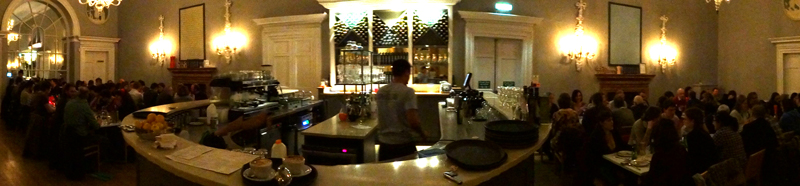
The NatSCA conference meal in York 2013. A lot of people and a lot of discussion!

One particular topic that saw a robust response was an NHM call for a national strategy for collections. After decades of the NHM focussing on their global placement the audience was
sceptical about the factors driving this change of focus. Rob Huxley from the NHM performed well on the spot and may have begun the slow work of winning over a surprisingly hostile crowd when he acknowledged that national museums often have lessons to learn from their smaller counterparts.

The full proceedings of the meeting will be published later this year in the new peer-reviewed Journal of Natural Science Collections. I would recommend taking a look if you want to find out how to non-destructively sample parchment for protein analysis, simplify your loan procedures or conduct a review of a quarter of a million objects in just one year.

This article is based on a piece originally written for the Museums Association website.

Useful information for the NatSCA conference in York

Don’t you hate it when everyone else seems to know where they’re going and what’s going on, but you somehow missed the memo and are left in the dark? It can be a particular problem at conferences held in unfamiliar cities, so we’ve decided to pull together a guide to the plans for the forthcoming conference in York to help make sure there is more time spent discussing interesting developments in natural science collections and less time discussing where everybody else has vanished to.

For the directionally challenged we’ve included this interactive map that highlights some of the more useful places to know about. Red pin for the Yorkshire Museum, where the main meeting is happening during the day on Thursday and Friday; blue pins for places we will be meeting on Wednesday evening;  green pins for places we’ll be going on Thursday evening and yellow pins for handy landmarks – you can click on the pins for more details.  Hopefully this potted plan for the conference will help make sure you’ll end up where you want to be.

Wednesday 27th February

In the early evening there will be a committee meeting in the (pretty small) Three-legged Mare on High Petergate, everyone else would be better off in the Guy Fawkes Inn, which is also on High Petergate. If you are standing at the cross-roads in front of the Minster you can see both these pubs but you have to look both ways down High Petergate. The committee will join everyone in the Guy Fawkes once the meeting is over.

Thursday 28th February

During the day we will be at the Yorkshire Museum for the sessions, after which  it’s back at the Guy Fawkes if you fancy pre-dinner drinks, as it’s two minutes from ‘Ask’ on Blake Street where we’re having dinner. After dinner we will head to the large Old White Swan on Goodramgate, after running the gauntlet of smaller pubs on Stonegate (which we probably won’t fit in en masse). Of these Clare recommends The Yorkshire Terrier, Ye Olde Starre Inne, Evil Eye Lounge (yes really) and The House of Trembling Madness.

Friday 1st March

Once again the day will be spent at the Yorkshire Museum, unless you are planning to take the tour to the off-site venue in the afternoon, but more details about that will be made available on the day.

For further information about what’s happening (and to keep up with the talks and discussions) you can check Twitter under the hashtag #NatSCA2013 and follow the NatSCA twitter account @Nat_SCA

We hope you find this useful and we look forward to seeing you in York!


N.B. If you want to print the map and are having trouble, here is a link to a printable version.

NatSCA conference and AGM 2013

Natural Science Collections: Policy and Practice

28th February & 1st March 2013 – The Yorkshire Museum, York

The Yorkshire Museum, York, England. Designed by architect William Wilkins in a Greek Revival style and was officially opened in February 1830. By Kaly99

At this year’s NatSCA conference we will be looking at how collection policies, reviews and legislation influence current practice in curation and care of collections. We will also be addressing some of the ongoing wider issues affecting the sector, including a proposed strategy for safeguarding collections for the future.

As usual, the meeting will provide a fantastic opportunity for communicating with colleagues and finding out what’s going on in the sector – all at a very reasonable price (especially if you fork out the £15 for membership)!

Two day cost: NatSCA members £85 (non-member £100)

Early bird booking by 11th January  £75 (non-member £90)

One day cost: NatSCA members:  £50 (non-member £60)

Early bird booking by 11th January:  £40 (non-member £50)

Deadline for bookings is 8th February 2013

Booking form for the NatSCA 2013 conference [doc file]

List of nearby accommodation for NatSCA 2013 conference [pdf]

Programme of talks for NatSCA 2013 conference [pdf]