Taxidermy: Just Add Death

Taxidermy is so hot right now. Here’s a great post by Alison Atkin explaining how taxidermist Polly Morgan mounts a specimen.

alisonatkin's avatarDeathsplanation

This time last week I was sat in a room, with thirty other people, staring at a dead bird. In the previous two hours it had been through the incredibly involved and yet stunningly simple process of taxidermy, as demonstrated by artist Polly Morgan.

Behind the walls of the museum, in its inner sanctum*, we gathered. In front of shelves which held all manner of taxidermied and skeletonised animals there was an old wooden workbench on wheels. A semi-circle of chairs looked in upon this workbench, where Morgan sat and transformed a blue tit from something fragile in its state of death, into something that would endure.

It was fascinating.

The amount of time, skill, patience, and effort that is applied solely to create something that looks almost exactly like it did when you set out, is remarkable. Especially since if it is done well, all of this will be…

View original post 1,834 more words

Celebrating the mundane

This article is reposted from the UCL Museums blog.

By Mark Carnall, Curator of the Grant Museum of Zoology, UCL

Earlier this month I was lucky(?) enough to have a spot on the excellent Museum Mile Museums Showoff special as part of the Bloomsbury Festival. For those of you who don’t know, Museums Showoff is a series of informal open-mic events where museum professionals have nine minutes to show off amazing discoveries, their research or just to vent steam to an audience of museum workers and museum goers. My nine minutes were about the 99% of objects that form museum collections but you won’t see on display. They fill drawers, cupboards, rooms and whole warehouses. But why do we have all this stuff? Who is it for? In my skit on Tuesday I only had nine minutes but I thought I’d take the time to expand on the 99% and the problem of too much stuff (particularly in natural history museums) and what we can do with it.

Tip of the Iceberg

Museums often display only the tip of the iceberg when it comes to collections. Here at the Grant Museum we have about 7% of the collection on display and it tends to be the Hollywood Animals that make the cut. At larger museums it can be less than 0.1% of the collection that makes up the public facing galleries. In my relatively short career as a museum professional I’ve been very fortunate to see behind the scenes in more museums than most and boy, there is a lot of stuff. Even though I love natural history and am very passionate about museums and the future of the museum sector sometimes I do wonder why do we have all this stuff?

In natural history, the obvious and often made, argument is that our collections can tell us about global challenges that affect us all including climate change, organisms that cause or spread human diseases, extinction, agriculture and aquaculture and from geology the exploitation of fossil fuels. Natural history collections are the only record of life on Earth and if we are to make any models or predictions we need to dip into the data enshrined in objects.

However, there are large portions of natural history collections which could never contribute to those agendas. All the ‘Raggy Doll‘ specimens without data for example. All those specimens that require four text books of explanation. Most fossil specimens can be used to reconstruct the past with only limited impact on what’s happening in the present. There are rooms and rooms full of bad taxidermy and taxidermy dioramas that for reasons of taste, health and safety and changing scientific ideas never see the light of day. Even something as simple as an animal not having a common name (to put on a label) can keep a specimen off display There are large chunks of the animal world which simply aren’t being actively studied (for now). Lastly there are all the models, casts and those dreaded boxes.

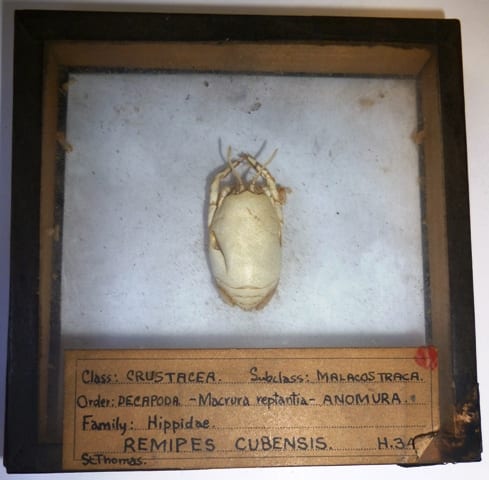
Image of a specimen of the crab Hippa testudinaria

Spare a thought for specimens like this. Dusty, pest attacked, wrongly named crabs. SAD SMILEY FACE.

So how do we make the most of the 99% now especially if they aren’t saving the world? Well, in short, it shouldn’t matter how important our specimens are to science. Every specimen has a story to tell.

Museums of Inspiration? Continue reading

Your collections in safe hands

When handling historic zoological or botanical specimens, it has been advised to wear suitable PPE (personal protective equipment), especially a chemically resistant glove. Most recommended are nitrile/butadiene rubber (‘nitrile’ or ‘NBR’ or butyl rubber which provides appropriate protection against a range of chemicals.

Without conducting chemical analysis, it is largely guesswork as to what could be present on your collections. It is advisable to be cautious of material pre-dating the 1980s. At Amgueddfa Cymru-National Museum Wales (AC-NMW,) the collections have been extensively analysed and therefore a relatively strong profile of the collections has been pulled together, identifying significant concentrations of naphthalene, arsenic, lead and mercury.

Historically, arsenic, lead and mercury have been applied and re-applied to natural history collections  since the 18th Century. These form particularly stable compounds and arsenic and mercury in particular can be absorbed through the skin.

As with most PPE it is essential that the right materials are used for the right task, it is also necessary that the PPE is maintained, and in the case of gloves, they should not adversely affect dexterity, have tears or punctures, or induce a biological reaction to the user. The gloves should also be disposed of after use, which can be a costly process.

Regardless of the quality of glove, it is frequently the personal choice of the user as to whether they do wear gloves or choose to  wash hands more regularly instead. Key herbarium workers have stated that gloves hinder dexterity and can feel unpleasant after prolonged wear.derma shield(image copright of Benchmarks Technologies Ltd. Derma Shield)

Applying a barrier cream has proved very effective for AC-NMW staff and the one I recommend is Derma Shield®. It is reasonably priced, has a very long shelf life and has been worn by AC-NMW staff for a few months now. It is applied as a mousse, and rubs into the skin easily leaving no greasy residue. The film is an effective barrier to a broad range of chemicals and lasts up to five hours regardless of hand washing. So far staff have been very accepting of this new approach, whereas there was some resistance to the wearing of gloves.

NATURAL HISTORY MUSEUM BINGO!

This article is reposted from the UCL Museums blog.

By Mark Carnall, Curator of the Grant Museum of Zoology, UCL

My colleague Jack Ashby alluded to the Natural History Bingo Card in a recent blog post so I thought I’d take the time to present it to the wide world! Natural history museums are funny places. Despite the millions of species of animals and the enormous variation within species between broods, sexes, life stage, populations and seasonal variations you’d expect that you could visit every natural history museum in the World (finances allowing) and never see the same thing twice. You might think that, but the truth is many natural history museums have the same stuff on display whether you’re at the Grant Museum, the Natural History Museum London or in Paris, New York, Prague or Plymouth.

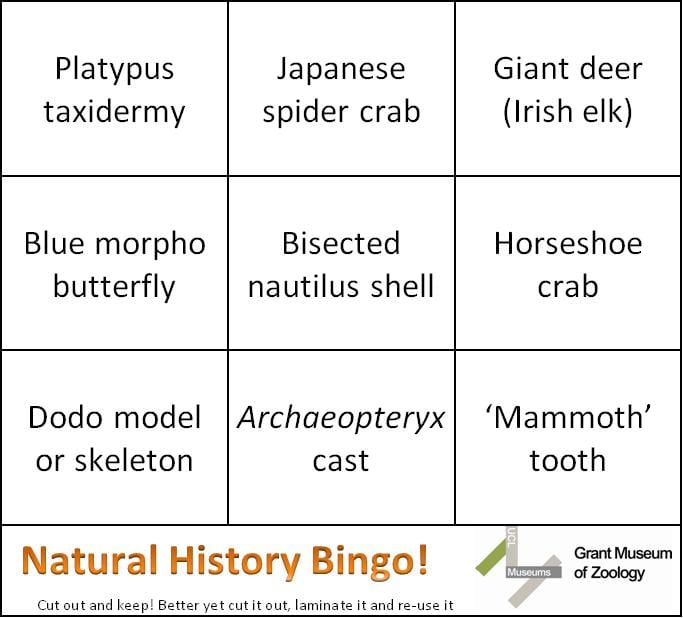
In fact, some specimens are so common, you can go around a natural history museum with this handy NATURAL HISTORY MUSEUM BINGO* and nine times out of ten you’ll have seen most of these specimens before you get to the gift shop. So what gives?

Natural History Bingo Card
Click to embiggernate & cut out and Keep! Natural History Bingo modified from the version in Carnall, M.A (2011): Completely Rethinking the Organisation of Natural History Museums: A Taxonomically Arranged National Collection. NatSCA News:21

I originally published the above figure in a paper looking at why natural history museums are all the same and what, if anything, could be for natural history museums to make the best use of their vast collections. You can tell from this Microsoft Paint produced chart that tongue was firmly in cheek but why does the Bingo hold true (go ahead and try it next time you are museuming)? It’s partly because, unlike other kinds of museums, natural history museums by and large have the same remit and are collecting and presenting the same thing (the natural world). But with so many different species and shapes of organisms why are the same specimens used as the public face of biology (specifically zoology) here? Continue reading

Bill Pettit Memorial Award 2013

I’m pleased to announce that NatSCA is calling for applications for the 2013 Bill Pettit Memorial Award. Any questions let me know.

Here’s last year’s project:

Margaret Gatty’s algal herbarium in St Andrews

In February 2013, NatSCA kindly granted me the Bill Pettit Memorial Award in order to assess and describe the algal herbarium of Margaret Gatty in the St Andrews University Herbarium.

Detail of: Chorda filum (Linnaeus) Stackhouse. Collected in Filey (Yorkshire. UK), August 1871. MG0079 in the Margaret Gatty herbarium, STA.

Detail of: Chorda filum (Linnaeus) Stackhouse. Collected in Filey (Yorkshire.
UK), August 1871. MG0079 in the Margaret Gatty herbarium, STA.

Margaret Gatty (1809-1873) started collecting seaweeds in 1848 when she spent some months convalescing at Hastings. She built up a large herbarium of her own collections, supplemented by local and foreign specimens sent to her by phycologists such as William Henry Harvey, Catherine Cutler and Jacob Georg Agardh. Margaret Gatty and her daughter Horatia carefully organized the herbarium in albums, following Harvey’s taxonomical insights. In 1863, Margaret Gatty published a two-volume book on British seaweeds.

The bulk of Margaret Gatty’s herbarium was donated to the Gatty Marine Laboratory in St Andrews in April 1907, by her daughter Horatia Eden. The collection was initially kept at the Gatty Marine Laboratory, which was named after its benefactor Charles Henry Gatty (1836-1903), a distant cousin of Margaret Gatty’s husband, the reverend Alfred Gatty. The collection was later incorporated in the St Andrews University Herbarium (STA) and moved to the Department of Botany. The STA collections are currently housed at the St Andrews Botanic Garden.

Detail of: Bellotia eriophorum Harvey. Collected by F. von Mueller, Phillip Island (Australia). MG0053 in the Margaret Gatty herbarium, STA.

Detail of: Bellotia eriophorum Harvey. Collected by F. von Mueller, Phillip
Island (Australia). MG0053 in the Margaret Gatty herbarium, STA.

Margaret Gatty’s herbarium was curated by Dr Helen Blackler (1902-1981), who started working in St Andrews in 1947. Dr Blackler published several short notes regarding the collection, but a comprehensive description of the whole collection was never made. My assessment of the collection started by locating and counting specimens and plates in the Margaret Gatty herbarium, which were retrieved from many different shelves and cabinets in the St Andrews Herbarium.

More than 8,825 specimens and 500 plates belonging to the Margaret Gatty herbarium have now been found in STA. Some 4,250 specimens in the collection are still mounted in the original albums, approximately 2,975 specimens were kept in folders or in unsorted stacks or packages. Around 1,600 specimens were taken out of the original albums and were mounted by Dr Blackler on herbarium sheets.

The collection shows a great deal of variation: some specimens are very nicely preserved, other specimens are in poor condition. Some specimens specify the collector, taxon name, collection date and location, whereas other specimens have no associated data at all. In her notes, Dr Blackler suggested that at least 500 specimens in the collection should be designated as type material. Although the full taxonomic scope of the collection has not yet been assessed, it is apparent that the collection contains several type specimens.

Following the retrieval and assessment of specimens, the STA collections were reorganised to allow the specimens in the Margaret Gatty herbarium to be stored together. Further curation is ongoing and includes numbering and databasing of selected specimens.

Detailed results of my findings will be described in a forthcoming paper in NatSCA News. I would like to thank NatSCA for providing this fantastic opportunity to promote and safeguard a very interesting and important historical collection.

Dr Heleen Plaisier, St Andrews University (Visiting Scholar, School of Biology)