Natural Science and the Law Seminar

colour-logosmall2.jpgswanslogo


A joint meeting between the South West Area of Natural Science Collections (SWANS) and NatSCA on ‘Natural Science and the Law‘ has been organised for June 15th at Bristol University. Save the date, as it looks to be a very interesting and relevant seminar on law and legislation.

There will be speakers covering asbestos in geology collections, radioactive specimens, and the Nagoya protocol, which is something that we need to be aware of, as well as CITES and the laws regarding collecting and movement of dead animals.

This event is now available to book on Eventbrite. See here for details: https://www.eventbrite.co.uk/e/natural-science-collections-and-the-law-seminar-tickets-24822253027

The Nature of Collections

The Nature of Collections: How Museums Inspire Our Connection to the Natural World

This was the theme for the NatSCA conference, held this week at the Silk Mill and Derby Museum and Art Gallery (21 – 22 April 2016), and the timing could not have been better, as I have been organising a ‘Spring Flower Power’ event at Bristol Museum and Art Gallery (BMAG). With support from the staff and Bristol Naturalists Society we had a really great day, teaching the public about what is in flower at this time of year. I was also able to network with a group and a region I am wholly unfamiliar with, having worked and lived in Cardiff for many years.

The Flower Identification table at Bristol Museum (© Bristol Culture BMAG)

The Flower Identification table at Bristol Museum (© Bristol Culture BMAG)

Flowers have not been in the main hall for many years now, and they really had an impact on the staff and public. Bringing the outdoors in can be inspiring, and it is something museums have been doing for decades. I was sent the picture below by the Bristol Naturalists Society (BNS). It shows Ivor Evans, a keen and well established botanist, admiring the table he helped set up with Ida Roper back in pre-war Bristol, still going strong in the 1960s.

Ivor Evans at Bristol Musuem during the 1960s with the Flower table he helped develop (© Bristol Naturalist Society)

Ivor Evans at Bristol Musuem during the 1960s with the Flower table he helped develop (© Bristol Naturalist Society)

Victoria Purewal
Senior Curator of Natural Sciences, Bristol Museum and Art Gallery
NatSCA Conservation Representative

Bournemouth’s ‘New’ Museum!

The Bournemouth Natural Science Society receives Museum Accreditation

Brighton Natural Science Society's impreesive Victorian building

Bournemouth Natural Science Society’s impressive Victorian building

The Bournemouth Natural Science Society (BNSS) is thrilled to announce its successful application to the Museum Accreditation Scheme. Our Museum Committee has been working hard for a long time to get our documents in order and up to scratch, and it is a credit to them that we are now an Accredited Museum.

The origins of the BNSS actually go back 150 years, with the 19th century passion for collecting natural objects. These early collections are now housed in the Society’s Victorian villa at 39 Christchurch Road, which is open to the public on Tuesday mornings, between 10am and 12.30pm. From archaeology to zoology, the BNSS has something to inspire and amaze!

Accreditation is granted by the Arts Council England (ACE) to museums that meet the stringent requirements imposed by their Accreditation Standard. The BNSS joins the 1,800 other museums participating in the scheme, working to manage their collections effectively for the enjoyment and benefit of users. Our Accreditation status will be renewed every three years to ensure that we are keeping up to standard.

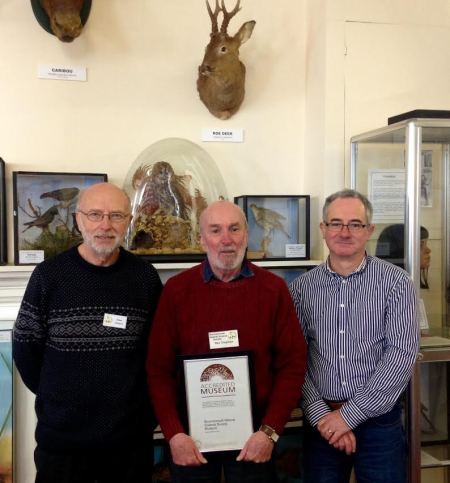
Steve Limburn, Ray Chapman, and Maklcolm Hadley with the BNSS Accreditation certificate

Steve Limburn, Ray Chapman, and Maklcolm Hadley with the BNSS Accreditation certificate

And the work doesn’t stop here! We are continuing to catalogue and photograph our collections and make them more accessible to the community. As well as our regular Tuesday morning sessions, we also run two open days during the year. The next one is coming up on Saturday 16th April, in collaboration with the Dorset Wildlife Trust. Our Young Explorers group meets once a month, and we welcome educational visits from organisations and groups of all ages.

Of course, none of this would be possible without our wonderful and dedicated volunteers and members, who give their time and enthusiasm to make the BNSS what it is. A huge thank you goes out to them for making this success happen.

If you would like to learn any more about the BNSS, visiting times, membership, or volunteer opportunities, please contact Katherine West, Communications Officer at publicity@bnss.org.uk.

NatSCA Digital Digest

ndd-b-rex
Welcome to the February installment of our new monthly format of the NatSCA Digital Digest. This will give your lovely blog editors much more time to write about cool stuff between digests, which can only be a good thing – right?
Jobs
You’d better get applying for Paolo‘s old job at the Horniman. Deadline is the 17th February!
Conferences and Workshops
It is the 14th Coleopterist Day at the Oxford University Museum of Natural History this Saturday. Do come along if you can, it’s free and no sign up is required.
Early word from the world of Darren and John suggests a likely November date for Tetzoocon 2016. If you haven’t been to a Tetzoocon yet, do go – they’re great fun with lots of informative speakers including several NatSCA members.
News from the Museums
The Grant Museum is hosting a Valentine’s event this year – do check it out – it looks like it’s going to be lots of fun.
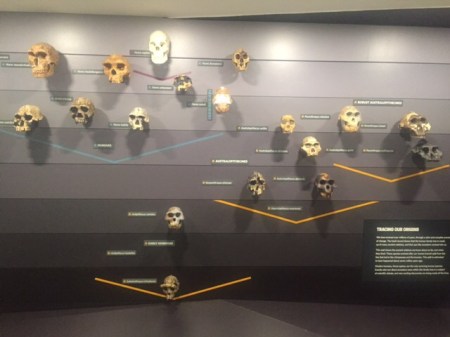
I went to visit the new Anthropology exhibition at the Natural History Museum, London at the end of last week. Those of you who visited the old one will notice some differences: Gone are the spinning skull casts worn smooth like the statue of a church Saint. Gone is the disproportionate emphasis on genus Homo and the appearance of agriculture. Instead what you have is a walk-through gallery outlining the entire hominid line, featuring footprints, skeletons, and tools – including a rather impressively preserved 420,000 year-old wooden spear. Beside each of the better-preserved skulls sits a fetching artist’s reconstruction of the individual. The cases are right up-to-date with specimens found as recently as last year. Sure the handling specimens will wear smooth and the taxonomy will need revising in another 30 years but, for now, it’s a beautiful place to visit and I can’t wait to see what they’re doing to the dinosaur gallery.
A tree full of hominids
If you missed Mark Carnall’s BBC Radio 4 talk about underwhelming fossil fish, fear not: you can catch it all on Inside Science. We are reminded in segments like these that the fossil record is no trophy room and nature will keep many specimens that we might otherwise throw back.
We often hear from London and Oxford Museums but today I have a small treat for you: did you know that the Doncaster Museum has a hybrid quagga foal? Neither did I until last month. You can read about it here. I suspect we’re going to be hearing a lot more from the Doncaster Museum in the near future – more on that story later.

Curiosity re-discovered at the Vienna Museum of Natural History

There are few museums for me that inspire greater reverence for beauty and the endless variety of nature on display than the London Natural History Museum, the Oxford Museum of Natural History, and Sedgwick Museum of Earth Sciences. These museums all present collections in spectacular, imaginative, and informative ways. However, I was unprepared for the scale, majesty, and awe-inspiring nature of the Naturhistorisches Museum in Vienna, Austria, during my visit this summer. For me, it was evocative of an early ‘Wunderkammer’ filled with curiosities. I walked through what seemed like a T.A.R.D.I.S. of never-ending rooms and corridors filled with objects.

The museum was commissioned by Emperor Franz Josef I and opened in 1889. It faces its equally beautiful sister museum, the Kunsthistorisches Museum, where you can admire the works of Rembrandt, Durer, Rubens, and a frieze painted by Gustav Klimt. The marble, statues, and painted ceilings offer the feeling of a palace. As you enter through the elaborate front doors you are greeted by an immense dome that takes your breath away. Disciplines such as Zoology, Geology, Palaeontology, Botany, and Anthropology are inscribed on the dome’s edge. They allude to its amazing collections and the 19th century desire to understand and bring order to the natural world.
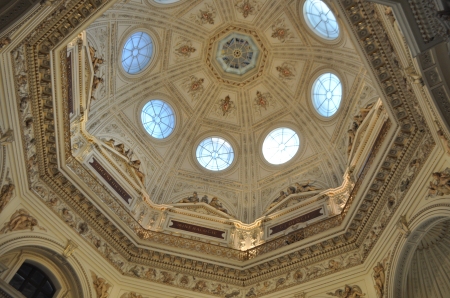
The dome hall in the Vienna Naturhistoriches Museum (Image: Anthony Roach)

The dome hall in the Vienna Naturhistoriches Museum (Image: Anthony Roach)

As I ascended the first floor to the Zoology gallery, the rooms or ‘halls’ are connected by long corridors which give you a dizzying view of the connected rooms stretching out in front of you. There are around 39 individual halls. I smiled when I walked into the first gallery called ‘Microcosm’ dedicated to Ernst Haeckel, the German Biologist whose beautiful drawings of radiolarians feature in ‘Kunstformen der Natur’, and inspired my interest in natural history.  The gallery contains models of microscopic radiolarians and water fleas, along with microscopes and a film featuring microscopic life.

The Zoology collections move from protozoans, corals, and molluscs systematically towards vertebrate life and is sympathetically and beautifully displayed, with some of the largest collections of insects and vertebrates I’ve ever seen. There are whole rooms filled with reptiles alone. The bird galleries contain remarkable specimens, and the museum has its very own taxidermy department. The mineral collections are five halls strong, with a Meteorite hall at the end that contains part of the ‘Tissint’ meteorite and an interactive that demonstrates the destruction force of meteorite impacts.

The museum houses over 30 million specimens, with 60 scientific staff working on the collections. Unforgettable specimens on display for me included a complete skeleton of Stellar’s Sea Cow (Hydrodamalis gigas), whose discovery in Alaska by Georges Stellar and rapid extinction is a frequently cited example of the consequences of systematic hunting by humans that was little known to science. I also marvelled at the 25,000 year old Venus of Willendorf figurine, whose palaeolithic origin is said to emphasise female fertility and childbearing. The museum’s palaeontology gallery is equally impressive, with an array of dinosaurs, flying reptiles, and a gigantic fossil turtle.
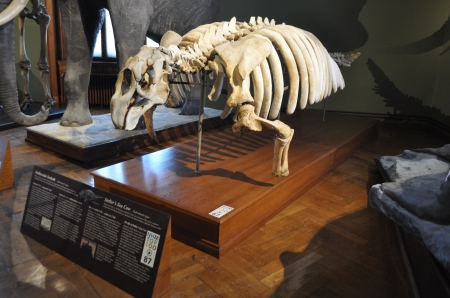
Skeleton of Stellar's Sea Cow (Hydrodamalis gigas) (Image: Anthony Roach)

Stellar’s Sea Cow (Hydrodamalis gigas) (Image: Anthony Roach)

When I finally reached the top floor, I saw something remarkable. In one long case were about 25 beautifully coloured glass models of marine organisms. They were Blaschkas, and they have fascinated me ever since I saw some of my first at the Grant Museum of Zoology. The models were displayed as part of an exhibition called the ‘Knowledge of Things’ that celebrated the 650 year history of scientific discovery at the University of Vienna. The then director, Carl Claus, commissioned 146 Blaschka models to be made in 1880, and they still remain part of the university’s Zoology collection.
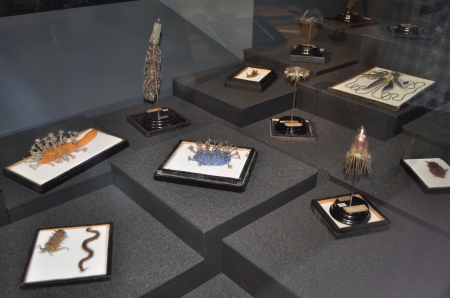
A myriad of wonderful Blashka glass models of marine invertebrates (Image: Anthony Roach)

A myriad of wonderful Blashka glass models (Image: Anthony Roach)
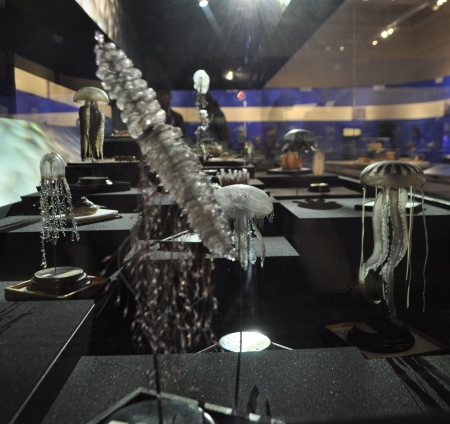
An example of a Siphonophore shown amongst many other Blashka models (Image: Anthony Roach)

An example of a Siphonophore shown amongst many other Blashka models (Image: Anthony Roach)

They were created by Leopold Blaschka, a glassworker whose skill at producing scientifically accurate models of plants and animals caught the attention of museums and scientific institutes. After the tragic death of his wife, Leopold left for America. Whilst travelling by sea he was fascinated by the marine life he observed. When Leopold eventually returned to Europe, his talents were recognised by Dresden Museum. who commissioned him to produce marine invertebrate models for scientific study. Along with his son Rudolph, he established a saltwater aquarium in Dresden to study their form and assist him in creating accurate representations of these enigmatic sea creatures.

The London Natural History Museum contains around 182 Blaschka models of anemones, nudibranchs, cnidarians, cephalopods, and other stunning marine organisms. The ‘Treasures’ gallery displays some of the best. As Miranda Lowe, Collections Manager responsible for the Blaschka models points out*, ‘‘The range, variety and colour of these invertebrate sea creatures show much more than spirit-preserved specimens, which do not retain vivid colour or form’’. You could argue that these beautiful glass objects are the museum equivalent of the Christmas tree bauble. After all, they are aesthetically, culturally, and symbolically valuable to us in much the same way.

Anthony Roach

Natural History Museum, London


*P. 34 – 37