
Written by Joe Rigby, Senior Lecturer, University of Chester: Faculty of Arts, Humanities and Social Sciences.
‘Storehouses for dinosaur bones, mineral samples, and fading dioramas portraying early humans. Do such places have something to tell us about capitalism and the climate crisis?’ (Wainwright 2025, p. 8)
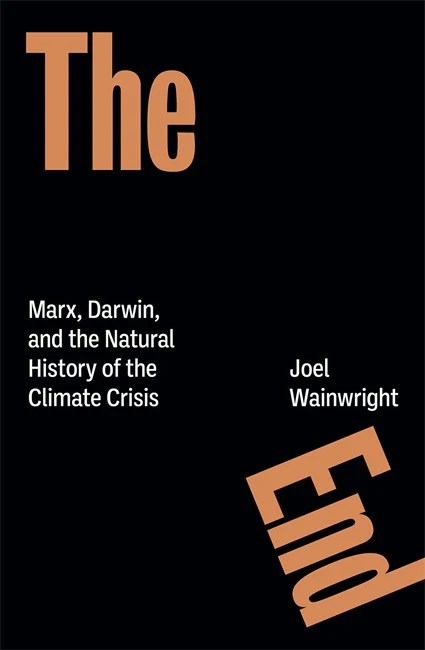
Attached cover image of Joel Wainwright’s The End
As readers of the Natsca blog will appreciate, the discipline of ‘natural history’ encompasses a wide range of what today have become institutionalised as more or less separate fields of knowledge, including geology, biology, geography, anthropology, and history. In The End: Marx, Darwin and the Natural History of the Climate Crisis Joel Wainwright argues that recovering this kind of knowledge of ‘the history of nature and the role of nature in history’ (Wainwright 2025, p. 8) is essential to help address the current climate crisis. Whilst Wainwright is hardly the first person to make such a claim about the importance of natural history today, The End makes a convincing case for the importance of drawing jointly on the ideas of Charles Darwin and Karl Marx in order to do so.
Darwin’s radical insights concerning the contingency of evolution and forms of life, Wainwright argues, significantly shaped Marx’s thinking and analysis of capitalism. Yet thanks to the influence of ‘social Darwinism’ in shaping the political interpretation of Darwin’s ideas, the two thinkers are often depicted as politically opposed today. Wainwright’s analysis of Darwin’s influence on Marx makes possible a different, anti-‘social Darwinist,’ interpretation of Darwin that is particularly important in the context of the climate crisis: one that can help challenge, rather than lend legitimation to, the hierarchies and inequalities that are the primary drivers of, and obstacles to reducing, contemporary global heating (IPCC 2023; Oxfam 2023).
The book is divided into three parts. Part I situates the development of Marx and Darwin’s ideas in their historical context and discusses the record and interpretation of known exchanges between the two. Readers unfamiliar with debates within Marxism may find some of this section, particularly Chapter 1 – ‘Marx before Darwin,’ challenging, as Wainwright situates his analysis within the field of competing interpretations of Marx. However, Wainwright handles these debates succinctly and the chapter provides a good introduction to the ways that Marx’s writings have inspired different analyses of capitalism.

Karl Marx. © John Jabez Edwin Mayall, Public domain, via Wikimedia Commons
In Chapter 2 – ‘Darwin and the defeat of teleology’ and Chapter 3 – ‘Marx after Darwin,’ Wainwright claims that Darwin’s Origin of the species, which Marx likely read shortly before developing what is considered his ‘mature’ analysis of capitalism in Capital Volume 1, helped Marx break with the teleological understanding of historical change he had inherited from the philosopher GWF Hegel. Indeed, Marx wrote to Lassalle that he thought Darwin’s book was ‘most important’ for dealing a ‘definitive blow to teleology in natural science’ and that processes of social change and ‘class struggle’ in human societies needed to be understood in a similarly non teleological way (Wainwright 2025, p. 86).
Writing from ‘the reading room of the British Library, within the British Museum, just down the street from where, a few years earlier, Darwin had written his notebooks,’ observes Wainwright, Marx declared his ‘standpoint’ in the Preface to Capital Volume 1 as one which treats ‘the development of society’s economic formation as a part of natural history’ (Wainwright 2025, p. 91). Where Darwin had argued for an understanding of species as always in a process of becoming and so having no ‘essence’ outside history, Wainwright argues, Marx developed this perspective and applied it to an analysis of changing forms of social organisation. This was a challenge to the main proponents of ‘political economy’ in Marx’s day, including many self-professed ‘social Darwinists’ such as Herbert Spencer, who drew on some of Darwin’s ideas concerning evolution and natural selection to argue that capitalism and market society were the highest and most civilized form of human society possible, working in harmony with humanity’s self-interested and egotistical nature.
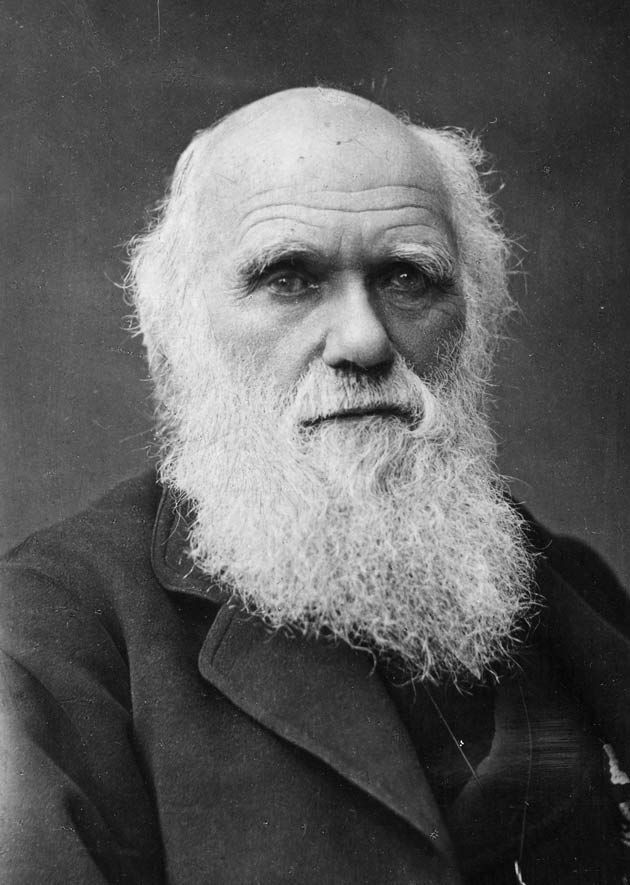
Charles Darwin. © Herbert Rose Barraud, Public domain, via Wikimedia Commons
Marx’s Critique of political economy, the subtitle to Capital Volume 1, consisted in showing that what political economists and thinkers like Spencer presented as ‘essential’ about human nature was in fact driven by ideology and social interest. After reading Darwin, Wainwright argues, Marx found the resources for maintaining a more thoroughly historical conception of human nature (Wainwright 2025, p.259-64) in which human beings continuously develop and change their ‘nature’ through interactions with their environment and through their changing forms of social organisation.
Marx sent Darwin a signed version of Capital in 1873 as a gift, adding an inscription to ‘Mr Charles Darwin, on the part of his sincere admirer, Karl Marx.’ In 2024 this inscribed copy of Capital was restored and put on display at the Darwin Museum at Down House. A press release from English Heritage claimed that the uncut nature of the pages and lack of annotations on the text suggested that Darwin did not think much of Marx’s work, but Wainwright challenges this interpretation. He cites a letter of thanks sent from Darwin to Marx expressing the former’s wish that he ‘was more worthy to receive’ the gift and recognising a shared desire to put knowledge in the service of the ‘happiness of Mankind’ (Wainwright 2025, p. 101). Indeed, that Darwin saw to it that the gift was preserved, despite not being sufficiently fluent in German to read and understand the text, suggests this letter of thanks was not entirely disingenuous.
Parts II and III of The End outline the importance of what Wainwright calls ‘Marxian natural history’ for understanding the impasses of contemporary climate politics. Despite widespread recognition of the need to act urgently to reduce carbon emission and so limit future anthropogenic climate change and global warming, it seems politically impossible to do so. In chapters such as ‘Labour, Nature and Technology,’ ‘Population, Value, and Commodity Fetishism,’ and ‘A Natural History of Capitalism’ Wainwright discusses some of the ways in which Marx’s conceptualisation of the link between capitalism and environmental destruction have been taken up and developed to provide some of the most powerful and convincing accounts of the role of power, ideology and inequality in hindering effective climate action. Unfortunately, however, Wainwright never directly answers the question that he temptingly poses in the ‘Preface to Part I’ concerning the role that natural history collections, ‘storehouses for dinosaur bones, mineral samples, and fading dioramas portraying early humans,’ might play in helping us navigate and resolve the climate crisis (Wainwright 2025, p. 8).
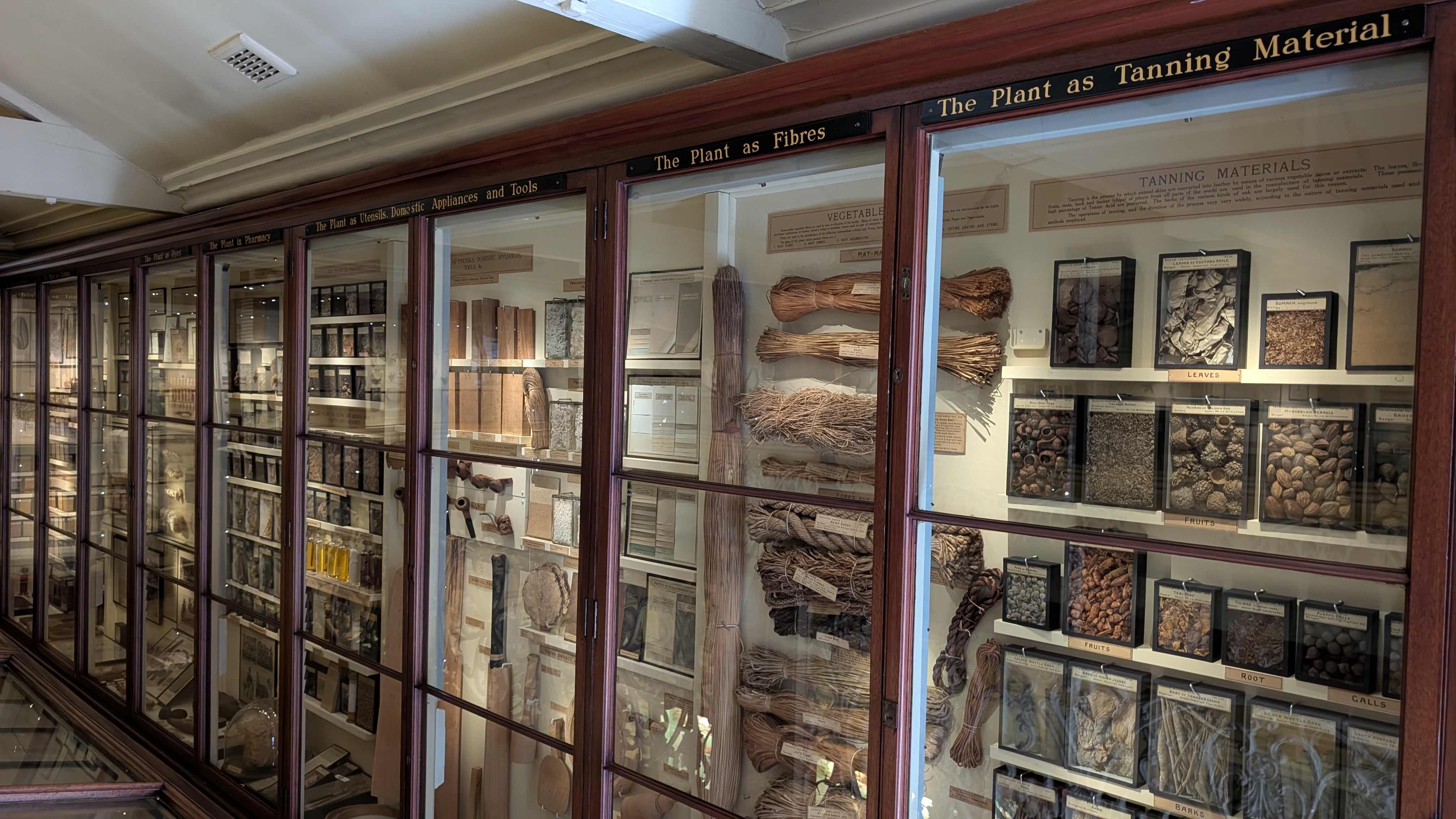
‘Economic Botany’ Gallery, Warrington Museum and Art Gallery, used with permission.
A central theme of Wainwright’s book, that of reconnecting natural and social history, does, however, suggest one additional way in which collection care and interpretation can perhaps help ‘save the world’ (Ashby 2025). The separation of the fields of ‘natural’ and ‘social’ history, Wainwright argues, is not incidental to the history of capitalism. It is the intellectual counterpart to the separation of people from the land and their means of existence, necessary for the creation of an industrial workforce, colonial expropriation, and the development of capitalism. 150 years after the publication of Darwin’s The Origin of the species and Marx’s Capital, humanity has become a predominantly urban, rather than rural species, existing in environments in which the dependence of human society on natural processes is difficult for many to appreciate and understand.
In this context collection interpretation that joins together natural and social history, such as Manchester Museum’s ‘Decolonise!’ trail, or the fantastically preserved 1920s ‘economic botany’ gallery at Warrington Museum and Art Gallery, can provide important resources for reconnecting people with their intertwined natural and social histories. Experiments in creating a ‘museum of the Anthropocene’ perhaps point to further ways that museums could heed some of the calls in Wainwright’s book to develop a ‘natural history of the climate crisis,’ and to support a 21st century urban species searching for a way out of, or end to, the climate crisis.

 NatSCA
Pingback: NatSCA Digital Digest – March 2026 | NatSCA