
Written by Wuu Kuang Soh, botanist at the National Botanic Gardens of Ireland (OPW).
The National Herbarium (DBN) at the National Botanic Gardens of Ireland is home to an ever-expanding collection of approximately 600,000 plant and fungal specimens from across Ireland and around the globe. This rich collection spans mainly from the early 1800s to the present day, including specimens gathered from voyages of exploration, ranging from the Americas to Asia. Some of the oldest specimens, dating back to 1661, are over 350 years old. Apart from our herbarium, the other important plant collections on the island of Ireland are held by the Ulster Museum and Trinity College Dublin. This makes the DBN collection invaluable not only as a source of natural heritage but also as a part of Ireland’s cultural legacy.
Herbarium collections are crucial to enhancing our understanding of the natural world. Beyond documenting plant species, these specimens reveal the intricate relationships between plants and their environments and tell the story of botanical discovery over time. The wealth of data gathered from this collection allows us to track historical and geographical changes in flora and helps predict future environmental impacts. Digitising this vast collection is a key step toward preserving these resources for future generations. Digital records not only provide greater access for researchers and the public but also safeguards the physical specimens by minimising handling and potential damage.
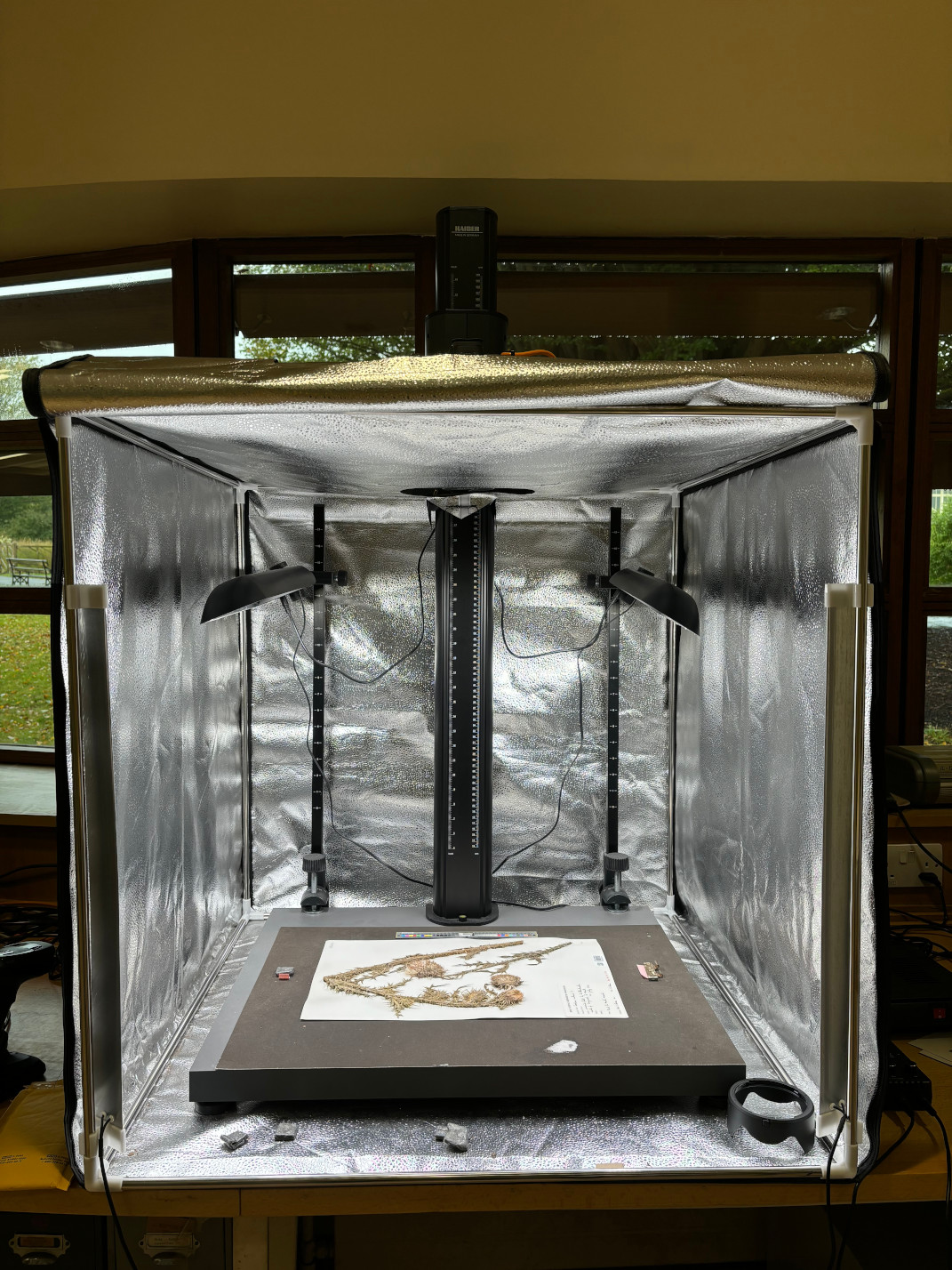
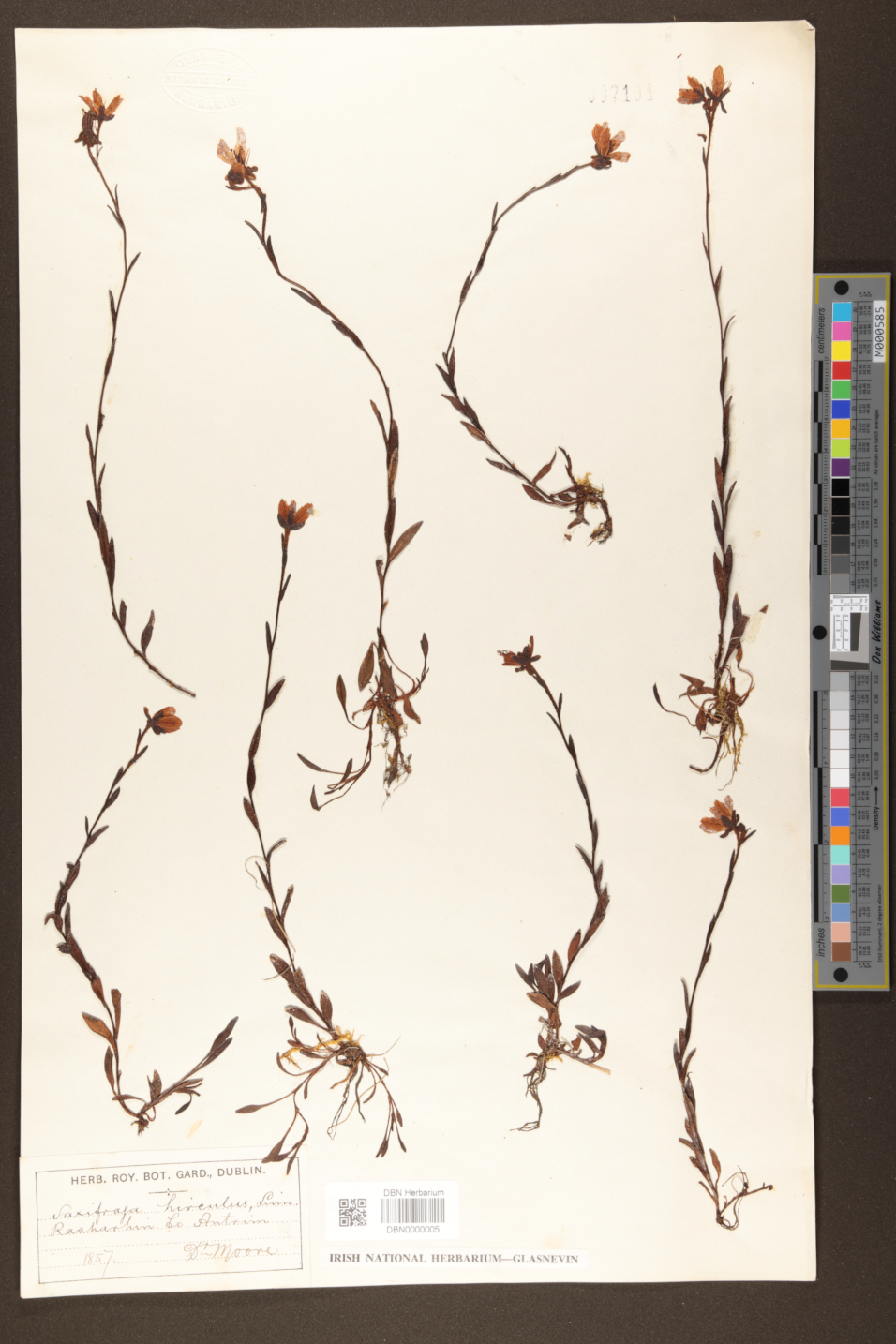
Recognising the need to improve public access to our herbarium collections, we established a digitisation facility at DBN in 2020, during the height of the COVID pandemic. We developed a digitisation workflow tailored to DBN’s needs, drawing on recommendations from iDigBio. Our imaging setup (Figure 1) includes a mirrorless interchangeable lens camera mounted on a copy stand with LED lighting, with a total equipment cost of around €10,000. This setup allows us to digitise specimens at an average rate of 50 sheets per hour. A dedicated team of staff and volunteers have been instrumental in carrying out the digitization work. So far, about 1% of the collection (around 6,000 specimens) has been digitised (Figure 2), although none are currently available online and can only be accessed by request. This digitisation effort marks an important step toward making our botanical collections more accessible to researchers and the public alike. However, at the current rate, it would take six to seven years to complete the digitization of all 600,000 specimens. This underscores the need for a more efficient approach to accelerate the digitisation process.
In many well-funded European herbaria, the potential of millions of plant specimens are currently being unlocked through innovative digitization technology. National herbaria in countries like the UK, Belgium, the Netherlands, and France have led the way in this effort. However, there remains a significant gap in baseline biodiversity data because digital access to collections in smaller herbaria (i.e. less than a million specimens) is still limited. This inequality is primarily due to the uneven implementation of digitisation technologies across herbaria, leaving many smaller institutions behind. Despite their size, small herbaria often house unique and invaluable collections of scientific and historical importance, which are not duplicated elsewhere. Yet, their preservation and long-term sustainability are far from certain.
To address this inequality and speed up the digitisation effort, transnational collaboration may be a way forward to bridge the technology and research capacity gap between underfunded and well-funded herbaria. Last year, we saw an opportunity to apply for the North-West Europe Interreg Small-scale Project fund and seized the chance to collaborate with other small herbaria to digitise our collections. In partnership with the State Museum of Natural History Karlsruhe in Germany and Ghent University in Belgium, DBN has spearheaded an ambitious herbarium digitisation project ─ DigiHerb https://digiherb.nweurope.eu/ (Figure 3) . Through the Interreg North-West Europe Programme, we secured nearly a half-million-euro grant over 18 months, co-funded by the EU.
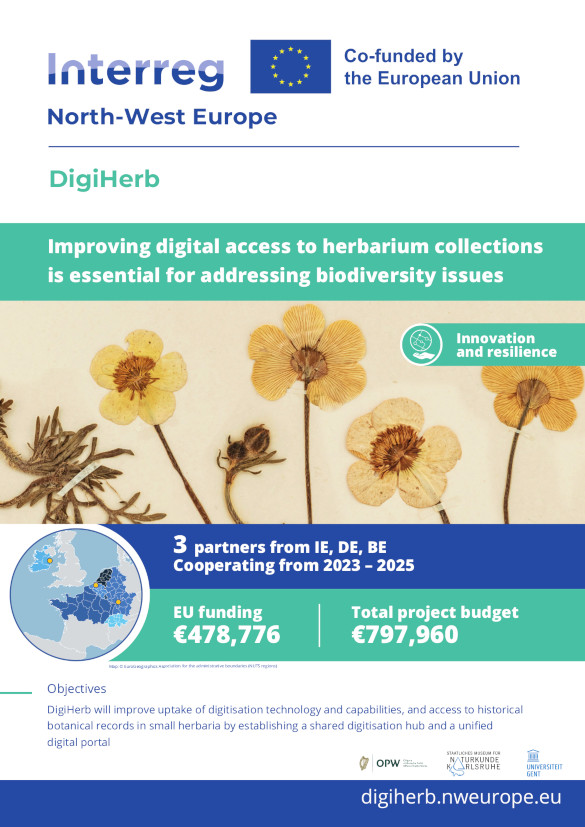
The DigiHerb project builds on the successful concept of herbarium consortia; an alliance of multiple small herbaria with a shared goal of digitizing collections. By pooling resources, sharing expertise, and consolidating digital collections under a unified data management system, we aim to enhance access to these valuable specimens. The project capitalises on high-throughput digitization technology, such as a high-speed conveyor-belt imaging system, capable of digitising up to 400 sheets per hour. Previously used only in larger, well-funded herbaria, this equipment will now be shared among the three project partners, making digitization more affordable and efficient. The digitisation hub will start in Ireland and later move to Karlsruhe, Germany.
Once completed, all digitised specimens alongside those from Belgium and Germany will be made accessible through a single digital portal, available for scientific research, education, and outreach. The project will utilise Symbiota, an open-source software platform for managing and sharing digital herbarium data. The choice of this free licensing software ensures that the project remains sustainable and that future expansion to other herbaria is not cost-prohibitive, which is crucial for underfunded institutions needing advanced biodiversity data management systems. Additionally, we will also seek advice from DiSSCo (Distributed System of Scientific Collections) network on data interoperability following EU standards.
DigiHerb is the first project of its kind in the EU, unifying transnational herbarium collections and curation under a single digital portal and data management system while paving the way for increased collaboration and access across Europe and the world.

 NatSCA
Pingback: NatSCA Digital Digest – November 2024 | NatSCA