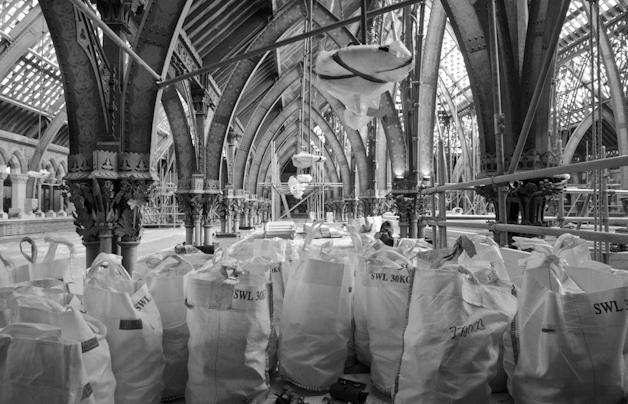
‘Crap in the Attic?’: the management and use of natural history collections

20 November 2013, 10.30-17.15, Oxford University Museum of Natural History

Oxford University Museum of Natural History, in partnership with Oxford ASPIRE, would like to invite colleagues from organisations with natural history collections in the region to ‘Crap in the Attic?’: a symposium on the challenges facing natural history collections in the region, the role of natural history collections within the wider sector, and what the region needs in order to ensure the future of these significant collections.

Book your free place at http://oxfordnaturalhistory.eventbrite.co.uk/

The best natural history specimen in the world (did not get thrown on a fire)

This article is reposted from the UCL Museums blog.

Last week I saw something that had never occurred to me might be possible to see. Through the years I have learned a lot about this object – I knew where it was, I knew where it came from and I certainly know its place in the pantheon of the history of natural history. We even have a cast of it in the Grant Museum.

If you had asked me what the best natural history object in the UK was, most days I would tell you it was this one. I had just assumed that seeing it wasn’t something that ever happened, even for people who run university zoology museums.

The Grant Museum team an a sperm whale jaw at the OUMNH (they're closed for roof repairs)Last Wednesday the staff of the Grant Museum went on an expedition to the Oxford University Museum of Natural History (OUMNH), which is closed for roof repairs until 2014. On a visit to the zoology section a cupboard was opened before us, it was filled with skulls, dried fish and a couple of boxes. As the history of this cupboard was explained – it was Tradescant’s Museum – the oldest in the country – it suddenly dawned on me what was in those boxes. And that we were going to see it.

We were going to see the only soft tissue of a dodo anywhere in the world. Continue reading

Natural Science and the National Curriculum

Last week the UK Government released the new National Curriculum for England, which includes the following section about evolution for Year Six (10-11 year-olds):

Evolution and inheritance

Pupils should be taught to:

  • recognise that living things have changed over time and that fossils provide information about living things that inhabited the Earth millions of years ago
  • recognise that living things produce offspring of the same kind, but normally offspring vary and are not identical to their parents
  • identify how animals and plants are adapted to suit their environment in different ways and that adaptation may lead to evolution

Notes and guidance (non-statutory)

Building on what they learned about fossils in the topic on rocks in year 3, pupils should find out more about how living things on earth have changed over time. They should be introduced to the idea that characteristics are passed from parents to their offspring, for instance by considering different breeds of dogs, and what happens when, for example, labradors are crossed with poodles. They should also appreciate that variation in offspring over time can make animals more or less able to survive in particular environments, for example, by exploring how giraffes’ necks got longer, or the development of insulating fur on the arctic fox. Pupils might find out about the work of palaeontologists such as Mary Anning and about how Charles Darwin and Alfred Wallace developed their ideas on evolution.

Note: at this stage, pupils are not expected to understand how genes and chromosomes work.

Pupils might work scientifically by: observing and raising questions about local animals and how they are adapted to their environment; comparing how some living things are adapted to survive in extreme conditions, for example, cactuses, penguins and camels. They might analyse the advantages and disadvantages of specific adaptations, such as being on 2 feet rather than 4, having a long or a short beak, having gills or lungs, tendrils on climbing plants, brightly coloured and scented flowers.

This provides a fantastic opportunity for natural science collections to support the new curriculum. If you are based in a museum, now would be a great time to start making contact with your Learning / Education departments to discuss how your collections might feed into their support of school groups; if you are in a smaller organisation, or have greater autonomy regarding your collection, you may want to start thinking about what you could do to support schools with your collections. For many of you this advice  will be as useful as an egg-sucking seminar for Grandmothers, but hopefully it will be useful for some.

Caring For Entomology Collections

Seminar series to explore basic entomology collections management, curation and conservation techniques.

NHM (Natural History Museum), South Kensington, London 9.30am – 4.30pm Friday 1st November 2013

Cost £34 for members or £49 for non-members (remember that becoming a member is just £15 a year!).

This course will cover all basic aspects of collections management for entomological collections, including storage and handling of specimens, loans and legislation, and specimen preparation.

There will be specialist sessions including Integrated Pest Management, storage facilities, spirit curation, specimen pinning, molecular collections, basic slide preparation, documentation and databasing. Tours of the collection areas will also occur.

The course will be both theory and practical supported by a booklet covering both aspects.

Schedule (TBC):

9:30 -10:00 Introduction and Coffee

10:00 -10:30 Entomological Storage

10:30 -11:00 IPM

11:00 – 11:30 Morning Coffee

11:30 – 12:00 Digitisation

12:00 – 12:30 Data-basing

12:30 – 2:00 Lunch

2:00 – 2:30 Specimen pinning

2:30 – 3:00 Slide preparation

3:00 – 3:30 Afternoon Coffee

3:30 – 4:00 molecular collections

4:00 – 4:30 Spirit collections

Download booking form

Contacts:

For further information: Erica McAlister – e.mcalister@nhm.ac.uk

For booking & payment: Holly Morgenroth – holly.morgenroth@exeter.gov.uk

To become a member: Maggie Reilly – maggie.reilly@glasgow.ac.uk

Margaret Gatty’s algal herbarium in St Andrews

In February 2013, NatSCA kindly granted me the Bill Pettit Memorial Award in order to assess and describe the algal herbarium of Margaret Gatty in the St Andrews University Herbarium.

Detail of: Chorda filum (Linnaeus) Stackhouse. Collected in Filey (Yorkshire. UK), August 1871. MG0079 in the Margaret Gatty herbarium, STA.

Detail of: Chorda filum (Linnaeus) Stackhouse. Collected in Filey (Yorkshire.
UK), August 1871. MG0079 in the Margaret Gatty herbarium, STA.

Margaret Gatty (1809-1873) started collecting seaweeds in 1848 when she spent some months convalescing at Hastings. She built up a large herbarium of her own collections, supplemented by local and foreign specimens sent to her by phycologists such as William Henry Harvey, Catherine Cutler and Jacob Georg Agardh. Margaret Gatty and her daughter Horatia carefully organized the herbarium in albums, following Harvey’s taxonomical insights. In 1863, Margaret Gatty published a two-volume book on British seaweeds.

The bulk of Margaret Gatty’s herbarium was donated to the Gatty Marine Laboratory in St Andrews in April 1907, by her daughter Horatia Eden. The collection was initially kept at the Gatty Marine Laboratory, which was named after its benefactor Charles Henry Gatty (1836-1903), a distant cousin of Margaret Gatty’s husband, the reverend Alfred Gatty. The collection was later incorporated in the St Andrews University Herbarium (STA) and moved to the Department of Botany. The STA collections are currently housed at the St Andrews Botanic Garden.

Detail of: Bellotia eriophorum Harvey. Collected by F. von Mueller, Phillip Island (Australia). MG0053 in the Margaret Gatty herbarium, STA.

Detail of: Bellotia eriophorum Harvey. Collected by F. von Mueller, Phillip
Island (Australia). MG0053 in the Margaret Gatty herbarium, STA.

Margaret Gatty’s herbarium was curated by Dr Helen Blackler (1902-1981), who started working in St Andrews in 1947. Dr Blackler published several short notes regarding the collection, but a comprehensive description of the whole collection was never made. My assessment of the collection started by locating and counting specimens and plates in the Margaret Gatty herbarium, which were retrieved from many different shelves and cabinets in the St Andrews Herbarium.

More than 8,825 specimens and 500 plates belonging to the Margaret Gatty herbarium have now been found in STA. Some 4,250 specimens in the collection are still mounted in the original albums, approximately 2,975 specimens were kept in folders or in unsorted stacks or packages. Around 1,600 specimens were taken out of the original albums and were mounted by Dr Blackler on herbarium sheets.

The collection shows a great deal of variation: some specimens are very nicely preserved, other specimens are in poor condition. Some specimens specify the collector, taxon name, collection date and location, whereas other specimens have no associated data at all. In her notes, Dr Blackler suggested that at least 500 specimens in the collection should be designated as type material. Although the full taxonomic scope of the collection has not yet been assessed, it is apparent that the collection contains several type specimens.

Following the retrieval and assessment of specimens, the STA collections were reorganised to allow the specimens in the Margaret Gatty herbarium to be stored together. Further curation is ongoing and includes numbering and databasing of selected specimens.

Detailed results of my findings will be described in a forthcoming paper in NatSCA News. I would like to thank NatSCA for providing this fantastic opportunity to promote and safeguard a very interesting and important historical collection.

Dr Heleen Plaisier, St Andrews University (Visiting Scholar, School of Biology)