Collecting biological specimens essential to science and conservation

A letter signed by more than 100 biologists and biodiversity researchers,  published online in Science today (Science 23 May 2014: Vol. 344 no. 6186 pp. 814-815 DOI:10.1126/science.344.6186.814), states why collecting plant and animal specimens is essential for scientific studies and conservation and does not, as some critics of the practice have suggested, play a significant role in species extinctions.

Beetle collection. Image by Paolo Viscardi

The letter is a response to an April 18 Perspectives article in Science arguing that alternative methods of documentation—such as high-resolution photography, audio recordings and nonlethal tissue sampling for DNA analysis—make the field collection of animal and plant specimens unnecessary. As most natural sciences collections professionals are fully aware, this is simply not the case.

“None of the suggested alternatives to collecting specimens can be used to reliably identify or describe animals and plants,” said Cody Thompson, mammal collections manager and assistant research scientist at the U-M Museum of Zoology.

“Moreover, identification often is not the most important reason to collect specimens. Studies that look at the evolution of animal and plant forms through time are impossible without whole specimens. Preserved specimens also provide verifiable data points for monitoring long-term changes in species health and distribution.”

In addition, specimens from museum collections and their associated data are essential for making informed decisions about species management and conservation now and in the future, the authors state.

“Photographs and audio recordings can’t tell you anything about such things as a species’ diet, how and where it breeds, how quickly it grows, or its lifespan—information that’s critical to assessing extinction risk,” said Luiz Rocha of the California Academy of Sciences, who organized the response to the Science article.

And contrary to statements made in the April 18 Science article titled “Avoiding (Re)extinction,” collecting biological specimens does not play a significant role in species extinctions, according to the rebuttal authors.

In the April article, Arizona State University’s Ben Minteer and three co-authors cite several examples of species extinctions and suggest that the events were linked to overzealous museum collectors.

Not so, according to authors of the rebuttal letter, who reviewed the evidence and found that none of the cited extinctions—including the disappearance of flightless great auks in Iceland and Mexican elf owls on Socorro Island, Mexico—can be attributed to scientific collecting.

Millions of great auks were harvested for food, oil and feathers over the millennia, and only about 102 exist in scientific collections. Mexican elf owls were common when specimens were collected between 1896 and 1932, and the most likely reasons for extinction around 1970 were habitat degradation and predation by invasive species.

At the same time, Minteer and his colleagues failed to point out any of the valuable services that museum biological collections have provided over the decades, according to the rebuttal authors.

Both historical and new collections played a key role in understanding the spread of the chytrid fungus infection, one of the greatest current global threats to amphibians. The decision to ban DDT and other environmental pollutants was based on the discovery of thinning bird eggshells collected over an extended period. And the declining body size of animals, one of the negative effects of climate change, was discovered using body-size data from museum specimens.
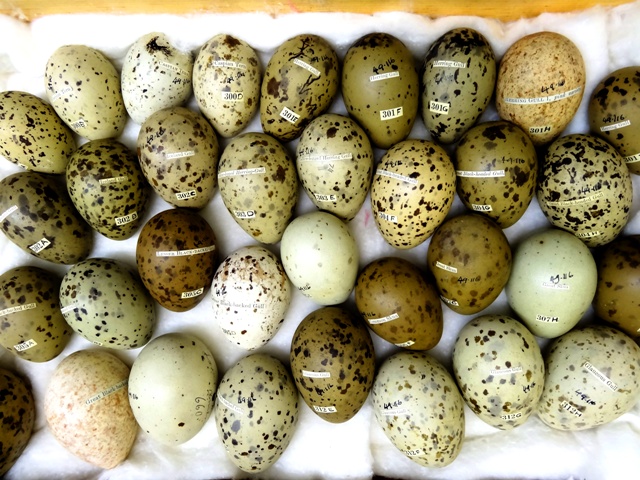
Egg collections like this helped identify the harm done by DDT. Image by Paolo Viscardi

In other cases, genetic data from decades-old scientific specimens has even been used to “de-extinct” species. One of these, the Vegas Valley leopard frog, was thought to have gone extinct in the wake of Las Vegas development. However, a study published in 2011 compared the genetics of specimens from the extinct population to individuals from surviving populations of similar-looking frogs elsewhere in the Southwest and found them to be the same species.

These types of discoveries are “the hallmark of biological collections: They are often used in ways that the original collector never imagined.” And with the continuing emergence of new technologies, this potential only grows.

That potential, combined with the increasing number of threats species face and the need to understand them, suggests that the need to collect specimens—and to share the information they hold—has never been greater.

In their April article, Minteer and his colleagues erroneously portray scientific collecting in a negative light that distracts from the primary causes of modern extinctions: habitat degradation and loss, unsustainable harvesting and invasive species.

“Halting collection of animal and plant specimens by scientists would be detrimental not only to our understanding of Earth’s diverse biota and its biological processes, but also for conservation and management efforts,” said Diarmaid O’Foighil, director of the U-M Museum of Zoology and a co-author of the rebuttal letter.

“That detriment in understanding would only increase with time because having museum specimens available for future generations of scientists will allow their study using research methodologies that have yet to be invented.”

A pre-publication pdf version of the letter can be read here.


Do you want to train to be Natural Science Curator?

Heritage Lottery Fund ‘Skills for the Future’

Natural History & Social History Training Opportunities

Support from the Heritage Lottery Fund ‘Skills for the Future’ programme and Natural Sciences Collections Association (NatSCA) has created opportunities for four individuals to train in curatorial skills with a partnership of regional museums and heritage sites.

We are looking for people who are passionate and enthusiastic about Natural History/Sciences or Social History. These traineeships are available to anyone who might not have qualifications in the subject area, or are not from museum background, or are wanting a career change.

  • ·         One Natural History traineeship based at The Manchester Museum The University of Manchester
  • ·         One Natural History traineeship based at Leeds Museum Discovery Centre
  • ·         One Natural Science  traineeship based at Thinktank Science Museum, Birmingham Museum Trust
  • ·         One Social History traineeship based at The Herbert Art Gallery & Museum, Coventry

Full information and application forms can be found within the job packs

Please follow link   www.bmag.org.uk/about/vacancies

Closing date is: 20 March 2013 at 10.00 AM   Proposed dates for interviews: W/C 14 April 2014
If you have any enquiries about these traineeship opportunities, please contact Paulette Francis-Green Project Manager by email projmangctrainee@aol.co.uk

Natural history under the hammer

Reblogged from UCL Museums & Collections Blog

Natural history under the hammer

By Mark Carnall, on 4 December 2013

Recently there have been a spate of high profile auctions of natural history specimens raising many issues about ownership, the value we should or shouldn’t put on natural history and the relationship between professional scientists, museums, amateurs and private collectors. My colleague Jack Ashby wrote about the recent dodo bones that were auctioned. Colleagues Dave Hone and Mark Graham give a balanced view of the recent sale of a Diplodocusskeleton over at the Guardian. The ‘duelling dinosaurs’ fossil was estimated to reach $9 million at auction in New York and last year the controversial proposed sale of an allegedly illicitly smuggled Tarbosaurus skeleton caused much debate.

I thought I’d add my thoughts on the subject here, in particular about the relationship between collectors, museums and ethics.

Lost to Science

One of the most common criticisms that comes from the scientific community is that these high profile and expensive auctions, way above the budgets that museums can afford, result in a loss to science when specimens pass into private collections. I don’t want to downplay that this is a real problem, I know of at least two examples of important material that would likely cause a re-evaluation of entire groups of organisms but which are resolutely in the hands of private collectors who won’t allow them to be accessed. However, other museums, particularly art collections, embrace and work with private collectors. The museums get to display important or interesting objects and the collectors receive credit and validation for the collections they have built up. Furthermore, the buying, selling and trading of artworks means that there’s an excellent paper trail in the form of auction and exhibition catalogues which means that the movement of works can be traced much more readily than natural history specimens which don’t have this tradition of a published, publicly accessible paper trail.

Private to Public

When it comes to natural history I think we’re too quick to demonise private collectors with the “loss to science” rhetoric. Many of today’s largest museums were founded as private collections that were donated to the nation including the Natural History Museum London, the Natural History Museum Tring and the British Museum. Of course the Tate galleries still bear the name of the man whose funds and collections seeded what is now considered one of the most important art collections in the world. Recently two George Stubbs paintings, the first Western depictions of Australian animals was ‘saved for the nation‘  by the National Maritime Museum (NMM). The works were finally secured by a significant donation from a shipping magnate and patron of the NMM. It would be interesting to consider if the paintings would have been saved in the same way if it were the Natural History Museum trying to secure the funds instead.  Natural history museums don’t receive anywhere near the same level or have such a long history of patronage supporting them as other kinds of museums. Often it’s assumed that buyers of multimillion pound specimens erect them in their mansions and display them as ‘trophy’ objects. That’s not to say that this doesn’t occur but I think it’s fair to assume that these buyers may have a keen interest and love of natural history. Perhaps talking to private collectors instead of instantly labelling them as a problem would improve the patronage and support of natural history museums and increase the awareness of ethical collecting and trading.

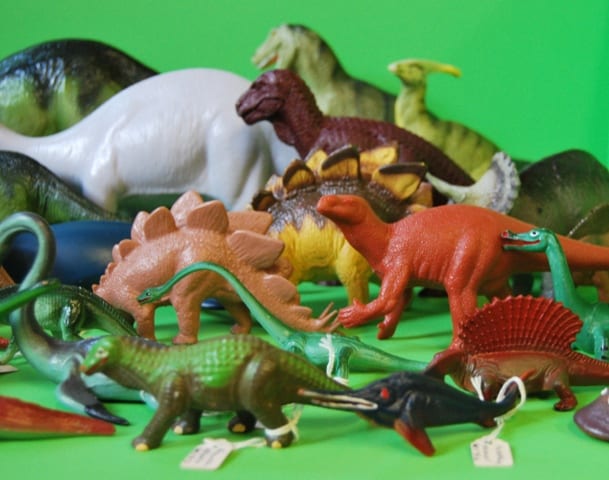
Grant Museum plastic dinosaur specimens

If relationships were improved there’s also the danger that scientific research on specimens could be used to increase the price tag of specimens as commercial assets. Say for example, if research on the recently sold Diplodocus skeleton revealed that it was the largest, rarest or the only example of a new species this increases the rarity and desirability of the object and pushes the price even further away from the reaches of public institutions. Conversely, research may devalue a specimen, yet another reason why private collectors may be wary of caliper bearing scientists examining their collections. It’s already ubiquitous across museums to never give a valuation on objects brought in for opinions or identifications to avoid certifying or authenticating material for sale. I’d recommend looking across the museum sector to seek guidance on how other museums deal with the issues of research affecting commodity prices.

Amateur vs. Professional

Lastly, working with private and amateur collectors can very realistically improve our knowledge about the natural world. Anecdotally, I’d say that there’s a deep mistrust of museums by amateur collectors (either those buying their collections or those collecting fossils and unfortunately extant animals from the wild). There’s the perception that once an object goes into a museum collection it’s essentially lost to the public, only accessible to card carrying scientists. With museums bursting at the seams with objects, only a tiny proportion of collections on display and visits to collections requiring managing it’s easy to see where this perception comes from. Again, looking to other museums provides guidance. The excellent, excellent Portable Antiquities Scheme is a solution to this exact problem in archaeology. There are thousands of amateur archaeologists, metal dectectorists and collectors and the portable antiquities scheme is an easy way to encourage the wider archaeological community to register finds. They are given full credit for the discoveries, there’s a prestige associated with contributing to the scheme and their finds and data are almost instantly available to the wider sector. Quite why a similar scheme for fossil finds doesn’t exist is increasingly perplexing especially as the legislation and policing of the movement of fossil material, as the aforementioned Tarbosaurus auction highlighted,  is nowhere near as robust as it is with artworks and archaeological material.

With museums brokering discussions with private collectors and auction houses we could better support patronage for museums, save important specimens for the public and improve our understanding of  palaeontology and biology.

Mark Carnall is the Curator of the Grant Museum of Zoology

Celebrating the mundane

This article is reposted from the UCL Museums blog.

By Mark Carnall, Curator of the Grant Museum of Zoology, UCL

Earlier this month I was lucky(?) enough to have a spot on the excellent Museum Mile Museums Showoff special as part of the Bloomsbury Festival. For those of you who don’t know, Museums Showoff is a series of informal open-mic events where museum professionals have nine minutes to show off amazing discoveries, their research or just to vent steam to an audience of museum workers and museum goers. My nine minutes were about the 99% of objects that form museum collections but you won’t see on display. They fill drawers, cupboards, rooms and whole warehouses. But why do we have all this stuff? Who is it for? In my skit on Tuesday I only had nine minutes but I thought I’d take the time to expand on the 99% and the problem of too much stuff (particularly in natural history museums) and what we can do with it.

Tip of the Iceberg

Museums often display only the tip of the iceberg when it comes to collections. Here at the Grant Museum we have about 7% of the collection on display and it tends to be the Hollywood Animals that make the cut. At larger museums it can be less than 0.1% of the collection that makes up the public facing galleries. In my relatively short career as a museum professional I’ve been very fortunate to see behind the scenes in more museums than most and boy, there is a lot of stuff. Even though I love natural history and am very passionate about museums and the future of the museum sector sometimes I do wonder why do we have all this stuff?

In natural history, the obvious and often made, argument is that our collections can tell us about global challenges that affect us all including climate change, organisms that cause or spread human diseases, extinction, agriculture and aquaculture and from geology the exploitation of fossil fuels. Natural history collections are the only record of life on Earth and if we are to make any models or predictions we need to dip into the data enshrined in objects.

However, there are large portions of natural history collections which could never contribute to those agendas. All the ‘Raggy Doll‘ specimens without data for example. All those specimens that require four text books of explanation. Most fossil specimens can be used to reconstruct the past with only limited impact on what’s happening in the present. There are rooms and rooms full of bad taxidermy and taxidermy dioramas that for reasons of taste, health and safety and changing scientific ideas never see the light of day. Even something as simple as an animal not having a common name (to put on a label) can keep a specimen off display There are large chunks of the animal world which simply aren’t being actively studied (for now). Lastly there are all the models, casts and those dreaded boxes.

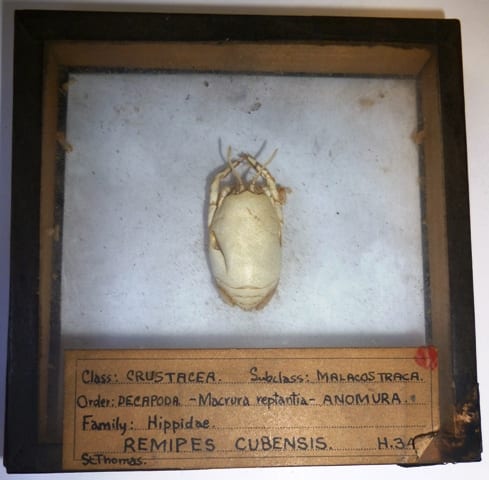
Image of a specimen of the crab Hippa testudinaria

Spare a thought for specimens like this. Dusty, pest attacked, wrongly named crabs. SAD SMILEY FACE.

So how do we make the most of the 99% now especially if they aren’t saving the world? Well, in short, it shouldn’t matter how important our specimens are to science. Every specimen has a story to tell.

Museums of Inspiration? Continue reading

NATURAL HISTORY MUSEUM BINGO!

This article is reposted from the UCL Museums blog.

By Mark Carnall, Curator of the Grant Museum of Zoology, UCL

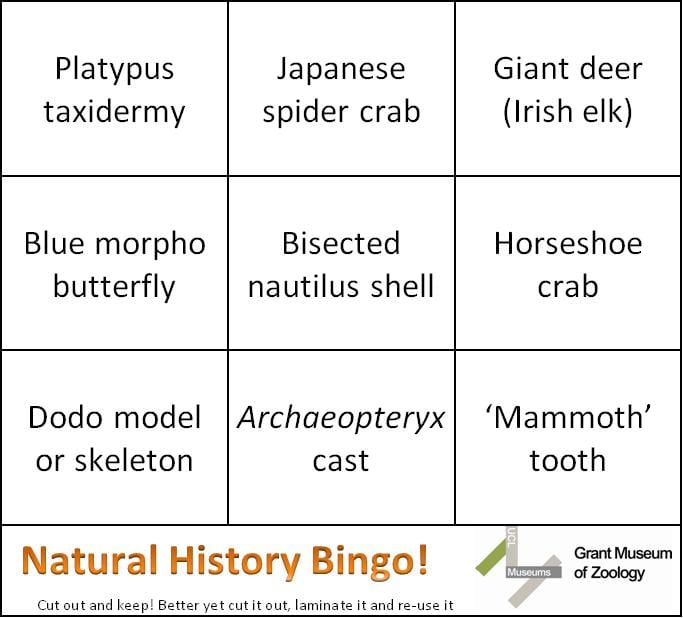
My colleague Jack Ashby alluded to the Natural History Bingo Card in a recent blog post so I thought I’d take the time to present it to the wide world! Natural history museums are funny places. Despite the millions of species of animals and the enormous variation within species between broods, sexes, life stage, populations and seasonal variations you’d expect that you could visit every natural history museum in the World (finances allowing) and never see the same thing twice. You might think that, but the truth is many natural history museums have the same stuff on display whether you’re at the Grant Museum, the Natural History Museum London or in Paris, New York, Prague or Plymouth.

In fact, some specimens are so common, you can go around a natural history museum with this handy NATURAL HISTORY MUSEUM BINGO* and nine times out of ten you’ll have seen most of these specimens before you get to the gift shop. So what gives?

Natural History Bingo Card
Click to embiggernate & cut out and Keep! Natural History Bingo modified from the version in Carnall, M.A (2011): Completely Rethinking the Organisation of Natural History Museums: A Taxonomically Arranged National Collection. NatSCA News:21

I originally published the above figure in a paper looking at why natural history museums are all the same and what, if anything, could be for natural history museums to make the best use of their vast collections. You can tell from this Microsoft Paint produced chart that tongue was firmly in cheek but why does the Bingo hold true (go ahead and try it next time you are museuming)? It’s partly because, unlike other kinds of museums, natural history museums by and large have the same remit and are collecting and presenting the same thing (the natural world). But with so many different species and shapes of organisms why are the same specimens used as the public face of biology (specifically zoology) here? Continue reading