NATURAL HISTORY MUSEUM BINGO!

This article is reposted from the UCL Museums blog.

By Mark Carnall, Curator of the Grant Museum of Zoology, UCL

My colleague Jack Ashby alluded to the Natural History Bingo Card in a recent blog post so I thought I’d take the time to present it to the wide world! Natural history museums are funny places. Despite the millions of species of animals and the enormous variation within species between broods, sexes, life stage, populations and seasonal variations you’d expect that you could visit every natural history museum in the World (finances allowing) and never see the same thing twice. You might think that, but the truth is many natural history museums have the same stuff on display whether you’re at the Grant Museum, the Natural History Museum London or in Paris, New York, Prague or Plymouth.

In fact, some specimens are so common, you can go around a natural history museum with this handy NATURAL HISTORY MUSEUM BINGO* and nine times out of ten you’ll have seen most of these specimens before you get to the gift shop. So what gives?

Natural History Bingo Card
Click to embiggernate & cut out and Keep! Natural History Bingo modified from the version in Carnall, M.A (2011): Completely Rethinking the Organisation of Natural History Museums: A Taxonomically Arranged National Collection. NatSCA News:21
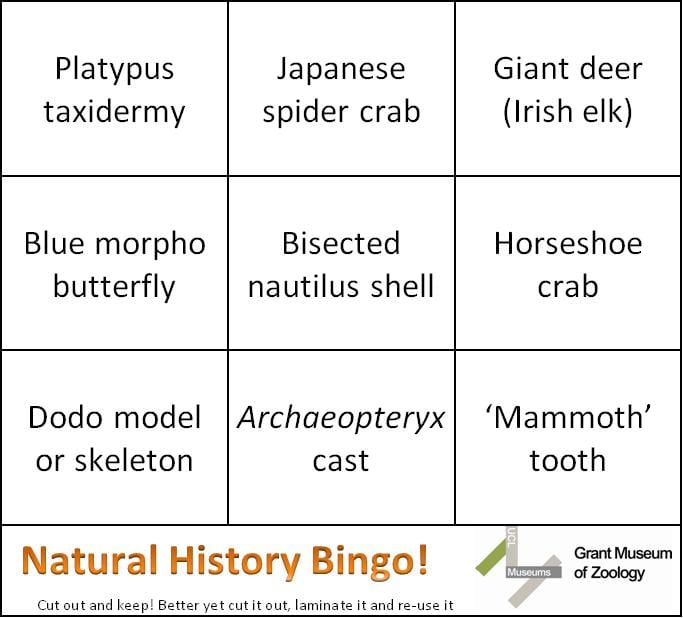
I originally published the above figure in a paper looking at why natural history museums are all the same and what, if anything, could be for natural history museums to make the best use of their vast collections. You can tell from this Microsoft Paint produced chart that tongue was firmly in cheek but why does the Bingo hold true (go ahead and try it next time you are museuming)? It’s partly because, unlike other kinds of museums, natural history museums by and large have the same remit and are collecting and presenting the same thing (the natural world). But with so many different species and shapes of organisms why are the same specimens used as the public face of biology (specifically zoology) here? Continue reading

The best natural history specimen in the world (did not get thrown on a fire)

This article is reposted from the UCL Museums blog.

Last week I saw something that had never occurred to me might be possible to see. Through the years I have learned a lot about this object – I knew where it was, I knew where it came from and I certainly know its place in the pantheon of the history of natural history. We even have a cast of it in the Grant Museum.

If you had asked me what the best natural history object in the UK was, most days I would tell you it was this one. I had just assumed that seeing it wasn’t something that ever happened, even for people who run university zoology museums.

The Grant Museum team an a sperm whale jaw at the OUMNH (they're closed for roof repairs)Last Wednesday the staff of the Grant Museum went on an expedition to the Oxford University Museum of Natural History (OUMNH), which is closed for roof repairs until 2014. On a visit to the zoology section a cupboard was opened before us, it was filled with skulls, dried fish and a couple of boxes. As the history of this cupboard was explained – it was Tradescant’s Museum – the oldest in the country – it suddenly dawned on me what was in those boxes. And that we were going to see it.

We were going to see the only soft tissue of a dodo anywhere in the world. Continue reading

Caring For Entomology Collections

Seminar series to explore basic entomology collections management, curation and conservation techniques.

NHM (Natural History Museum), South Kensington, London 9.30am – 4.30pm Friday 1st November 2013

Cost £34 for members or £49 for non-members (remember that becoming a member is just £15 a year!).

This course will cover all basic aspects of collections management for entomological collections, including storage and handling of specimens, loans and legislation, and specimen preparation.

There will be specialist sessions including Integrated Pest Management, storage facilities, spirit curation, specimen pinning, molecular collections, basic slide preparation, documentation and databasing. Tours of the collection areas will also occur.

The course will be both theory and practical supported by a booklet covering both aspects.

Schedule (TBC):

9:30 -10:00 Introduction and Coffee

10:00 -10:30 Entomological Storage

10:30 -11:00 IPM

11:00 – 11:30 Morning Coffee

11:30 – 12:00 Digitisation

12:00 – 12:30 Data-basing

12:30 – 2:00 Lunch

2:00 – 2:30 Specimen pinning

2:30 – 3:00 Slide preparation

3:00 – 3:30 Afternoon Coffee

3:30 – 4:00 molecular collections

4:00 – 4:30 Spirit collections

Download booking form

Contacts:

For further information: Erica McAlister – e.mcalister@nhm.ac.uk

For booking & payment: Holly Morgenroth – holly.morgenroth@exeter.gov.uk

To become a member: Maggie Reilly – maggie.reilly@glasgow.ac.uk

Looking to the future

As some of you may be aware, NatSCA is the Subject Specialist Network (SSN) for natural science collections.

That means we are recognised by organisations like Arts Council England (ACE) as supporting the understanding, development and care of collections across the UK and beyond.

At the moment NatSCA are undertaking several projects to consolidate our role and to improve advocacy for natural science collections. We want to establish better communications between ourselves and other SSNs in order to share expertise and improve collaborative frameworks within the museum sector. We are also addressing public perceptions of the natural sciences and developing plans for improving that perception.

By laying this groundwork, NatSCA hopes to safeguard natural science collections for the future, by demonstrating their relevance now.

ACE have been very supportive of our aims and we have received funding to appoint a consultant to help us achieve them. Please see below for a description of the post and details on how to apply.

If you would like to support our efforts yourself then why not contact the fantastic Maggie about becoming a member?

NatSCA Project Coordinator Post Advert

NatSCA conference and AGM 2013

Natural Science Collections: Policy and Practice

28th February & 1st March 2013 – The Yorkshire Museum, York

The Yorkshire Museum, York, England. Designed by architect William Wilkins in a Greek Revival style and was officially opened in February 1830. By Kaly99

At this year’s NatSCA conference we will be looking at how collection policies, reviews and legislation influence current practice in curation and care of collections. We will also be addressing some of the ongoing wider issues affecting the sector, including a proposed strategy for safeguarding collections for the future.

As usual, the meeting will provide a fantastic opportunity for communicating with colleagues and finding out what’s going on in the sector – all at a very reasonable price (especially if you fork out the £15 for membership)!

Two day cost: NatSCA members £85 (non-member £100)

Early bird booking by 11th January  £75 (non-member £90)

One day cost: NatSCA members:  £50 (non-member £60)

Early bird booking by 11th January:  £40 (non-member £50)

Deadline for bookings is 8th February 2013

Booking form for the NatSCA 2013 conference [doc file]

List of nearby accommodation for NatSCA 2013 conference [pdf]

Programme of talks for NatSCA 2013 conference [pdf]